Boys Bedroom Ideas
There comes a point when a boy starts wanting his room to feel a little cooler. The bright decorations and cartoon themes that worked a few years ago start feeling out of place, and he wants a room that feels more like him. The challenge is that a boys bedroom has to do more jobs than almost any other room in the house. It is where he sleeps, plays games, builds things, reads books, hangs out with friends, and sometimes hides out when he wants a little space. A bedroom needs to keep up with all of that. It should feel comfortable and practical, but it should also have enough personality to make it feel special.
The good news is that a boys bedroom does not need a lot of fancy decoration to stand out. A cool wall colour, a great bed setup, a place to display favourite hobbies, or a few clever design details can completely change the look of a room. The short version of this guide is this: pick one theme or colour story, build the room around a bed that works hard, give every activity its own small zone, and make storage so easy that tidying up takes five minutes instead of fifty.
The ideas below are arranged in the order most parents use them: how to pick a theme first, then the colours and walls, then the twenty ideas grouped by what they do — themes, beds and furniture, activity zones, storage and display, and comfort and finishing touches. After the ideas come the practical parts: a weekend plan, small and shared rooms, ages, budgets, and the mistakes that make a boys bedroom look wrong.
How to Pick a Theme Your Son Won't Outgrow in a Year
The theme is the first decision, because it decides the colours, the bedding, and what goes on the walls. The best way to pick one is to start with what your son already loves, not with what looks good in a shop. Ask him what he would put in his dream room if he could choose anything, and listen for the interest underneath the answer. A boy who says "space" might really want dark blue walls and stars. A boy who says "football" might really want a place to display his kit and his trophies. A boy who says "dinosaurs" might really want green walls and a shelf full of models. The interest is the theme; the room just gives it a home.
Give him a choice between two or three options you have already approved, rather than the whole internet. "Space or dinosaurs?" is a question a child can answer with genuine opinions. "What do you want your room to look like?" is a question that usually ends in silence, or in a request for something that would take a month and a fortune to build. Narrowing the choice first keeps the room feeling like his without handing over a blank cheque.
The second rule is to put the theme in the cheap, changeable things, not in the expensive, permanent ones. Bedding, cushions, posters, decals, a rug, and a few display pieces carry a theme perfectly well, and they can all be swapped in an afternoon when interests change. Painted murals, themed beds shaped like cars or castles, and wallpaper covered in one character are much harder to undo, and they are the things parents regret most when a nine-year-old suddenly decides he is too old for them. A room that is themed through its accessories can change its mind in a weekend. A room that is themed through its walls and furniture cannot.
The third rule is to check the theme against the room you actually have. A dark space theme needs a room with decent light, or it will feel like a cave. A sports corner needs floor space, or the balls will end up everywhere except the corner. A gaming zone needs a socket and a desk, or the cables will trail across the floor. Stand in the room, look at where the window, the door, and the sockets are, and ask whether the theme fits the space before you buy anything for it. A theme that fights the room will always look like a compromise, however good the individual pieces are.
Finally, involve your son in the work at the level he can handle. A younger child can choose between two bedding sets, stick decals on the wall, and arrange his own display shelf. An older child can paint a wall, build flat-pack furniture, and plan where his desk should go. A room a child helped to make is a room he will look after, and a room he chose is a room he will actually want to spend time in.
Boys Bedroom Themes at a Glance
Not every theme suits every age, every room, or every budget. The table below compares the themes in this guide so you can see at a glance which one fits your son, your room, and how long you want the look to last. The themes that last longest are the ones built on a colour rather than a character: navy and grey, forest green and wood, or a neutral base with one strong accent colour. Those rooms can change their theme by swapping the bedding and the wall art, while the walls and the furniture stay exactly where they are.
| Theme | Best age | Main colours | What carries the theme | How long it lasts |
|---|---|---|---|---|
| Space | 5–11 | Navy, charcoal, silver | Star decals, planet mobile, glow stars | 3–5 years |
| Dinosaurs | 4–9 | Sage green, khaki, wood | Dinosaur models, framed art, decals | 2–4 years |
| Sports | 6–13 | Team colours, white, grey | Balls, trophies, striped bedding | 4–6 years |
| Superhero | 5–10 | Red, blue, yellow | Comic art, bold cushions, bedding | 2–4 years |
| Nautical | 5–12 | Navy, white, red | Stripes, rope details, ship art | 4–6 years |
| Woodland / adventure | 5–12 | Forest green, cream, wood | Map wall, leaf wallpaper, tent den | 4–6 years |
| Gaming | 9–14 | Dark grey, blue, black | Desk setup, LED lighting, shelves | 3–5 years |
| Industrial / modern | 10–14 | Charcoal, grey, mustard | Metal fixtures, dark furniture | 5+ years |
If you cannot decide between two themes, pick the one with the longer lifespan for the walls and let the other one live in the accessories. A navy space room with a few dinosaur models on the shelf is a room that can become a dinosaur room in an afternoon, just by swapping the bedding and the wall art. A room painted entirely in one character's colours cannot change its mind that easily. When in doubt, choose the calmer wall and the louder bedding — bedding is cheap to replace, paint is not.
Colour First: The Palette That Holds the Room Together
Before you buy a single piece of furniture, decide the palette. A boys bedroom works best with three colours: one main colour that covers the biggest surfaces, one second colour that shows up in the bedding and the rug, and one accent colour that appears in small doses — a cushion, a lamp, a storage bin. Three colours are enough to make a room feel designed, and few enough that nothing clashes. Four or five colours, especially if they are all bright, make a room feel busy no matter how tidy it is.
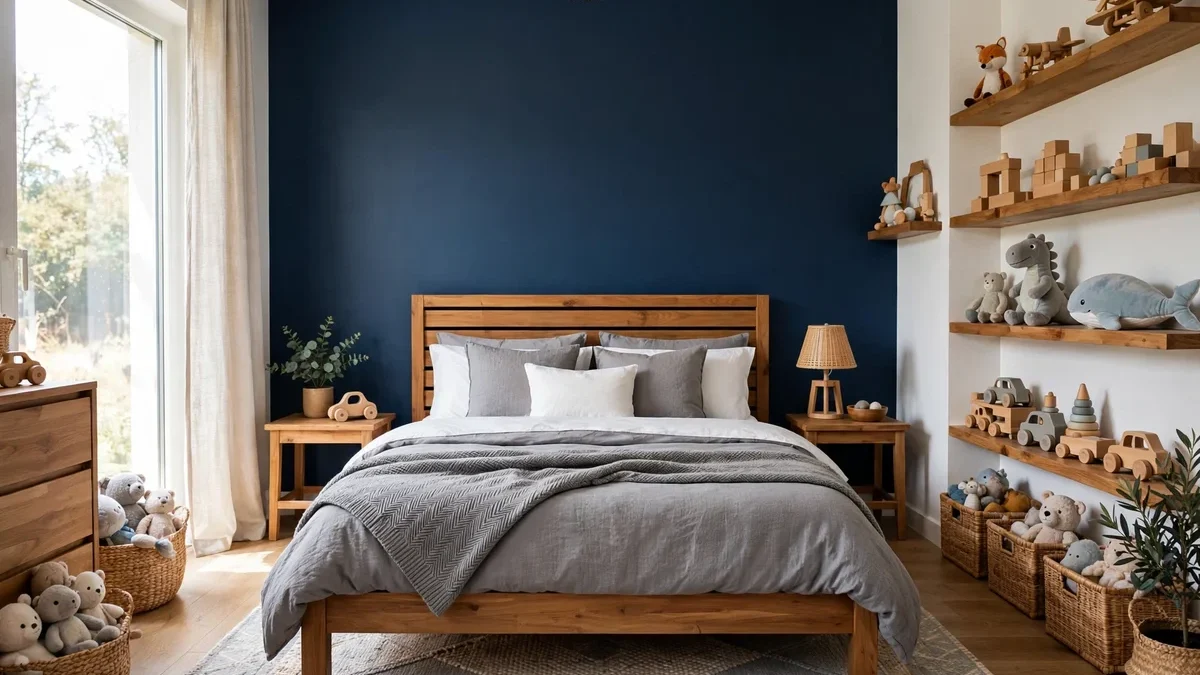
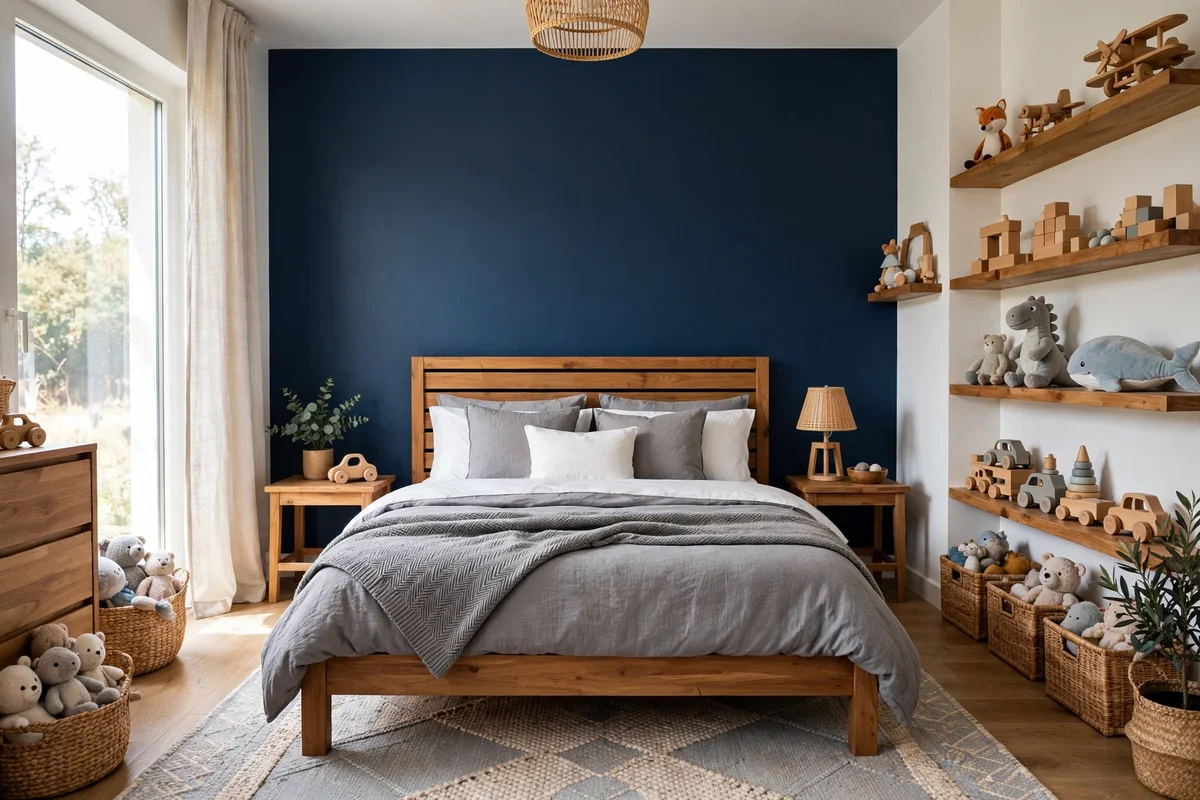
Navy blue is the most forgiving main colour for a boys bedroom. It feels calm, it suits every age from toddler to teenager, and it pairs with almost anything — white, grey, mustard, red, green, or natural wood. A navy accent wall behind the bed gives the room a focal point without darkening the whole space, and navy bedding is easy to find in every price range. If the room is small or north-facing, use navy on one wall only and keep the other three walls white or pale grey, so the room keeps its light.
Grey is the quiet workhorse. A mid-grey wall, grey bedding, and wooden furniture make a room that can take any accent colour you like — swap the cushions and the whole room changes mood without a single tin of paint. Grey also suits shared rooms, because it takes no side when two brothers have different favourite colours. Warm it up with wood, a textured rug, and warm white lighting, or it can feel cold.
Green is the colour parents choose most often once they see it in a real room. Sage green is soft and restful and suits younger boys and reading corners. Forest green is bolder and suits bigger rooms with white beds and wooden furniture, where it reads as grown-up rather than themed. Green pairs naturally with the two things every kids room already has — wood and white — so it rarely clashes with existing furniture.
Whatever palette you choose, test it the way you will actually live with it. Hold paint swatches and bedding against each other in daylight and again under the bedroom lamp at night, because colours shift more between those two lights than most people expect. A navy that looks rich at noon can look almost black at bedtime. If a swatch looks wrong in either light, pick a different shade of the same colour rather than a different colour altogether.
20 Boys Bedroom Ideas
Colour and Walls
1. Paint one bold accent wall
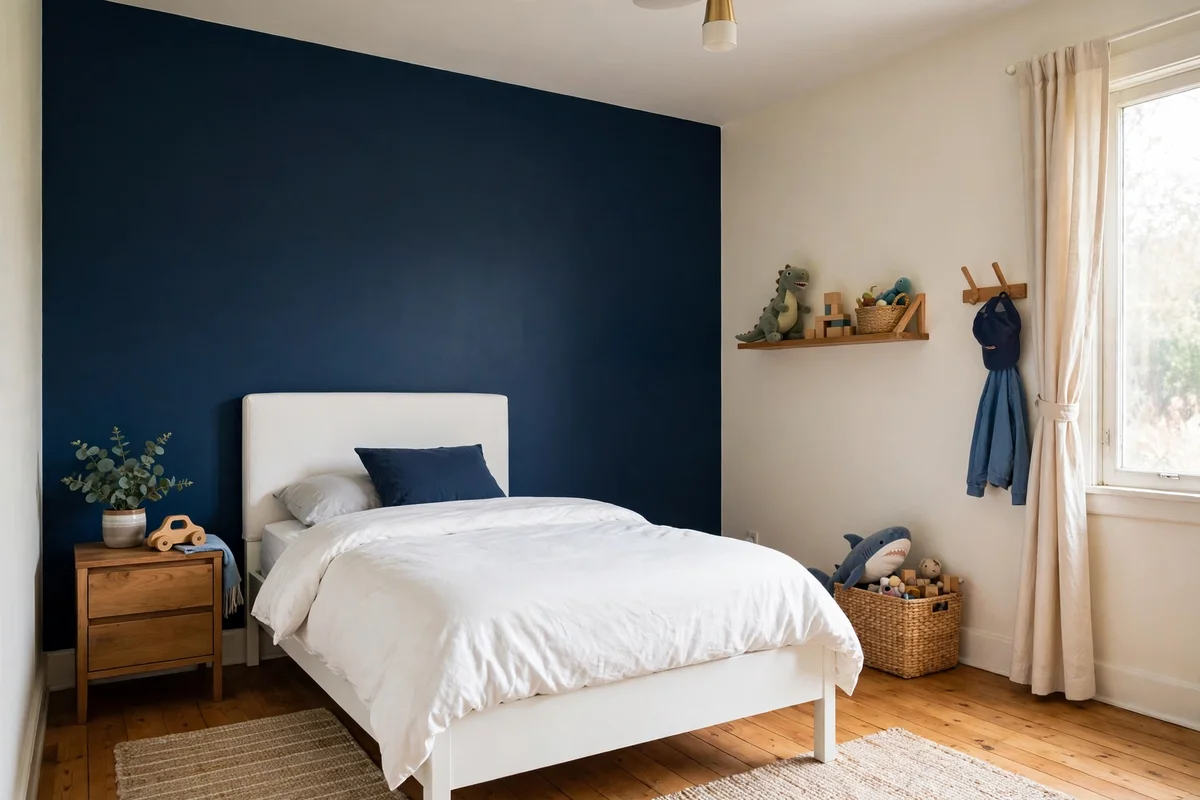
A single wall in a deep, confident colour is still the simplest way to change a boys bedroom, and it is the one most rooms need. Deep navy, forest green, charcoal grey, or a rich teal each change the mood of a room in a different way: navy calms it, green steadies it, charcoal makes it feel older and more grown-up, teal wakes it up. Choose the colour from something already in the room — the bedding, a favourite shirt, a book cover your son loves — rather than from a paint chart alone, because a colour that already belongs to the room will always look more intentional than one chosen in isolation.
Paint the wall behind the bed, because that is the wall you see from the door and the wall that frames the biggest piece of furniture in the room. Use a washable, low-sheen emulsion, because a wall behind a bed gets touched, leaned on, and bumped by pillows. Paint two thin coats rather than one thick one, and let the first coat dry fully before the second. Keep the other three walls white or warm cream, and repeat the accent colour twice more in the room — a cushion and a storage bin, or a rug stripe and a lampshade — so the wall has company. More finishes and wall choices are covered in the accent wall ideas for kids rooms guide.
2. Use a neutral base with pops of colour
A neutral base is the most flexible room you can build. Grey, beige, white, and navy walls, plain bedding, and wooden furniture create a backdrop that works with any theme, and then the personality comes from the things that are cheap to change: colourful pillows, a bright rug, artwork, and storage bins. When your son's favourite colour changes — and it will — you swap the cushions and the bins, not the walls. This approach also makes future updates far more affordable, because the room stays fresh without needing a complete redesign.
The trick is to make the neutral base warm rather than flat. A plain white room with grey furniture can feel like a waiting room. Add texture to fix it: a woven rug, a knitted throw, wooden shelves, a linen cushion, or a cork pinboard. Texture is what makes a neutral room feel cosy instead of empty, and it costs far less than a new colour scheme. Pick one strong accent colour and use it in three places — for example, a mustard cushion, a mustard storage bin, and a mustard lamp — and keep everything else neutral. Three touches of one colour read as a plan. One touch reads as an accident, and five touches read as a theme you did not mean to choose.
3. Add geometric patterns and stripes
Geometric patterns add style without overwhelming a room, and they work on bedding, rugs, wall art, and accessories alike. Bold stripes in blue and white suit a sporty or nautical room. Triangles and arches in muted greens and blues suit a calmer, modern room. Colour-blocked shapes in primary colours suit a playroom. Unlike a heavily themed design, geometric patterns tend to stay relevant as children grow, which makes them a practical choice for a room you want to last.
The easiest way to get a geometric pattern on the wall is with painter's tape. Sketch the pattern on paper first, mark the key points on the wall in pencil, tape along the lines, and paint one colour at a time, peeling the tape off while the last coat is still slightly tacky for the cleanest edge. Keep the pattern to one wall and the colours to three at most. On bedding and rugs, the rule is simpler: one patterned piece per zone. A striped duvet with a plain rug and solid cushions lets the pattern breathe.
Themes He'll Actually Love
4. Build a space-themed bedroom
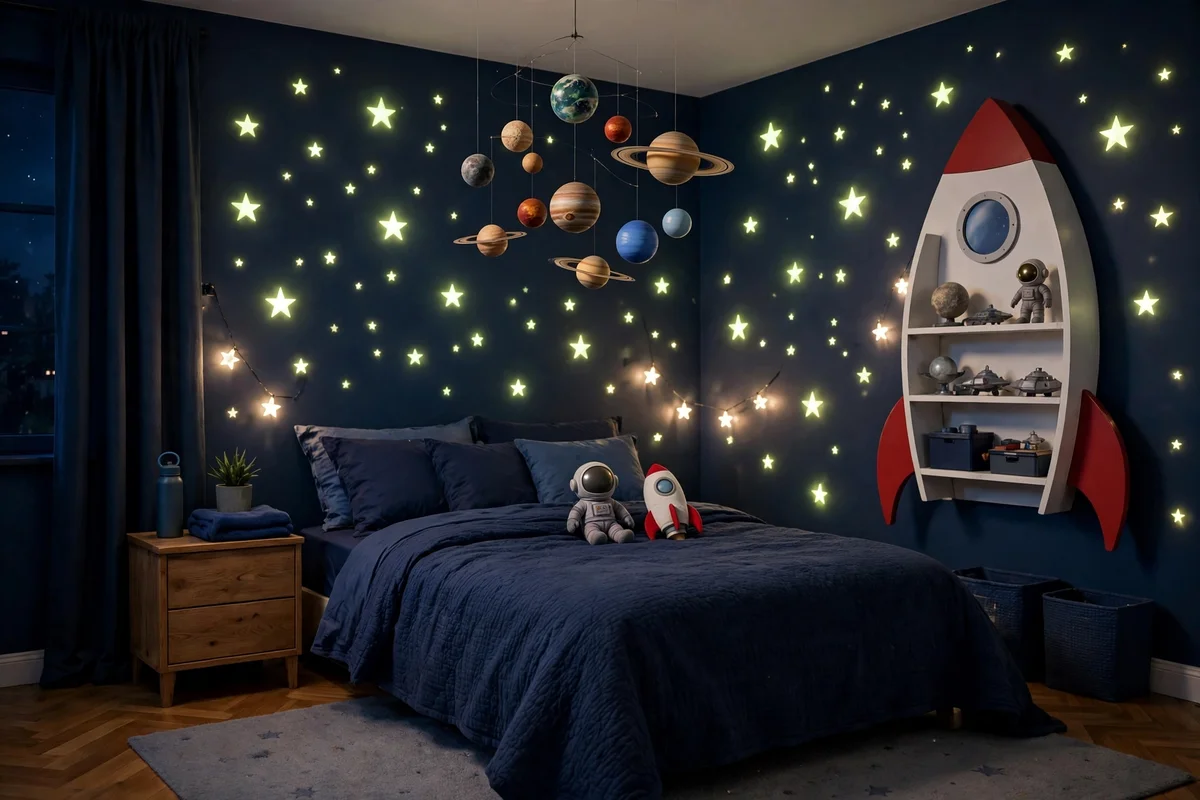
Space is the classic boys bedroom theme, and it is one that you can get as creative with as you like. A darker blue wall resembles the night sky, and glow-in-the-dark star stickers, space-themed posters, and a planet mobile above the bed bring it to life. A galaxy mural or a starry ceiling made with fairy lights turns bedtime into something a child looks forward to, and it suits children who are nervous about the dark, because the wall gives the dark a shape and a story.
Keep the palette tight: navy, charcoal, and deep blue as the base, with silver, white, and one bright accent — cyan, green, or orange — for the stars and planets. Put the stars on the wall behind the bed or on the ceiling above it, where they are the last thing your son sees before sleep, and keep the rest of the room's lighting warm and low in the evening. A model solar system above the bed, a rocket-shaped shelf, and bedding with a subtle star print finish the theme without needing a single expensive piece. When he outgrows it, the stars peel off, the bedding changes, and the navy walls are ready for whatever comes next.
5. Create a dinosaur bedroom

Dinosaurs suit younger boys better than almost any other theme, because the room can be playful without being babyish. A sage green or khaki wall, wooden furniture, and dinosaur models on open shelves give the room its prehistoric feel, while framed dinosaur art and a few well-placed decals do the rest. The trick is to let the dinosaurs live on the shelves and the walls, not on every surface. A dinosaur duvet, dinosaur curtains, dinosaur rug, and dinosaur lamp all at once is a room that will feel young very quickly. A plain green duvet with one dinosaur cushion and a shelf of models is a room that can grow.
Display matters more than quantity here. A low shelf at your son's eye level, with his favourite models arranged in a row and a little space between them, looks like a collection. The same models piled in a box look like clutter. Give him one shelf that is his to arrange, and let him change it whenever he likes — the room will feel like his, and the dinosaurs will stay on display instead of ending up under the bed. For more animal inspiration, the animal-themed bedroom ideas for kids who love wildlife guide covers how to use animal art and natural textures without turning the room into a zoo.
6. Make a sports corner
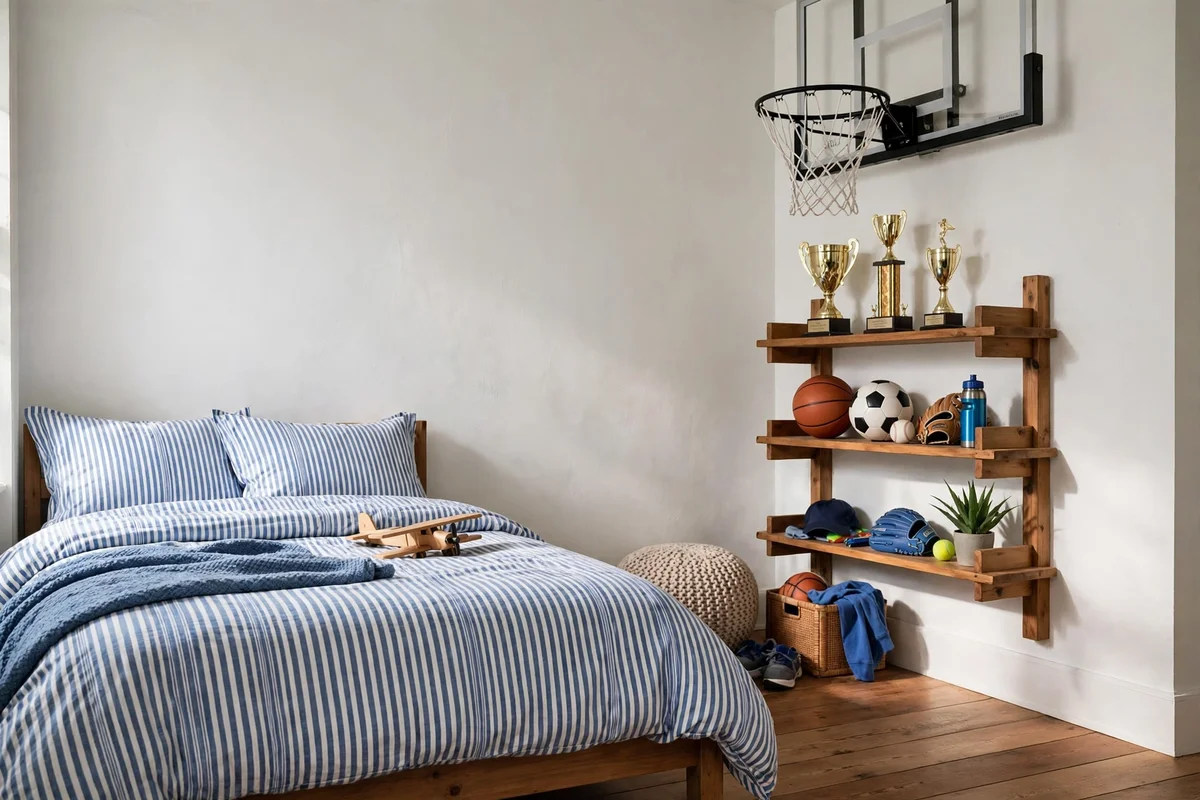
For boys who love sports, a dedicated corner for equipment and memorabilia adds both function and style. Use wall hooks, shelves, or baskets to store balls, helmets, and kit neatly, and display a favourite jersey, team photos, or trophies where they can be seen. This keeps everything organised while celebrating a favourite hobby, and the room feels more personal when interests are part of the design. If your son plays more than one sport, give each one its own hook or basket, so the corner stays sorted instead of becoming a pile.
The sports corner also solves the biggest storage problem in an active boy's room: where the balls go. A large basket or a wall-mounted ball rack by the door means the balls have a home, and the floor stays clear for playing. Stripes are the natural pattern for a sports room — striped bedding, a striped rug, or a striped cushion in team colours — and they work with any combination of blues, greens, reds, black, and white. If your son needs to burn off energy indoors on rainy days, the active kids room ideas guide has more ways to build movement into a bedroom without turning it into a gym.
7. Design a superhero headquarters
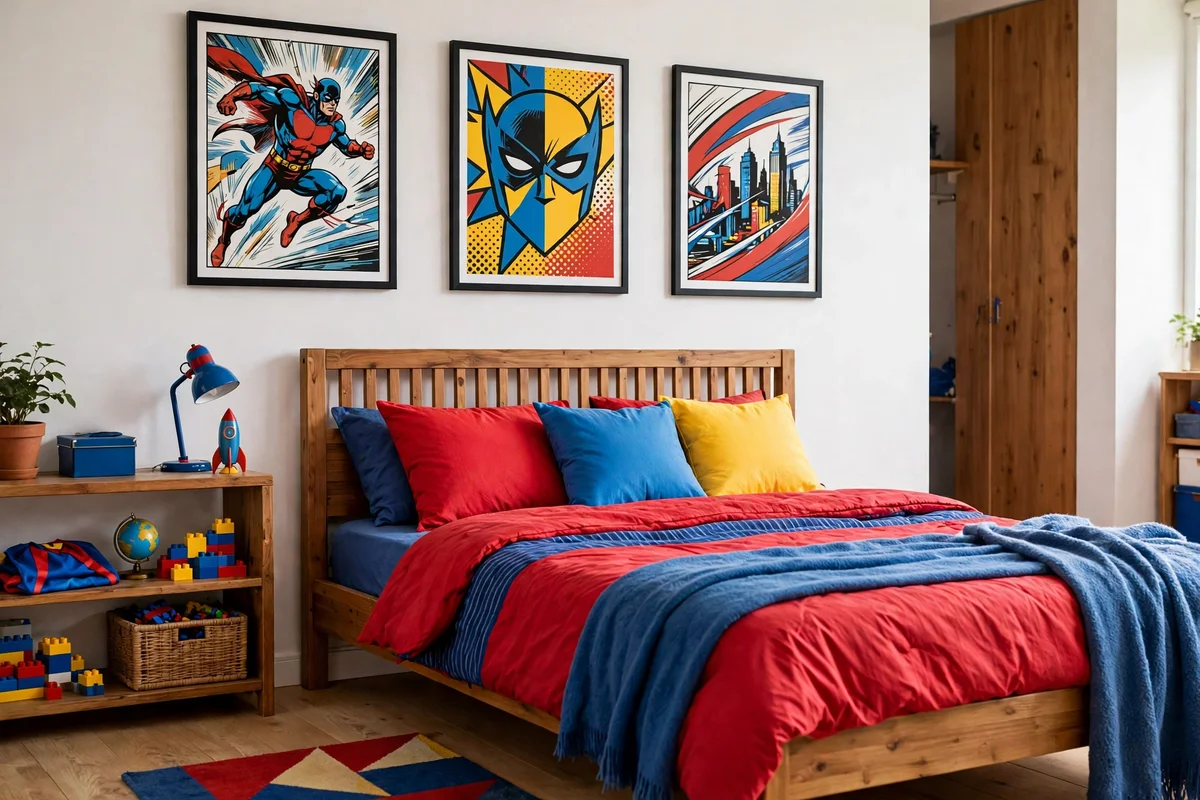
If your son is obsessed with comic books and superhero films, you will have no trouble finding toys and accessories for his bedroom, and the superhero world is bright, colourful, and action-packed — which is exactly what the room should be. The key is to use the superhero idea as a colour story rather than a character collection. Bold primary colours — red, blue, and yellow — on a white or grey base, comic-style framed art on the wall, and bedding in one strong colour give the room its energy without needing a single licensed character on every surface.
A gallery of framed comic art works better than a wall covered in posters. Three or four framed prints in matching frames, hung at your son's eye level, look collected and deliberate, while a dozen posters taped to the wall look temporary. A red cushion, a blue throw, and a yellow storage bin carry the colours into the rest of the room, and a mask or cape hung on a hook by the door doubles as decoration and as dressing-up storage. Because superhero tastes change fast, keep the expensive pieces neutral: a plain bed, plain walls, and plain furniture, with the superhero theme living in the art and the bedding. When the next obsession arrives, the room changes in an afternoon.
8. Try a nautical bedroom
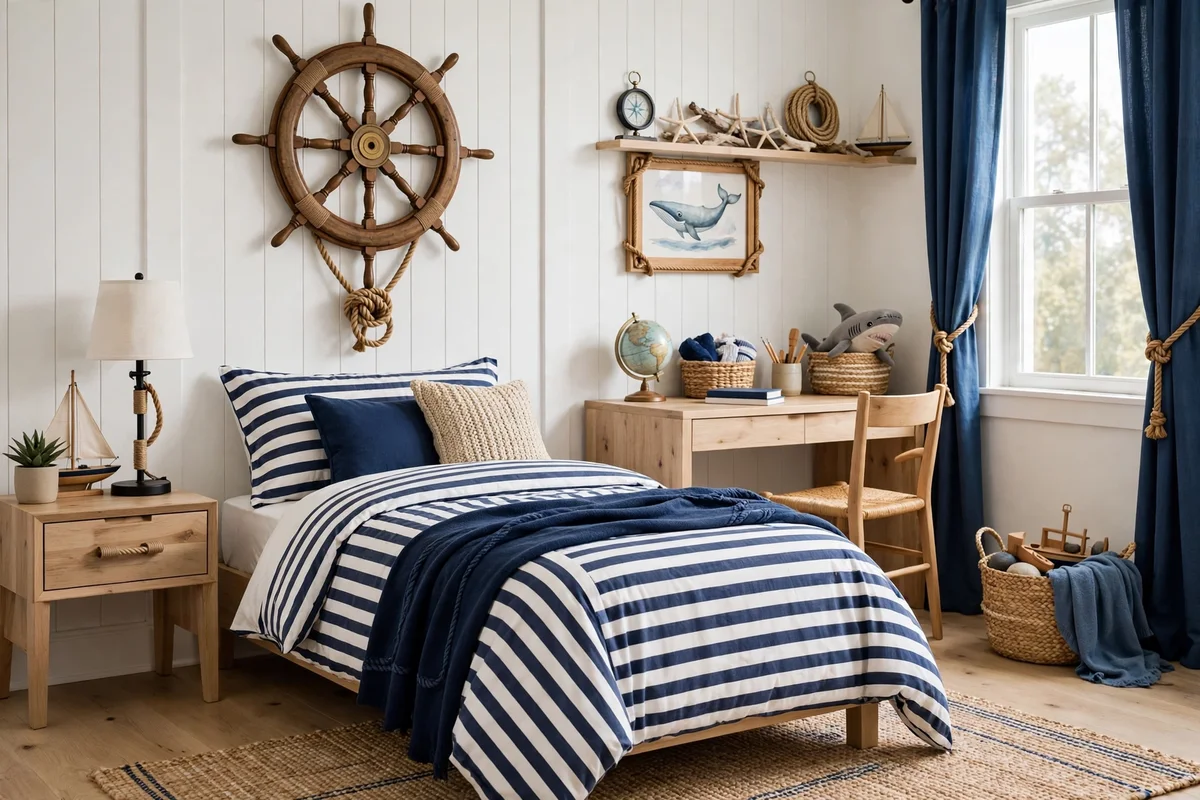
A nautical theme is one of the longest-lasting boys bedroom ideas, because it is built on a colour scheme — navy, white, and red — rather than on a character or a trend. Striped bedding, a ship wheel or anchor on the wall, rope details on a shelf, and light wood furniture give the room its seaside feel, and it suits boys from five to twelve without ever feeling babyish. A boat-shaped bed is the showpiece version, but it is not necessary: the stripes and the colours do most of the work on their own.
Plank walls or shiplap painted white add texture without pattern, and they suit a nautical room better than a busy wallpaper. A gallery wall with antique-style posters, sailboat prints, and a map or two gives the room a collected feel, and a red accent — a cushion, a lamp, a storage bin — stops the navy and white from feeling cold. Keep the rope and the ship details to two or three pieces; a room with a rope on every shelf looks like a theme park. One ship wheel above the bed, one striped rug, and one red cushion are enough to make the theme unmistakable.
9. Go on an adventure with a map wall and woodland den
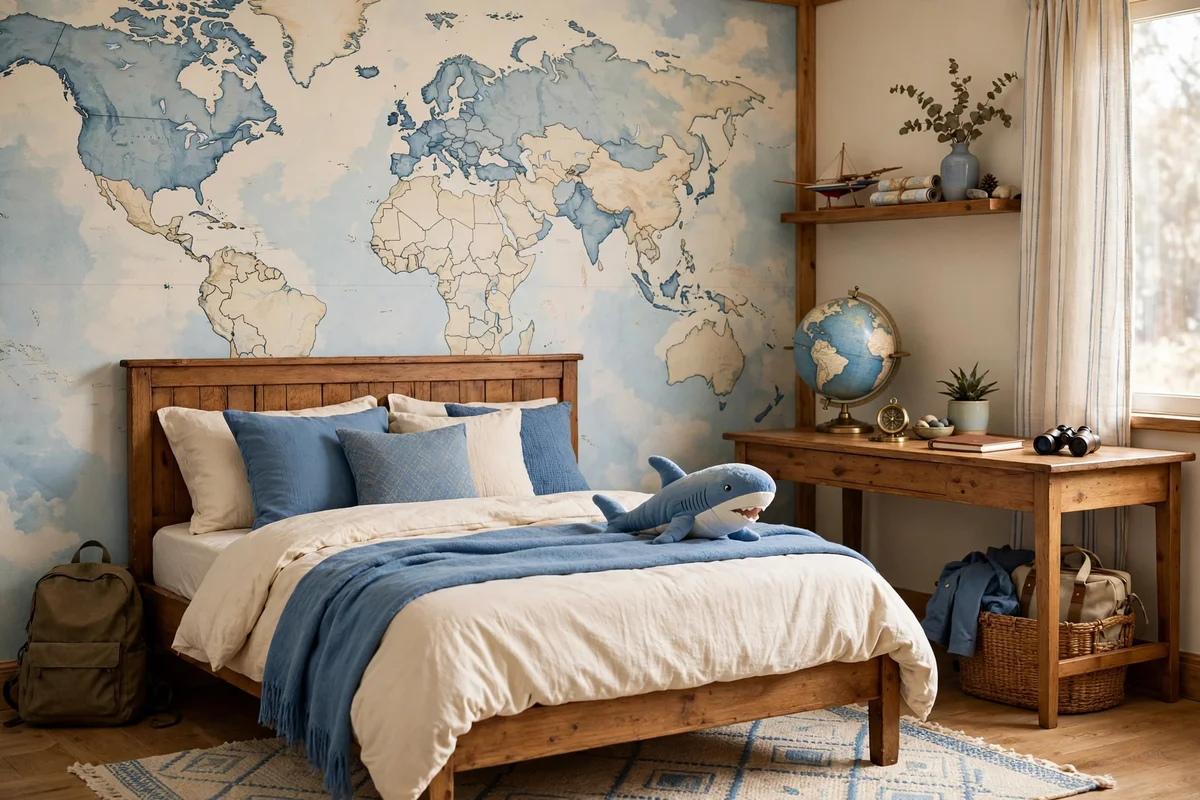

Maps add both style and learning value to a bedroom. A large world map, a city map, or an adventure-themed map on one wall creates a unique focal point, inspires curiosity about new places, and works with many decorating styles without feeling childish. A map wall pairs naturally with a woodland look: forest green walls or leaf wallpaper, wooden furniture, woven baskets, and a small tent or den in the corner for reading and hiding. Together they make a room that feels like a base camp, and that is exactly the feeling most boys want from a bedroom.
Hang the map on the wall your son faces from his bed or his desk, so it is part of everyday life rather than decoration behind a wardrobe. Add pins or small markers for places he has been, places family live, or places he wants to visit one day — the map becomes personal instead of generic, and it gives him something to look at and talk about. For the full adventure treatment, the adventure-themed kids room ideas for curious explorers guide covers maps, explorer corners, and outdoor-inspired rooms in more depth.
Beds and Furniture That Work Hard
10. Choose a cabin bed or mid-sleeper with storage underneath
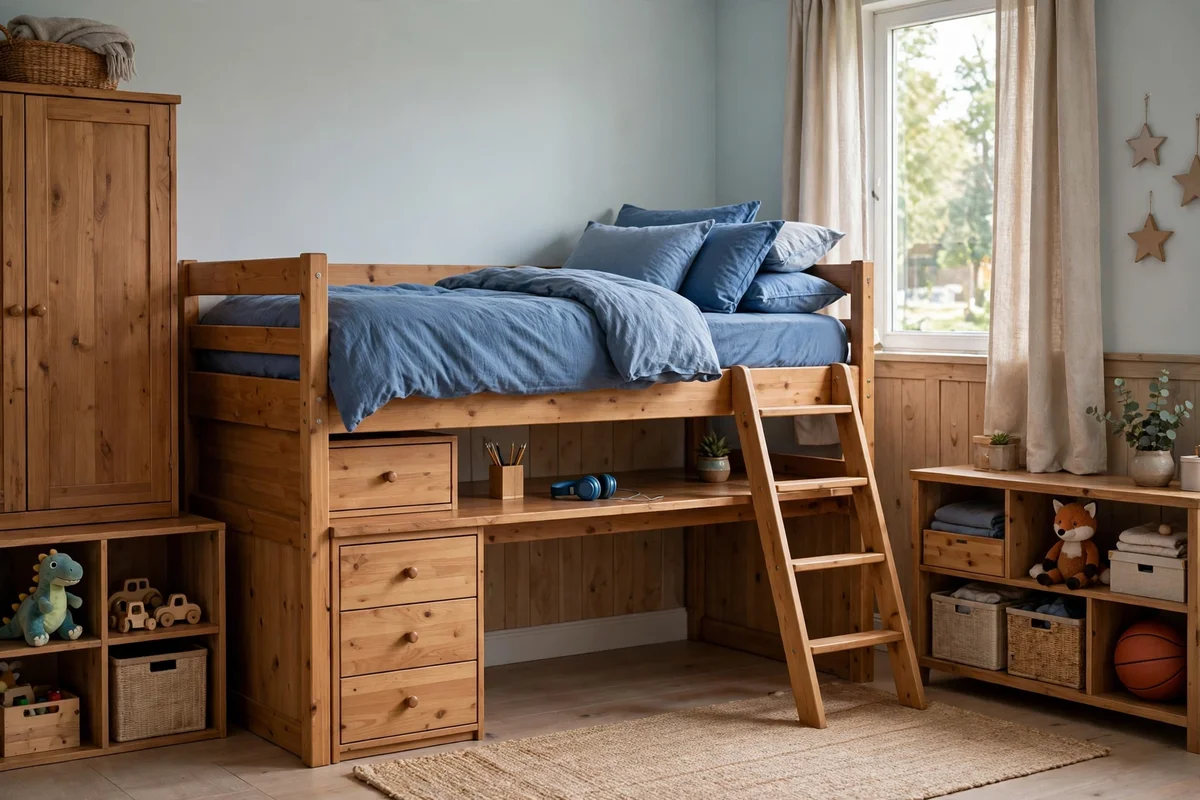
The bed is the most important decision in any boys bedroom, because it is the biggest piece of furniture and the one that decides how much floor space is left for everything else. For most boys between five and twelve, a cabin bed or mid-sleeper is the smartest choice. The bed is raised just enough to fit storage drawers, a desk, or a play space underneath, and the room gains a whole zone without gaining a single square metre. A single bed with under-bed storage drawers is the practical choice for a smaller room, while a mid-sleeper with a desk underneath starts to earn its keep as homework becomes part of life.
For younger boys, keep the bed low and simple. A toddler bed or a low single close to the ground is ideal up to about age five, because safety matters more than style and he will be climbing in and out on his own. For older boys, a high sleeper maximises the space underneath for a desk, storage, or a sofa, but it only works in a room with a high enough ceiling and a child old enough to climb the ladder safely in the dark.
11. Use bunk beds and trundles for shared rooms and sleepovers
Bunk beds are the classic answer to a shared boys bedroom, and they work because they free up half the floor. Two boys, one footprint, and a whole room left over for playing. Modern bunk beds come with storage drawers in the stairs, shelves built into the frame, and even a desk slung underneath the top bunk, so the bed itself does the work of three pieces of furniture. If the room is shared by brothers of different ages, give the older child the top bunk and the younger child the bottom, and give each boy his own colour for bedding and storage bins, so the shared room still feels like two rooms.
A trundle bed is the quieter alternative, and it suits rooms where a bunk bed would feel too tall or too permanent. The second bed slides out from under the first for sleepovers and slides away in the morning, so the room is a single bedroom six days a week and a double bedroom on Saturday night. It also suits a boy who has friends to stay often but does not share his room full-time. Whichever you choose, check the ceiling height before you buy a bunk bed, leave enough headroom for the child on top to sit up without hitting the ceiling, and put a small shelf or a clip-on light on each bunk so both boys can read in bed.
12. Make the bed the statement piece
A statement bed can carry a whole room. A house-shaped bed frame adds whimsy and a homey feel for younger boys. A vintage car bed makes a young car lover's dream come true, especially in a palette of cool blues and fresh whites that keeps the focus on the bed itself. A wooden sleigh bed or a dark metal frame gives an older boy's room a grown-up anchor, and a tall upholstered headboard in navy or charcoal makes even a plain room feel finished. The bed is the biggest thing in the room, so it is the piece worth spending on — everything else can be simple if the bed is right.
The risk with a themed bed is the same as with any themed furniture: it dates. A car bed is wonderful at six and embarrassing at ten. If you buy one, buy it knowing it has a four-year life, and keep everything else in the room neutral so the next bed slides in without a redecoration. A safer version of the same idea is a statement headboard rather than a statement bed: a tall wooden headboard, a fabric headboard in a bold colour, or a headboard made from reclaimed wood gives the room its focal point, and it can be swapped or repainted far more cheaply than a whole bed. Pair the bed with a good bedside table — a lamp, a book, and a glass of water within reach — and the sleep zone is done. The bedside table ideas guide has small, practical options that fit beside any bed without crowding the room.
Activity Zones: Reading, Gaming, Homework, and Hobbies
13. Create a reading corner
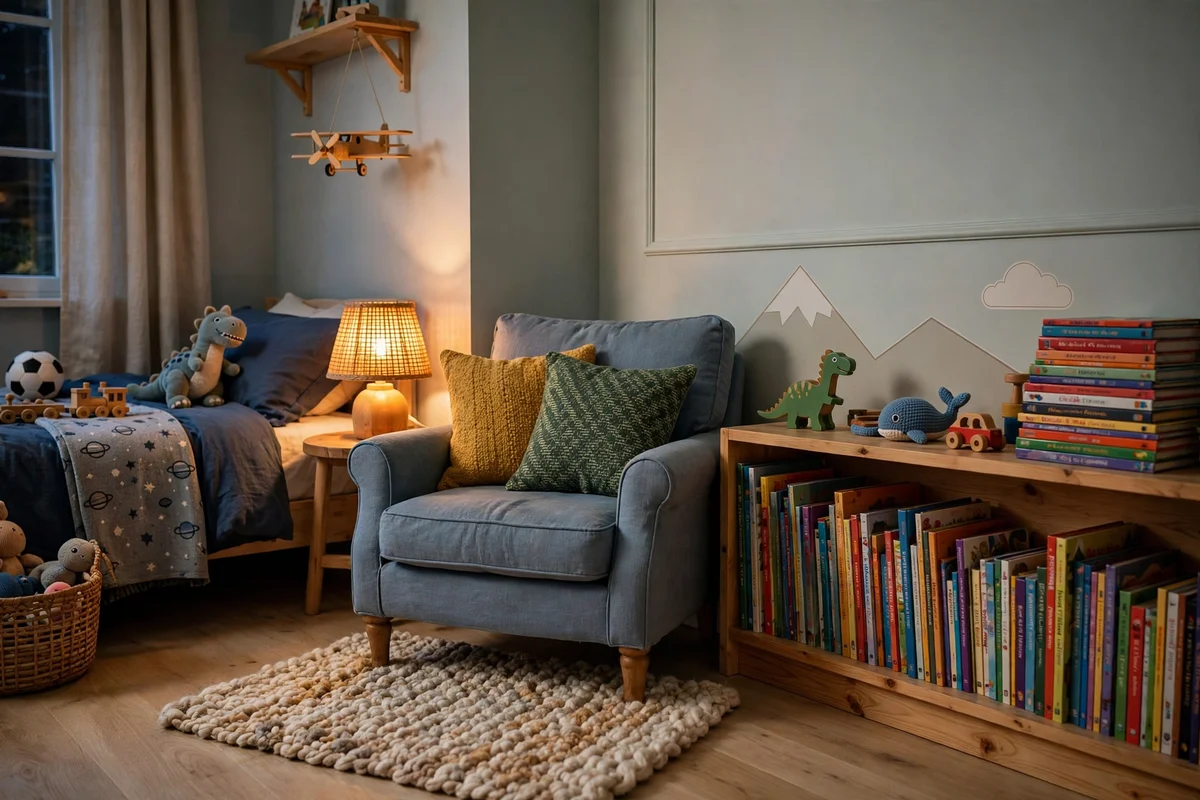
Every bedroom benefits from having a quiet place to relax, and a reading corner is the zone that gets more use than parents expect. A comfortable chair, soft lighting, and a small bookshelf create a cosy retreat where a boy can unwind, read, or simply take a break from busy days. It does not need much space: a corner by the window, a bean bag and a low shelf, or a small armchair with a cushion and a throw are enough. The key is that the corner belongs to reading and resting, not to toys or homework, so it feels like a retreat rather than another workstation.
Put the books where they can be reached without getting up. A low bookshelf, a wall-mounted book ledge, or a basket of current favourites beside the chair all work. Add a warm lamp rather than relying on the ceiling light, because a reading corner lit by a soft lamp feels like a different room from the rest of the bedroom, and that is the point. For more corner ideas, the cute bedroom corner ideas for kids guide covers reading nooks, window seats, and cosy corners that work in small rooms too.
14. Build a gaming zone that stays tidy
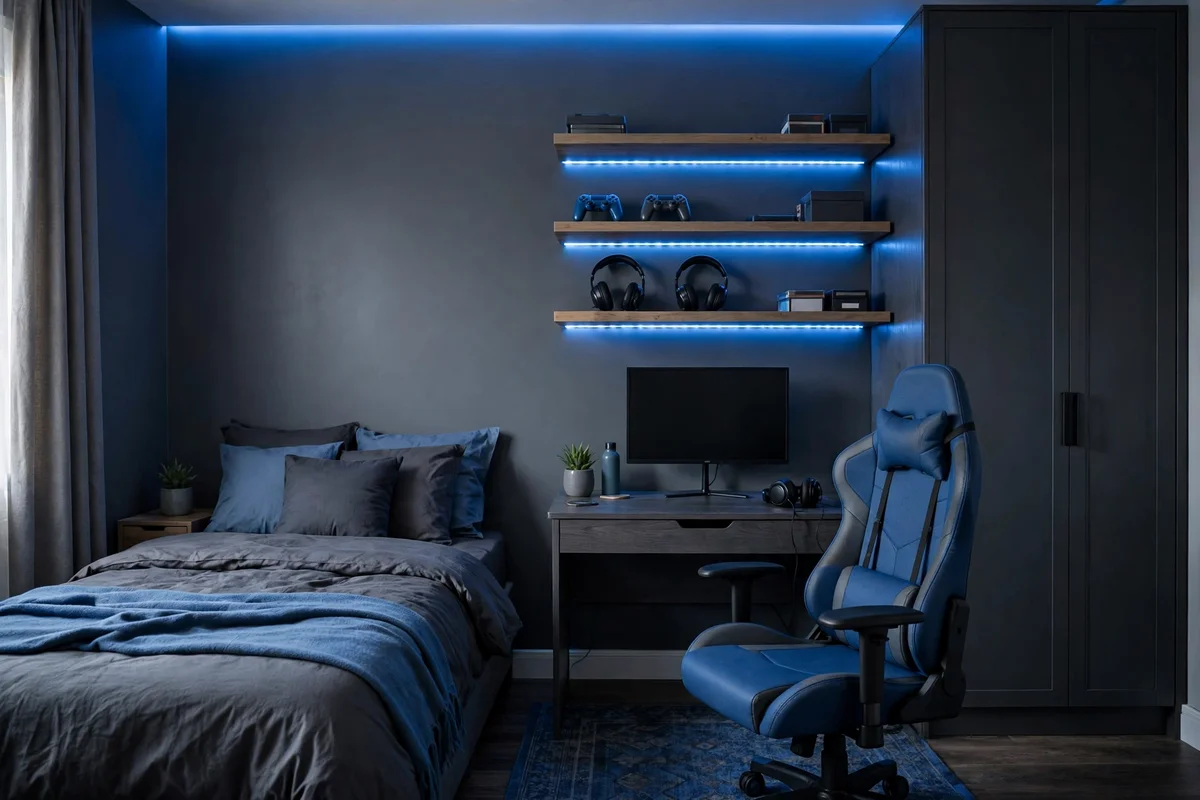
For boys who enjoy gaming, a dedicated gaming area makes the room feel extra special, and it does not need to be large to be effective. A comfortable chair, good lighting, a desk at the right height, and organised storage for equipment keep everything in one place and help reduce clutter elsewhere in the room. The zone works best when it has clear edges: a desk against one wall, a rug underneath the chair to mark the area, and shelves or a small unit for controllers, headsets, and games. When the gaming things live in the gaming zone, they stop living on the bed, the floor, and the dining table.
Cable control is the difference between a gaming zone and a cable nest. A cable tray under the desk, a power strip fixed to the desk leg, and one labelled box for chargers keep the wires out of sight and out of the way. Lighting matters too: a desk lamp for homework, warm LED strip lighting behind the desk or the shelves for atmosphere, and a ceiling light that is bright enough for everything else. Keep the screens out of the bed zone if you can, so the bed stays a place for sleep, and agree the screen-free time before the zone is built, not after.
15. Add a desk for creativity and homework
A desk provides a dedicated space for homework, drawing, building projects, and hobbies, and even younger boys benefit from having a place that belongs to them. Pair the desk with comfortable seating and good lighting, and keep supplies organised in pots, trays, and drawers so the desk can be cleared in a minute. A desk against the wall under a window gets the best light for homework and drawing, while a desk in a corner with a pinboard above it suits a boy who likes to plan and display his work.
The desk does not need to be big; it needs to be clear. A small desk that is kept clear is worth more than a large desk covered in things, because a clear desk is a desk that gets used. Give every supply a home — pencils in a pot, paper in a tray, building sets in a box on the shelf — and the desk stays usable. As homework becomes a bigger part of life from about age eight onwards, the desk earns its keep every day, and a boy with his own desk is a boy who can work without spreading across the kitchen table.
16. Build a display wall for hobbies and collections

Most boys have something they are passionate about, whether it is sports, cars, building sets, skateboards, music, or collectibles. Instead of hiding those items away, turn them into part of the decor. Wall shelves, pegboards, and display racks can showcase favourite hobbies while adding personality to the room, and a display wall instantly makes the bedroom feel unique and personal. It also allows the decor to grow and change as interests evolve, because the wall changes when the shelf changes.
A pegboard wall is the most flexible version: hooks, shelves, and baskets move whenever the collection changes, and it suits Lego, tools, craft supplies, and small collections alike. A row of floating shelves with a little empty space between the objects looks like a display; shelves packed edge to edge look like storage. A shadow box or a glass-fronted case suits collections that are precious or fragile — model cars, action figures, trading cards, rocks, or souvenirs — and it keeps them visible without gathering dust. Let your son arrange his own display wall, and leave one shelf empty on purpose, because a collection that has room to grow is a collection that stays interesting.
Storage and Display
17. Use open shelves for storage and style
Open shelving provides storage while giving boys a chance to display their favourite items, and books, trophies, collectibles, and framed photos all look great on well-styled shelves. The key is leaving some empty space so everything does not feel crowded — a shelf that is three-quarters full looks designed, while a shelf that is packed solid looks like a cupboard with its door off.
Put the shelves where they will be used, not where they look best in a photo. A shelf beside the desk holds homework supplies. A shelf above the bed holds books for bedtime. Keep the heavy things low and the display things high, so a shelf cannot be pulled down by a child reaching for a trophy, and fix every shelf to the wall properly rather than relying on adhesive strips. Label the boxes and baskets on the lower shelves, and the room starts to tidy itself.
18. Add a pinboard, gallery wall, and personal touches
A pinboard gives a boy a place to display photos, notes, artwork, schedules, and memories, and it keeps important items organised while adding personality to the room. The display can change over time as interests evolve, which makes a pinboard useful for many years, and it encourages creativity and self-expression. A cork board, a fabric-covered board, or a magnetic board above the desk is the practical version; a gallery wall is the decorative one. Mix framed artwork, favourite photos, posters, maps, and prints to create a display that reflects your son's interests, and the best gallery walls feel collected over time rather than perfectly planned.
The most memorable bedrooms are the ones that reflect the person who lives in them. Favourite books, framed photos, sports memorabilia, travel souvenirs, and meaningful keepsakes all help tell a story, and these details make the room feel authentic rather than staged. Personal touches create a stronger connection to the space, and they ensure the room feels unique. Hang the gallery at your son's eye level, not adult eye level, so the wall belongs to him, and leave space for his own art — a clip frame or a magnetic poster hanger lets him swap art without tools. If you want the gallery wall to look like art rather than clutter, use matching frames and one colour for the mats, and let the pictures inside do the talking. The artsy kids room decor ideas guide has more ways to display children's art so it looks intentional instead of accidental.
Comfort and Finishing Touches
19. Add a hanging chair or a big soft seat
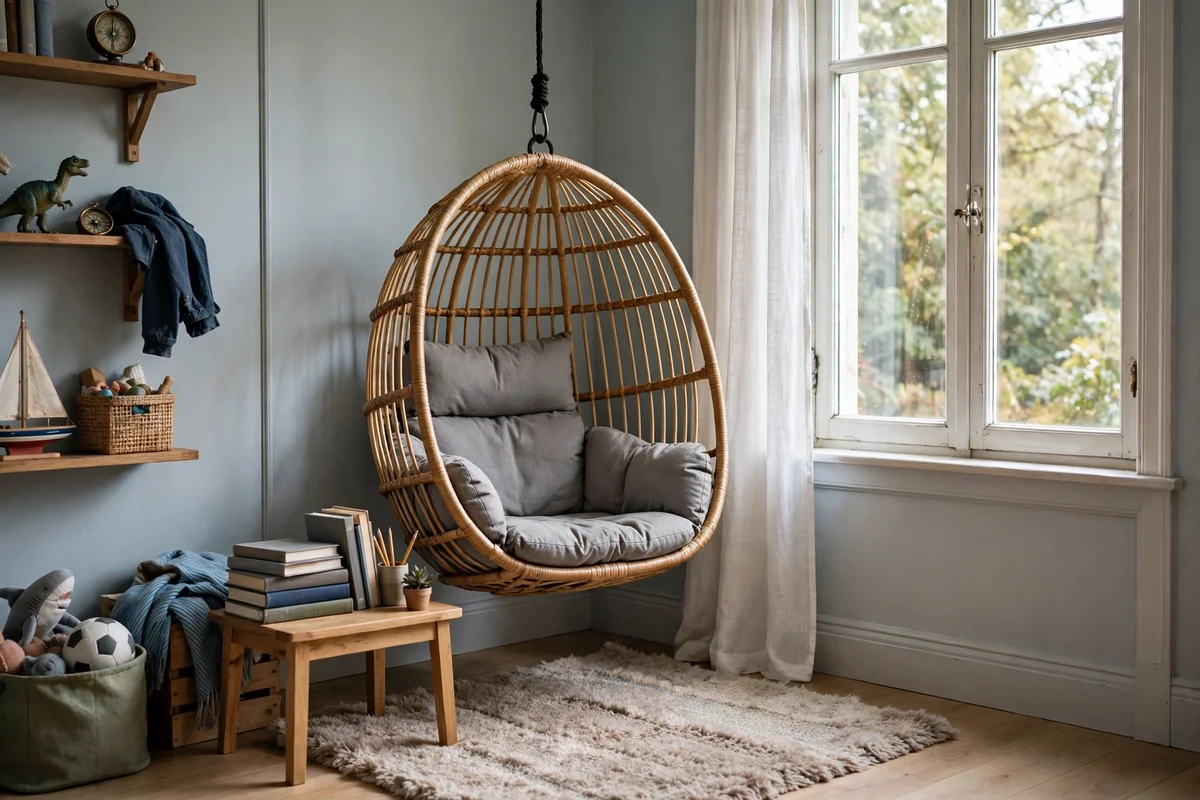
A hanging chair creates a fun place to relax, read, or simply unwind, and it adds visual interest while making the room feel more inviting. Children often love furniture that feels a little different from the ordinary, and the gentle movement can make the chair especially comfortable. It quickly becomes a favourite spot for many kids, and few pieces of furniture feel as fun as a hanging chair. Hang it in a corner with a soft rug underneath and a small side table for books, and the corner becomes a destination rather than dead space.
Check the fixing before you buy: a hanging chair needs a ceiling joist or a proper floor-standing frame, not a plasterboard ceiling, and it needs enough clearance to swing without hitting the wall or the furniture. If hanging is not possible, a large bean bag, a floor cushion, or a small sofa does the same job on the ground, and it can be moved when the room is rearranged. Soft seating is also the cheapest way to make a room feel comfortable — a bedroom can look amazing, but it also needs to feel comfortable, and soft bedding, good lighting, practical storage, and cosy seating all contribute to a room a boy actually wants to spend time in.
20. Finish with a statement light and layered lighting
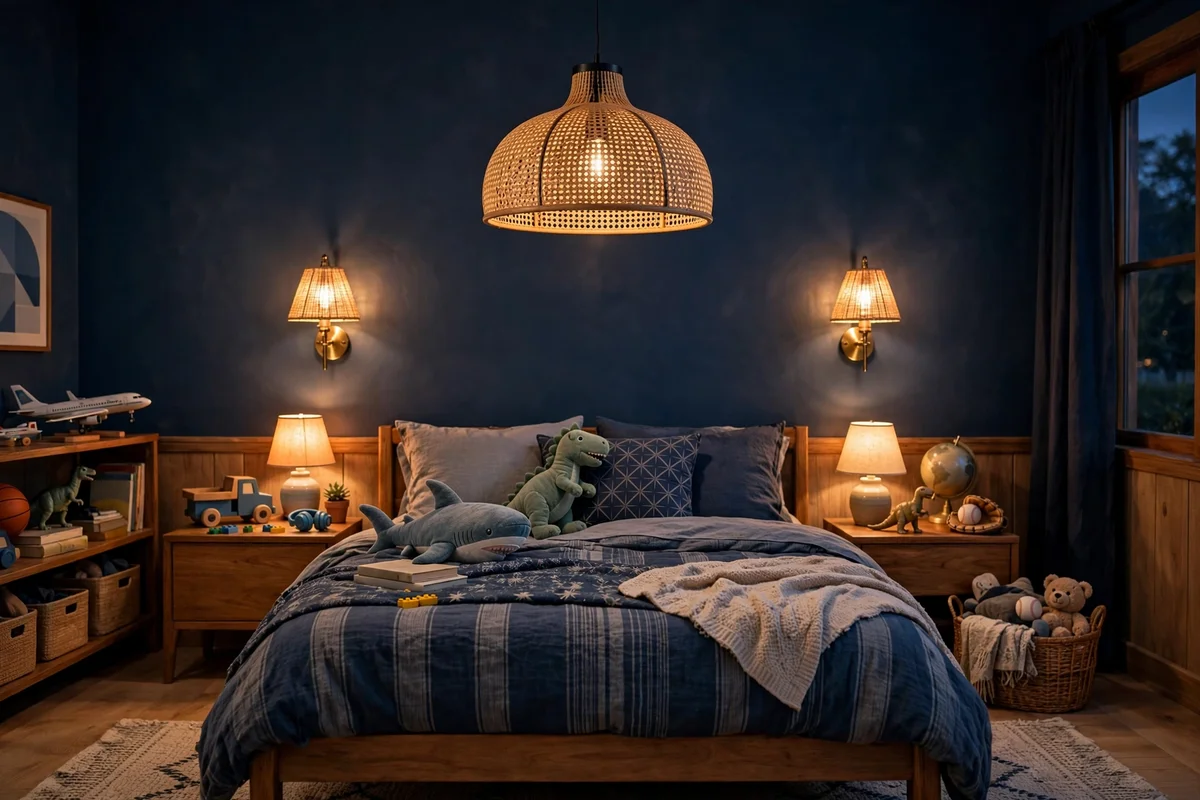
Lighting often gets overlooked during decorating, but it can completely change a room. A bold pendant light, an industrial fixture, or a unique ceiling lamp adds personality while improving the overall design, and it naturally draws attention and helps create a focal point. Good lighting also makes the room feel more comfortable and functional, and a stylish fixture can make the entire room feel more finished. This is one of the easiest upgrades you can make, and it costs far less than repainting the room.
Layer the light the way you layered the zones: a ceiling light for playing and tidying, a desk lamp for homework, a bedside lamp for reading, and a warm accent light — a wall sconce, a picture light, or a strip of warm LED lighting along a shelf — for the evenings. Use warm white bulbs, not cool white, because warm light makes a bedroom feel cosy while cool light makes it feel like a classroom. Put the accent lighting on a separate switch or a timer, so it can be on for reading and off for sleep without touching the main light. A star projector or a string of fairy lights in a space-themed room does the same job for younger boys, and it turns the ceiling into part of the theme for the price of a single light.
Small Rooms and Shared Rooms
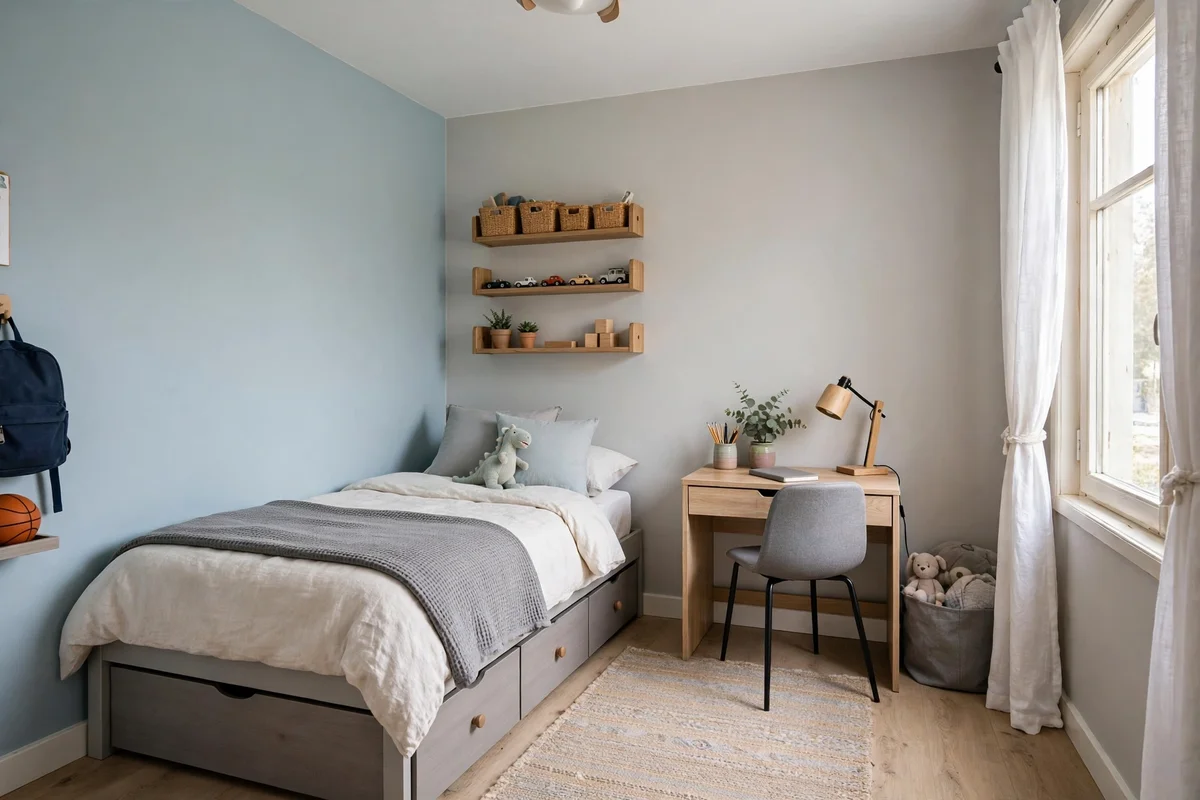
A small boys bedroom needs the furniture to work harder and the floor to stay clearer. Use the bed as the storage: a cabin bed with drawers underneath, a bed with a trundle for sleepovers, or a mid-sleeper with a desk below it. Use the walls as the storage: floating shelves, wall hooks, and a pegboard hold more than a chest of drawers and take up no floor space at all. Keep the main colour light, keep one wall completely plain, and give every activity a small zone instead of spreading it across the floor.
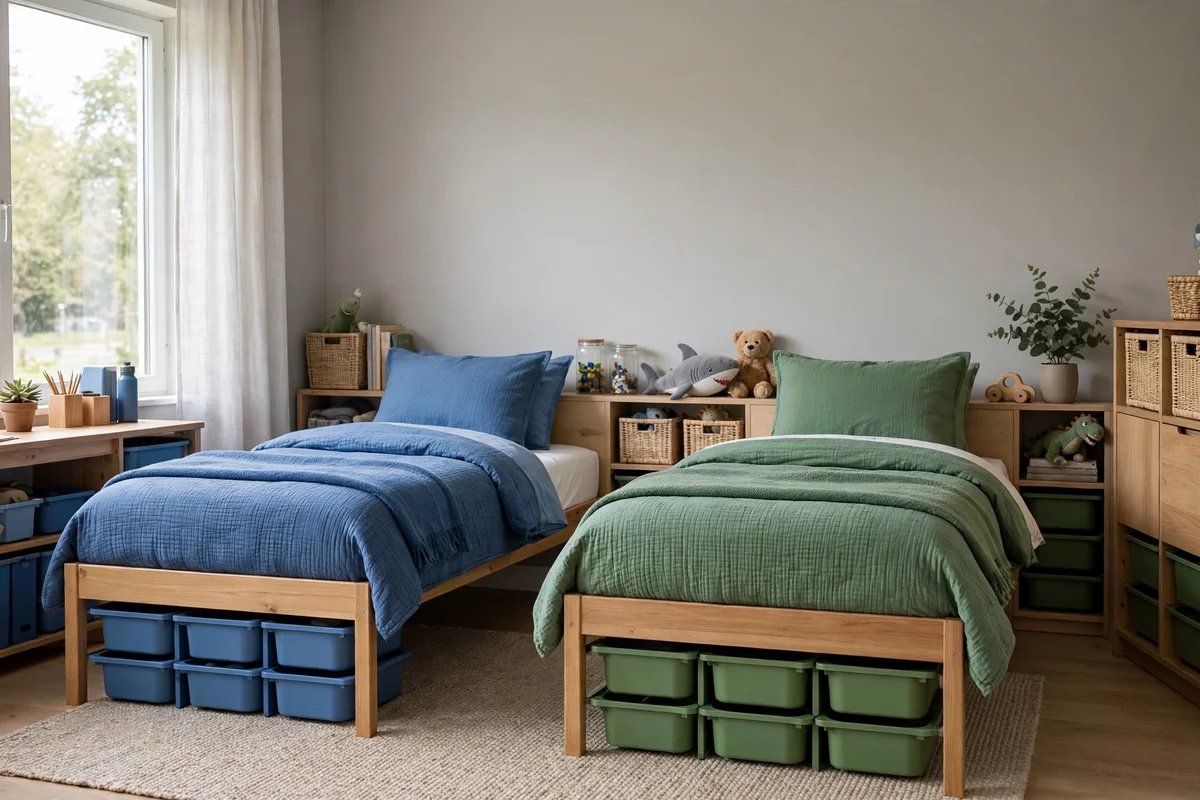
A shared room needs a plan both boys can live with, and a way for each boy to have his own colour inside it. A neutral or mid-tone wall — sage, dusty blue, warm grey — works well here, because it is less likely to feel like one child's taste imposed on the other. Give each boy one signature colour inside the shared scheme: one boy's bedding in blue, the other's in green, while the walls use a colour both accept. If the beds are on opposite walls, each bed wall can carry its own small accent — a painted arch, a strip of wallpaper, a cluster of decals in that boy's colours — with the shared wall kept neutral. Colour-coded storage earns its keep twice over in a shared room: each boy's bins in his own colour end most arguments about whose toys are whose. Bunk beds free up the floor for playing, and a curtain or a shelf between the beds gives each boy a little privacy without building a wall.
Boys Bedrooms by Age
A toddler room, up to about age five, can be bolder, because toddlers use the room for play as much as sleep. A low bed close to the ground, a floor-level reading corner with a basket of books, decals at toddler height, and storage bins he can reach himself all suit this age. Safety comes first: furniture fixed to the wall, no heavy shelves above the bed, and nothing with small parts within reach of a child who still puts things in his mouth.
A school-age boy's room, roughly six to eleven, can carry the strongest version of a theme, because he can tell you what he likes and what he has outgrown. This is the age for the space mural, the dinosaur shelf, the sports corner, the map wall, and the reading nook. It is also the age to involve him in the work: a school-age boy can tape a geometric pattern, stick decals, arrange his own display shelf, and choose between two colours with genuine opinions. Let him choose between options you have already approved — "navy or green?" — rather than facing the whole paint chart, and the room will feel his without becoming a colour you regret.
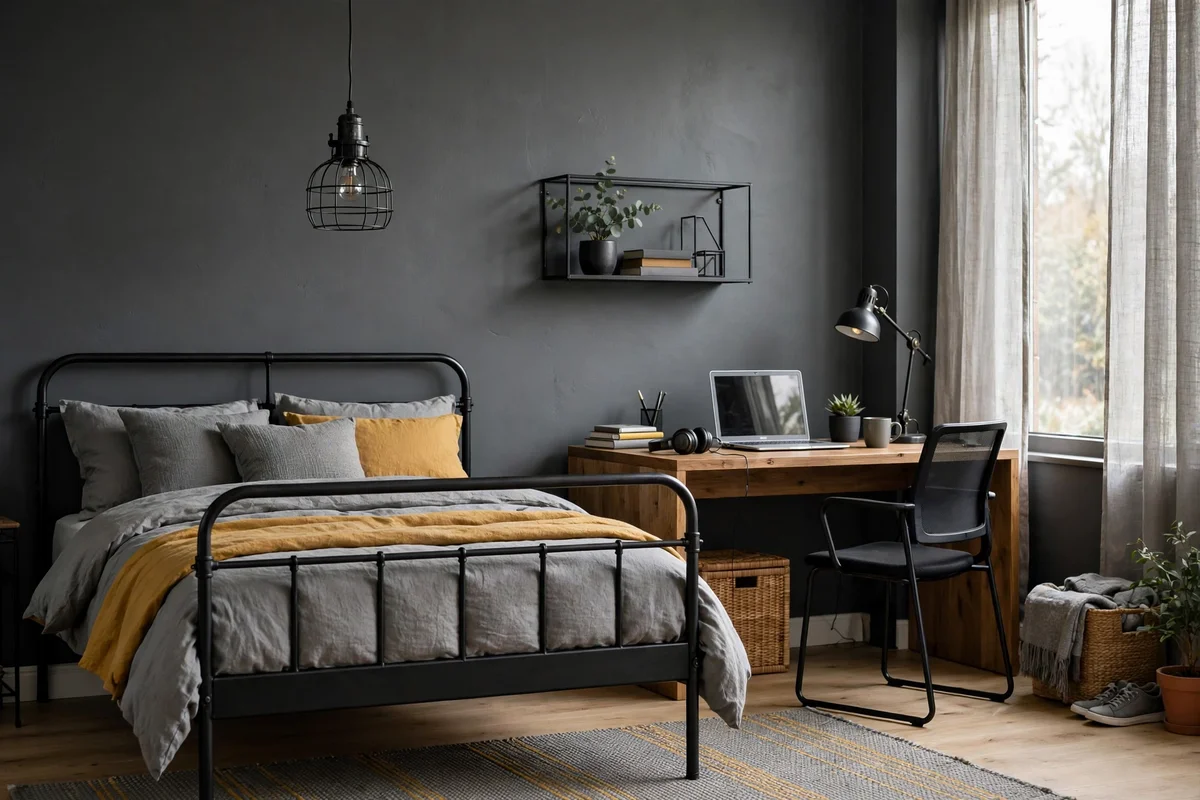
A pre-teen's room, roughly twelve to fourteen, needs to feel grown-up, not themed. Dark grey walls, a metal bed frame, an industrial light, a proper desk, and a gaming zone all work, because they read as design rather than decoration. This is the age where a mural of a cartoon character or a wall of decals starts to feel young, and where the room should be chosen so it can stay for several years. The big kids room ideas guide covers this older age group in more depth, including desks, storage, and layouts that suit a boy who is nearly a teenager.
A Weekend Plan: Saturday and Sunday
A boys bedroom does not need a month of planning. It needs a clear order, because painting before you have measured, or buying furniture before you have chosen the theme, creates the rework that eats weekends.
On Saturday morning, choose the theme and the palette with your son, measure the room, and draw the layout on paper: bed, desk, reading corner, storage, and the route between them. Buy only what is on the list: paint or wallpaper, bedding, a rug, and any furniture that is already decided. Move the furniture away from the walls, protect the floor, and do the messy work — paint the accent wall, hang the paper or the decals, and build the flat-pack furniture. While the paint dries, wash the new bedding and cushion covers so they are ready for Sunday. Do not try to hang art or arrange shelves while paint is wet; it will get marked.
On Sunday, put the room back together in this order: bed and bedding first, then the rug, then storage, then the desk and the reading corner, then wall art and display shelves last. Art goes last because it is the easiest thing to move, and you will only know where it belongs once the furniture is in place. Finish by walking to the door and looking at the room as a visitor would — the view from the door is the view that matters most, because it is the one you see every day.
Budget: Three Price Levels
A boys bedroom does not have to be expensive. The difference between the three levels below is how much is painted and how much is bought ready-made, not how good the result looks.
A refresh under $50 uses paint you already own or one tin of emulsion, a roll of painter's tape for a geometric pattern, a set of removable decals, a new cushion cover or two, and art your son has already made in clip frames. The room changes without any new furniture, and it takes an afternoon. This is the level to choose when the room is basically fine and just needs a lift, or when you are testing a theme before committing to it.
A mid-level refresh, roughly $50 to $200, adds the pieces that make the biggest difference: a new duvet set, a rug, a bookshelf or floating shelves, a desk lamp, or a roll of peel-and-stick wallpaper for one wall. This is the level most families choose, because it changes the room properly without changing the furniture. Spend it on the things your son touches every day — the bedding, the rug, the chair — rather than on things that sit on a shelf.
A full redo, $200 and up, adds the bed, the desk, and the storage furniture. This is worth doing when the room is being redecorated anyway — a move, a new bed size, or a brother moving out — rather than as a standalone project. Spend it on the things that are hardest to change later: the bed and the storage. Bedding and art can always be upgraded later, one piece at a time. Whatever the budget, buy the paint after you have chosen the bedding, not before — paint comes in thousands of shades and bedding in dozens, so matching paint to bedding is easier than the other way round.
Mistakes That Make Boys Bedrooms Look Wrong
The most common mistake is theming everything. A dinosaur duvet, dinosaur curtains, dinosaur wallpaper, a dinosaur rug, and a dinosaur lamp all in one room is not a theme, it is a costume, and it will feel young within a year. Pick two or three themed pieces and keep the rest plain. The room should hint at the theme, not shout it from every surface.
The second mistake is buying furniture before measuring the room. A bed that is too big, a desk that blocks the door, or a wardrobe that covers the only socket all come from the same cause: the furniture was bought before the room was measured. Mark the footprint of every large piece on the floor with tape before you buy it, and check the route from the door to the bed, the desk, and the window. If the tape layout feels cramped, the furniture will feel cramped too.
The third mistake is storage that a child cannot use. High shelves, deep boxes without labels, and cupboards with doors that stick are all storage that looks good in a photo and never gets used in real life. Storage works when a boy can reach it, see what is inside it, and put things back in under a minute. Open baskets, labelled bins at his height, and shelves he can reach without a chair are the storage that actually gets used.
The fourth mistake is forgetting the light. A dark navy room with one small window and a single ceiling bulb feels like a cave, and a pale room with harsh cool-white bulbs feels like a classroom. If the room feels wrong and the colours looked right in the shop, the light is usually the reason. Swapping a dark colour for a lighter shade of the same colour, or adding a warm lamp, often fixes it without redecorating.
The fifth mistake is designing the room for the boy you have now and forgetting the boy he will be in two years. A room that only works for a seven-year-old will need redoing at nine. Build the room on a neutral base, a good bed, and storage that fits a teenager as well as a child, and put the age-specific parts — the theme, the bedding, the wall art — in the things that are cheap to change.
How to Let the Room Grow Up With Your Son
The best boys bedrooms are built to be undone in stages. When your son outgrows the theme, change the cheap things first: peel off the decals, swap the bedding for a solid colour, take down the themed prints, and change the cushion covers. That alone removes most of the theme, and the room will already feel older.
If that is not enough, repaint the accent wall in a single colour drawn from the old design — navy, sage green, or warm grey — and keep the shelves, the desk, and the storage, which were never really part of the theme at all. The bed can stay until he outgrows it, and the reading corner can stay forever, because a comfortable chair and a good lamp suit every age.
Talk to your son about the change before you make it, and let him choose the next version. A boy who chose his room at seven and chose it again at ten has a room that has grown with him, not a room that was done to him. The rooms boys love most are rarely the ones with the most decoration — they are the ones where the bed is comfortable, the toys have a home, there is a good corner to sit in, and the walls show what he cares about.
Frequently Asked Questions
What is the best colour for a boys bedroom?
Navy blue is the most forgiving choice: it feels calm, suits every age, and pairs with almost anything. Grey is the most flexible, because any accent colour works against it. Sage or forest green suits boys who like nature and the outdoors. Whichever you choose, use it on one wall or in the bedding rather than on all four walls, and repeat it twice more in the room so the colour looks planned.
How do I decorate a small boys bedroom?
Use the bed as the storage — a cabin bed with drawers or a mid-sleeper with a desk underneath — and use the walls for shelves, hooks, and a pegboard. Keep the main colour light, keep one wall completely plain, and give every activity a small zone instead of spreading it across the floor. A small room with a plan feels bigger than a big room without one.
What theme lasts longest in a boys bedroom?
Themes built on a colour last longest: navy and grey, forest green and wood, or a neutral base with one strong accent. Themes built on a character date fastest. Space, sports, nautical, and woodland themes last four to six years when the theme lives in the bedding and the wall art.
How can I make a boys bedroom look stylish without spending a lot?
Start with one tin of paint for an accent wall, a new duvet set, and a rug. Those three changes alter the room more than any single piece of furniture. Add a reading corner with a cushion and a lamp, put his collections on a shelf instead of in a box, and tidy the cables. A refresh under $50 can change the whole feel of the room.
How do I organise a boys bedroom so it stays tidy?
Give everything a home your son can reach and see: labelled bins at his height, open baskets for balls and soft toys, a hook by the door for bags, and a shelf for the things he uses every day. Storage works when putting things back takes under a minute. If tidying takes longer than playing, the storage is in the wrong place.
When should a boys bedroom change from a themed room to a teen room?
Usually between eleven and thirteen, when the theme starts to feel young to him. Change the cheap things first — bedding, decals, wall art — and keep the bed, the desk, and the storage. A dark grey wall, a proper desk, and a gaming or study zone are the pieces that carry a room into the teenage years without a full redecoration.
Final Checklist Before You Start
- Pick the theme with your son — give him two or three approved choices, not a blank page.
- Choose three colours: one main, one second, one accent, and repeat the main colour twice more in the room.
- Measure the room and mark the bed, desk, and storage footprints on the floor with tape before buying.
- Pick a bed that works hard: storage drawers, a desk underneath, or a trundle for sleepovers.
- Give every activity its own zone: sleep, reading, homework, gaming, and display.
- Put storage where your son can reach it, label the bins, and leave one shelf empty for the collection to grow.
- Test paint swatches in daylight and under the bedroom lamp at night.
- Buy the paint after the bedding, not before.
- Keep the theme in the cheap, changeable things — bedding, cushions, decals, art — not in the walls or the bed.
- Leave at least one wall completely plain.
A boys bedroom does not need to be perfect, and it does not need to be finished in one go. Start with the theme and the bed, add one zone, and let the rest grow over time. The rooms boys love most are the ones where the toys have a home, there is a comfortable corner to sit in, and the walls show what he cares about.