
Animal Themed Bedroom Ideas For Kids Who Love Wildlife
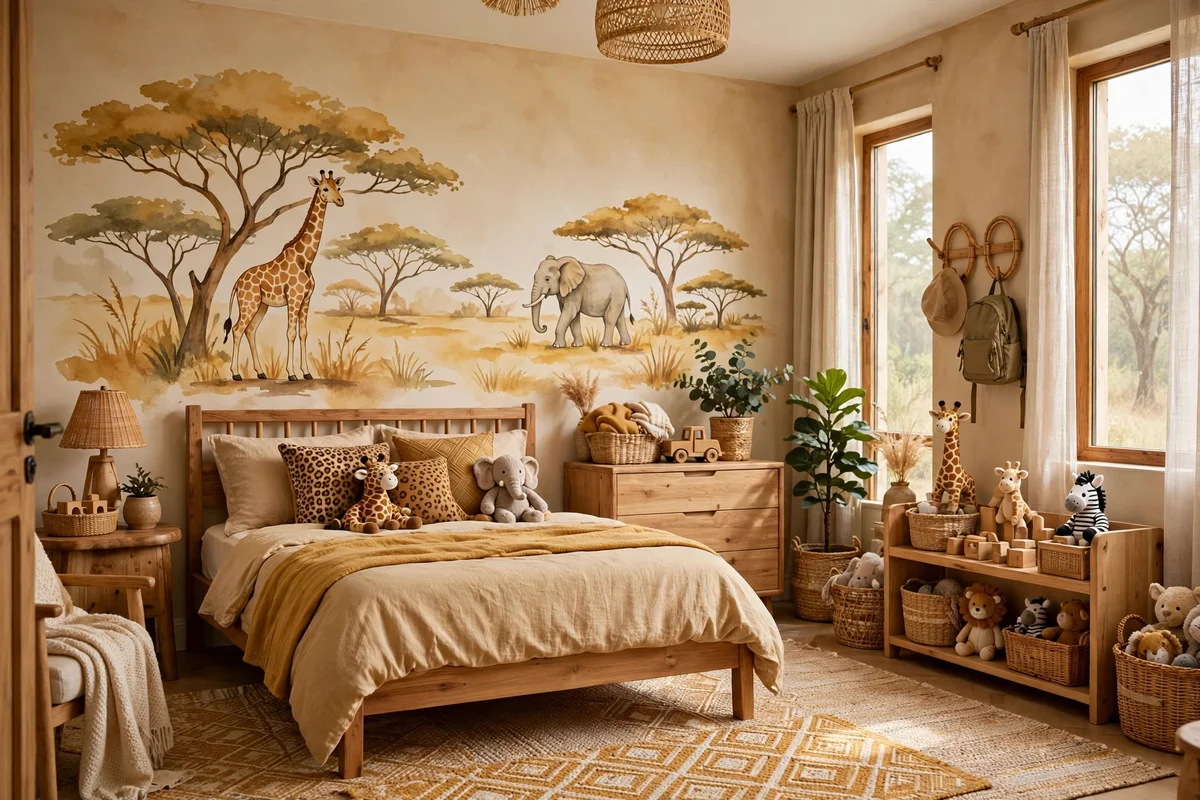
An animal themed bedroom works best when one habitat leads the room. Pick safari, jungle, woodland, or ocean before you buy anything, and let every other choice follow from that one decision. The habitat sets the colours, the animals, the bedding, and even the storage. Without it, a room fills up with a lion cushion, a dinosaur lamp, a whale poster, and a fox rug, and none of them look like they belong together. With it, even a small room with a few well-chosen pieces feels like a real place — a savanna at sunrise, a forest clearing, or a quiet stretch of ocean.
If you want the short version: choose one habitat and three colours drawn from it. Put the biggest animal moment on one wall — a mural, wallpaper, or a gallery of prints — and keep the other walls plain. Let the bedding, a rug, and the storage carry the theme from there. A room done this way feels adventurous without feeling cluttered, it is easy to tidy, and it can change in a weekend when your child moves on from lions to sharks. The ideas below are arranged in the order most parents actually use them — habitat first, then walls, then the bed, then the floor, then storage, then the learning corners that make the room more than decoration.
Pick Your Habitat First: Safari, Jungle, Woodland, or Ocean
The habitat is the one decision that affects everything else, so make it before you shop. There are four habitats that work reliably in children's rooms, and each one suits a different kind of room and a different kind of child.
Safari and savanna is the warmest option: honey gold, sandy tan, warm brown, and leaf green, with lions, elephants, giraffes, and zebras. It suits bright rooms with plenty of daylight, big rooms, and children who love big animals and adventure stories. It is also the easiest habitat to shop for, because most animal bedding, rugs, and toys are made in safari colours. The trade-off is that it is the most common animal theme, so a safari room needs one personal touch — your child's own drawings, a map of where the animals live, a collection of figurines — to keep it from looking like a shop display.
Jungle and rainforest is the lushest option: deep green, teal, bright orange, and pops of parrot red and toucan yellow, with monkeys, tigers, parrots, and frogs. It suits playrooms, rooms with a lot of wall space, and children who love colour and noise. It photographs well and it is the easiest habitat for a dramatic feature wall, because a jungle mural or wallpaper does most of the work by itself. The trade-off is that it needs the most plain space around it — white or cream walls on three sides, plain wood furniture — or it can feel overwhelming by bedtime.
Woodland and forest is the calmest option: sage green, warm brown, soft cream, and dusty orange, with foxes, bears, deer, rabbits, and owls. It suits nurseries, small rooms, and north-facing rooms that get cool light, because the soft colours keep the space feeling warm. It also suits children who find strong colour overstimulating at bedtime, and it is the habitat that ages best — a woodland room still looks right when a child is ten in a way a bright jungle room sometimes does not. The trade-off is that it is harder to shop for, because fewer ready-made products come in woodland colours, so you will paint, sew, or make more of it yourself.
Ocean and marine is the coolest option: deep blue, seafoam green, sandy beige, and coral, with whales, dolphins, sea turtles, octopuses, and colourful fish. It suits rooms that need to feel calm at bedtime, because blue is the most restful of the four palettes, and it suits children who love the sea, boats, and sea creatures. It is also the easiest habitat to keep tidy-looking, because the palette is naturally limited. The trade-off is that it is the hardest to make playful without tipping into a cartoon look, so the art and bedding need to be chosen carefully — realistic sea creatures and soft waves rather than grinning cartoon fish everywhere.
| Habitat | Best for | Watch out for | Easiest to change later |
|---|---|---|---|
| Safari / savanna | Bright big rooms, adventure lovers, easy shopping | Can look like a shop display without a personal touch | Bedding and art swap out easily |
| Jungle / rainforest | Playrooms, big walls, colour-loving kids | Needs lots of plain space around it | Wallpaper and bedding swap out easily |
| Woodland / forest | Nurseries, small rooms, calm sleepers | Harder to find ready-made products | Bedding and art swap out easily |
| Ocean / marine | Calm bedtimes, sea lovers, tidy look | Can tip into cartoonish if art is too cute | Bedding and rug swap out easily |
If you cannot decide, ask your child to name their three favourite animals. If all three live in the same habitat, the decision is made. If they are a lion, a shark, and a fox, pick the habitat of the animal they talk about most, and let the other two appear as small accents — a shark on a bookshelf, a fox on a cushion — rather than as equal themes. One habitat leading and two animals visiting works. Three habitats competing does not.
The One-Habitat Rule: Where the Animals Go
Every good animal room has one place where the wildlife is concentrated, and everywhere else the animals are an echo. That one place is usually the wall behind the bed, because it is the first thing you see from the door and the backdrop for the bed itself. A mural, a strip of wallpaper, or a gallery of framed prints all work on that wall. The key is that it is one wall, not four.
If the bed is against a short wall, a single large mural or one big framed print, centred over the bed, is usually enough. The feature should be roughly the width of the bed plus a little extra on each side, so the bed looks framed rather than crowded. If the bed is against a long wall, a horizontal scene — a savanna landscape, a forest line, a wave — works better, because a small picture on a long wall can look lost.
The wall opposite the bed is the second-best spot, and it suits a different kind of feature: a map showing where the animals live, a bookshelf with animal books ordered by habitat, or a row of floating shelves with figurines and nature finds. This works well when the bed wall has a window or a wardrobe in the way, and it gives a child something interesting to look at from bed without the animals being right behind their head.
The ceiling is the third option, and it is the one people forget. Glow-in-the-dark stars with a whale or a flock of birds, or a soft sky-blue ceiling with a few clouds, turn bedtime into something a child looks up at, and it leaves every wall free. It suits rooms where the walls are already busy with doors, windows, and built-in storage. It is also the hardest to change later, so it is best saved for a room you expect to keep for several years, or done with removable decals rather than paint.
Whichever wall you choose, measure it before you buy paint or wallpaper. Write down the width and height, note where the sockets, switches, and skirting boards are, and check whether the wall is straight — older houses often have walls that lean slightly, which matters for wallpaper and for straight painted stripes. A tape measure and ten minutes now save a second trip to the shop later.
20 Animal Themed Bedroom Ideas You Can Actually Copy
Walls
1. Paint a safari mural behind the bed
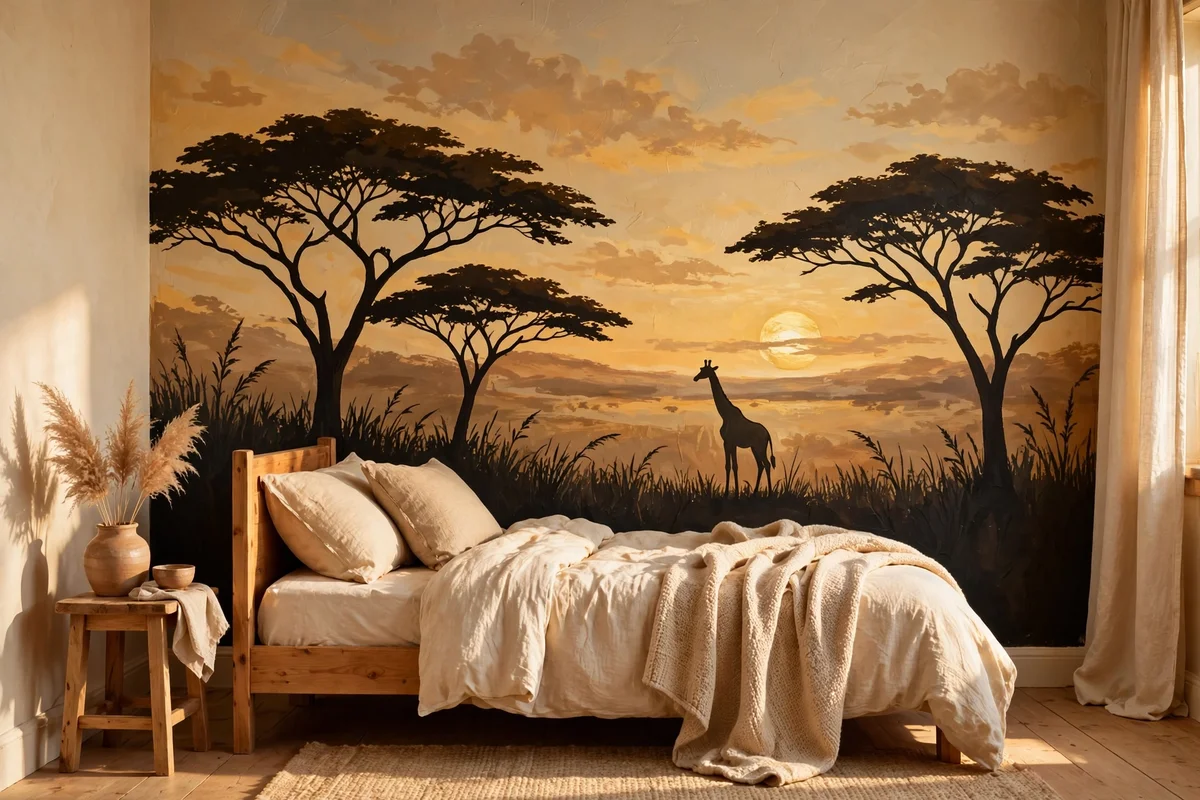
A painted savanna is the most forgiving animal feature wall there is. You do not need to be good at painting — a low sun, a few acacia trees, and long grass are simple shapes, and a slight wobble reads as handmade rather than wrong. Paint the sky first in a warm cream or pale gold, then add the sun low on the horizon, then the trees as dark silhouettes, then the grass as a band along the bottom. Add one or two animals as simple shapes — a giraffe's neck and head, an elephant's outline — rather than trying to paint a whole herd. A low-sheen washable paint is the practical choice here, because a feature wall behind a bed gets touched, leaned on, and bumped by pillows. If you are renting, the same savanna can be made with removable wall decals in tree and animal shapes, which peel off without taking paint with them.
2. Hang one strip of jungle wallpaper
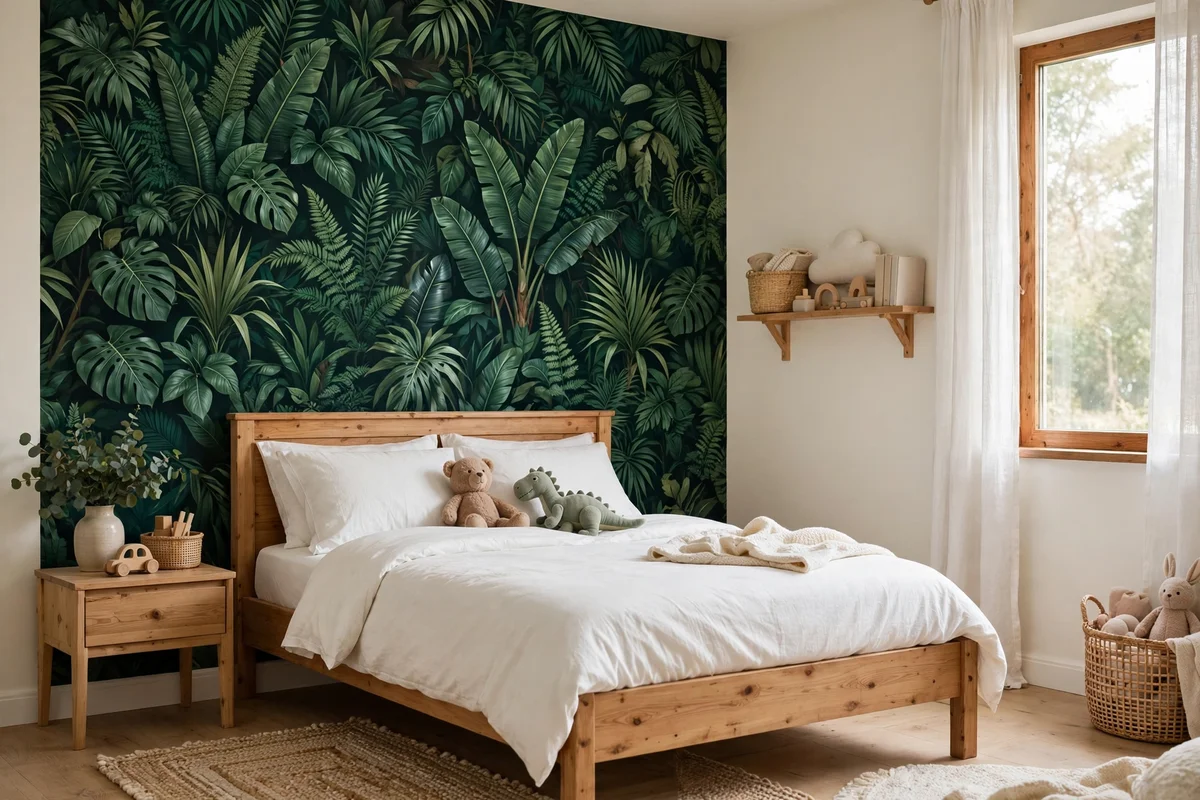
Wallpaper makes the biggest impact for the least painting skill, and one strip or one wall is all you need. A jungle print with large leaves softens a room, a tropical print with parrots and monkeys sharpens it, and a narrow vertical leaf pattern makes a low ceiling feel taller. Paste-the-wall wallpaper is the easiest type for a first attempt, and many modern wallpapers peel off cleanly, which matters in a child's room. Before you order, buy one roll and check the pattern repeat — a large animal motif may need more rolls than the coverage on the packet suggests, because you lose paper matching the pattern at each join. Apply it to the bed wall, and keep the other walls plain so the pattern has room to breathe.
3. Build a forest wall with decals and paint

A woodland wall works best as a combination: a painted band of trees along the bottom half of the wall, and removable decals of foxes, deer, rabbits, and owls above it. The painted band hides scuffs far better than white paint does — the lower half is the part that gets bumped by toys and feet — while the decals can be moved when the furniture moves. Put the largest animal at eye level from the bed, not up near the ceiling where it is hard to see, and cluster smaller decals around it rather than scattering them evenly across the wall. A cluster reads as a scene, while evenly spaced decals can look like a pattern that ran out of ideas. Keep a few spare decals in a drawer; when one peels at the corner, replacing it takes a minute, while re-sticking a peeling decal rarely holds.
4. Make an ocean wave wall
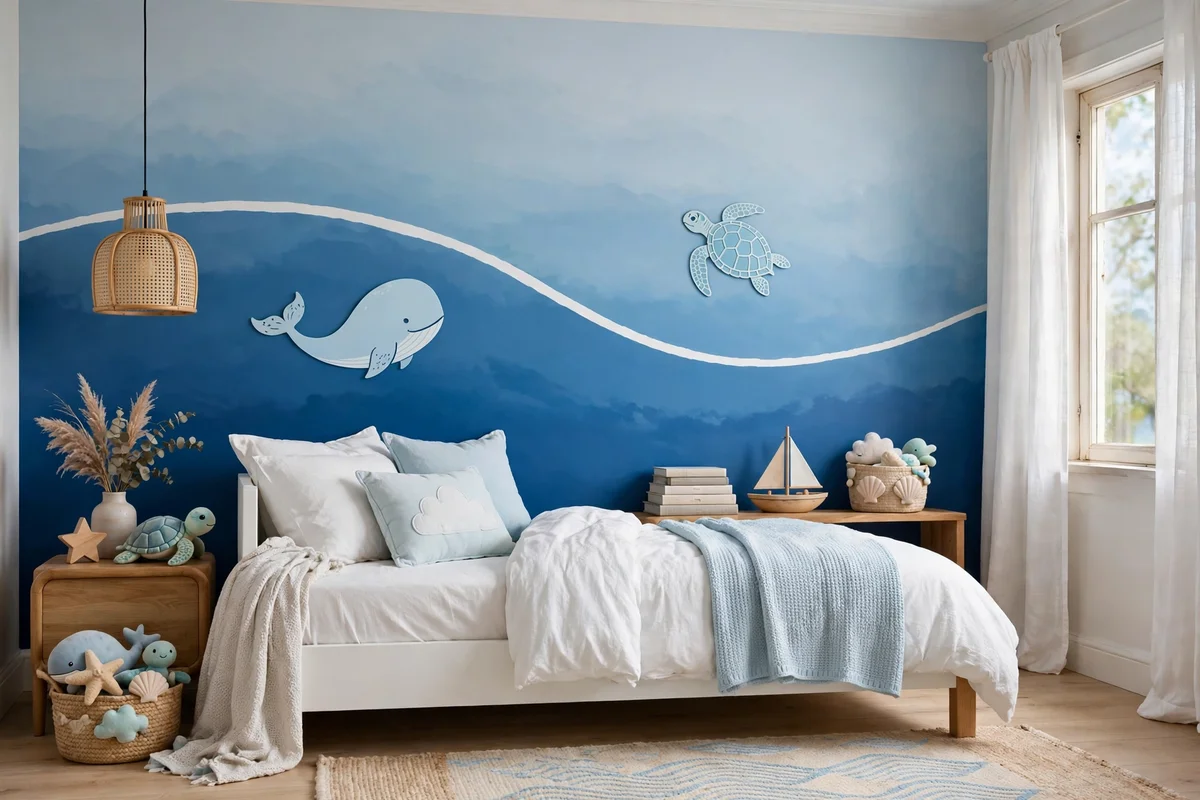
An ocean wall needs only two colours to work: a deep blue at the bottom fading into a pale blue at the top, with a white wave line where they meet. Paint the fade with a large roller and blend while the paint is still wet, working in sections so the join does not dry before you blend it. Add a few sea creatures as decals or simple painted shapes — a whale, a turtle, a school of small fish — swimming in the same direction, as if they are all travelling together. The direction matters: animals all facing the same way read as a journey, while animals facing random directions read as a jumble. Leave the wall behind the bed mostly plain blue above the wave, so the room feels calm at bedtime rather than busy.
5. Lay an animal footprint trail

Animal footprints add a playful detail that costs almost nothing. Use decals, a stencil, or a stamp to make a trail of paw prints across the floor or up one wall — lion paws leading to the bed, bear paws leading to the reading corner, or a mix of tracks leading to the toy storage. Children enjoy following the paths and imagining the animal that made them. Make the trail lead somewhere real, not just across a blank wall: footprints that end at the bookshelf or the tent feel like part of a story, while footprints that stop in the middle of nowhere feel like decoration that ran out of ideas. Keep the prints to one colour, darker than the wall or floor, so they read clearly without competing with everything else.
The bed
6. Let animal bedding do the theme work
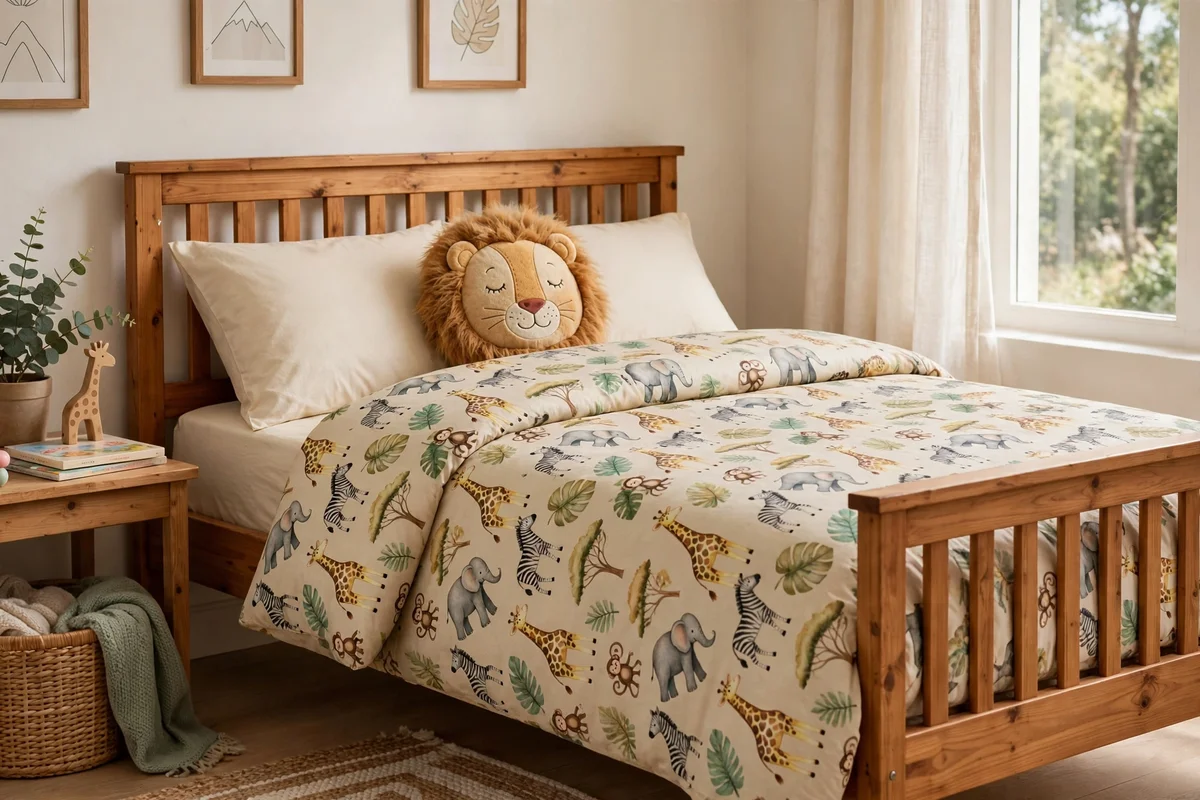
Bedding is the fastest animal change you can make, and the easiest to reverse. A safari-striped duvet cover, a woodland quilt with foxes and deer, or plain sheets in a habitat colour with an animal throw across the foot of the bed all work. The trick is to pick one animal piece and keep the rest plain: an animal-print duvet with plain pillowcases, or plain bedding with animal cushions. If everything on the bed is patterned, the animals fight with each other. Layering helps here — a flat sheet in one habitat colour, a throw in another, and a cushion shaped like an animal's face gives depth without clutter. Choose bedding you can wash often, because children's bedding gets washed more than any other textile in the house, and check that the colours are colourfast before the first wash by washing the pillowcase alone.
7. Add a jungle canopy over the bed
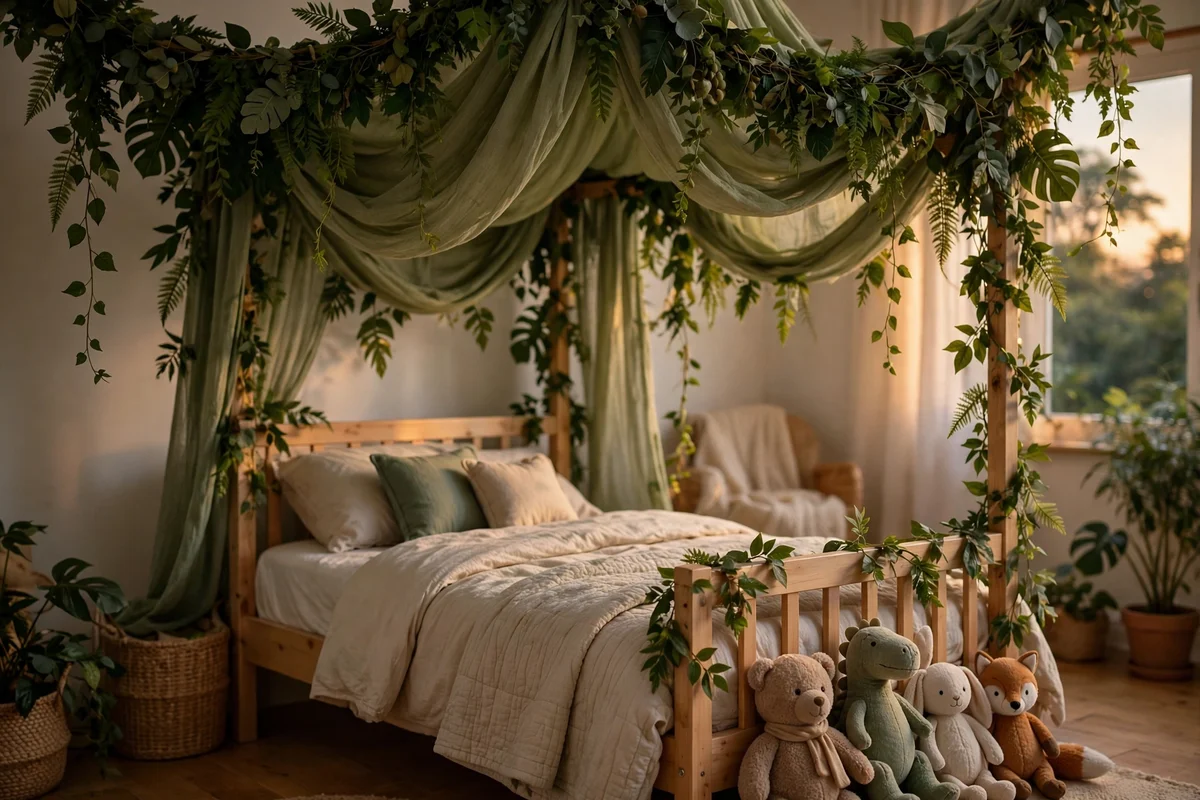
A canopy turns an ordinary bed into a hideaway, and in an animal room it reads as a jungle camp or a forest den. Green fabric, leafy garlands, or a plain white canopy with animal bunting all work. Hang it from a hoop or a ceiling hook above the bed, and let the fabric fall on two sides so the bed is sheltered but not enclosed — a child should be able to see out and you should be able to see in. Keep the fabric light and well away from any lamp or heater, and make sure it can be taken down and washed. If floor space is tight, a canopy is the better choice over a tent, because it uses no floor at all.
8. Choose a bed that looks like part of the habitat
A bed frame in natural wood suits every habitat, and it is the safest choice if you expect the theme to change. A house-shaped bed frame reads as a forest cabin, a low wooden frame with a canvas roof reads as a safari tent, and a white frame with blue bedding reads as a boat. You do not need a novelty bed to make the theme work — a plain wooden bed with the right bedding and a canopy does the same job for less money and lasts longer. If you do buy a themed bed, check the guard rails and the weight limit before you buy, and make sure standard bedding fits it, because unusual bed shapes often need unusual bedding. A bed that is hard to make in the morning is a bed that stays unmade.
The floor
9. Anchor the room with an animal rug
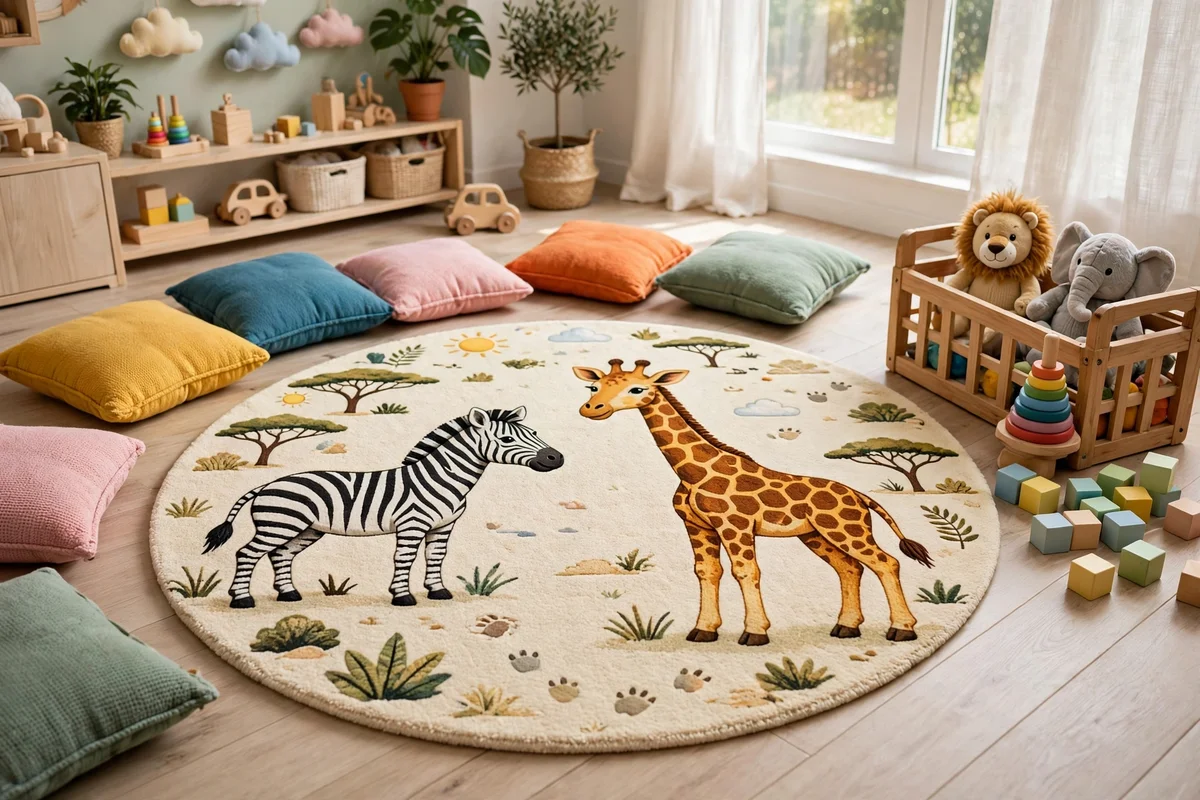
A rug does two jobs at once: it adds a large block of colour, and it marks out where play happens. A rug with a savanna scene, a round rug that looks like a pond, or a rectangular rug with a jungle border under the bed's foot or in the middle of the play area pulls the room together, especially when the walls are mostly plain. A round rug works well in a small room because it softens the corners, while a rectangular rug suits a long room. Choose a low-pile, washable rug — high-pile rugs trap crumbs and small toy parts, and a child's rug will be spilled on. Put a non-slip underlay underneath, even on carpet, because a rug that slides is a tripping hazard. If a full animal rug feels too much, a plain rug in one habitat colour, such as sage green or sandy beige, with animal cushions on top of it, gives you the theme without the pattern.
10. Add a wildlife adventure tent for play
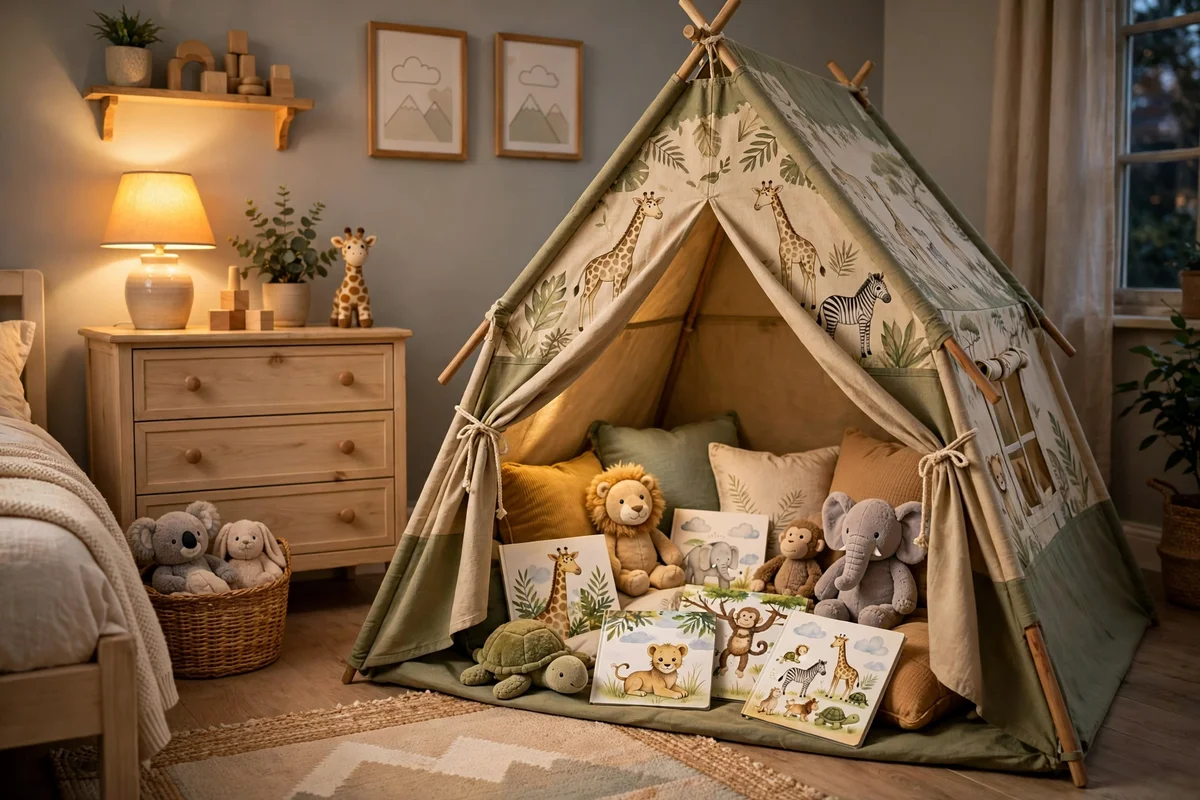
A small tent creates a dedicated imaginative play area, and in an animal room it becomes a safari camp, a forest den, or a ranger station. Fill it with cushions, animal books, and a few stuffed animals, and keep it in a corner where it does not block the door or the window. A tent with a roll-up door is easier to use than one with a fixed opening, because a child can see out and you can see in. Keep heavy toys out of the tent and light toys in, so nothing falls from a height when the tent is bumped. If floor space is tight, a canopy over the bed does the same job without taking up floor space, and a tent can wait until the room is bigger.
Storage that earns its theme
11. Tame the stuffed animals with a hammock and baskets
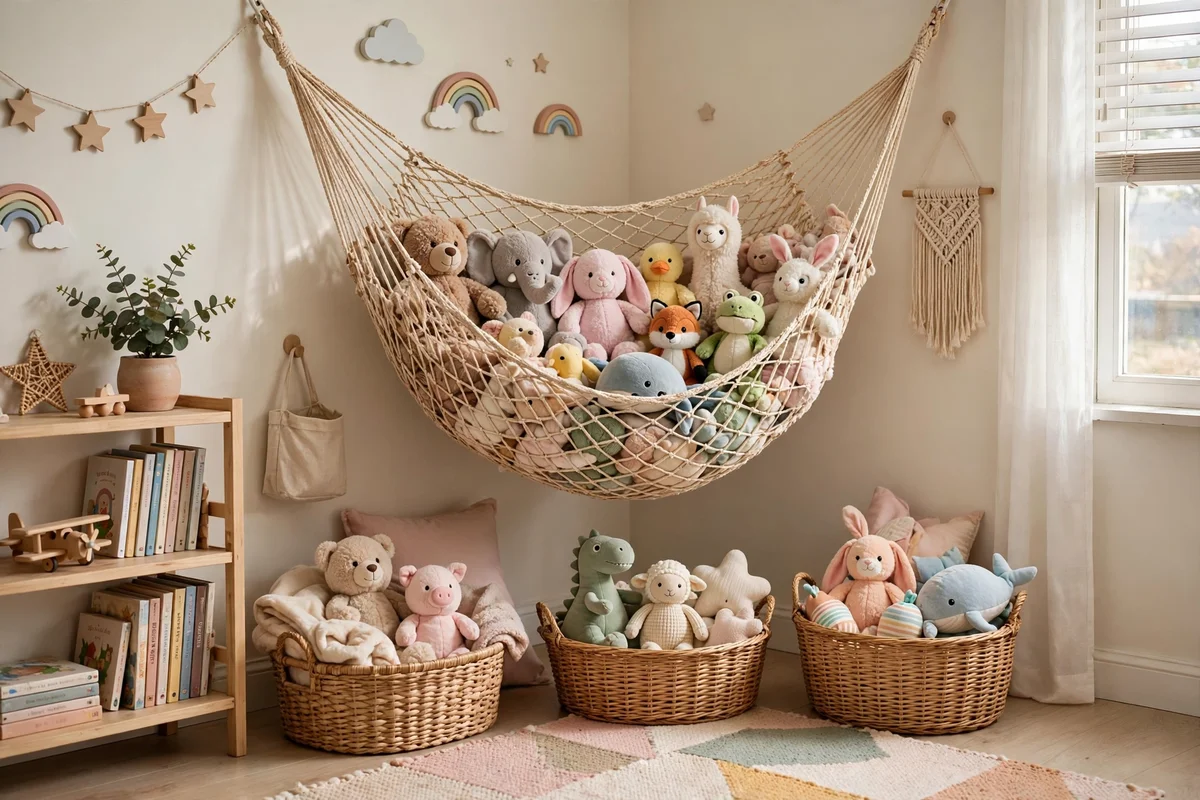
Stuffed animals are the one collection that grows faster than any storage plan. A corner hammock made from netting or fabric holds a surprising number of soft toys up high, where they are visible but out of the way, and a child can pull one down without emptying the whole collection. Underneath, use baskets — one for the animals currently in play, one for the rest. Animal-shaped storage baskets, such as a bear, a fox, or a lion, add to the theme while doing a real job. Keep the hammock at a height your child can reach, or the animals in it will never be played with. And set a simple rule with your child: when the hammock is full, one animal goes to a new home before a new one arrives.
12. Put collections on floating shelves
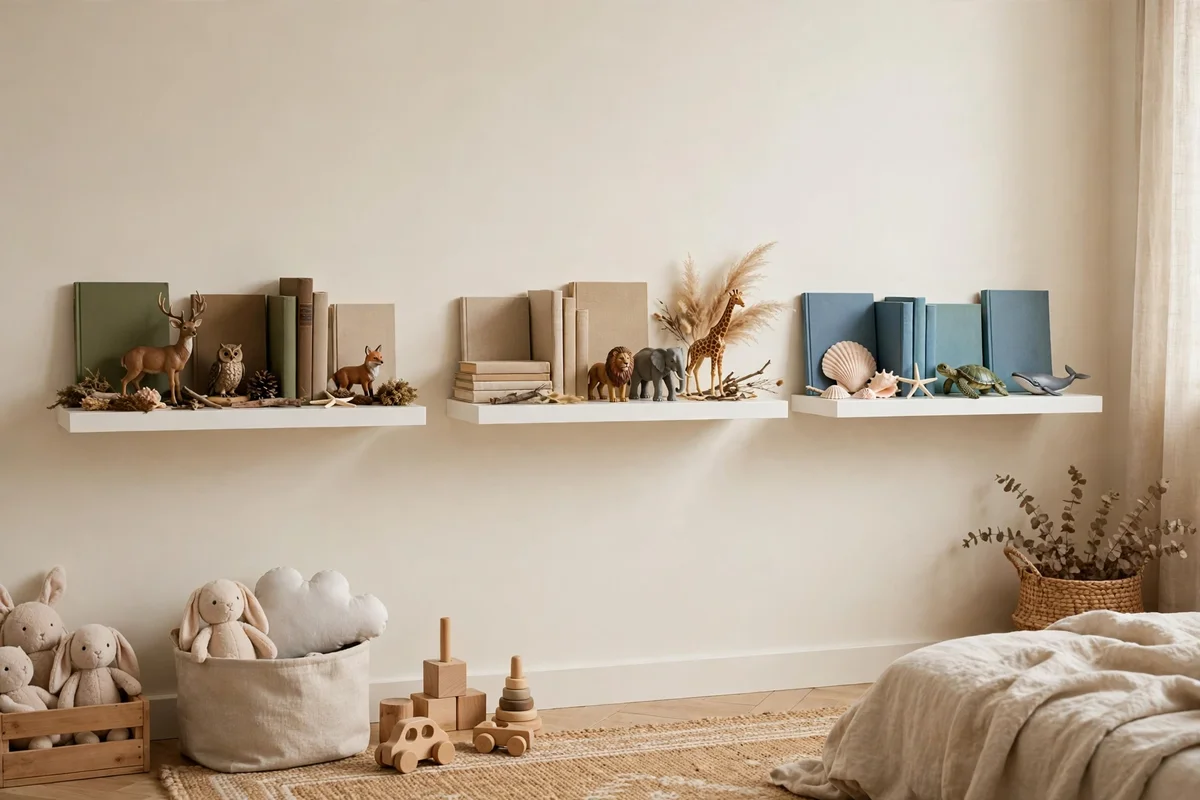
Many children collect animal figurines, shells, pinecones, and wildlife books. Floating shelves give those treasures a home while keeping surfaces clear. Put the shelves at your child's eye level, not adult eye level, so the collection belongs to them. Arrange the shelves by habitat or by animal type — all the sea creatures together, all the woodland animals together — rather than mixing everything, because a grouped display reads as a collection and a mixed display reads as clutter. Keep the heaviest items on the lowest shelf, and fix every shelf securely to the wall, because a shelf full of figurines is heavier than it looks. Leave one shelf empty, or half empty, so there is room for the next find.
13. Use animal-shaped storage for everyday toys
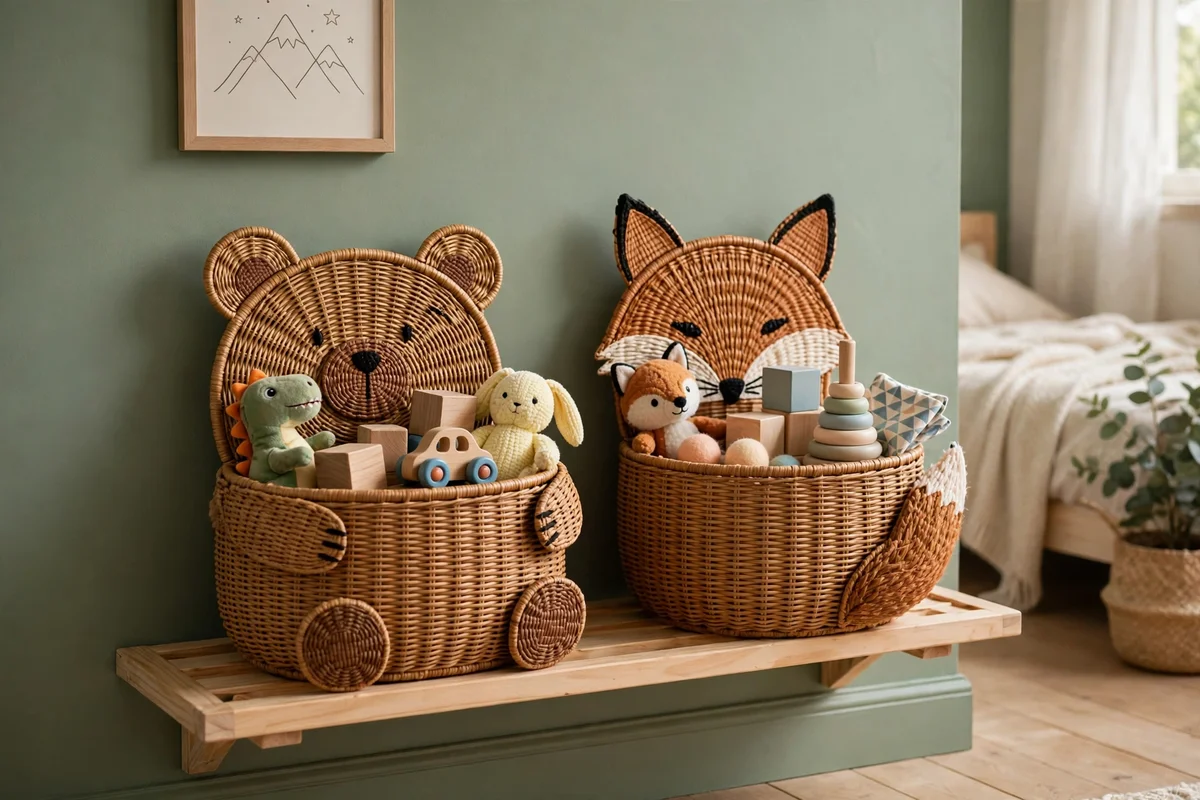
Storage can carry the theme without any extra decoration. Baskets shaped like bears, foxes, or lions, a toy chest painted with a jungle scene, or fabric bins in habitat colours all keep toys tidy while adding personality. Label each bin with a picture as well as a word for younger children, so tidying does not depend on reading. Open baskets on low shelves work better than lidded boxes for everyday toys, because a child can see what is inside and put it back without help. Keep the bins themselves in habitat order on the shelf — greens together, sands together — so the shelf looks planned even when the bins are full of different things.
Learning corners that make the room more than decoration
14. Build an animal reading nook
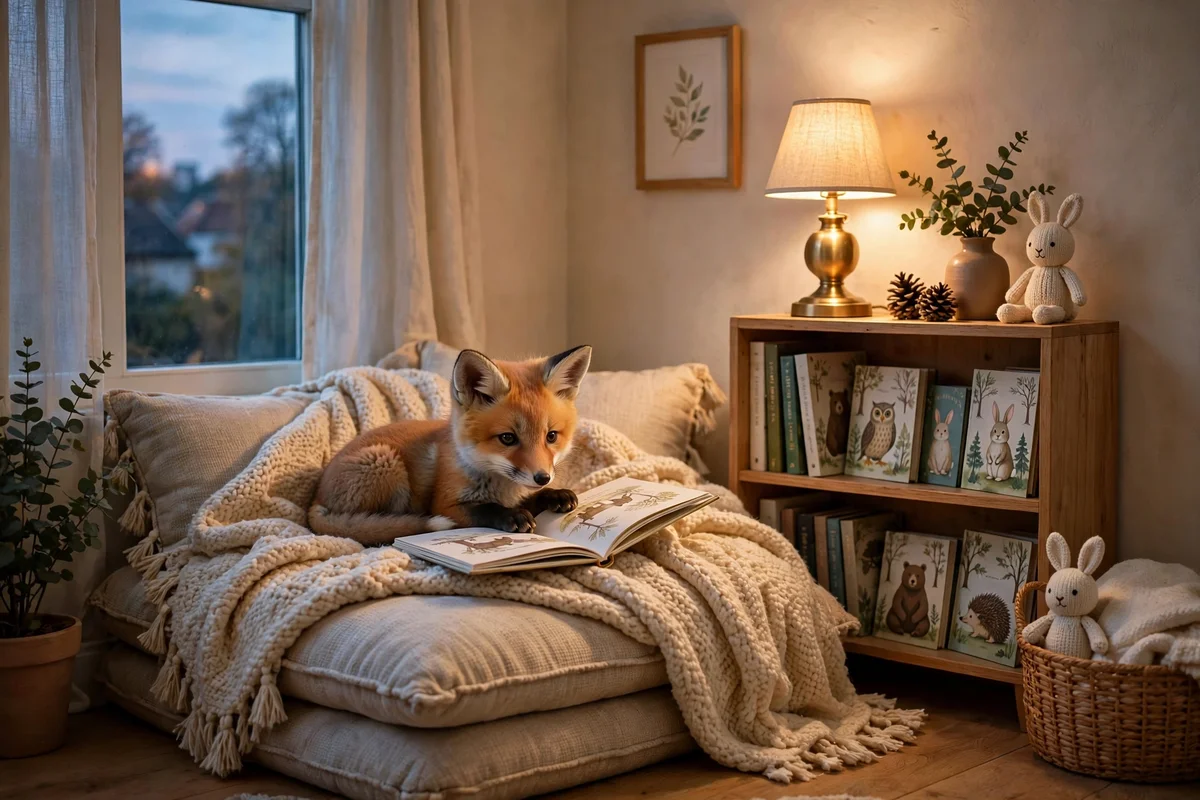
A reading nook needs only three things: something soft to sit on, light to read by, and books within reach. A corner of the room with a floor cushion, a small bookshelf of animal stories and nature guides, and a lamp does the job. A painted arch or a canopy above the nook marks it out as its own place, even in a small room. Add a small basket for the book currently being read, and keep the book selection small and rotated: ten books on the shelf, swapped every few weeks, get read more than fifty books crammed together. A reading nook also gives the stuffed animals a job — they sit in the nook as the audience for story time, which keeps them off the bed and the floor.
15. Set up a wildlife explorer station
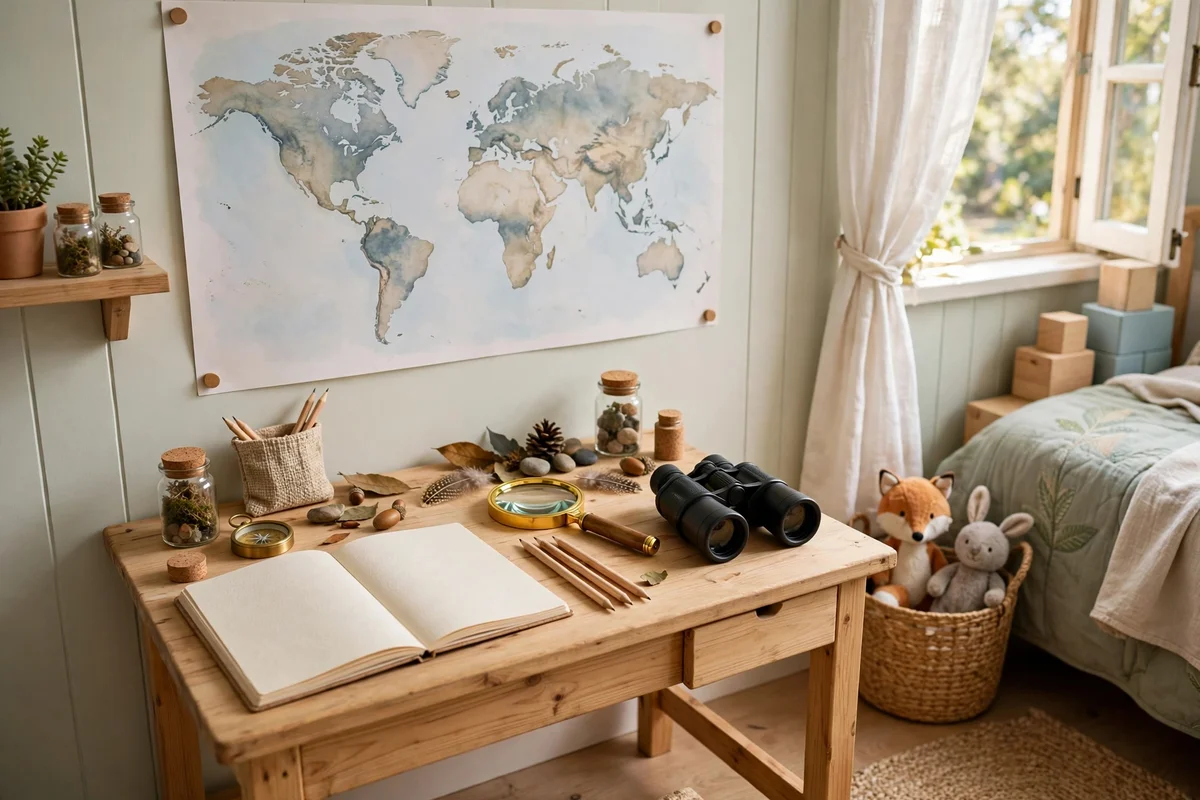
Many children who love animals also love learning about them. A small desk or table with wildlife books, a world map, drawing supplies, and a magnifying glass becomes an explorer station. Add a notebook for recording what they see — birds from the window, bugs in the garden, animals in books — and the station turns a bedroom into a place where curiosity has somewhere to go. Keep the supplies visible rather than hidden in drawers: children use what they can see. A corkboard above the desk for maps, drawings, and facts keeps the wall useful, and a small shelf for a globe or a pair of binoculars makes the station feel like a real base camp.
16. Hang a wildlife map on the wall

A world map showing where animals live is decoration and education in one piece. Hang it where your child can reach it, and add small stickers or pins for each animal's home — a lion in Africa, a panda in China, a kangaroo in Australia, a polar bear in the Arctic. As your child learns about a new animal, finding its home on the map becomes a small ritual. Choose a map with clear, friendly illustrations rather than a dense political map, because a map a child cannot read is decoration for adults, not for them. A map also solves the problem of what to put on a long empty wall, because it fills the space without needing a dozen small frames.
17. Create a zoo display area
A zoo display is a shelf or a low table where animal figurines, books, and maps are arranged by habitat or by animal type. It works best when it is small and specific — one shelf for savanna animals, one for ocean animals — rather than a whole room of figurines. Rotate the display every few weeks: the animals on display change, the ones in storage come out, and the room feels new without any shopping. A zoo display can grow as new interests develop, and it gives a child a reason to care for their collection, because the display is theirs to arrange. Keep the display at child height, and keep a small basket nearby for the animals that are currently in play, so the display does not get emptied every afternoon.
Light and air
18. Use nature-inspired lighting
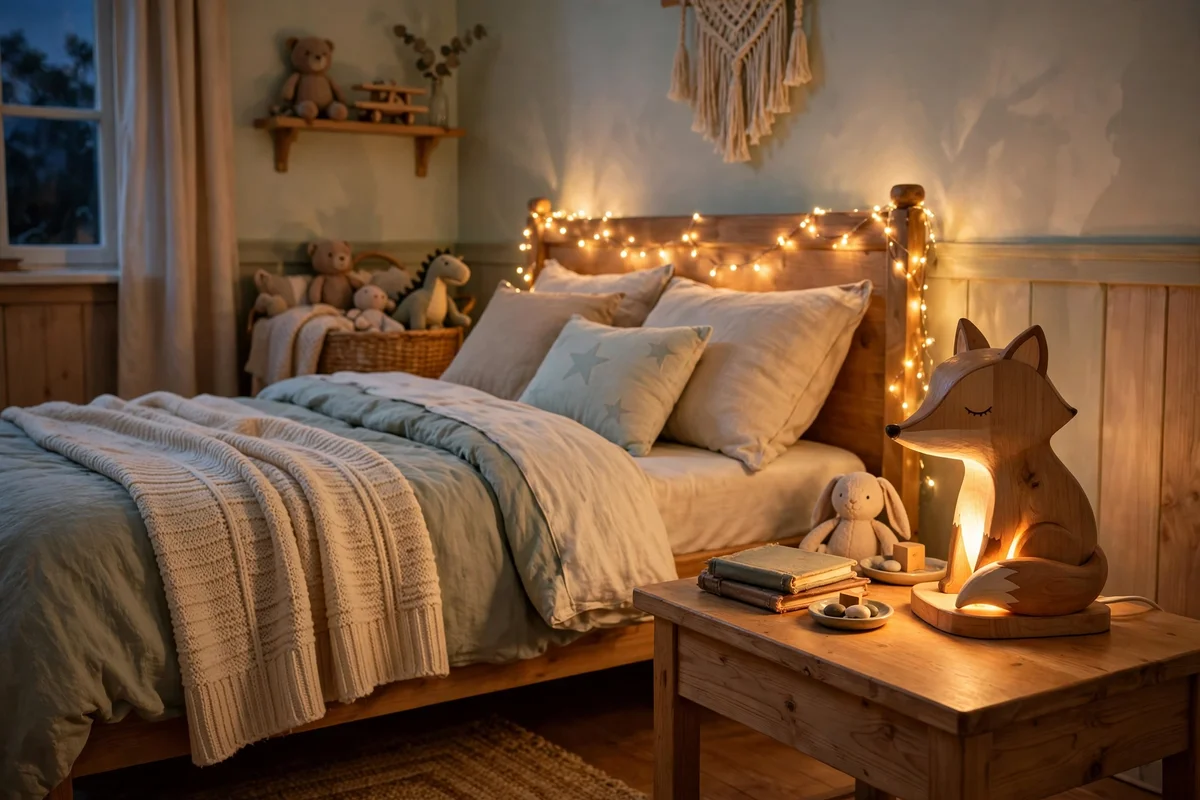
Lighting is what turns an animal room from a daytime playroom into a calm bedroom in the evening. A lamp with a wooden base, a leaf-shaped shade, or an animal motif — a fox, an owl, a giraffe — adds to the theme without adding clutter. Warm white light suits bedtime better than coloured bulbs, which can make the room feel like a party when it should feel like winding down. A string of warm white fairy lights around the bed frame or the reading nook adds a soft glow, and a nightlight shaped like a moon or a firefly helps younger children settle. Keep cords and battery packs out of reach of younger children, and use a timer plug or a lamp with a built-in timer so the lights go off by themselves.
19. Add a nature art gallery

Turn one wall into a wildlife art display. Frame animal illustrations, nature sketches, photographs, and your child's own drawings in matching frames — same frame colour, different art inside — and leave empty space for new work. A simple clip frame or a magnetic poster hanger lets you swap art without tools. Arrange the frames on the floor first, take a photo of the arrangement you like, and then hang them using the photo as a guide. Keep the frames at your child's eye level, not adult eye level, so the wall belongs to them. A gallery wall also solves the problem of what to do with school art: instead of a pile on top of the wardrobe, the best pieces go on the wall and the rest go in a folder.
20. Let the room breathe with plain space
The last idea is the one that makes all the others work: leave some of the room plain. One plain wall, a clear patch of floor, and a shelf with nothing on it give the animals room to stand out. A room where every surface is decorated is a room where nothing stands out, and it is also a room that is hard to tidy, because there is nowhere to put anything down. Plain space is not unfinished space. It is the part of the room that lets a child play, build, and spread out a puzzle without moving decoration out of the way first. If the room feels busy, remove one thing before you add anything else — the answer is almost always less, not more.
A Weekend Plan: Friday, Saturday, Sunday
An animal room does not need a month of planning. It needs a clear order, because painting before you have measured, or buying bedding before you have chosen a habitat, creates the rework that eats weekends.
On Friday evening, decide the habitat and measure the feature wall. Take the swatches home, look at them in daylight and lamplight, and pick your three habitat colours. Measure the wall, note the sockets and switches, and make a list: paint or wallpaper, bedding, rug, storage baskets, and any one piece of furniture to paint. Order or buy only what is on that list.
On Saturday, do the messy work. Move the furniture away from the feature wall, protect the floor, and paint the mural or the wave wall — or hang the wallpaper. While the paint dries, paint the furniture piece outside or in a ventilated space. Wash the new bedding and cushion covers so they are ready for Sunday. Do not try to hang art or arrange shelves while paint is wet; it will get marked.
On Sunday, put the room back together in this order: bed and bedding first, then the rug, then storage and shelves, then the reading nook and explorer station, then wall art and decals last. Art goes last because it is the easiest thing to move, and you will only know where it belongs once the furniture is in place. Finish by walking to the door and looking at the room as a visitor would — the view from the door is the view that matters most, because it is the one you see every day.
Small Rooms and Shared Rooms
A small room needs the habitat to work harder and take up less space. Use the theme on things that already have to be there: the bedding, the curtains, the storage baskets, and one painted mural or one strip of wallpaper behind the bed. Skip the tent, the large rug, and the gallery wall — in a small room, those three eat floor and wall space that the room cannot spare. A round rug instead of a rectangular one, a wall-mounted bookshelf instead of a standing one, and a canopy instead of a tent all save space while keeping the animals. A mirror opposite the window bounces light around a dark corner. Keep at least one wall completely plain, so the room has somewhere for the eye to rest.
A shared room needs a habitat both children can live with, and a way for each child to have their own animal inside it. The woodland habitat works well here, because it is the calmest of the four and the least likely to feel like one child's taste imposed on the other. Give each child one signature animal — one child's bedding with foxes, the other's with bears, for example — while the shared parts of the room, the rug, the curtains, and the storage, use the full habitat. If the beds are on opposite walls, each bed wall can carry its own small feature in that child's colours, with the shared wall kept neutral. Colour-coded storage earns its keep twice over in a shared room: each child's bins in their own colour end most arguments about whose toys are whose. And keep the layout symmetrical where you can — matching beds, matching lamps, matching shelves — because symmetry makes a shared room feel fair even when the animals differ.
Animal Rooms by Age
A nursery animal room should be soft and low. Pastel or muted habitat colours, a mobile with gentle animals over the cot, soft bedding, and a few framed prints are enough. Keep the wall behind the cot plain or very pale, because strong colour behind a baby's head is stimulating at exactly the time you want calm. Everything within reach of the cot should be washable, and anything hung above it should be fixed securely.
A toddler room can be bolder, because toddlers use the room for play as much as sleep. Low furniture, a floor bed or a low bed with a mural behind it, animal baskets at floor level, and a reading corner with floor cushions suit this age. Keep the habitat to the same three colours, but let the toddler choose between two animals — "lion bedding or giraffe bedding?" — rather than facing the whole habitat at once. That choice is enough to make the room feel theirs.
A school-age child's room can carry the strongest version of the theme, because the child can tell you what they like and what they have outgrown. This is the age for the explorer station, the wildlife map, the zoo display, and the gallery wall with their own art. It is also the age to start planning the exit: a school-age child who loves lions now may not at twelve, so keep the expensive parts — the mural, the wallpaper, the painted furniture — to one wall and one piece, and let the rest be bedding and art that can change in an afternoon.
Budget: Three Price Levels
An animal room does not have to be expensive. The difference between the three levels below is how much is painted and how much is swapped, not how wild the result is.
A refresh under $50 uses what you already have: sort the books by habitat, move the toys onto open shelves in habitat order, swap two cushion covers, add a set of removable decals, and hang a print you already own or print at home. The room changes without any paint or new furniture, and it takes an afternoon.
A mid-level refresh, roughly $50 to $200, adds the pieces that make the biggest difference: animal bedding, a washable rug, a set of animal-shaped storage baskets, and paint for one mural or one piece of furniture. This is the level most families choose, because it changes the room properly without changing the furniture.
A full redo, $200 and up, adds wallpaper or a full mural on the feature wall, a themed bed frame or a painted dresser, new curtains, and lighting. This is worth doing when the room is being redecorated anyway — new bed, new flooring, or a move — rather than as a standalone project. If you are spending at this level, spend it on the things that are hardest to change later: the wall finish and the furniture. Bedding and art can always be upgraded later, one piece at a time.
Whatever the budget, buy the rug and the bedding after you have chosen the paint, not before. Paint comes in thousands of shades and bedding in dozens, so it is easier to match bedding to paint than paint to bedding.
Mistakes That Make Animal Rooms Feel Messy
The most common mistake is mixing habitats. A lion cushion, a shark poster, a fox rug, and a penguin lamp in one room look busy, because each animal brings its own colours with it. One habitat leading, with at most two visiting animals as small accents, looks planned. If the room feels chaotic, count how many habitats are in it. Any habitat that appears only once is a candidate to remove.
The second mistake is matching everything exactly. Animal bedding, an animal rug, animal curtains, and an animal wall all in the same print fight each other. Pick one patterned piece — the bedding or the rug — and keep the rest solid colours drawn from the same habitat. Solid colours let the pattern breathe.
The third mistake is forgetting storage. A wildlife room with nowhere to put toys is a wild mess by Tuesday. Stuffed animal storage, a bookshelf, and a toy chest need to be part of the plan from the start, not added after the decorating is done. A good rule is that every toy should have a home a child can reach without help; if it does not, the storage is in the wrong place or there is not enough of it.
The fourth mistake is decorating at adult eye level. Art hung too high, shelves a child cannot reach, and a reading nook built for an adult all make the room look good in photos and work badly in real life. Hang the gallery wall and the hooks at your child's height, and test every shelf by asking your child to reach it.
The fifth mistake is ignoring the light. A jungle palette in a dark, north-facing room can feel heavy, and a safari palette in a bright, south-facing room can look washed out. If the room feels wrong and you cannot say why, the light is usually the reason. Swapping a deep green for a lighter shade of the same colour, or adding a warm lamp, often fixes it without redecorating.
How to Let the Room Grow Up With Your Child
The best animal rooms are built to be undone in stages. When your child outgrows the theme, change the cheap things first: swap the bedding for a solid colour, take down the decals, replace the animal prints with new art, and change the cushion covers. That alone removes most of the animals, and the room will already feel older.
If that is not enough, repaint the feature wall in a single colour drawn from the old habitat — sage green, warm sand, or soft blue — and keep the painted furniture, which will now look like a single accent piece rather than part of a theme. The storage baskets can stay, because animal-shaped storage is useful at any age, and the bookshelf organised by habitat still looks good when the books themselves have changed.
The expensive reversals are the mural and the wallpaper, which is why they belong on one wall only. A single wall can be repainted in a day; four walls cannot. If you think the room will need to change within two years, choose decals over wallpaper and a painted mural over a full wallpapered room. Future you will be grateful.
Frequently Asked Questions
What animals work best in a kids bedroom theme?
The animals that work best are the ones your child already loves, grouped into one habitat. Lions, elephants, giraffes, and zebras suit a safari room; monkeys, tigers, and parrots suit a jungle room; foxes, bears, deer, and owls suit a woodland room; whales, dolphins, and turtles suit an ocean room. The habitat matters more than any single animal, because it is what keeps the colours and the art consistent. If your child's favourite animal does not fit the habitat you chose, let it visit as a small accent — a cushion or a bookshelf figure — rather than making it a second theme.
How do I do an animal room in a rental?
Use removable decals instead of paint or wallpaper, animal bedding and a rug instead of a feature wall, and animal-shaped storage instead of painted furniture. A canopy over the bed, a gallery wall hung with removable hooks, and a tent in the corner all add animals without touching the walls. When you move out, the decals peel off, the hooks come down, and the bedding and rug move with you.
Is an animal room too stimulating for bedtime?
It can be, if the brightest animals are right behind the bed and the lighting is bright white. Keep the boldest animal art on the wall your child faces when they wake up, not the wall behind their head, use warm white lamps in the evening, and keep the bedding calmer than the walls — plain sheets with a single animal throw, rather than a full animal-print duvet. A consistent wind-down routine matters more than any single animal choice, and a room that is tidy at bedtime feels calmer than a wild room that is not.
What age is an animal themed bedroom best for?
It works from nursery to about age ten, with the habitat changing as the child grows: soft woodland colours for a nursery, brighter safari and jungle colours for toddlers and younger school-age children, and muted or realistic wildlife art for older children who want animals without a theme that feels young. After that, the same habitat can stay in a more grown-up form — one painted piece of furniture, animal-shaped storage, and wildlife photography — without the room reading as a themed children's room.
How much does an animal themed bedroom cost?
A refresh using what you already own can cost under $50. A mid-level refresh with new bedding, a rug, storage baskets, and paint for one wall or one piece of furniture usually falls between $50 and $200. A full redo with wallpaper or a mural, a themed bed frame, curtains, and lighting costs $200 and up. The cheapest way to start is with bedding and decals, because both can be changed in an afternoon if the habitat does not work.
Final Checklist Before You Buy Anything
- Pick one habitat — safari, jungle, woodland, or ocean — and write down your three habitat colours.
- Ask your child to name their three favourite animals, and check they live in the same habitat.
- Measure the feature wall, note the sockets and switches, and check the wall is straight.
- Look at your swatches in daylight and under the bedroom lamp at night.
- Count how many times each habitat colour will appear, and make sure every colour appears at least twice.
- Check that the rug has a non-slip underlay and that tall furniture will be anchored to the wall.
- Choose washable paint and washable fabric for everything a child can reach.
- Buy the paint first, then match the bedding and rug to it.
- Leave one wall plain, and leave some open floor space.
An animal themed bedroom does not need to be perfect, and it does not need to be finished in one go. Start with the habitat and the one wall, add the bedding and the storage, and let the reading corner and the explorer station grow over time. The rooms that children love most are rarely the ones with the most animals — they are the ones where the animals have a home, the toys have a home, and there is a comfortable corner to sit in. Get those three things right, and the wildlife takes care of itself.

1 comment