
Accent Wall Ideas For Kids Rooms
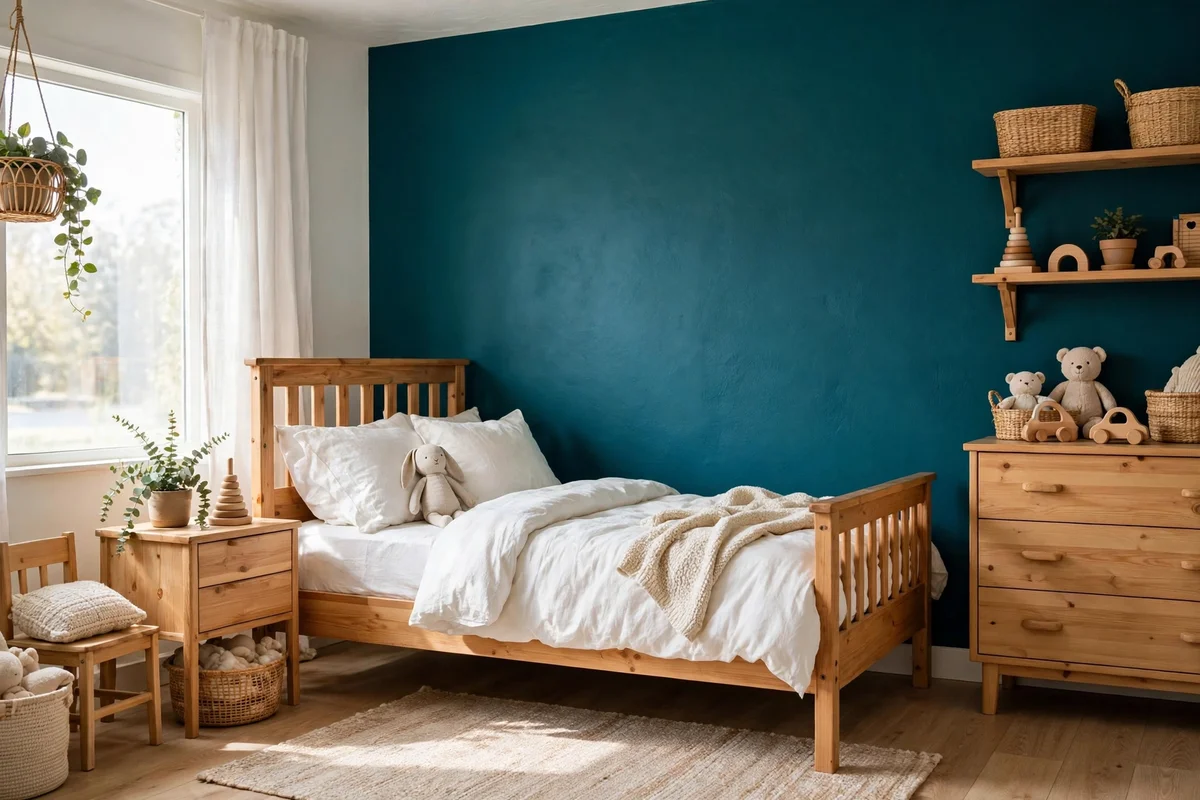
One wall can do the work of a whole redecoration. Paint it, paper it, or cover it in wood slats, and the room suddenly has a focal point, a personality, and a backdrop that makes everything else in it look intentional. The other three walls can stay plain, the furniture can stay exactly where it is, and the room still feels transformed. That is the whole appeal of an accent wall, and it is why it is usually the first thing worth doing in a kids room that feels flat or unfinished.
The short version: pick the wall behind the bed, or the wall your child faces when they wake up. Choose one finish — paint, peel-and-stick wallpaper, a mural, wood slats, or decals — and one colour family, then repeat that colour twice more in the room so the wall does not look stranded. Do the messy work on a Saturday, put the room back together on Sunday, and leave the other walls alone. The ideas below are arranged in the order most parents actually use them: how to choose the wall first, then the finishes, then the ideas grouped by technique, then the practical parts — small rooms, shared rooms, ages, budgets, and the mistakes that make an accent wall look wrong.
How to Choose the Right Wall
An accent wall only works if it is the right wall. The best candidate is usually the wall behind the bed, because the bed is the biggest piece of furniture in the room and the wall behind it is the first thing you see from the door. A bold colour or pattern there frames the bed the way a picture frame frames a photo, and it gives the whole room a centre. If the bed wall has a window, a radiator, or a built-in wardrobe in the way, the wall opposite the bed is the next best choice — it is the wall your child looks at from bed, so it suits a gallery wall, a mural, or a reading corner backdrop.
The wall with the door is usually the worst choice. It gets interrupted every time someone walks in, and the door itself cuts the design in half. The wall beside the bed can work for a narrow feature — a strip of wallpaper, a row of shelves, a half-height paint band — but a full pattern there can feel like it is pressing in on the sleeper. Before you commit, stand in the doorway and look at each wall in turn. The wall that reads as a single clear rectangle from the door, with the fewest interruptions, is your accent wall.
Measure it before you buy anything. Write down the width and the height, note where the sockets, light switches, and skirting boards sit, and check whether the wall is straight by holding a long spirit level against it. Older houses often have walls that lean slightly, which matters for wallpaper and for straight painted stripes — a stripe that starts level at the skirting board and drifts by a centimetre at the ceiling will be visible. A tape measure and ten minutes now save a second trip to the shop later, and they tell you exactly how much paint or how many rolls of wallpaper to buy.
One Wall, One Finish, One Colour Family
Three decisions keep an accent wall from looking like a mistake. First, one wall only. Two accent walls compete with each other, and the room loses its focal point. If you are tempted to do a second wall, use a much quieter version of the same idea there — a solid colour pulled from the wallpaper, or a single shelf in the same wood — so the second wall echoes the first instead of shouting over it.
Second, one finish. Paint plus wallpaper plus wood slats on the same wall is three ideas fighting for attention. Pick the finish that suits your skill, your budget, and how long you want the look to last, and let that one finish carry the wall. The other elements — the art, the shelves, the lighting — sit on top of the finish, not alongside a second one.
Third, one colour family. The accent wall should share its colours with the rest of the room. A deep blue wall works when the bedding has blue in it, the rug has a blue stripe, or the storage bins are blue. A green wall works when the curtains or the cushions pick up the same green. When the wall's colour appears nowhere else in the room, it looks like a sample that escaped. Repeat the main colour at least twice more, in two different materials — fabric, wood, paper, or paint — and the room will read as a plan.
A useful test before you buy: gather the items you already own that will stay in the room — the bedding, the rug, the curtains — and hold paint swatches or a wallpaper sample against them in daylight and again under the bedroom lamp at night. Colours shift more between those two lights than most people expect. A sage green that looks soft in the shop can turn grey at night, and a navy that looks rich in daylight can turn almost black under a warm bulb. If a swatch looks wrong in either light, pick a different shade of the same colour rather than a different colour altogether.
Paint, Paper, Wood, or Decals: Which Finish Lasts?
The finish you choose decides how much skill the job needs, how long it takes, and how easy it is to undo. Paint is the cheapest and the most forgiving. A tin of washable emulsion, a roller, and a roll of painter's tape can change a wall in an afternoon, and if the colour is wrong you can paint over it the next weekend. Paint suits bold colour, geometric patterns, half-wall designs, and murals painted with tape as a guide. Its weakness is that it shows every bump and crack in the wall underneath, so a rough wall needs filling and sanding first.
Peel-and-stick wallpaper is the easiest way to get a pattern you could never paint. Florals, animals, stars, maps, and geometric prints all come ready-made, and the paper peels off cleanly when your child outgrows it, which matters in a kids room and even more in a rental. It suits one-wall patterns and murals printed as a single scene. Its weakness is cost — it runs more per square metre than paint — and it needs a smooth, clean wall to stick properly. Dusty or textured walls make the edges lift.
Wood slats and moulding add texture rather than colour. Thin vertical battens, painted the same colour as the wall or left in natural wood, give a plain wall architectural interest without any pattern at all. Decorative moulding — rectangles of trim fixed to the wall and painted over — does the same thing in a more traditional style. Both suit rooms where you want the wall to feel custom and calm rather than loud. Their weakness is the fitting: slats need to be cut straight and fixed level, and moulding needs mitred corners, so both take longer than paint and are harder to remove.
Decals are the no-commitment option. Stars, animals, rainbows, maps, and geometric shapes stick on, peel off, and move when the furniture moves. They suit renters, younger children whose tastes change fast, and anyone who wants to test an idea before committing to paint or paper. Their weakness is scale: decals work best as a cluster or a border, and covering a whole wall with them can look patchy and cost more than a roll of wallpaper.
| Finish | Best for | Skill needed | Easiest to undo |
|---|---|---|---|
| Paint | Bold colour, geometric patterns, half-walls, murals | Low — roller and tape | Paint over it in a day |
| Peel-and-stick wallpaper | Patterns and printed murals | Low — measure and smooth | Peels off cleanly |
| Wood slats / moulding | Texture and a custom, calm look | Medium — cutting and levelling | Needs filling and sanding |
| Decals | Renters, testing an idea, small clusters | Very low — peel and stick | Peel off in minutes |
If you cannot decide, ask how long the look needs to last. Less than a year, or a rental: decals or peel-and-stick. Two to three years: paint. Five years or more: wood slats, moulding, or a painted mural, because those are the finishes that still look good when the child who chose them is several years older.
18 Accent Wall Ideas For Kids Rooms
Paint
1. Paint a bold colour feature wall
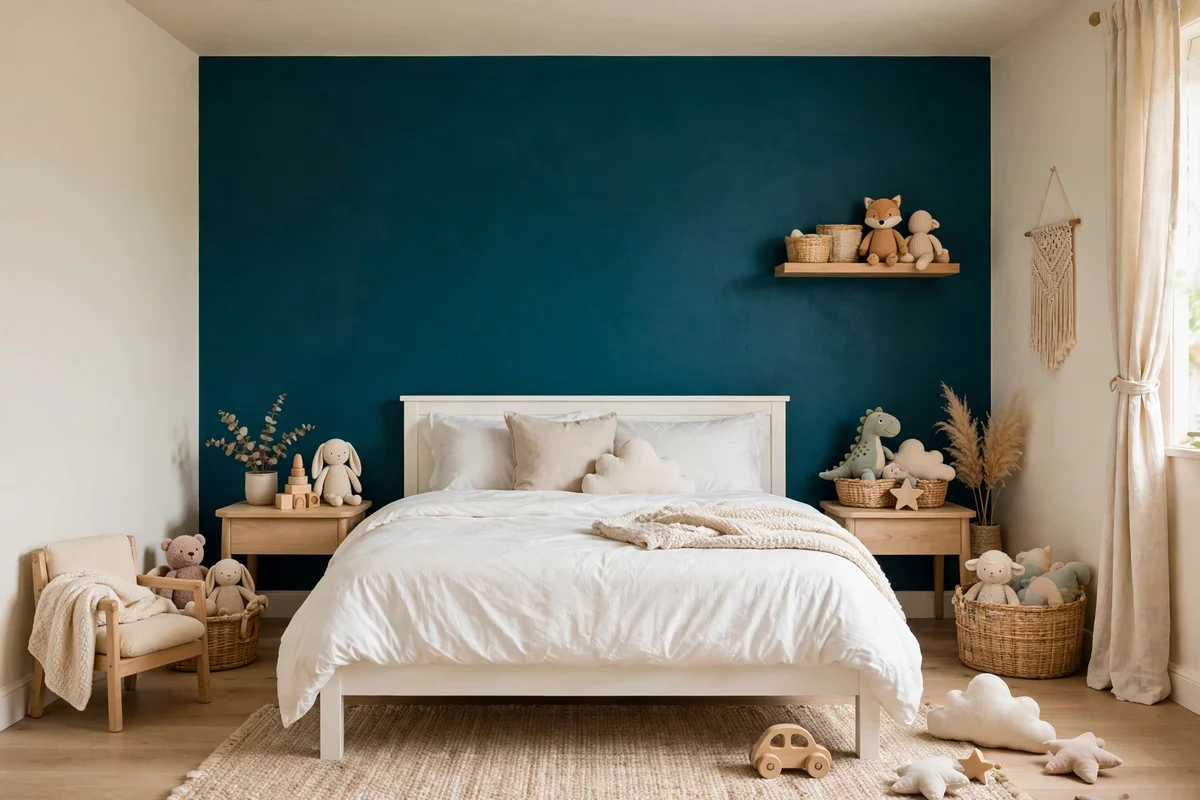
A single wall in a deep, confident colour is still the simplest accent wall there is, and it is the one most rooms need. Deep blue, forest green, terracotta, dusty rose, or a rich mustard each change the mood of a room in a different way: blue calms it, green steadies it, terracotta warms it, mustard wakes it up. Choose the colour from something already in the room — the bedding, a favourite toy, a book cover your child loves — rather than from a paint chart alone, because a colour that already belongs to the room will always look more intentional than one chosen in isolation. Use a washable, low-sheen emulsion, because a wall behind a bed gets touched, leaned on, and bumped by pillows. Paint two thin coats rather than one thick one, and let the first coat dry fully before the second, or the finish will drag and show roller marks. Keep the other three walls white or warm cream, and repeat the accent colour twice more in the room — a cushion and a storage bin, or a rug stripe and a lampshade — so the wall has company.
2. Paint a half-wall design

A half-wall — the lower half painted, the upper half left white or pale — gives a room colour without the weight of a full wall of it, and it suits small rooms and minimalist bedrooms better than almost any other idea. It also has a practical advantage: the lower half of a wall is the part that gets scuffed by toys, shoes, and feet, and a painted band hides scuffs far better than white paint does. Mark the line with a spirit level and painter's tape, and paint up to the tape in one session so the edge stays crisp. A chair rail, a thin strip of wood trim, or a simple painted line in a second colour can finish the edge, but the clean tape line on its own is enough. This design works with any colour, but it looks best in a mid-tone — sage, dusty blue, warm clay — rather than a very dark shade, which can make the lower half of the room feel heavy. Pair it with plain bedding and let the wall do the colour work.
3. Create a geometric pattern with tape
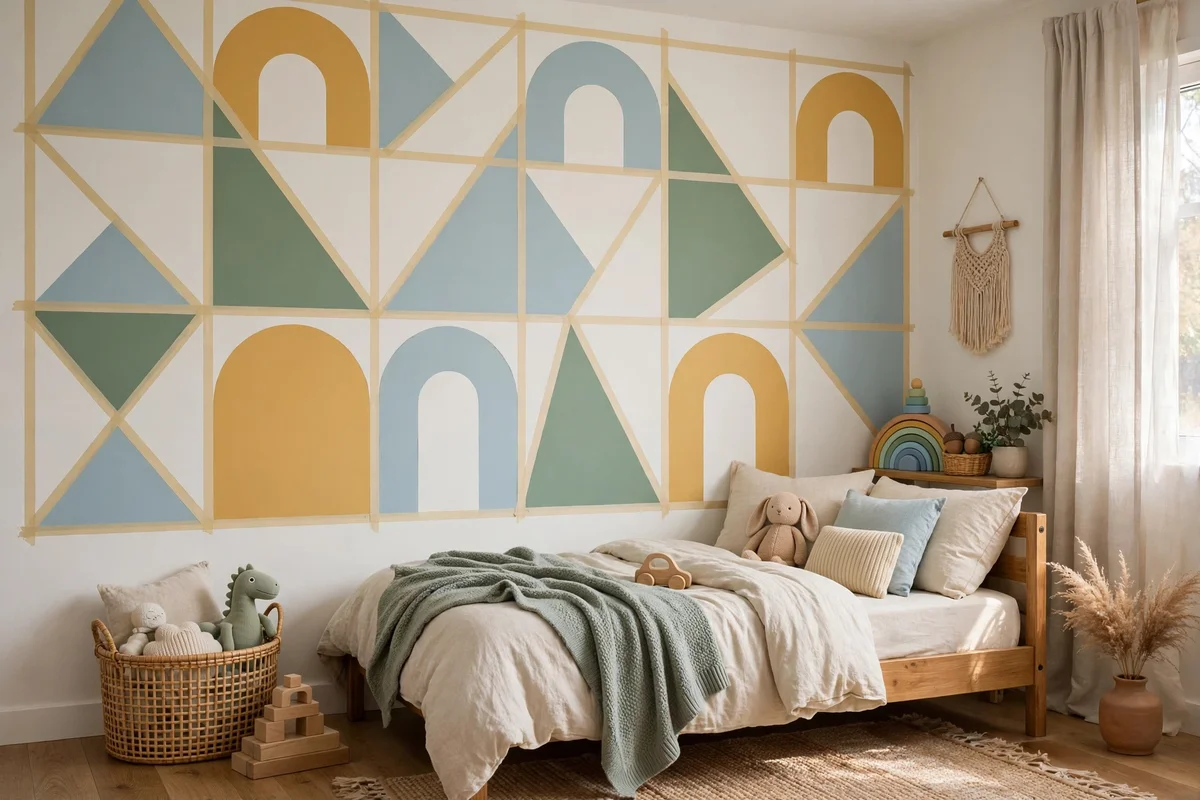
Geometric patterns — triangles, arches, stripes, colour-blocked shapes — give you the impact of a mural without needing any drawing skill. A roll of painter's tape, a spirit level, and two or three colours are all you need. Start by sketching the pattern on paper at a small scale, then mark the key points on the wall in pencil: the peaks of mountains, the centres of arches, the lines where stripes begin and end. Tape along the pencil lines, press the tape down firmly so paint cannot bleed underneath, and paint one colour at a time, peeling the tape off while the last coat is still slightly tacky for the cleanest edge. Mountains in two shades of green and blue suit a nature-loving child; bold colour blocks in primary colours suit a playroom; soft arches in pastel shades suit a nursery that needs to last into the toddler years. Keep the pattern to one wall and the colours to three at most, or the geometry starts to look busy instead of bold.
4. Paint one wall blue — and pick the right blue
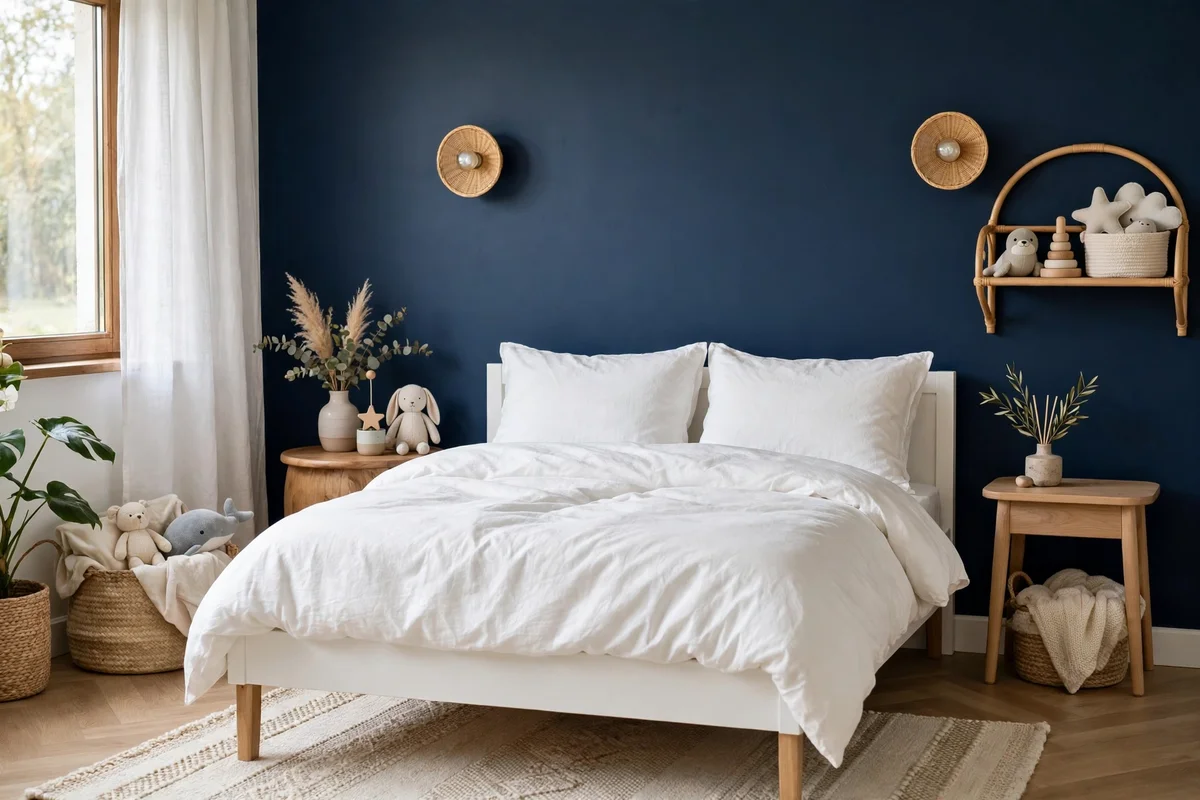
Blue is the most popular accent wall colour in kids rooms for a reason: it feels calm, it suits every age, and it pairs with almost anything. The trick is picking the right blue for the room you have. A deep navy works in a big, bright room and behind a white bed, where the contrast does the work. A mid-tone dusty blue works in a smaller room, because it gives colour without darkening the space. A pale powder blue works in a nursery or a north-facing room, where it reads as fresh rather than cold. Test three blues on the wall itself, in patches at least as big as a sheet of paper, and look at them morning and evening before you commit. A blue that looks perfect at noon can look grey at bedtime. Once the wall is painted, keep the bedding mostly white or cream with one blue element — a throw, a cushion, a rug — so the wall stays the star and the bed does not compete with it.
5. Use black and white contrast
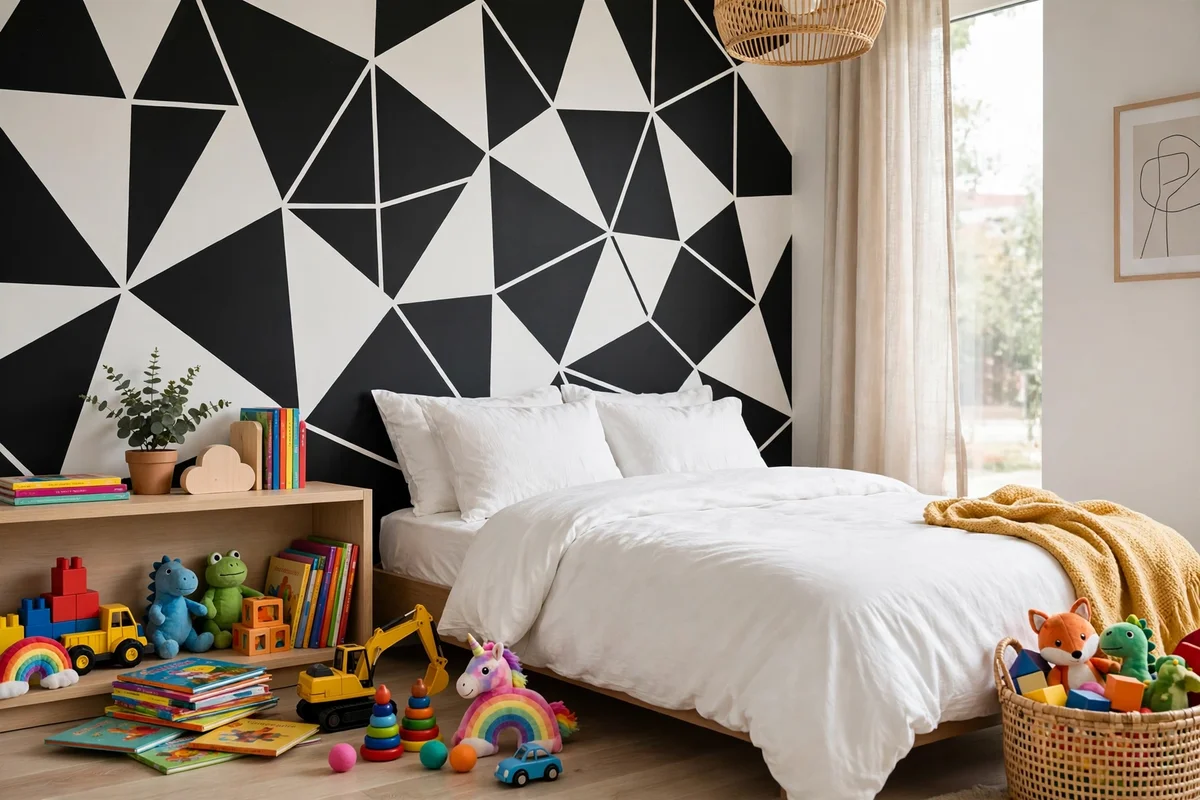
A black and white accent wall sounds severe for a child's room, and done badly it is. Done well, it is one of the most flexible backdrops there is, because every toy, book, and cushion in the room provides the colour against it. A black and white geometric pattern, a bold stripe, or a monochrome mural lets the room's contents change colour as your child grows, without the wall ever needing to change. It suits modern bedrooms, older children, and shared rooms where two children have different favourite colours, because the wall takes no side. Keep the black to one wall and balance it with plenty of white elsewhere — white bedding, pale wood furniture, a light rug — so the room feels graphic rather than dark. And use a washable paint, because black shows every fingerprint and scuff that a lighter colour would hide.
6. Paint a green accent wall
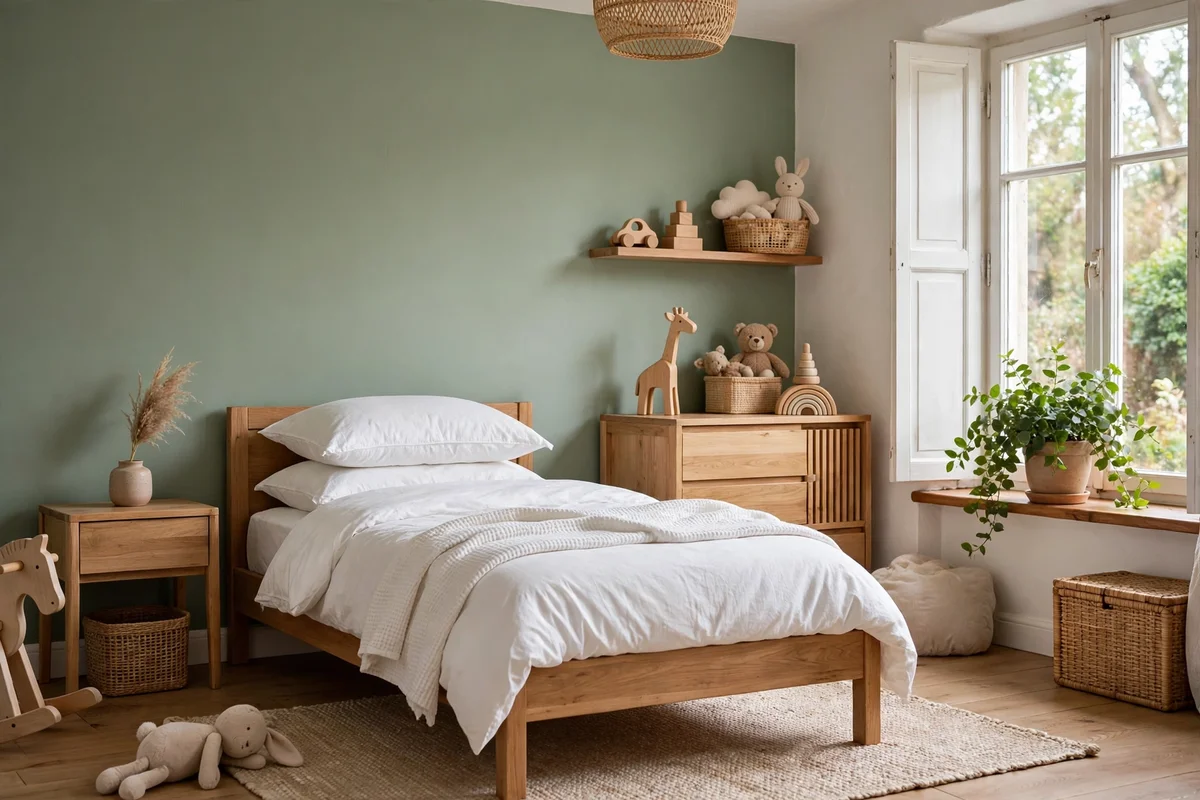
Green is the accent colour that most often gets chosen for a reason parents only notice later: it makes a bedroom feel calm and connected to the outdoors, and it is the colour children tire of last. Soft sage suits a nursery or a reading corner, because it is restful without being pale. Olive suits a room with natural wood furniture, because the two warm each other up. Forest green suits a big room with a white bed and brass or wooden details, where it reads as grown-up rather than themed. Green also pairs well with the two things every kids room already has — wood and white — so it rarely clashes with existing furniture. If the room faces north and gets cool light, pick a green with a warm, yellow undertone rather than a blue one, or the wall can look cold in winter. Repeat the green in a plant, a cushion, or the storage bins, and the wall will look like it was always meant to be there.
Wallpaper
7. Use peel-and-stick wallpaper for instant pattern
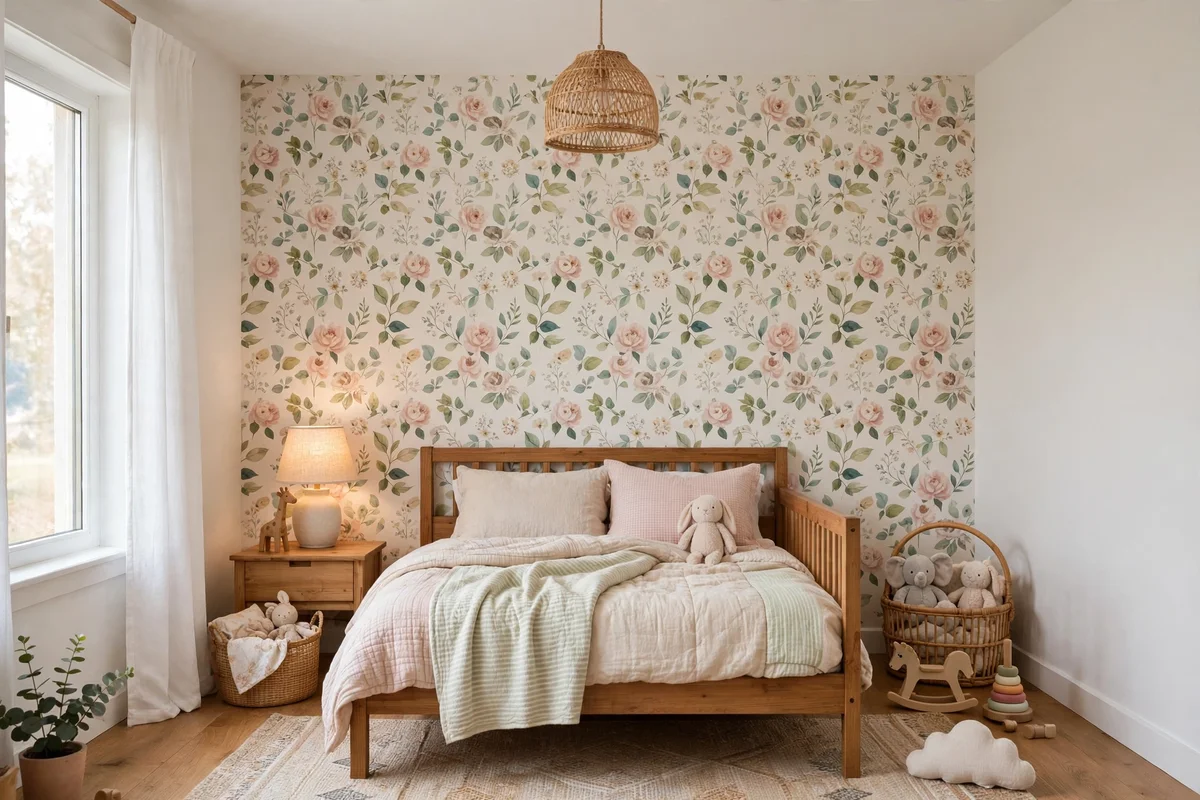
Peel-and-stick wallpaper is the fastest way to put a real pattern on a wall, and it is the friendliest option for anyone who has never hung wallpaper before. Florals, woodland animals, stars, maps, and geometric prints all come in peel-and-stick form, and the paper can be repositioned while you hang it — if a strip goes on crooked, peel it back and try again, which is impossible with pasted wallpaper. Measure the wall, add ten percent for pattern matching and trimming, and hang the first strip with a spirit level, because every strip after it follows the first. Smooth each strip from the centre outward with a plastic smoother or a clean cloth to push out air bubbles. The paper peels off cleanly when your child outgrows the pattern, which is the real reason it suits kids rooms: the wall can change in an afternoon, without filler, sanding, or repainting. Keep the pattern to one wall, and keep the other walls plain, because a busy pattern on all four walls overwhelms a small room.
8. Add botanical wallpaper for a calm, natural feel
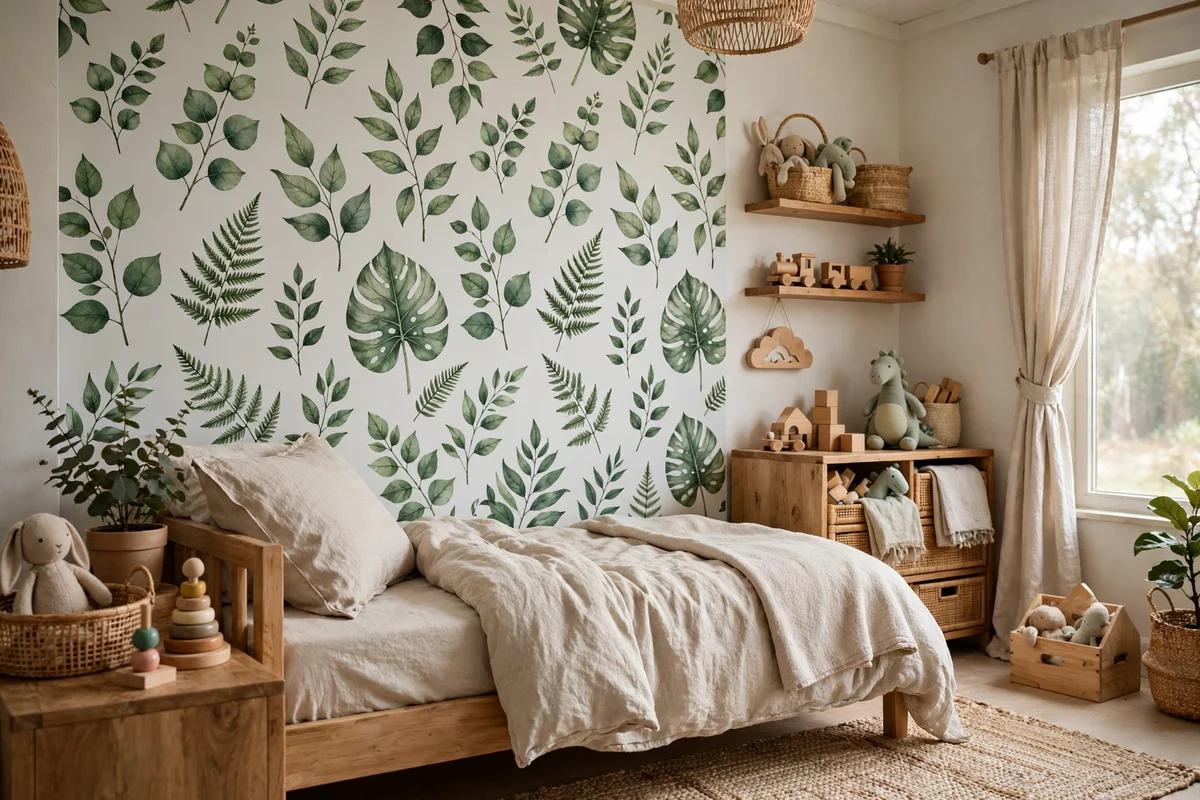
Botanical wallpaper — leaves, ferns, flowers, and trailing vines — brings the outdoors into a bedroom without a single toy or theme, and it is one of the few patterns that still looks good when a child is ten. A soft sage botanical on a white ground suits a calm sleeper and a small room. A bolder tropical leaf in deep green suits a playroom or a big bedroom with plenty of daylight. Because the pattern is nature, it pairs naturally with wood furniture, woven baskets, and linen bedding, and it rarely dates the way a cartoon character or a trend pattern does. When you order, buy one roll first and check the pattern repeat — a large leaf motif may need more rolls than the coverage on the packet suggests, because you lose paper matching the pattern at each join. Apply it to the bed wall, keep the bedding mostly plain, and let one green cushion or a plant on the windowsill echo the wallpaper's green.
9. Hang a mural wallpaper scene
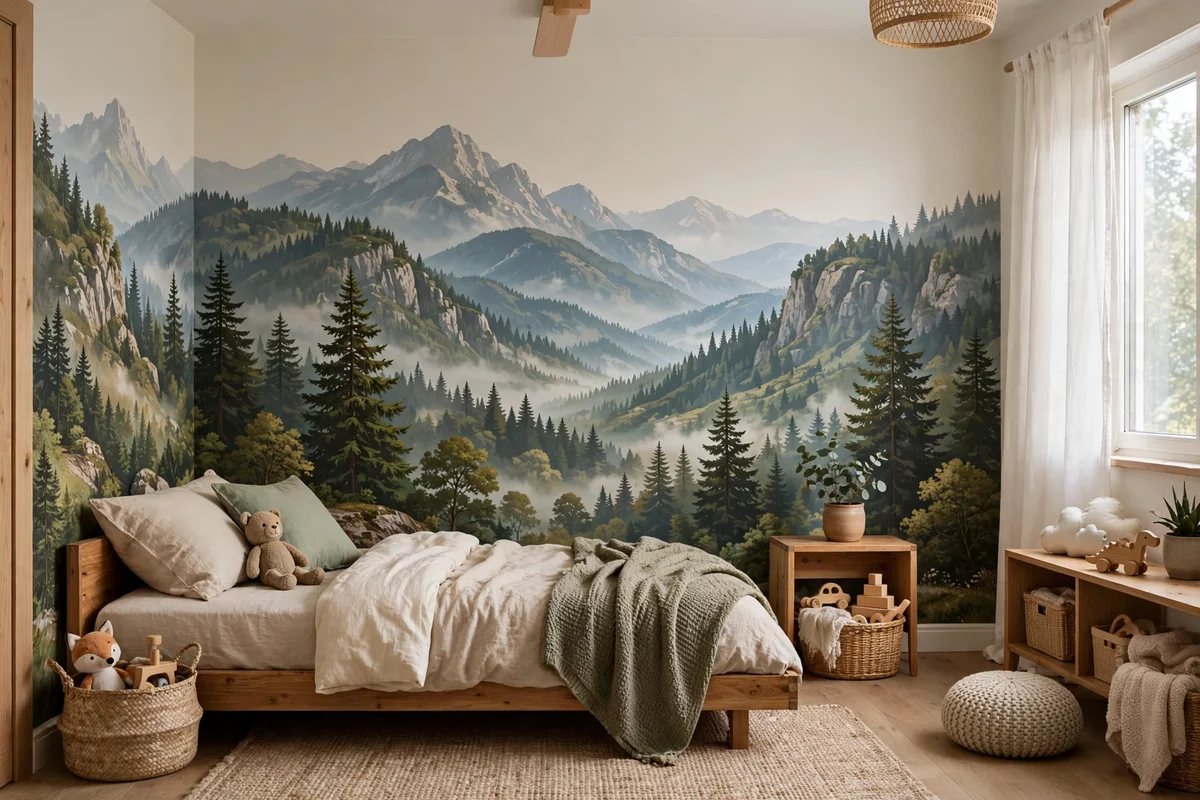
A mural wallpaper — one large printed scene that covers the whole wall — is the closest thing to a painted mural without needing an artist. Mountains and forests, a starry sky, an underwater scene, or a storybook landscape all come as mural panels sized to your wall. Measure carefully and order the panels in the right sequence, because a mural hung in the wrong order is very hard to fix. This is the best option when the wall is large and mostly uninterrupted, and when the room's theme is a place rather than a colour — a forest, the sea, space. Keep the furniture in front of a mural low and simple, so the scene stays visible, and keep the rest of the room's colours pulled from the mural itself: the blue of the sky in the bedding, the green of the trees in a cushion. A mural is the hardest accent wall to change later, so it suits a room you expect to keep for several years, or a wall you are happy to repaint when the theme changes.
Wood and texture
10. Add wood slat details
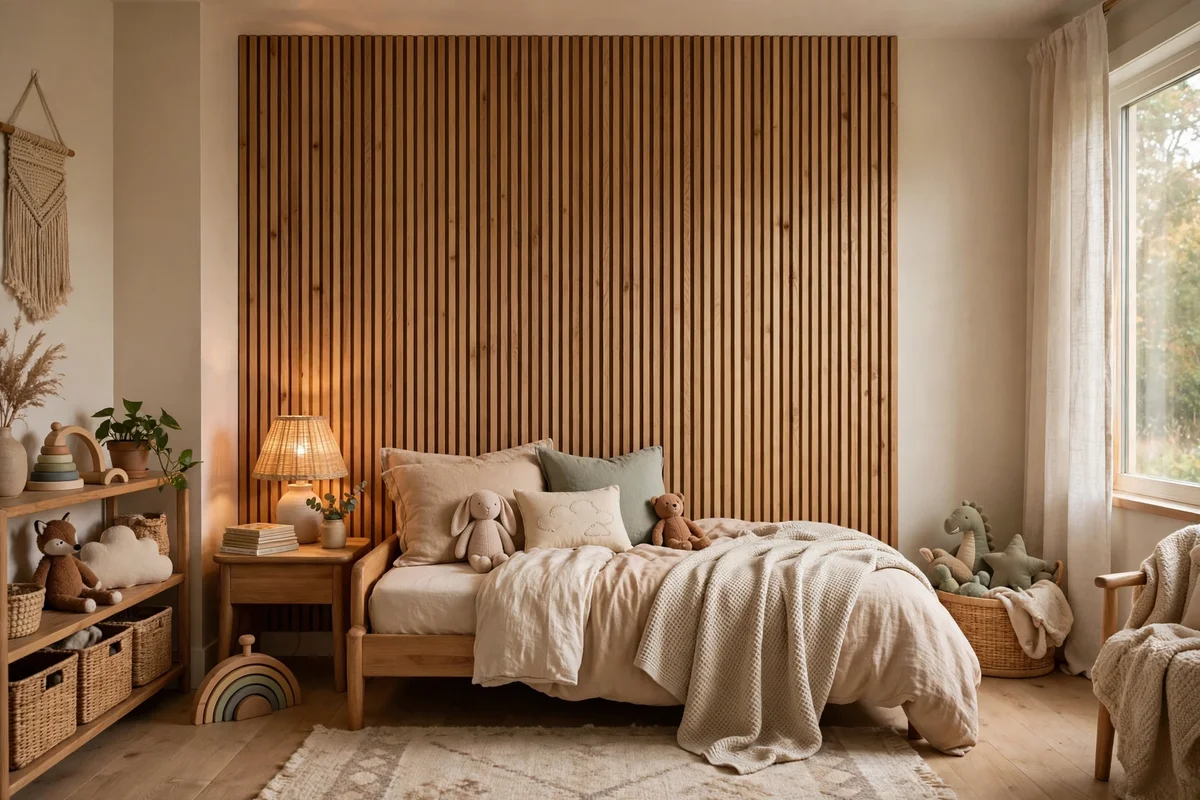
Vertical wood slats have become the go-to accent wall for parents who want texture without pattern, and they suit modern, Scandinavian, and calm bedrooms better than almost any other finish. Thin battens, fixed vertically with small even gaps, add warmth and architectural interest to a plain wall, and they make even simple furniture look custom. Natural pine or oak suits a neutral room; slats painted the same colour as the wall give a subtle, tonal texture that reads as expensive without being loud; slats painted a bold colour give the texture and the colour in one move. Measure the wall, cut the slats to the same length, and fix them with a level and a spacer block so the gaps stay even — uneven gaps are the one thing that makes a slat wall look homemade in the wrong way. Slats work best on the bed wall, behind the headboard, where they frame the bed. They also hide a multitude of sins: a wall with dents, cracks, or old picture-hook holes looks perfect once the slats are up.
11. Use decorative moulding for a custom look
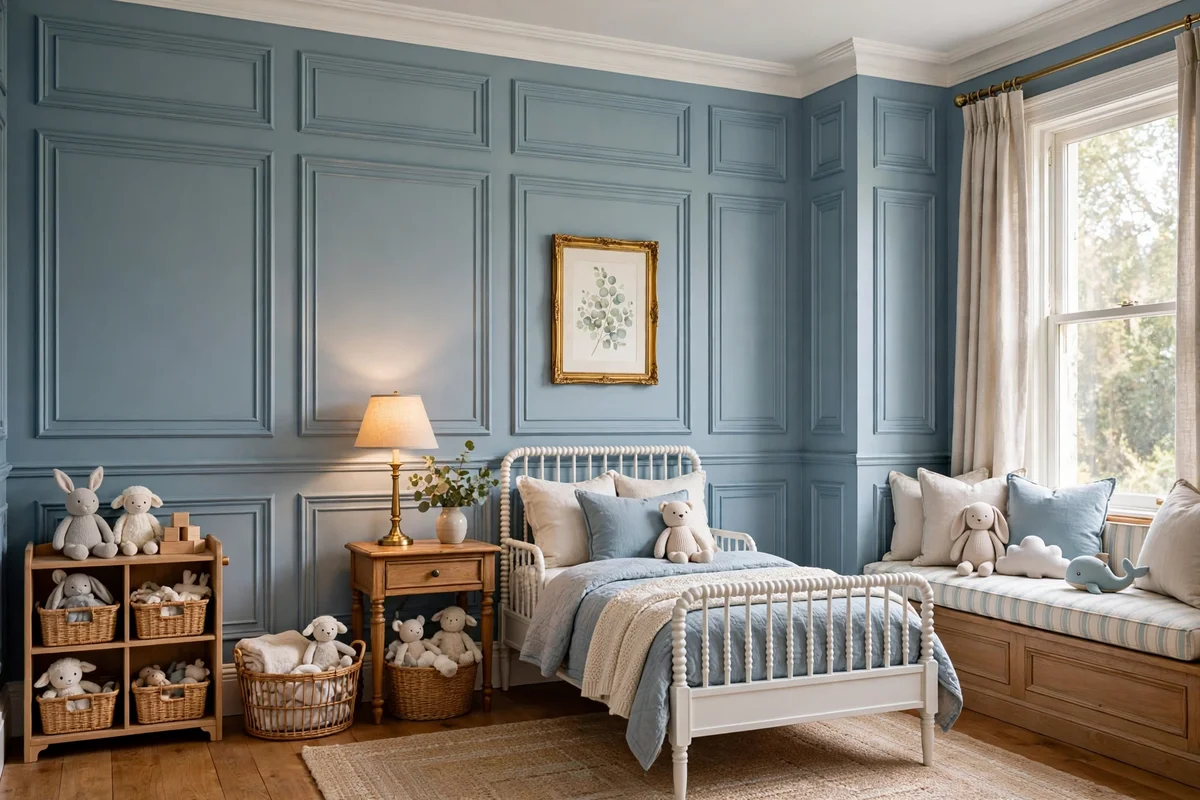
Decorative moulding — rectangles or squares of trim fixed to the wall and painted over in one colour — gives a plain wall the look of panelling without any building work, and it suits traditional and elegant kids rooms that would look wrong with a bright mural. Paint the moulding and the wall the same colour for a subtle, tonal effect, or paint the moulding a shade darker than the wall for definition. The rectangles should be sized to the wall, not to a standard: on a wide wall, two large rectangles look better than four small ones, and the spacing between them should be even. Cut the corners at 45 degrees, fix the trim with adhesive and small pins, fill the joins, and paint two coats. Moulding takes longer than paint and is harder to remove — you will need to fill and sand when it comes down — so it suits a room that will keep its look for years, and a child old enough to appreciate a calmer, more grown-up wall.
Art and display
12. Create a gallery wall

A gallery wall is the accent wall that grows with your child, because the wall itself stays the same while the art on it changes. Start with three or four framed prints in matching frames — the same frame colour, different art inside — and leave empty space for your child's own drawings. A clip frame or a magnetic poster hanger lets you swap art without tools, which matters when the display changes every few weeks. Arrange the frames on the floor first, take a photo of the arrangement you like, and hang them using the photo as a guide. Keep the frames at your child's eye level, not adult eye level, so the wall belongs to them. Mix one or two larger pieces with several small ones, and keep the spacing between frames even — a hand's width apart is a good rule. A gallery wall also solves the problem of what to do with school art: the best pieces go on the wall, the rest go in a folder, and the wall never looks finished, which is exactly the point.
13. Combine paint and wall art
Paint and artwork work best together when the paint is treated as a backdrop, not a competitor. A bold wall colour behind framed prints, a shelf of books, or a row of decorative objects makes the display look intentional and dramatic, because the colour gives the art something to stand against. The rule is simple: if the wall is bold, the art should be calm — white mats, simple frames, one or two colours in the prints. If the wall is pale, the art can be bolder. A deep blue wall with white-framed prints, a terracotta wall with a wooden shelf and a few plants, or a sage wall with a row of black-and-white photographs all work on the same principle. Hang the art after the paint is fully dry, and use proper picture hooks rather than adhesive strips for anything heavy, because a frame that falls off a painted wall takes paint with it.
14. Frame the bed with the accent wall
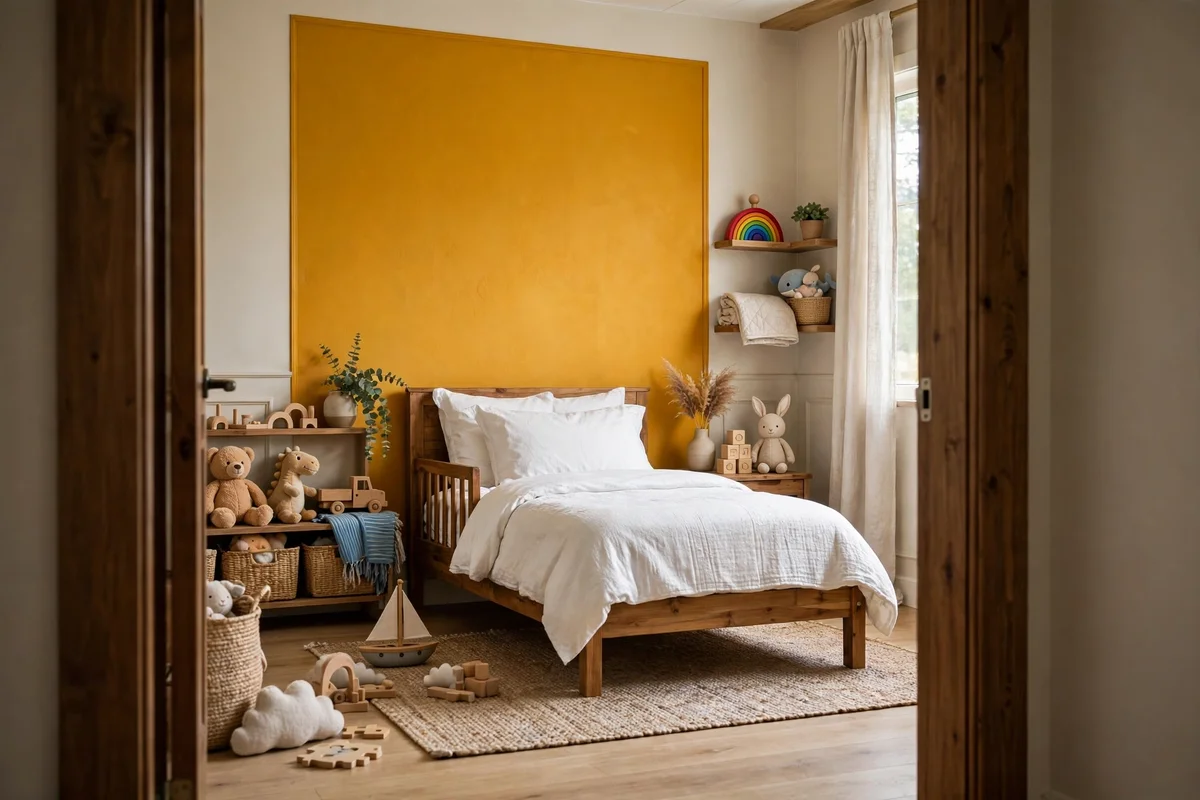
The most effective placement for any accent wall is behind the bed, and it is worth treating as a design decision in its own right rather than a coincidence. A bold colour, a mural, or a wood slat wall behind the headboard draws the eye to the bed, balances the room, and makes the bed look like it belongs exactly where it is. The wall should be roughly the width of the bed plus a little extra on each side, so the bed looks framed rather than crowded — a narrow feature on a wide wall looks lost, and a feature that runs the whole wall can overwhelm a small bed. If the bed moves to another wall later, the accent wall moves with it in the sense that you will want to repaint: an accent wall behind an empty stretch of wall looks like a mistake. So before you paint, be sure the bed is staying where it is, and anchor the bed wall as the room's permanent focal point.
Flexible and interactive
15. Use decals for a flexible design

Wall decals are the right first step if you are unsure about the theme, if you rent, or if your child changes their mind often. Stars, animals, rainbows, flowers, maps, and geometric shapes stick on in minutes, peel off without taking paint with them, and can be moved when the furniture moves. The trick is to cluster them rather than scatter them: a large rainbow or a group of stars at eye level from the bed, with smaller decals around it, reads as a design, while decals spaced evenly across the whole wall can look like a pattern that ran out of ideas. Keep a few spare decals in a drawer, because when one peels at the corner, replacing it takes a minute, while re-sticking a peeling decal rarely holds. Decals also layer well over paint or wallpaper — a few stars over a navy wall, or a row of animals along the top of a half-wall, give a finished wall a second layer without any more work.
16. Create a starry night wall
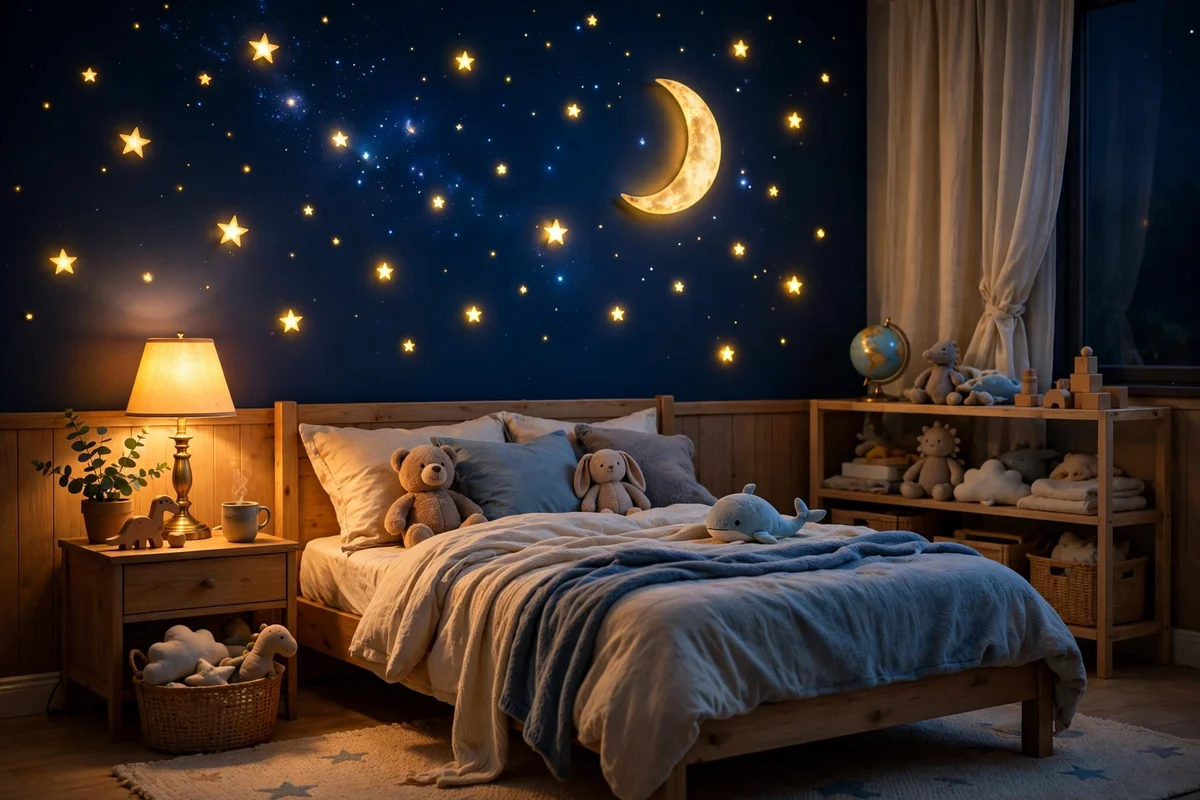
A starry night wall turns bedtime into something a child looks forward to, and it works in any room because it is dark, calm, and simple. Paint the wall a deep midnight blue or soft charcoal, then add stars with decals, a stencil, or glow-in-the-dark paint — or all three, with the decals as the main stars and the glow paint as the faint ones that appear when the lights go out. A crescent moon, a few clouds, or a small constellation your child can learn to find by name makes the wall personal rather than generic. This idea works especially well behind the bed, where it is the last thing a child sees before sleep, and it suits children who are nervous about the dark, because the wall gives the dark a shape and a story. Keep the rest of the room's lighting warm and low in the evening, and the star wall will do its quiet work on its own.
17. Add a chalkboard or magnetic wall

A chalkboard wall is the accent wall that earns its keep every day, because it is a surface, not just a decoration. A section of the wall painted with chalkboard paint gives your child a place to draw, practise spellings, leave messages, and plan the week — and it can be wiped clean and started again in a minute. Magnetic paint, applied underneath chalkboard paint or a top coat of colour, adds a second function: magnets, photos, and artwork can be stuck up and moved around without tape or pins. Apply the magnetic paint first, in three or four coats, then the chalkboard paint on top, and let each coat dry fully — magnetic paint only works if it is thick enough. Frame the chalkboard section with a strip of wood trim so it reads as a deliberate panel rather than a patch of black paint, and keep chalk and a small eraser in a pot on the shelf below it. This wall suits school-age children best, and it suits a study corner or the wall beside the desk more than the wall behind the bed.
18. Highlight the wall with layered lighting

Lighting is the accent wall idea that most people forget, and it is the one that makes every other idea look better after dark. Wall sconces, a picture light, or a strip of warm LED lighting along the top of a slat wall or behind a shelf can emphasise colour and texture that daylight flattens. A mural lit from above looks deeper, a wood slat wall lit from the side shows its shadows, and a gallery wall with one small picture light looks like a real gallery. Use warm white light, not coloured bulbs, which can make the wall look like a party when it should feel like a bedroom. Keep the wiring tidy — battery lights or a plug-in sconce avoid any electrical work — and put the accent lighting on a separate switch or a timer, so it can be on for reading and off for sleep without touching the main light. Good lighting often elevates a design instantly, and it costs less than repainting the wall.
Small Rooms, Shared Rooms, and Nurseries
A small room needs the accent wall to work harder and take up less space. Use the finish on things that already have to be there: the wall behind the bed, a half-wall that doubles as a scuff guard, or a strip of wallpaper that makes a low ceiling feel taller. Skip the full mural and the gallery wall in a very small room — both eat wall space the room cannot spare, and a mural behind a bed that fills the whole wall can feel like it is leaning over the sleeper. Vertical stripes or vertical slats make a low ceiling feel taller, and a mirror opposite the window bounces light into a dark corner. Keep at least one wall completely plain, so the room has somewhere for the eye to rest, and keep the accent colour light rather than dark, so the room does not feel smaller than it is.
A shared room needs an accent wall both children can live with, and a way for each child to have their own colour inside it. A neutral or mid-tone wall — sage, dusty blue, warm grey — works well here, because it is less likely to feel like one child's taste imposed on the other. Give each child one signature colour inside the shared scheme: one child's bedding in blue, the other's in green, while the wall itself uses a colour both accept. If the beds are on opposite walls, each bed wall can carry its own small accent — a painted arch, a strip of wallpaper, a cluster of decals in that child's colours — with the shared wall kept neutral. Colour-coded storage earns its keep twice over in a shared room: each child's bins in their own colour end most arguments about whose toys are whose.
A nursery accent wall should be soft and low. Pastel paint, a gentle botanical wallpaper, or a row of decals above the cot are enough. Keep the wall behind the cot plain or very pale, because strong colour behind a baby's head is stimulating at exactly the time you want calm. Everything within reach of the cot should be washable, and anything hung above it should be fixed securely. A nursery accent wall is also the one most worth choosing with the next five years in mind: a soft sage or dusty blue wall works for a baby and still works for a five-year-old, while a themed mural may not.
Accent Walls by Age
A toddler room can be bolder, because toddlers use the room for play as much as sleep. Low furniture, a floor bed with a painted arch or a starry wall behind it, decals at toddler height, and a chalkboard panel low enough to reach all suit this age. Keep the design to one wall and one idea, because toddlers change their minds fast and a room with three ideas is a room that needs redoing three times as often.
A school-age child's room can carry the strongest version of an accent wall, because the child can tell you what they like and what they have outgrown. This is the age for the mural, the geometric tape pattern, the gallery wall with their own art, and the chalkboard wall. It is also the age to involve them in the work: a school-age child can tape a geometric pattern, stick decals, and choose between two colours with genuine opinions. Let them choose between options you have already approved — "blue or green?" — rather than facing the whole paint chart, and the wall will feel theirs without becoming a colour you regret.
A pre-teen's room needs the accent wall to feel grown-up, not themed. Wood slats, moulding, a single bold colour, or a black and white pattern all work, because they read as design rather than decoration. This is the age where a mural of a cartoon character or a wall of decals starts to feel young, and where the wall should be chosen so it can stay for several years. If the room will need to change within two years, choose decals over wallpaper and paint over a mural. Future you will be grateful.
A Weekend Plan: Saturday and Sunday
An accent wall does not need a month of planning. It needs a clear order, because painting before you have measured, or buying wallpaper before you have chosen the wall, creates the rework that eats weekends.
On Saturday morning, choose the wall and the finish, measure the wall, and buy only what is on the list: paint or wallpaper, tape, a roller or smoother, and any trim. Move the furniture away from the wall, protect the floor, and do the messy work — paint the wall, hang the paper, or fix the slats. While the paint dries, wash the new bedding and cushion covers so they are ready for Sunday. Do not try to hang art or arrange shelves while paint is wet; it will get marked.
On Sunday, put the room back together in this order: bed and bedding first, then the rug, then storage, then wall art and decals last. Art goes last because it is the easiest thing to move, and you will only know where it belongs once the furniture is in place. Finish by walking to the door and looking at the room as a visitor would — the view from the door is the view that matters most, because it is the one you see every day.
Budget: Three Price Levels
An accent wall does not have to be expensive. The difference between the three levels below is how much is painted and how much is bought ready-made, not how good the result looks.
A refresh under $50 uses paint you already own or one tin of emulsion, a roll of painter's tape for a geometric pattern, a set of removable decals, and art your child has already made in clip frames. The wall changes without any new furniture, and it takes an afternoon.
A mid-level refresh, roughly $50 to $200, adds the pieces that make the biggest difference: a roll or two of peel-and-stick wallpaper, a tin of washable paint for a bold wall, a set of wood slats, or a mural wallpaper panel. This is the level most families choose, because it changes the wall properly without changing the room.
A full redo, $200 and up, adds a painted mural by hand or by an artist, full wood panelling, decorative moulding, and layered lighting. This is worth doing when the room is being redecorated anyway — new bed, new flooring, or a move — rather than as a standalone project. If you are spending at this level, spend it on the things that are hardest to change later: the wall finish and the trim. Bedding and art can always be upgraded later, one piece at a time.
Whatever the budget, buy the paint after you have chosen the wallpaper or the bedding, not before. Paint comes in thousands of shades and bedding in dozens, so it is easier to match paint to bedding than bedding to paint — and a paint sample pot costs far less than a duvet set bought in the wrong shade.
Mistakes That Make Accent Walls Look Wrong
The most common mistake is accenting the wrong wall. A bold wall behind a door, or a mural split by a wardrobe, looks like an accident no matter how good the finish is. If the room feels wrong and you cannot say why, stand in the doorway and check which wall you actually see first. That is the wall that should carry the accent.
The second mistake is two accent walls. A bold wall and a patterned wall in the same room compete, and the room loses its focal point. If you want colour on a second wall, use a quiet echo — a solid colour pulled from the wallpaper, or a single shelf in the same wood — not a second statement.
The third mistake is a pattern that fights the room. A busy wallpaper plus patterned bedding plus a patterned rug is three patterns arguing. Pick one patterned piece — the wall or the bedding — and keep the rest solid colours drawn from the same palette. Solid colours let the pattern breathe.
The fourth mistake is ignoring the light. A dark wall in a dark, north-facing room can feel heavy, and a pale pattern in a bright, south-facing room can look washed out. If the wall feels wrong and the colour looked right in the shop, the light is usually the reason. Swapping a dark colour for a lighter shade of the same colour, or adding a warm lamp, often fixes it without redecorating.
The fifth mistake is forgetting that the wall is behind furniture. A mural hidden behind a tall bookshelf, or decals placed where the bed will cover them, wastes the work. Arrange the furniture on paper first, mark where the bed, the desk, and the shelves will sit, and design the wall around those rectangles, not behind them.
How to Let the Wall Grow Up With Your Child
The best accent walls are built to be undone in stages. When your child outgrows the theme, change the cheap things first: peel off the decals, swap the bedding for a solid colour, take down the themed prints, and change the cushion covers. That alone removes most of the theme, and the room will already feel older.
If that is not enough, repaint the accent wall in a single colour drawn from the old design — sage green, dusty blue, or warm cream — and keep the wood slats or moulding, which will now look like a single architectural feature rather than part of a theme. The storage and the bookshelf can stay, because they were never really part of the theme at all.
The expensive reversals are the mural and the full-wall wallpaper, which is why they belong on one wall only. A single wall can be repainted or re-papered in a day; four walls cannot. If you think the room will need to change within two years, choose decals over wallpaper and paint over a mural. A wall that can change in a weekend is a wall you will never regret.
Frequently Asked Questions
Which wall should be the accent wall in a kids room?
The wall behind the bed is the best choice in most rooms, because it frames the bed and is the first wall you see from the door. If that wall has a window or a wardrobe in the way, use the wall opposite the bed instead. Avoid the wall with the door, because the door cuts the design in half every time it opens.
Is one accent wall enough in a kids bedroom?
Yes. One wall gives the room a focal point, and the other three walls stay calm so the colour has room to breathe. Two accent walls compete with each other and the room loses its centre. If you want colour elsewhere, repeat the accent colour in bedding, cushions, or storage instead of painting a second wall.
What is the best accent wall for a rental?
Peel-and-stick wallpaper or removable decals. Both go up without paste or paint, peel off cleanly when you move out, and leave the wall underneath untouched. A gallery wall hung with removable hooks and a bold duvet set add colour without touching the walls at all.
Can I do an accent wall in a small kids room?
Yes, and it often helps a small room feel designed rather than cramped. Use a half-wall, a vertical stripe or slat pattern, or a light-to-mid-tone colour rather than a very dark one, and keep at least one wall completely plain. A mural or a full gallery wall can overwhelm a very small room, so keep the design to one clear idea.
How do I choose a colour for a kids accent wall?
Start from something already in the room — the bedding, a favourite toy, a book cover — and pick a shade from it. Test three shades on the wall itself in patches as big as a sheet of paper, and look at them in daylight and lamplight before you commit. Then repeat the chosen colour twice more in the room, in different materials, so the wall looks planned rather than random.
How much does a kids accent wall cost?
A paint-and-tape refresh can cost under $50. Peel-and-stick wallpaper or wood slats usually fall between $50 and $200 for one wall. A hand-painted mural, full panelling, or moulding with lighting costs $200 and up. The cheapest way to start is with paint and decals, because both can be changed in an afternoon if the colour does not work.
Final Checklist Before You Start
- Pick the wall — behind the bed if you can — and measure it, noting sockets, switches, and skirting boards.
- Choose one finish: paint, peel-and-stick wallpaper, wood slats, moulding, or decals.
- Pick one colour family and repeat its main colour twice more in the room.
- Test swatches on the wall in daylight and under the bedroom lamp at night.
- Check the wall is straight and smooth enough for your finish; fill and sand if it is not.
- Arrange the furniture on paper first, so the design is not hidden behind the bed or shelves.
- Buy the paint after the bedding and wallpaper, not before.
- Leave at least one wall completely plain.
An accent wall does not need to be perfect, and it does not need to be finished in one go. Start with the wall and the finish, add the bedding and the storage, and let the art grow over time. The rooms children love most are rarely the ones with the most colour on the walls — they are the ones where one wall has a plan, the toys have a home, and there is a comfortable corner to sit in. Get those three things right, and the accent wall takes care of itself.

4 comments