Bunk Bed Room Ideas
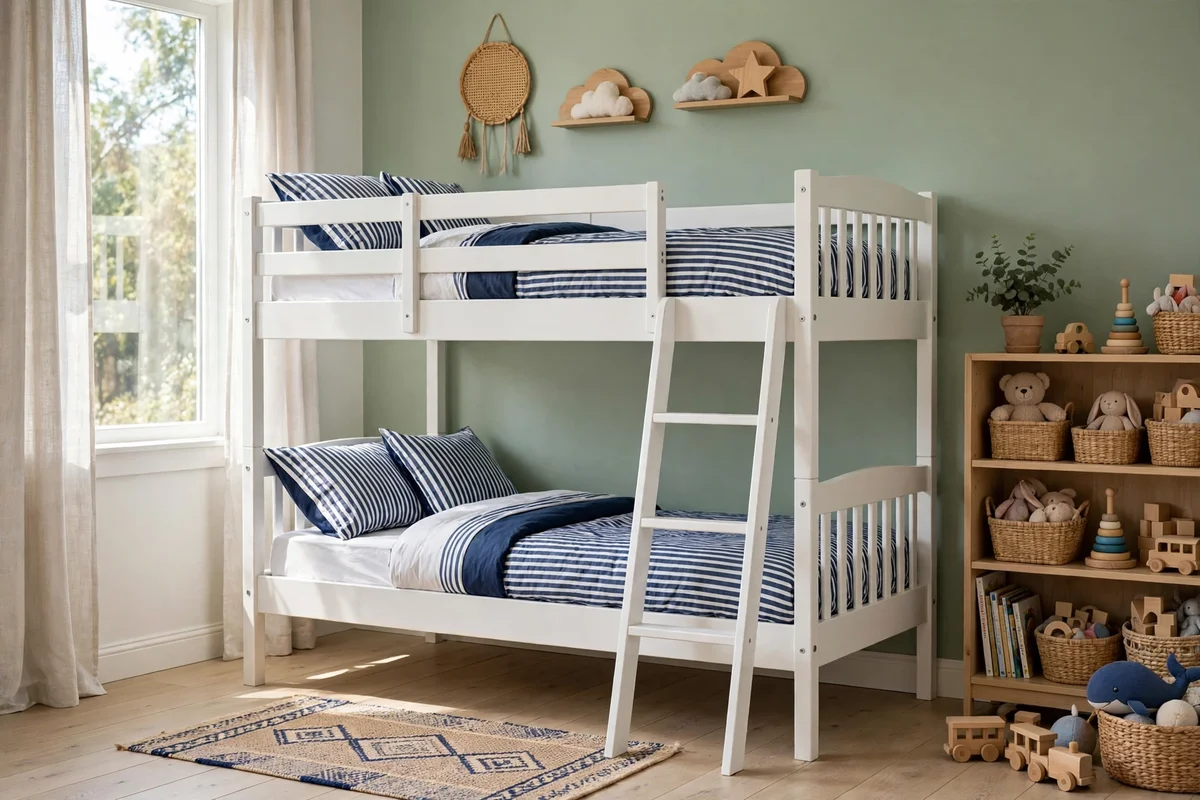
A bunk bed is the single most effective piece of furniture in a small kids room. Two beds stacked in the footprint of one frees up the floor for everything else a bedroom has to do: play, homework, reading, and storing the sheer volume of things children own. It is also, for most children, the most exciting piece of furniture in the house — a top bunk feels like a den, a lookout, and a sleepover spot all at once.
The short version: measure the room and the ceiling before you fall in love with a bed, decide who sleeps where, and pick the layout that solves your actual problem — two sleepers, one sleeper plus a desk, three sleepers, or a small room that needs storage more than anything. Choose stairs if the climber is young or nervous, a ladder if floor space is tight, and drawers wherever you can get them. Then style the bed lightly, because a bunk bed already makes a statement and the room around it should stay calm enough to sleep in. The ideas below are arranged in the order most parents actually use them: how to choose first, then safety, then the bed layouts, the storage, the styles, and the cosy details — followed by the practical parts: small rooms, shared rooms, ages, budgets, mistakes, and a weekend plan to get it done.
How to Choose the Right Bunk Bed
Start with the problem, not the picture. A bunk bed that looks wonderful online can be wrong for your room in three measurable ways, and all three are easy to check before you order.
First, the floor. Measure the wall the bed will stand against, and the space in front of it. A standard twin-over-twin bunk takes up roughly the floor area of one single bed, which is the whole point — but stairs, a trundle, or an L-shaped layout each add floor space back, and a bed with a slide or a wide staircase can end up using more floor than two single beds would have. Mark the footprint on the floor with painter's tape, including the ladder or stairs and the space needed to pull out any drawers or a trundle. Then walk the room: can the door open fully, can a child get from the bed to the door in the dark without climbing over toys, and is there still a clear patch of floor for play? If the tape outline eats the play space, the bed is too big for the room, however good it looks.
Second, the ceiling. The top bunk needs enough headroom for the sleeper to sit up without ducking, and the room needs enough height above the bed for the bed to feel safe rather than cramped. Measure from the floor to the ceiling, then subtract the height of the bed frame and the thickness of the top mattress — what is left is the sitting space. If it is tight, look at a lower-profile bunk, a half-height loft, or a bed designed for rooms with low ceilings, and check the ceiling fan and any light fitting: a bunk bed should never sit directly under a ceiling fan or a low-hanging light. Measure the real room, not the catalogue photo, because catalogue rooms are almost always taller than real ones.
Third, the sleepers. Who sleeps on top, and who sleeps below? The older, steadier climber goes on top, and the younger child, the restless sleeper, or the child who gets up in the night goes below. If the age gap is large, a twin-over-full gives the older child a bigger lower bunk and the younger one the twin on top — or the other way round, depending on who needs the space. If only one child uses the room, a loft bed with a desk or a play space underneath may be a better use of the footprint than a second mattress nobody sleeps in. And if sleepovers are a weekly event, a trundle earns its keep; if they happen twice a year, an air mattress in the cupboard does the same job for far less money and floor space.
Once those three checks are done, the choice narrows quickly. Two similar-aged siblings in a small room: twin-over-twin. One child who needs a study space: a loft bed with a desk. Three children, or two plus constant guests: a triple bunk or a bunk with a trundle. A room with an awkward corner: an L-shaped bunk. A room that needs storage more than a second bed: a bunk with drawers in every step and under the lower bunk. Decide the layout from the problem, and the style — white, wood, colourful, minimalist — becomes a much easier second decision.
Safety First: The Rules That Come Before Style
A bunk bed is a piece of furniture children climb on every day, often in the dark and half asleep, so safety is not a finishing touch — it is the first filter every bed has to pass, before colour or style get a say. The guidance below is general practice for family bunk beds. Always read and follow the manufacturer's instructions for the exact bed you buy, because sizes, weight limits, and assembly details vary from one model to another, and the manufacturer's instructions are the authority for that bed.
Guard rails matter most. The top bunk should have guard rails on both sides, including the side against the wall, because children roll in their sleep. Check that the rails are fixed firmly and cannot be removed by a child, and that there are no gaps a head or limb could get caught in — the mattress should fit the frame snugly, with no space at the sides. The top mattress should be thin enough that a good height of guard rail still stands above it: a thick, soft mattress raises the sleeper up and eats into the rail's protection. If you are unsure, use the mattress thickness the manufacturer recommends for that bed and no thicker.
Age is the next rule, and it is the one parents most often wish away. Children under six should not sleep on the top bunk. Younger children are still developing the balance and judgement that safe climbing needs, especially at night, and the top bunk is no place to learn it. Put the younger child on the bottom bunk and the older child on top, and keep it that way even when the younger one begs — the bottom bunk can be made just as special with curtains, lights, and bedding of their own.
The way up matters as much as the bed itself. A ladder should be firmly fixed to the frame, never a loose ladder leaning against the bed, and the rungs should be flat and wide enough for bare feet in the dark. Stairs are easier and safer for younger children and for night-time trips, and stair drawers add storage, but they take up more floor. Whichever you choose, teach one rule and repeat it until it sticks: the ladder or the stairs are the only way up and down. No climbing the frame, no jumping from the top bunk, and only one child on the top bunk at a time. A small night light near the ladder or stairs makes night-time climbs far safer, and it costs almost nothing.
Then the room around the bed. Anchor the bunk bed and any tall furniture — wardrobes, bookshelves, chests of drawers — to the wall, so nothing can tip if a child climbs it. Keep the bunk away from windows and ceiling fans. Never hang ropes, belts, scarves, or cords from the bed or the guard rails, and keep blind cords well away from the bed. Check the bolts and fixings every few months and tighten anything that has worked loose, because a bed that gets climbed daily loosens over time. None of this is complicated, and none of it shows in a photo — but it is what makes the difference between a bed that is fun and a bed that is safe to be fun in.
Bunk Bed Types Compared
There is no single best bunk bed, only the best one for your room, your children, and your budget. The table below compares the main layouts so you can see the trade-offs at a glance.
| Layout | Best for | Floor space | Storage | Watch out for |
|---|---|---|---|---|
| Twin-over-twin | Two siblings, small rooms | Smallest — one bed's footprint | Low unless drawers added | Ladder climb; top bunk age rule |
| Twin-over-full | Siblings with an age gap; one older child | Slightly wider than twin-over-twin | Low unless drawers added | Needs a wider wall; heavier frame |
| L-shaped / corner | Awkward corners; siblings who want space | Medium — spreads along two walls | Good — space under the raised end | Needs two clear walls |
| Triple bunk | Three children; frequent guests | Small for three sleepers | Low unless drawers added | Tallest — check ceiling height carefully |
| Loft bed + desk | One child who needs a study space | Small — desk sits under the bed | Medium — desk and shelves fit below | Top bunk age rule still applies |
| Loft bed + play space | One younger child; small rooms | Small — play area under the bed | Medium — toy storage fits below | Keep the under-bed area low and open |
| Bunk with stairs | Younger climbers; nervous sleepers | Largest — stairs need floor space | Best — drawers in the steps | Measure the stair run before ordering |
| Built-in wall bunks | A room being renovated; holiday homes | Small — built into the wall | Best — shelves and cupboards around | Permanent; costs the most to change |
If you cannot decide between two layouts, ask which problem is costing you the most sleep — literally. If the children wake each other up, the answer is privacy and separation, and curtains or an L-shaped layout help more than drawers. If the room is drowning in toys and clothes, the answer is storage, and stairs with drawers or a built-in wall wins. If homework is happening on the bed, the answer is a desk, and a loft bed solves it. The bed should fix the worst problem first; the rest is decoration.
20 Bunk Bed Room Ideas
Layouts
1. Start with the classic twin-over-twin
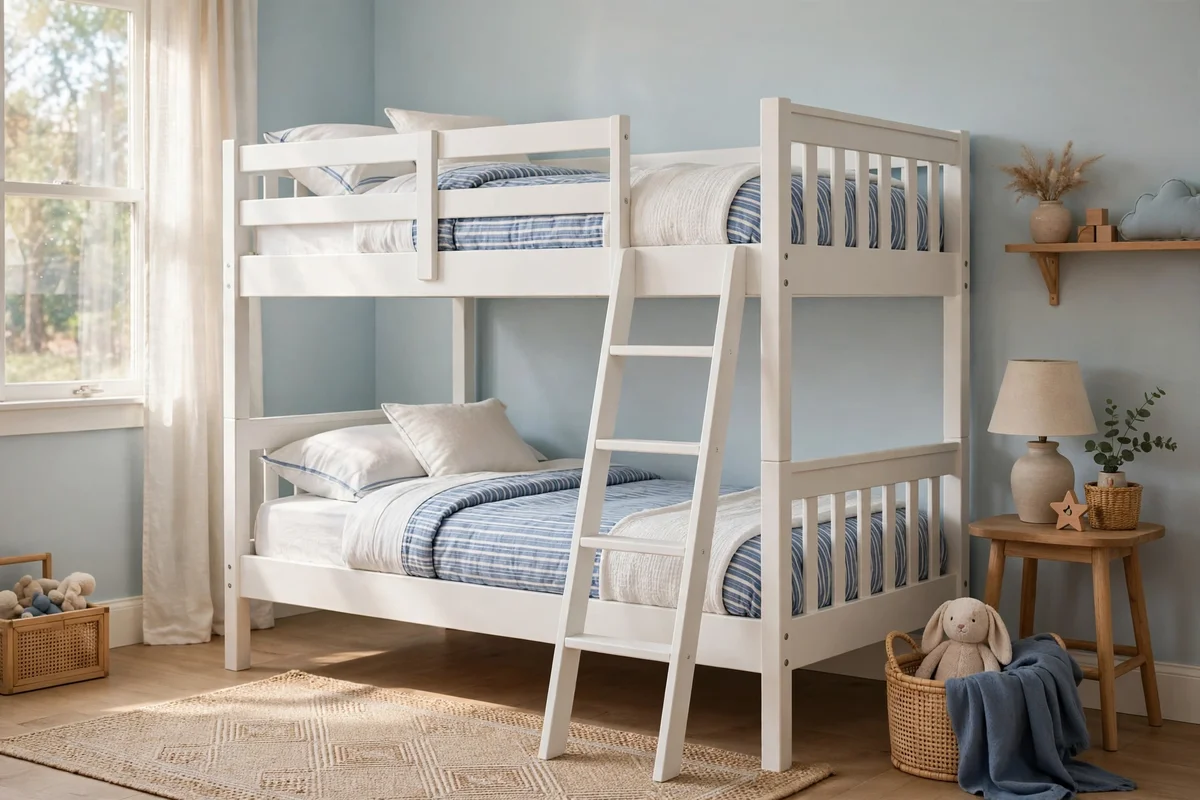
The classic twin-over-twin is the default for a reason: two single beds stacked in the footprint of one, a simple frame, and a layout that fits almost any room and any budget. It works for siblings close in age, for a shared room that also needs a desk and a play corner, and for a guest room that occasionally sleeps two children. Because the design is so simple, it is also the easiest to style — the bedding does the decorating, so each child can have their own colours and patterns while the frame stays neutral. Choose a solid wood frame over a thin metal one if the bed will be climbed daily, and check that the ladder can be fixed on either side, because the side that works in the shop may not be the side that works against your wall. Keep the bedding simple and washable, give each bunk its own small shelf or pocket for a book and a water bottle, and the classic layout will do its quiet job for years without ever needing to be the centre of attention.
2. Give the older child room with a twin-over-full
A twin-over-full puts a single bed on top and a double bed below, and it is the layout to choose when the age gap matters. The older child gets the bigger lower bunk — room to sprawl, room for a friend on a sleepover, and no climbing when they are tired — while the younger child gets the twin on top, which feels like the adventure bunk. It also suits a room where one child is much taller, or where the lower bunk doubles as a daytime sofa for reading. The trade-off is width: the bed needs a wider wall than a twin-over-twin, and the frame is heavier, so measure the wall and the doorway it has to come through before you order. Style it with matching bedding in two shades of the same colour family so the different-sized bunks still read as one bed, and give the lower bunk a row of cushions along the wall so it works as a reading seat during the day.
3. Open up the room with an L-shaped bunk

An L-shaped bunk turns the beds through a right angle instead of stacking them directly, and the change in geometry changes the whole room. The lower bed extends out from under the top bunk, which creates a pocket of floor space underneath the raised end — room for a small desk, a bookshelf, a toy chest, or a reading chair — and gives each child a little more sense of their own space than a straight stack does. It suits larger shared rooms and rooms with an awkward corner, because the bed tucks into the corner and leaves the middle of the room open. The cost is floor space along two walls instead of one, so measure both walls and mark the L on the floor with tape before you commit. Give each bunk its own wall light and its own shelf, and the L-shape starts to feel like two small bedrooms sharing one room, which is exactly what siblings in a shared room usually want.
4. Fit three sleepers with a triple bunk
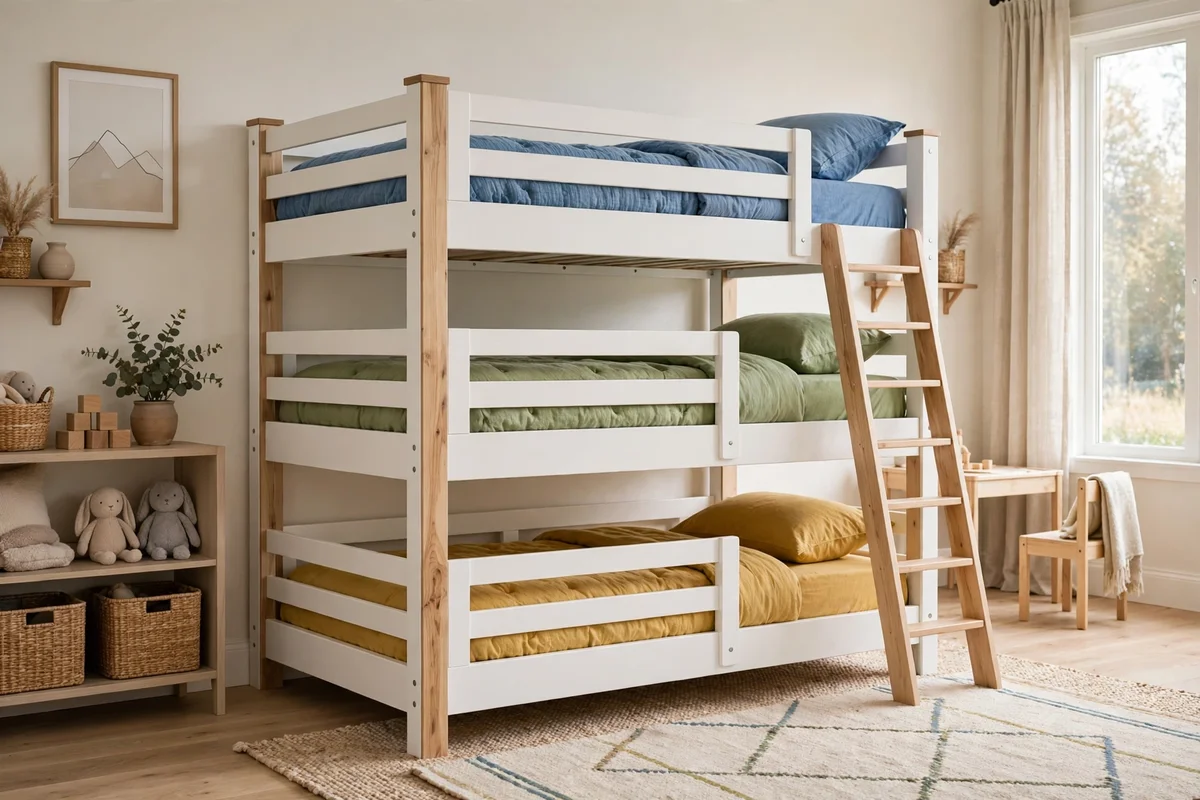
Three children in one room, or two children plus a guest who stays often, is where a triple bunk earns its keep. Three beds stacked or arranged in an L with a third level use far less floor than three single beds, and leave room for the storage and play space that three children need. This is the tallest layout, so the ceiling check matters more here than anywhere else: the top sleeper needs room to sit up, and the middle sleeper needs room to get in and out without bumping their head. A triple bunk with a staircase rather than a ladder is worth the extra floor space, because three children climbing daily is a lot of climbing. Keep the bedding coordinated but not identical — the same colour family, different patterns — so each bunk feels personal, and give the middle bunk its own light, because it is the one that gets the least daylight. If the room is small, pair the triple bunk with the strictest storage rules in the house: everything has a drawer or a basket, or it does not live in the bedroom.
5. Put a desk under a loft bed

A loft bed — one raised bed with the whole space underneath free — is the smartest layout for a single child who needs a study space more than a second mattress. A desk, a chair, and a shelf fit neatly under the bed, turning one footprint into a bedroom and a homework station, and the child gets a workspace that feels separate from the rest of the room, which helps concentration more than most parents expect. This layout suits school-age children best, and it suits small rooms where a bed plus a desk would otherwise leave no floor at all. Keep the desk area well lit — a desk lamp plus the room light — and keep the space under the bed open rather than filling it with storage, because a cramped desk under a low bed is a desk nobody uses. The top bunk age rule still applies to a loft bed, and the same guard rail and ladder rules, so a loft is not a shortcut around safety for a younger child.
6. Turn the space below into a play zone
If the child is younger, or the room already has a desk elsewhere, the space under a loft bed makes a better play zone than a study area. A low play table, a bean bag, a basket of toys, and a small rug turn the under-bed space into a den — a place that feels enclosed and private without being dark, as long as you keep it open on at least one side and add a light. This works especially well in small rooms, because the play area uses space that would otherwise be wasted, and it keeps toys contained in one zone instead of spread across the floor. It also gives the room a clear rhythm: sleep up top, play below, and the floor in the middle stays clear. For more ways to use the freed-up floor, see active kids room ideas — the same thinking about movement and play zones applies once the bed has done its space-saving work. Keep the play zone low and simple, with nothing a child could climb on to reach the top bunk from underneath, and tidy it every evening so the den stays inviting rather than becoming a dumping ground.
Storage and access
7. Build storage into the bed with drawers
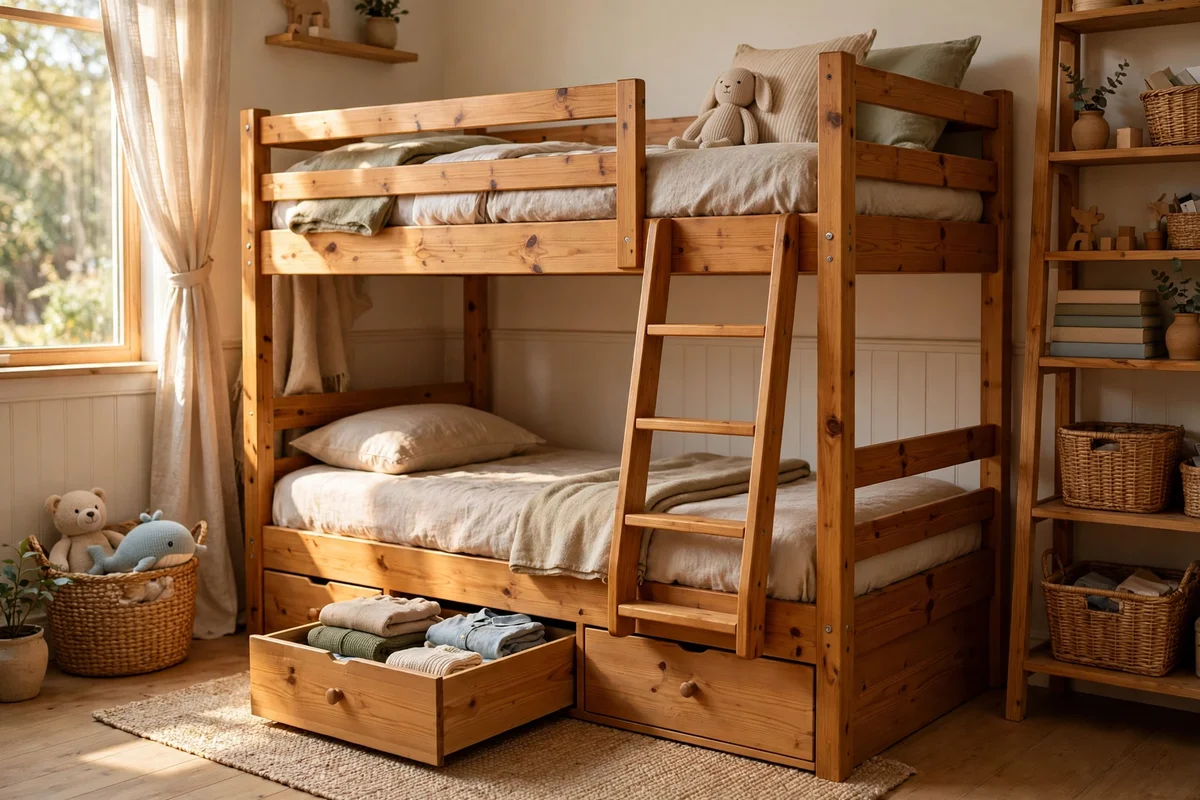
The space under the lower bunk is the most wasted space in a kids bedroom, and drawers built into the bed frame reclaim it completely. Clothes, spare bedding, out-of-season toys, and school kits all fit in deep drawers that slide out from under the bed, which means the room needs one less chest of drawers — and in a small room, one less piece of furniture is a visible difference. Drawers work best when they are on full-extension runners, so a child can reach the back without climbing in, and when each drawer has a job: one for clothes, one for bedding, one for toys. Label the drawers with pictures for younger children, and keep the heaviest items in the lowest drawers. This is the single most practical upgrade on a bunk bed, and it is worth paying for even if it means choosing a plainer frame, because storage is what keeps a small room liveable day after day.
8. Swap the ladder for stairs
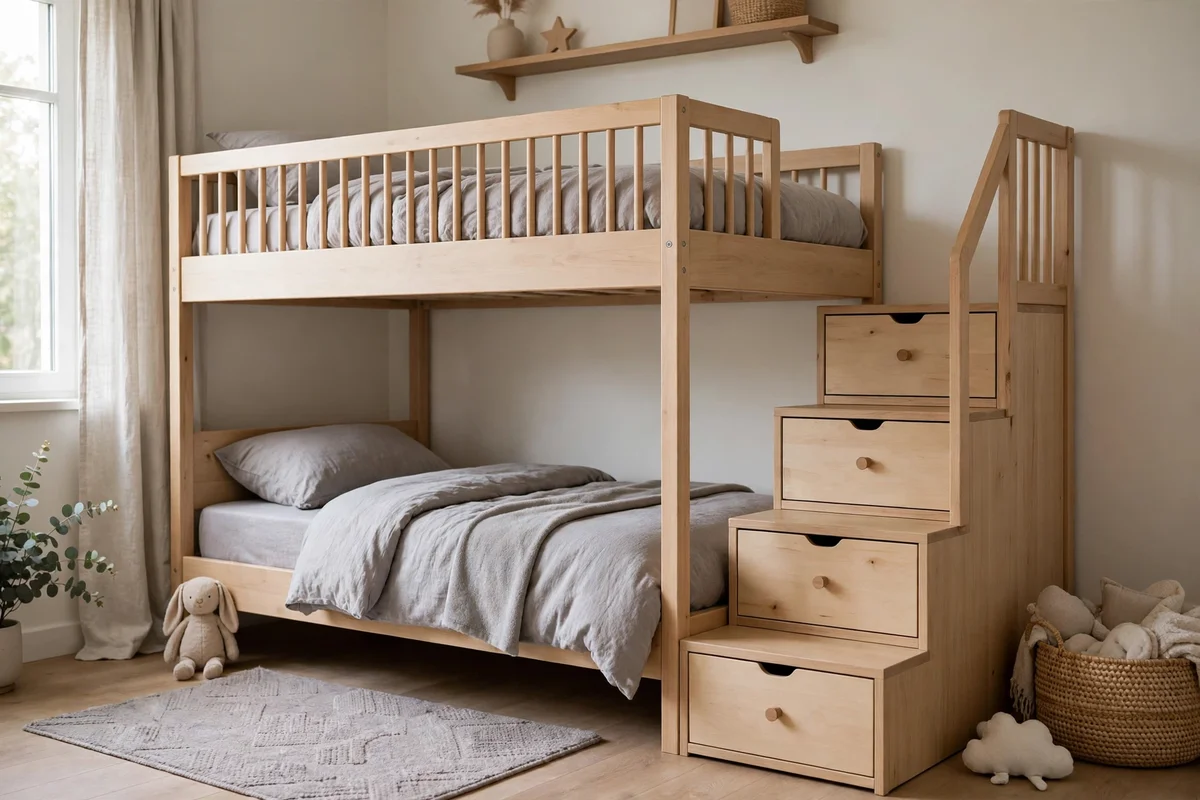
Stairs instead of a ladder change how a bunk bed feels to use, especially at night. Wide, flat steps are easier on bare feet, easier for a sleepy child, and easier for a parent carrying a child or a pile of bedding. Most stair bunks also hide a drawer in every step, which adds a surprising amount of storage — each step holds a surprising amount of small things, from socks to puzzle pieces. The trade-off is floor space: a staircase needs a run of floor in front of the bed, so measure it and mark it with tape before ordering. Stairs suit younger climbers, nervous sleepers, and any family where the top bunk gets used several times a night. They also suit rooms where the bed will be used for years, because a staircase is a feature a teenager will still happily use, where a vertical ladder starts to feel like a chore. If floor space is genuinely too tight for stairs, choose an angled ladder with flat, wide rungs instead of a vertical one with round dowels — it is a real improvement for very little extra space.
9. Go custom with built-in wall bunks
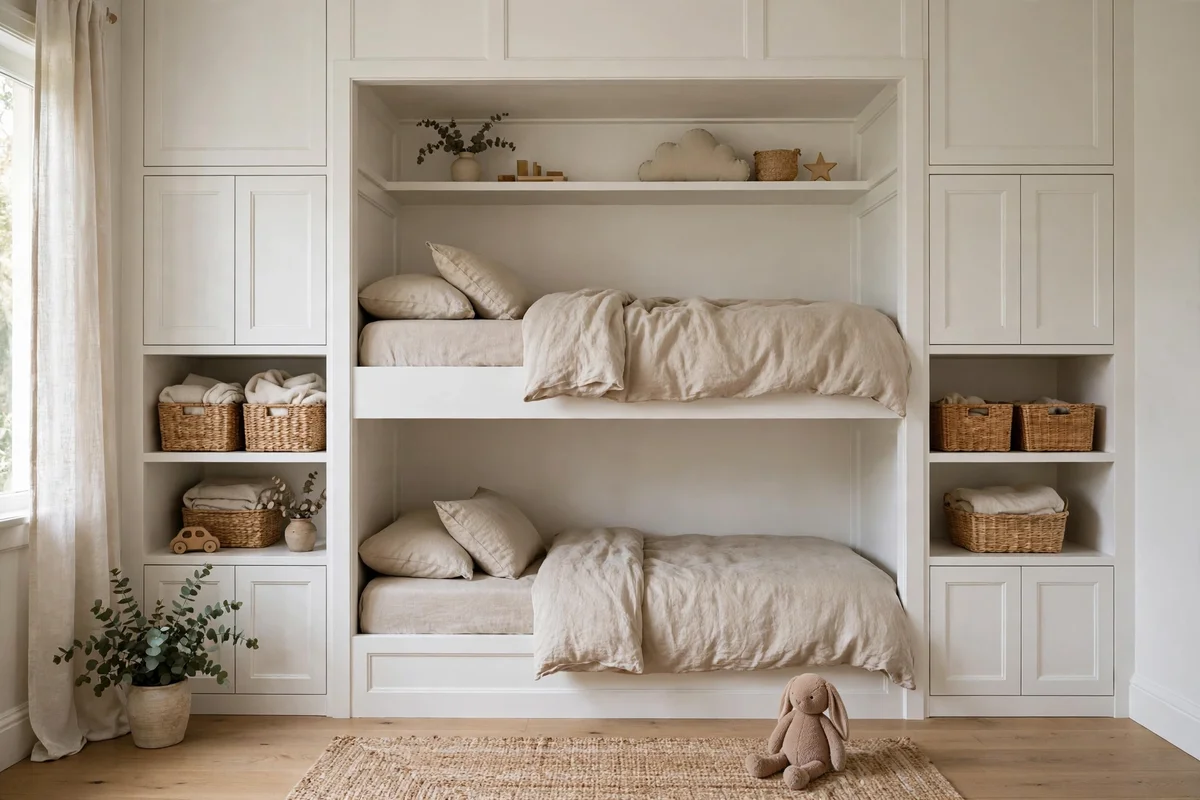
Built-in bunk beds — bunks set into a wall niche, with shelves, cupboards, and sometimes a desk built around them — are the most polished option, and the one that makes a small room feel designed rather than furnished. Because the bunks are fixed to the wall, they feel solid and quiet, with no wobble and no gaps behind the bed for toys to disappear into. The surrounding joinery holds books, clothes, and toys exactly where they are needed, and the whole wall works as one piece of furniture. This is the right choice when a room is being renovated anyway, or for a holiday home or a room that will keep the same layout for years, because built-ins are permanent and cost the most to change. If you go this route, plan the lighting and the power points into the build — a reading light and a charging point per bunk — because adding them afterwards means chasing cables through finished joinery. And keep the bunks themselves simple and neutral, so the room can grow up with new bedding and new art rather than needing a rebuild.
10. Add a trundle for sleepovers

A trundle — a low bed on wheels that slides out from under the lower bunk — is the sleepover solution that takes up no floor space at all when it is not in use. It pulls out in a minute, sleeps a friend at the same height as the lower bunk, and slides away in the morning, which makes it ideal for children whose friends stay over often but not every night. It suits rooms where a third bed would crowd the floor, and families who host cousins and grandparents' visits as well as sleepovers. Check two things before you buy: that the trundle mattress is a proper mattress, not a thin pad, because a guest deserves a real night's sleep; and that there is a clear run of floor in front of the bed to pull it out, with the rug moved aside. Keep the trundle bedding in a labelled bag or a drawer so a sleepover can be set up without a hunt through the linen cupboard, and the room is always ready for one more.
11. Use the walls for storage, not the floor
When the floor is full, the walls are the only space left, and a bunk bed room is the perfect place to use them. Wall-mounted shelves beside each bunk hold books and a water bottle within reach, hooks on the end of the bed hold tomorrow's clothes, and a narrow shelf above the lower bunk holds the things a child wants to see but not to play with. Tall, narrow storage uses the height the bunk bed has already claimed, and it keeps the floor clear for play. Anchor every shelf and every tall unit to the wall — this matters doubly in a bunk room, because children climb, and a shelf that can be pulled down is a hazard. Give each child one shelf that is theirs alone, at their own bunk, and the shared shelves a simple rule: what lives on the shelf lives on the shelf, and everything else lives in a drawer. The room will look calmer, the floor will stay clearer, and the morning hunt for shoes and school bags gets shorter.
Style and finish
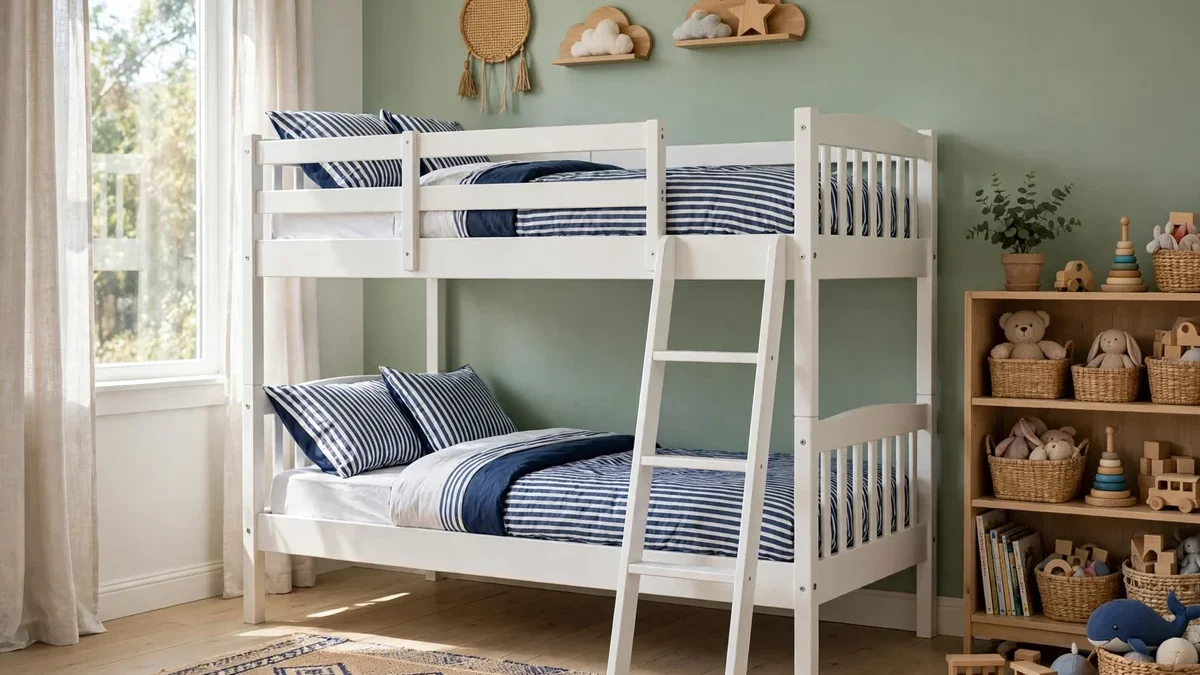
12. Keep it bright with a white bunk bed

A white bunk bed is the easiest way to keep a small room feeling light and large. White reflects the daylight, makes the bed look less bulky than a dark frame, and goes with any bedding colour, which means the room can change its look with a new duvet set rather than new furniture. It suits small rooms, north-facing rooms, and rooms where the bed is the biggest thing in it — which is most bunk rooms. The practical side: white shows scuffs and fingerprints more than wood, so choose a washable, wipeable finish and keep a small pot of touch-up paint in the cupboard. Style it with colourful bedding and one strong accent — a mustard cushion, a coral throw, a patterned rug — and the white frame becomes a frame in the true sense, showing off the colour rather than competing with it. If the wall behind the bed feels plain, a single painted accent wall in a soft colour makes the white bed stand out beautifully; see accent wall ideas for kids rooms for how to choose the wall and the finish.
13. Warm it up with natural wood
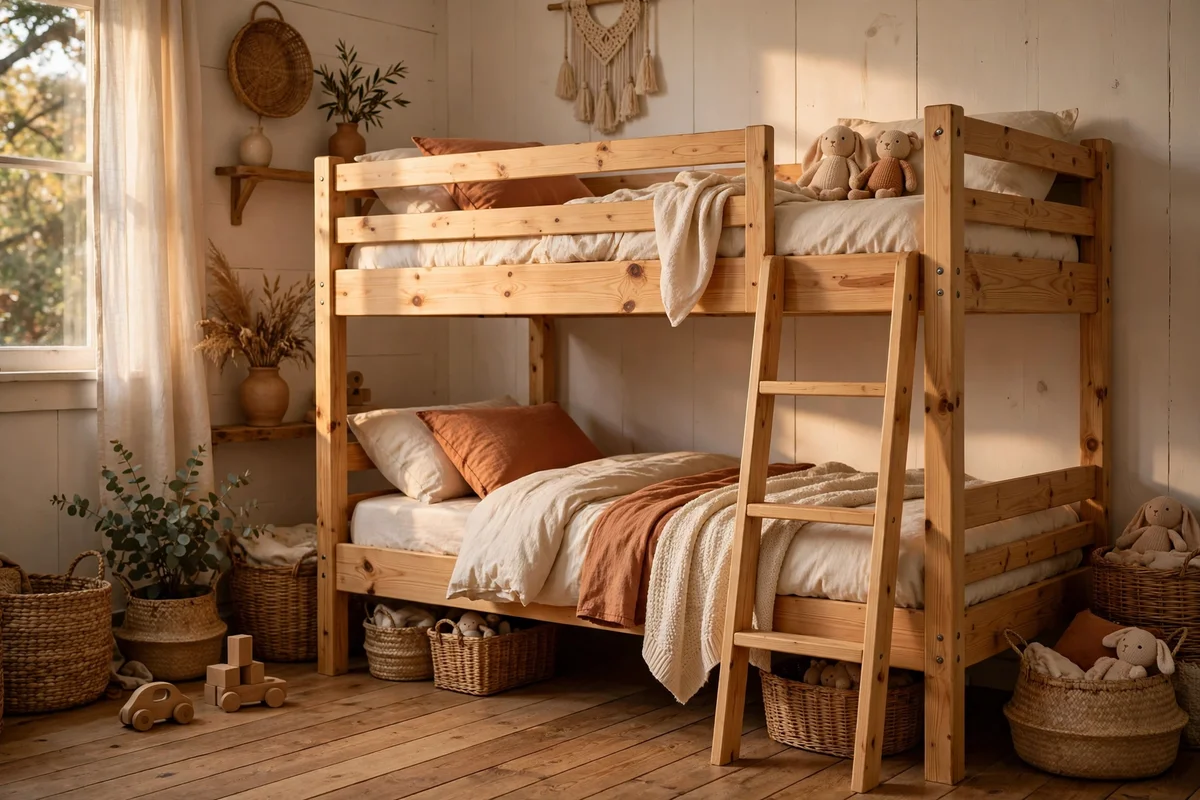
Natural wood — pine, oak, or a warm beech — gives a bunk room a calm, timeless feel that painted frames cannot quite match. The grain adds texture without pattern, the colour warms up white walls, and the bed ages gracefully: a wooden bunk that looks good at six still looks good at twelve, where a themed or brightly coloured frame may not. Wood suits rooms with natural textures already in them — a woven rug, linen bedding, wicker baskets — and it pairs well with almost any wall colour, from soft sage to dusty blue. If you choose wood, check the finish: a smooth, sealed finish wipes clean and resists the sticky fingerprints that are part of life with children, while raw or rough-sawn wood catches dust and is harder to clean. Keep the bedding mostly plain with one or two natural textures, and let the wood be the warmest thing in the room.
14. Choose a modern minimalist bunk
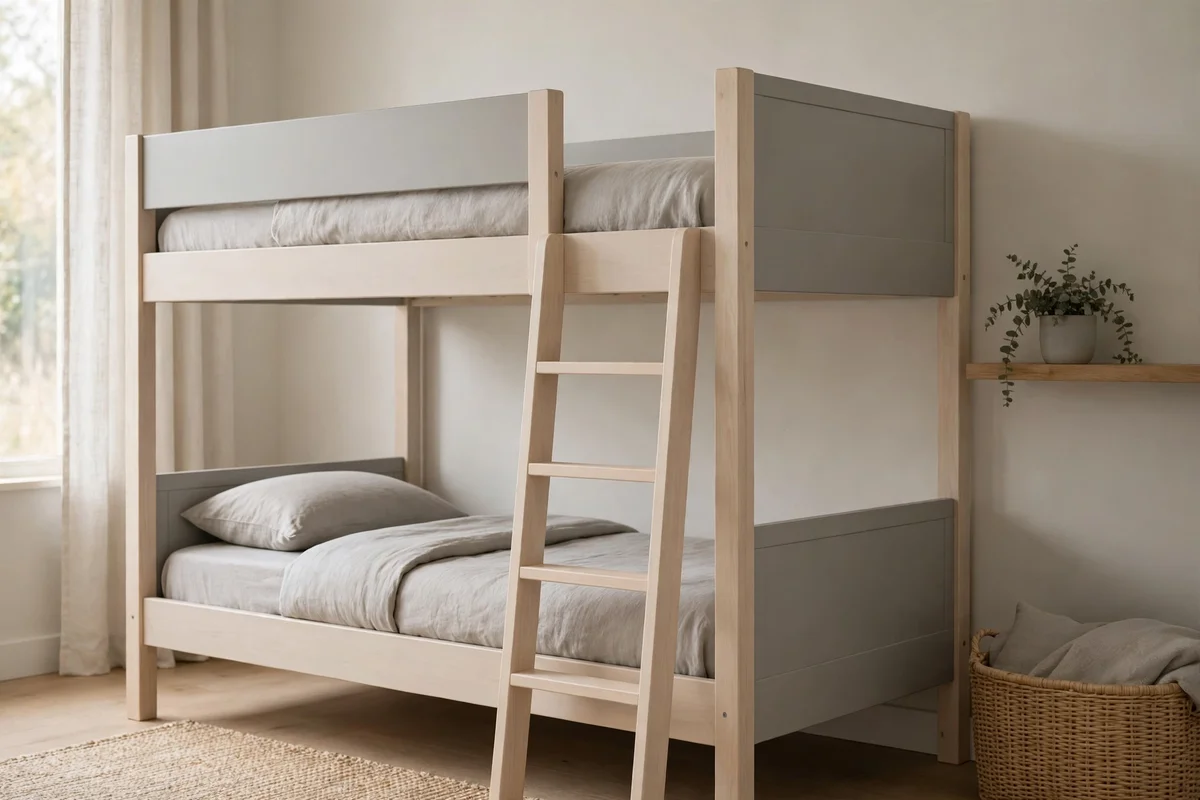
A modern minimalist bunk — clean lines, no decoration, a neutral frame in white, grey, or pale wood — is the layout for parents who want the room to feel calm and for children who are growing out of themed furniture. There is nothing on the bed to date it, nothing to outgrow, and nothing competing with the rest of the room, which means the bedding, the art, and the toys provide the personality and can change as the child does. This style suits older children and pre-teens, small rooms that need to feel uncluttered, and shared rooms where two children have different tastes, because a neutral bed takes no side. Keep the room equally simple: one colour family, plain bedding with a single pattern, storage that closes away. The discipline pays off in a room that feels bigger than it is and stays looking good with almost no effort — and when the child is ready for a more grown-up room, the bed does not need to change at all.
15. Let colour do the work
A colourful bunk bed — a painted frame in deep blue, forest green, mustard, or dusty pink — turns the bed into the room's focal point, and it is the fastest way to give a plain room personality without redecorating. Colour works best when it is deliberate: one strong colour for the frame, bedding that picks up that colour in a softer shade, and the rest of the room kept neutral so the bed can carry the look. It suits playful rooms, younger children, and rooms that need cheering up, and it is easy to change later — a painted frame can be repainted in a weekend when tastes change. If the whole room is already colourful, keep the frame neutral instead and put the colour in the bedding, because a colourful bed plus colourful walls plus colourful bedding is three statements arguing. Choose the frame colour from something the child already loves — a favourite book, a toy, a sports team — and the room will feel theirs in a way no catalogue colour ever manages.
16. Make it a house with a house-shaped bunk

A house-shaped bunk — a frame with a peaked roof outline above the top bunk — turns the bed into a little house, and for younger children that is the whole appeal. The roof frame holds string lights, draped fabric, or bunting, the top bunk becomes a lookout, and the bottom bunk becomes a cosy den, all without any extra furniture. It suits children roughly from four to nine, and rooms where the bed is also the play space, because the house shape invites imagination in a way a plain frame does not. Keep the rest of the room simple, because the house frame is already a strong shape, and keep the roof line clear of the ceiling — measure the total height, including the peak, before you order. The house shape is also easy to retire gracefully: when the child outgrows it, the lights and fabric come down, the frame reads as a plain bunk with a peak, and the room grows up without a new bed.
Cosy and personal
17. Give each bunk privacy with curtains

A curtain on each bunk is the cheapest privacy a shared room can buy, and for siblings it can be the difference between sharing happily and arguing nightly. A simple linen or cotton panel on a slim rail or a tension rod gives each child a space they can close off to read, to sleep, or just to be alone for a while, and it makes the lower bunk — which can feel exposed — into a cosy retreat. Curtains also soften the look of the bed, add texture, and help block a little light and draught. Choose a lightweight, washable fabric, and fix the rail firmly so a tug does not bring it down. Keep the curtain short of the floor and clear of the ladder, and never use cords or ties with loops near the bed. Give each child their own colour or pattern, and the curtains become part of how the room says who sleeps where — which, in a shared room, matters more than most decorating decisions.
18. Build a theme around the bed — lightly
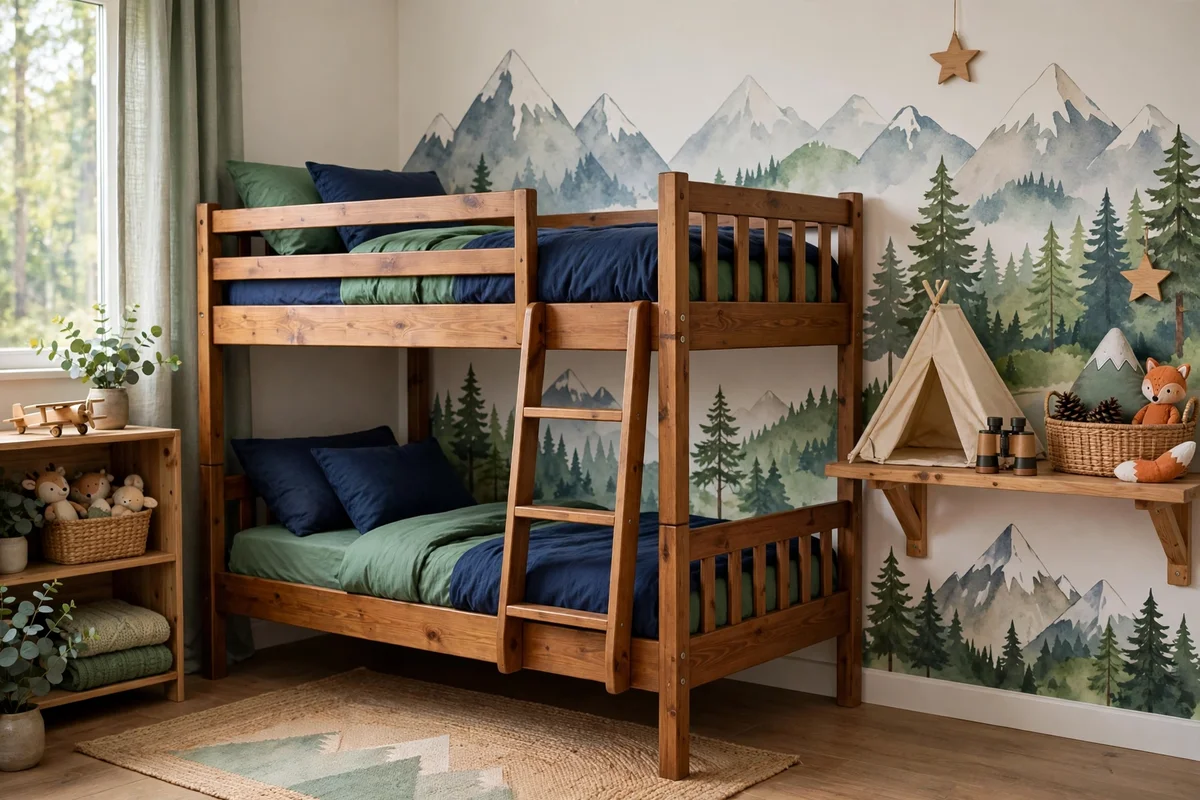
A themed bunk bed can make a bedroom feel magical, but the trick is to theme lightly so the room can grow up without a rebuild. Pick one idea — adventure, space, the sea, a forest — and put it in the things that are easy to change: the bedding, a wall decal or two, a shelf of themed books and toys, and the colour of the cushions. Leave the bed frame neutral and the walls plain or softly coloured, and the theme sits on top of the room rather than being built into it. An adventure theme suits a bunk bed particularly well, because the top bunk already feels like a lookout and the bottom bunk like a base camp; see adventure-themed kids room ideas for curious explorers for ways to build the theme out across the whole room. Avoid the full themed bed with moulded towers and fixed decorations unless you are sure the child will love it for years, because a theme built into the furniture is expensive to undo, while a theme built from bedding and decals can change in an afternoon.
19. Light each bunk like its own room
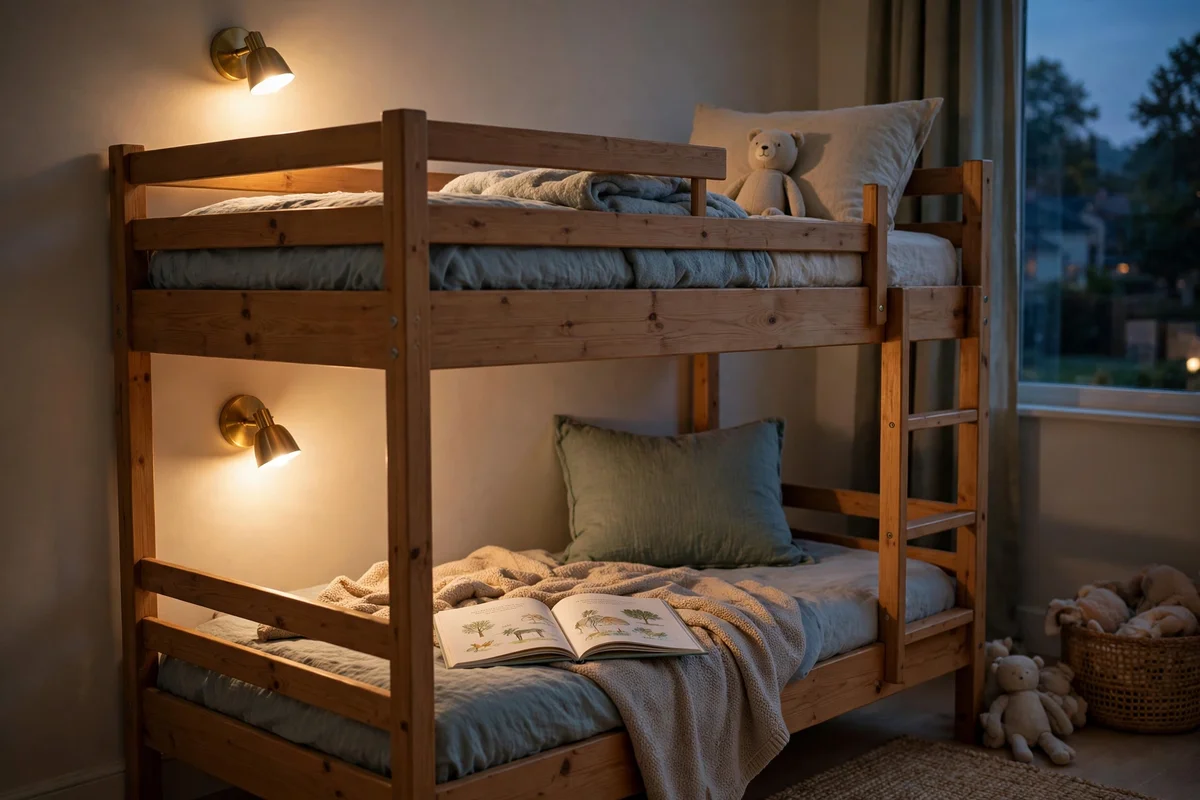
A bunk bed is really two small bedrooms stacked, and each one needs its own light. A small wall-mounted reading light beside each bunk — or a clip-on light fixed where a child can reach it without standing — lets one child read while the other sleeps, and makes the top bunk feel safe at night instead of dark and high up. Warm light suits bedtime better than bright white, and a light with its own switch at the bunk means nobody has to climb down to turn it off. Add a small shelf or pocket beside each light for a book and a water bottle, and each bunk becomes self-contained: light, book, water, and a place to put them. Keep cables and chargers tidy and away from the ladder, and choose lights that are fixed firmly rather than loose clip-ons that can be knocked off in the night. It is a small detail and a small cost, and it is the one most families say they wish they had planned from the start.
20. Make a reading nook under the bunk

The space under a loft bed, or beside a bunk in a corner, makes a natural reading nook: a cushion or two on the floor, a low bookshelf, a soft light, and a blanket are all it needs. Children love a space that feels enclosed and theirs, and a nook under the bed feels separate from the rest of the room in a way a chair in the corner never does. It suits quiet children, keen readers, and any child who needs a place to calm down, and it costs almost nothing if the cushions and books are already in the house. Keep the nook open on one side so it never feels shut in, keep the light warm and low, and keep the book selection small and rotating — a full bookshelf overwhelms, while six books at a time get read. A nook also gives the room a second purpose beyond sleeping and playing, which is what turns a bedroom with a bunk bed into a room a child actually wants to spend time in. For corner ideas that pair well with a nook, see cute bedroom corner ideas for kids.
A Weekend Plan: Saturday and Sunday
A bunk bed room does not need a month of planning. It needs a clear order, because assembling a bed before you have measured, or buying bedding before you have chosen the frame, creates the rework that eats weekends.
On Saturday morning, measure the room and the ceiling, mark the bed's footprint on the floor with painter's tape, and check the ladder or stairs, the drawer run, and the door swing. Order or collect the bed, the mattresses, and the fixings, and check that every part is there before you start — a missing bolt discovered at bedtime is a miserable discovery. Assemble the bed with two people, following the manufacturer's instructions step by step, and do not skip the wall anchoring. While one person assembles, the other can wash the new bedding and sort the storage: one drawer per child, one basket per kind of toy.
On Sunday, make the beds, add the lights and the shelves, and put the room back together in this order: bed and bedding first, then storage, then the rug and the play zone, then the personal touches — curtains, name signs, art — last. Art and personal touches go last because they are the easiest to move, and you will only know where they belong once the furniture is in place. Finish by walking to the door and looking at the room as a visitor would, and by checking the safety list: rails firm, ladder fixed, bolts tight, furniture anchored, night light by the ladder, and nothing hanging from the rails. Then let the children in — and be ready for the argument about who gets the top bunk.
Small Rooms, Shared Rooms, and Low Ceilings
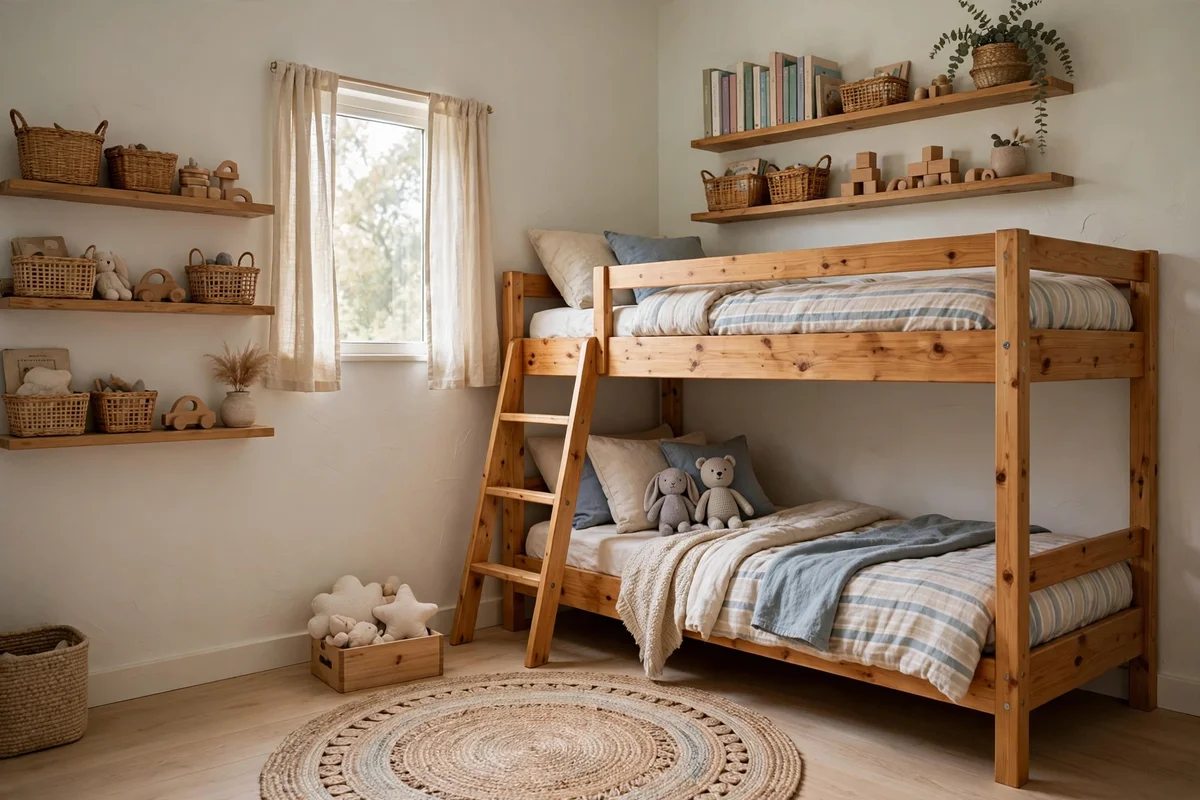
A small room needs the bunk bed to work harder and take up less space. Choose the simplest layout — twin-over-twin with drawers — and let the bed do the storage work instead of adding furniture around it. Use the walls for shelves and hooks, keep at least one patch of floor completely clear for play, and keep the colours light so the room does not feel smaller than it is. A rug in the middle of the clear floor marks the play zone and makes the room feel finished without adding furniture. Avoid a triple bunk or a wide staircase in a very small room, because both eat the floor the bed was supposed to free, and avoid a theme that needs a lot of decoration — a small room with a big theme feels crowded fast.
A shared room needs the bunk bed to give each child something of their own. Curtains on each bunk, a light and a shelf per child, bedding in each child's colour, and a drawer or basket each — these small separations prevent most of the arguments that shared rooms generate. If the children are different ages, the twin-over-full or the L-shaped layout gives the older child more space without making the younger one feel short-changed. Colour-coded storage earns its keep twice over in a shared room: each child's bins in their own colour end most arguments about whose toys are whose. And agree the top bunk rota before the bed arrives, not after — a simple weekly swap, or a rule that the older child always takes the top, decided in advance, saves a surprising amount of negotiation.
A low ceiling needs a low bed. Measure the sitting height on the top bunk and be honest about it: if the sleeper cannot sit up, the bed is too tall for the room, and no amount of styling fixes that. Look for a low-profile bunk, a half-height loft, or a bed designed for rooms with low ceilings, and keep the ceiling fan and light fittings well clear. A low room also benefits from a pale frame and pale walls, because dark colours make a low ceiling feel lower, and from keeping the top of the bed free of tall decorations. If the ceiling is too low for any bunk, two low single beds with storage underneath may be the better answer — a bunk bed is a wonderful solution, but only when the room is tall enough to hold one safely.
Bunk Beds by Age
A younger child's room — roughly four to six — should keep the top bunk out of bounds. The younger child sleeps below, in a bunk that feels special in its own right: curtains, a light, bedding they chose, and a shelf of their own. A house-shaped frame or a low half-height loft suits this age, because the bed feels playful without being high. Keep the room's decoration low and reachable — hooks, shelves, and art at the child's height — and keep the ladder or stairs easy and well lit.
A school-age child's room — roughly seven to ten — is where a bunk bed comes into its own. The older child can take the top bunk, the room can carry a theme, a desk under a loft bed, and a reading nook, and the child can be involved in the choices: which colour, which bunk, what goes on their shelf. This is also the age to teach the safety rules properly and to expect them to be followed — one child on the top bunk, ladder only, no jumping — because a school-age child can understand why the rules exist, not just that they exist.
A pre-teen's room needs the bunk to feel grown-up, not themed. A minimalist or natural wood frame, plain bedding, a proper desk under a loft bed, and a reading light per bunk all work, because they read as design rather than decoration. This is the age where a house-shaped frame or a themed bed starts to feel young, and where the bed should be chosen so it can stay for several years. If the room will need to change within two years, choose a neutral frame and change the bedding, not the bed. For ideas on styling a room that is growing up with its owner, see big kids room ideas.
Budget: Three Price Levels
A bunk bed room does not have to be expensive. The difference between the three levels below is how much is built in and how much is bought ready-made, not how good the result looks.
A refresh under $150 uses a simple twin-over-twin frame, bedding you already own or one new set per bunk, a set of curtains for privacy, and a clip-on light per bunk. The bed changes the room without any new furniture, and it takes a weekend.
A mid-level refresh, roughly $150 to $600, adds the pieces that make the biggest difference: a bed with built-in drawers or stairs, a trundle for sleepovers, a small desk under a loft bed, wall shelves, and a rug for the play zone. This is the level most families choose, because it changes the room properly without changing the room's structure.
A full redo, $600 and up, adds a built-in wall of bunks, custom joinery, a fitted desk and wardrobe around the bed, and layered lighting. This is worth doing when the room is being renovated anyway — new flooring, a move, or a room being reconfigured for two children — rather than as a standalone project. If you are spending at this level, spend it on the things that are hardest to change later: the bed, the joinery, and the lighting. Bedding, curtains, and art can always be upgraded later, one piece at a time.
Whatever the budget, buy the mattresses after you have chosen the bed, not before. Mattresses come in standard sizes, but the top bunk needs a specific thickness so the guard rail stays effective, and the manufacturer's recommendation for that bed is the one to follow. A mattress bought first and a bed bought second is how families end up with a top mattress that is too thick for its rails.
Mistakes That Make Bunk Bed Rooms Look Wrong
The most common mistake is buying the bed before measuring the room. A bed that is too tall for the ceiling, too wide for the wall, or too deep for the door swing is a problem that no amount of styling solves, and returning a bunk bed is far harder than returning a cushion. Measure first, tape the footprint on the floor, and only then order.
The second mistake is choosing a ladder when the family needed stairs, or stairs when the room needed a ladder. A young or nervous climber with a vertical ladder will avoid the top bunk, and a staircase in a room with no floor to spare eats the play space the bed was supposed to create. Match the way up to the climber and the room, not to the photo.
The third mistake is filling the freed-up floor with more furniture. The point of a bunk bed is the empty floor it creates, and a room where that floor is immediately filled with a second wardrobe, a toy chest, and a desk has gained nothing. Leave a clear patch of floor, and let the room breathe.
The fourth mistake is theming the bed instead of the bedding. A bed with moulded towers, fixed decorations, or a strong theme built into the frame is expensive to undo when the child outgrows it. Theme the bedding, the decals, and the cushions, and keep the frame neutral, so the room can change in an afternoon.
The fifth mistake is forgetting the bottom bunk. The top bunk gets the view, the adventure, and all the attention, while the bottom bunk gets the dark and the dust. Give the bottom bunk its own light, its own curtain, and bedding just as good as the top, because a child who feels short-changed by their bunk will not love the room, however good the top bunk looks.
The sixth mistake is skipping the safety checks because the bed looks sturdy. A bed that looks solid can still have loose bolts, a ladder that is not fixed, or a mattress that is too thick for its rails. Check the fixings when the bed goes up, check them again after a month, and check them every few months after that. It takes five minutes, and it is the most important maintenance in the room.
How to Let the Bunk Bed Grow Up With Your Child
The best bunk bed rooms are built to change in stages. When the theme gets outgrown, change the cheap things first: take down the decals, swap the themed bedding for plain colours, remove the curtains, and change the cushions. That alone removes most of the theme, and the room will already feel older.
If that is not enough, repaint a painted frame in a neutral colour, or strip the house-shaped extras — the lights, the fabric, the bunting — and let the frame read as a plain bunk. The storage, the desk, and the shelves can stay, because they were never really part of the theme at all.
The expensive reversals are the built-in wall and the custom themed bed, which is why they belong in rooms you expect to keep for years. A freestanding bunk can be separated into two single beds when the children get their own rooms — many twin-over-twin frames are designed to split — which is the most graceful ending of all: the bed that saved space in a shared room becomes two beds in two rooms. When you buy, ask whether the frame separates. Future you will be grateful.
Frequently Asked Questions
What age can a child sleep on the top bunk?
Children under six should not sleep on the top bunk. Younger children are still developing the balance and judgement that safe climbing needs, especially at night. Put the younger child on the bottom bunk and the older child on top, and follow the manufacturer's age guidance for your specific bed.
How much headroom does the top bunk need?
Enough for the sleeper to sit up without ducking or bumping their head. Measure from the top of the top mattress to the ceiling in your actual room before you buy, and remember to allow for the ceiling fan and any light fitting. If the sitting space is tight, look at a lower-profile bunk or a half-height loft.
Are stairs or a ladder better for a bunk bed?
Stairs are easier and safer for younger children, nervous sleepers, and night-time climbs, and they usually add drawer storage — but they take up more floor space. A ladder suits rooms where floor space is tight, and an angled ladder with flat, wide rungs is a real improvement over a vertical ladder with round dowels. Match the choice to the climber and the room.
Can a bunk bed work in a small kids room?
Yes — that is what bunk beds are for. A twin-over-twin with built-in drawers uses roughly the floor area of one single bed and frees the rest of the room for play and storage. Keep the layout simple, use the walls for shelves, and leave a clear patch of floor. Avoid wide staircases and triple bunks in a very small room.
How do I stop siblings arguing over the top bunk?
Decide before the bed arrives. A simple weekly swap, or a rule that the older child always takes the top, agreed in advance, prevents most arguments. Make the bottom bunk just as special — its own curtain, light, and bedding — so it never feels like the losing bunk.
What should I put on the bedside table in a bunk bed room?
Keep it minimal: a small shelf or pocket per bunk beats a shared table, because each child can reach their own book, water bottle, and light without disturbing the other. For table ideas that work in tight spaces beside a bed, see bedside table ideas.
Can a bunk bed be separated into two single beds?
Many twin-over-twin frames are designed to split into two single beds, which makes them a good long-term buy for a shared room that may one day become two rooms. Ask before you buy, because not every frame separates, and keep the instructions and fixings for the day you need them.
How do I make the bottom bunk feel less dark?
Give it its own warm reading light, a light-coloured curtain rather than a dark one, and pale bedding. Keep the area under the top bunk open rather than filling it with storage, and choose a frame colour that reflects light. A small mirror on the wall opposite can also bounce daylight into the lower bunk.
Final Checklist Before You Start
- Measure the wall, the floor footprint, and the ceiling height — and tape the footprint on the floor.
- Decide who sleeps where, and keep under-sixes off the top bunk.
- Choose the layout from the problem: two sleepers, a desk, three sleepers, or storage.
- Pick stairs for young or nervous climbers, a ladder where floor space is tight.
- Check the guard rails, the mattress thickness, and the manufacturer's instructions for your bed.
- Anchor the bed and all tall furniture to the wall.
- Give each bunk its own light, shelf, and storage.
- Agree the top bunk rota before the bed arrives.
- Leave a clear patch of floor for play.
- Check the bolts again after a month, and every few months after that.
A bunk bed does not need to be the fanciest bed in the catalogue, and the room does not need to be finished in one go. Start with the measuring and the safety checks, choose the layout that fixes your worst problem, add the storage, and let the personal touches grow over time. The rooms children love most are rarely the ones with the most furniture in them — they are the ones where the bed has a plan, the toys have a home, and there is a clear patch of floor to play on. Get those three things right, and the bunk bed takes care of itself.