Bedroom Corner Ideas For Kids
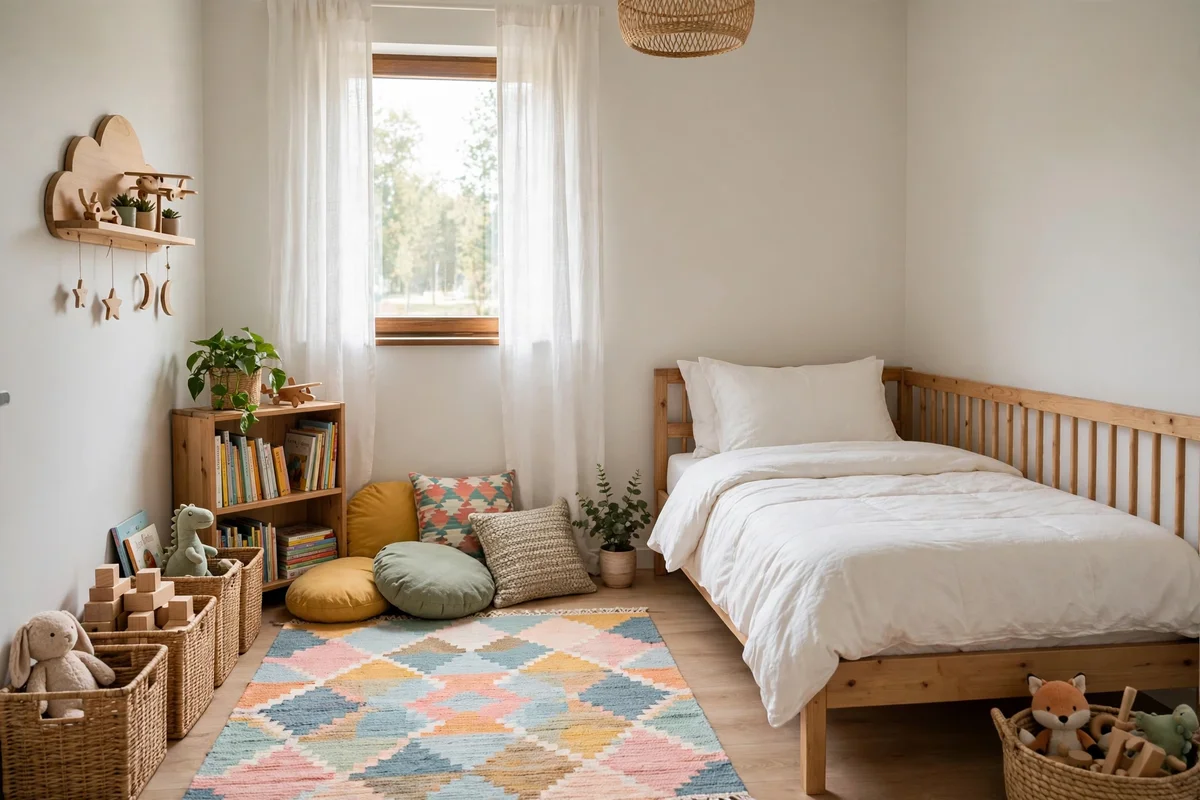
Every bedroom corner can have one job. That is the whole idea behind this article, and it is the reason corners work so well in children's rooms: a corner is a small, defined space with two walls to lean things against, and when you give it a single purpose, a child knows exactly what happens there. The reading corner is where books live. The play corner is where the tent goes. The study corner is where homework happens. Nothing in the corner has to do two jobs at once, and nothing drifts out into the middle of the room.
If you want the short version: pick one corner, give it one job, and measure it before you buy anything. A usable reading nook needs at least 24 by 24 inches of clear floor — about 6 square feet — and a 3 by 4 foot rug is enough to mark out a toddler nook. Start with the corner your child will use most, set it up properly with seating, light, and storage within reach, and leave the other corners alone until the first one is working. The ideas below are arranged by job — read corners first, then play, then learn, then calm, then storage and display — so you can jump straight to the corner you need and copy it this weekend.
How to Pick Which Corner Gets Which Job
A bedroom usually has four corners, and they are not interchangeable. One corner is near the window and gets the best daylight. One is near the door and gets walked past a dozen times a day. One is dark, quiet, and out of the way. One has a plug socket, and one has a radiator. The job you give each corner should follow what that corner already offers, not fight it.
Start by standing in the doorway and watching how the room is actually used for a day or two. Which corner does your child naturally drift to with a book? Which corner collects the toys? Which corner is always empty because it is awkward to reach? The corner your child already uses is the easiest one to improve, because you are working with a habit that exists rather than trying to create one from nothing.
Then check the three things that decide whether a corner will work: traffic, light, and heat. Traffic comes first. Keep corners out of the bed-approach path, the closet door swing, and the main walkway from the door to the bed. A reading nook placed in the path to the closet will be stepped through, not sat in, and a toy corner that blocks a door will be tidied away in frustration. Walk the routes yourself, open the closet door fully, and mark the floor space that stays clear. Whatever is left is your usable corner space.
Light comes second. A reading corner and a study corner need good light, so they belong near the window or near a lamp you can switch on easily. A calm corner and a sleep corner want the opposite — the dimmest, quietest part of the room, away from the window and the door. A play corner is happy in the middle ground: bright enough to see what you are doing, but it does not need the best light in the room. If the only corner with good light is also the corner by the door, put the reading corner there and accept the traffic, or move the reading corner to the window wall and give the door corner to storage, which does not mind being walked past.
Heat and power come third. Check where the radiator is, and keep soft furnishings, cushions, tents, and paper well away from it. A tent draped over a radiator is a fire risk, and a bookshelf pressed against one will warp. Check where the plug sockets are, too: a study corner needs a socket for a lamp, a music corner may need one for a keyboard, and a night-light corner needs one within reach of the bed. If a corner has no socket, a battery lamp or a rechargeable light can fill the gap, but a corner that needs mains power and has none is the wrong corner for that job.
Finally, measure the footprint before you buy anything. Tape out the corner on the floor with painter's tape, put the furniture or cushions inside the tape, and let your child sit in it. A corner that looks generous on a shopping website can feel cramped once a bookshelf, a cushion, and a child are all in it. The tape test takes ten minutes and saves the most common corner mistake of all: buying furniture that fits the room in theory and the corner in practice only if nobody sits in it.
Corner Types at a Glance
Use this table to match a corner type to the space you have, the age of your child, and the rough cost of setting it up. Footprints are for the corner itself, not the whole room, and costs are rough ranges for a basic setup using ordinary shop-bought pieces — not researched prices.
| Corner type | Footprint needed | Best age | Rough cost | Needs |
|---|---|---|---|---|
| Reading corner | 24 x 24 in (6 sq ft) minimum | 3 and up | Under $50 to $200 | Cushion, light, books within reach |
| Window reading nook | Window width, about 3 ft deep | 4 and up | $50 to $200+ | Seat cushion, pillows, book storage |
| Play tent corner | About 3 x 3 ft | 2 to 8 | Under $50 to $200 | Tent, cushion, blanket, toy basket |
| Pillow fort corner | About 3 x 3 ft | 3 to 9 | Under $50 | Cushions, blankets, lights |
| Dress-up corner | About 2 x 3 ft | 3 to 7 | Under $50 to $200 | Low rail, mirror, basket |
| LEGO / building corner | About 3 x 3 ft | 4 and up | $50 to $200 | Low table, sorted bins, display shelf |
| Study desk corner | About 3 x 2 ft | 6 and up | $50 to $200+ | Desk, chair, lamp, shelf or pegboard |
| Art and craft corner | About 3 x 3 ft | 3 and up | Under $50 to $200 | Table, chair, wipe-clean mat, storage |
| Calm / relax corner | 24 x 24 in minimum | 3 and up | Under $50 | Soft seat, blanket, quiet toys |
| Night-light dream corner | Bedside corner | 2 and up | Under $50 | Night light, soft bedding, book |
| Toy storage corner | About 3 x 2 ft | 2 and up | Under $50 to $200 | Low shelves, bins, picture labels |
| Display / library corner | Wall space, little floor | 3 and up | Under $50 to $200 | Floating ledges, shelf, a few books |
20 Bedroom Corner Ideas For Kids You Can Actually Copy
Read Corners
1. The classic reading corner with floor cushions

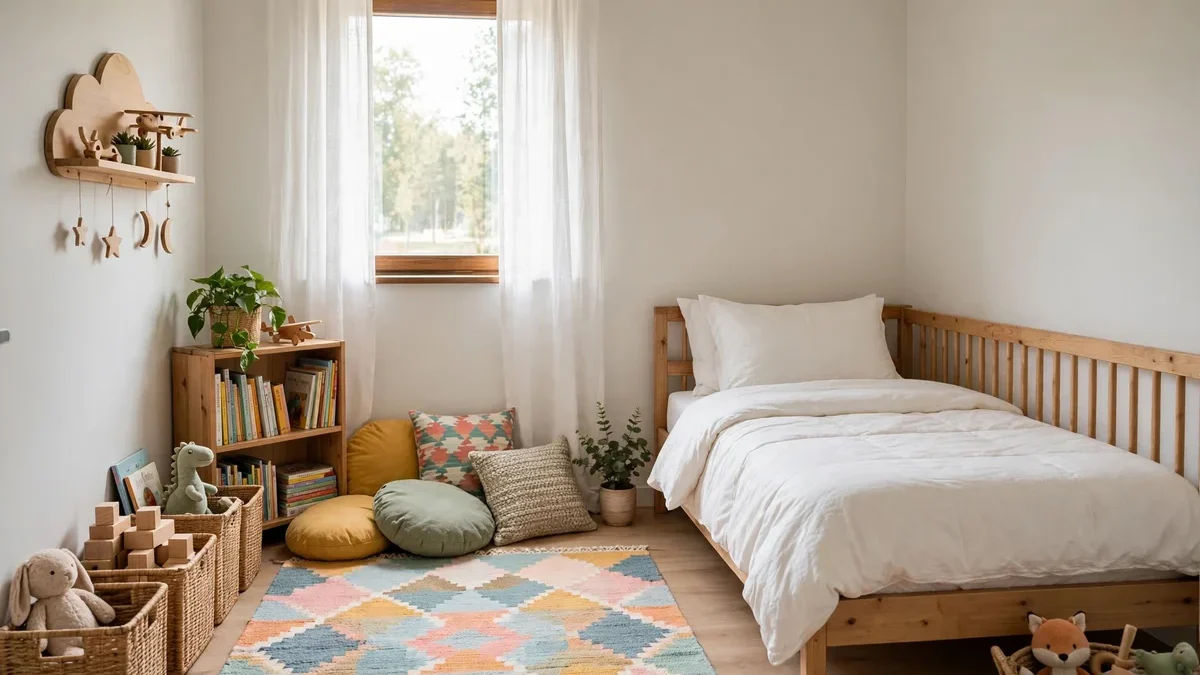
A reading corner needs only three things: something soft to sit on, light to read by, and books within reach. That is why the floor-cushion version works in almost every room — it asks for very little and gives back a place a child will actually sit.
Start with the floor. A rug marks the corner out as its own place, and a 3 by 4 foot rug is enough to mark a toddler nook; an older child will want a little more room, so a rug that fits the cushion and a book basket is about right. Put a large floor cushion or two smaller ones on the rug, angled into the corner so your child can lean against both walls. A cushion with a removable, washable cover is the practical choice, because a reading cushion gets sat on, spilled on, and dragged around.
Light matters more than most people expect. Room lighting is usually too dim for reading, so a dedicated reading lamp belongs in the corner, at a height your child can switch on without standing up. A clip-on lamp fixed to a low shelf, a small table lamp on a low stool, or a wall lamp above the cushion all work. Warm white light is the comfortable choice for evening reading, and a lamp your child can control themselves is the difference between a corner they use and a corner you have to set up for them every time.
Books belong within arm's reach and no higher than your child's shoulder when sitting. A low forward-facing bookshelf, a basket on the floor, or a single floating ledge at sitting height all work. Keep the selection small and rotate it: ten books on the shelf, swapped every few weeks, get read far more than fifty books crammed together. A basket for the book currently being read keeps the corner tidy without any rules at all.
2. The window reading nook
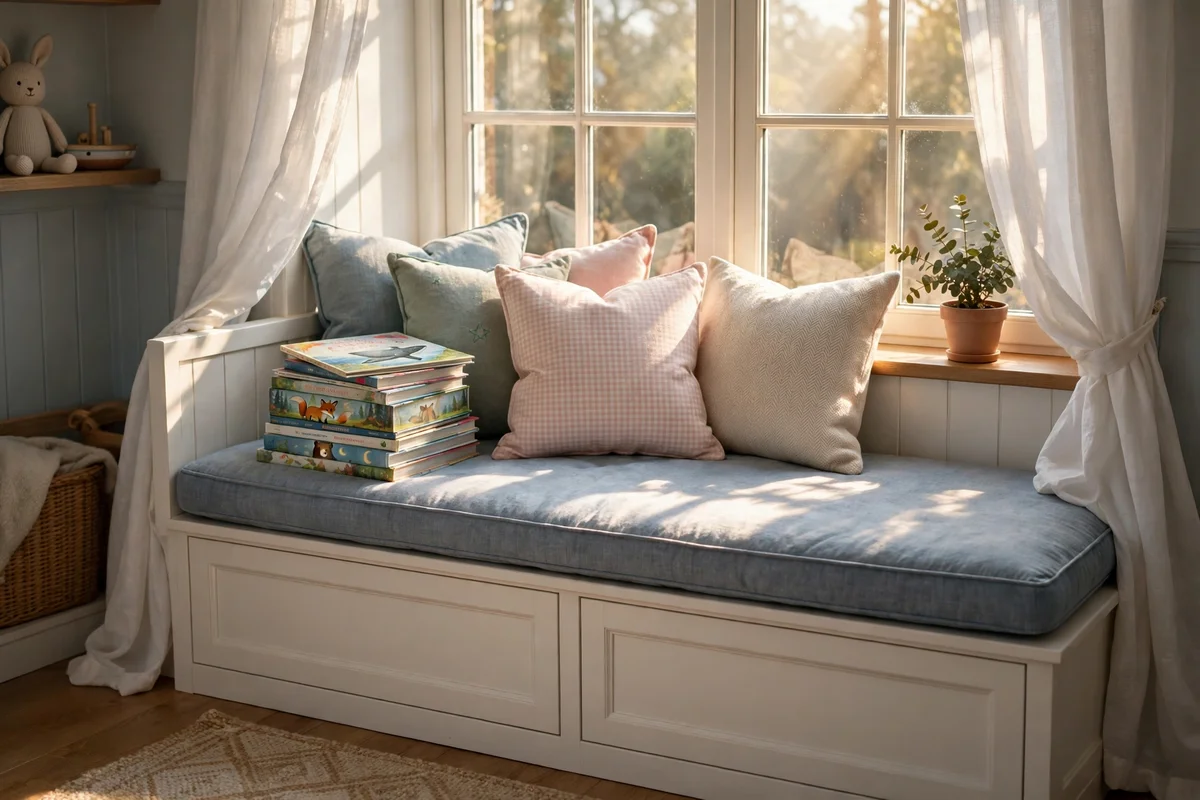
A window seat is the reading corner that children ask for by name, because it feels like a secret place even though it is in plain sight. It works best on a low, wide windowsill or a window seat built into the wall, but a simple version needs no building work at all: a cushion on the floor beneath the window, a stack of pillows against the wall, and a basket of books beside it.
Measure the window first. The nook is as wide as the window and about 3 feet deep, and that depth is what decides whether it works. Less than 2 feet deep and there is no room for a cushion and a child; more than 3 feet and the space behind the cushions becomes a gap where books and toys disappear. A cushion cut to fit the width of the window, with a washable cover, is the one purchase that makes the biggest difference — a cushion that slides around or is too short leaves a hard edge that nobody wants to sit against.
Light is the window nook's great advantage and its one problem. Daylight is the best reading light there is, but late-afternoon sun can glare straight onto the page. A sheer curtain or a blind that filters the light without blocking it solves the glare, and a small clip-on lamp covers the evenings. Keep the books out of direct sun as well, because spines fade and pages yellow faster than you would expect on a sunny sill.
Safety comes before comfort here. If the window opens, fit a restrictor so it cannot open wide enough for a child to climb through, and keep the nook clear of blind cords, which should be tied up out of reach or fitted with a safety cleat. A window nook is a reading place, not a climbing frame, and the rule worth stating out loud is that the nook is for sitting, not standing on the sill.
3. The mini library wall
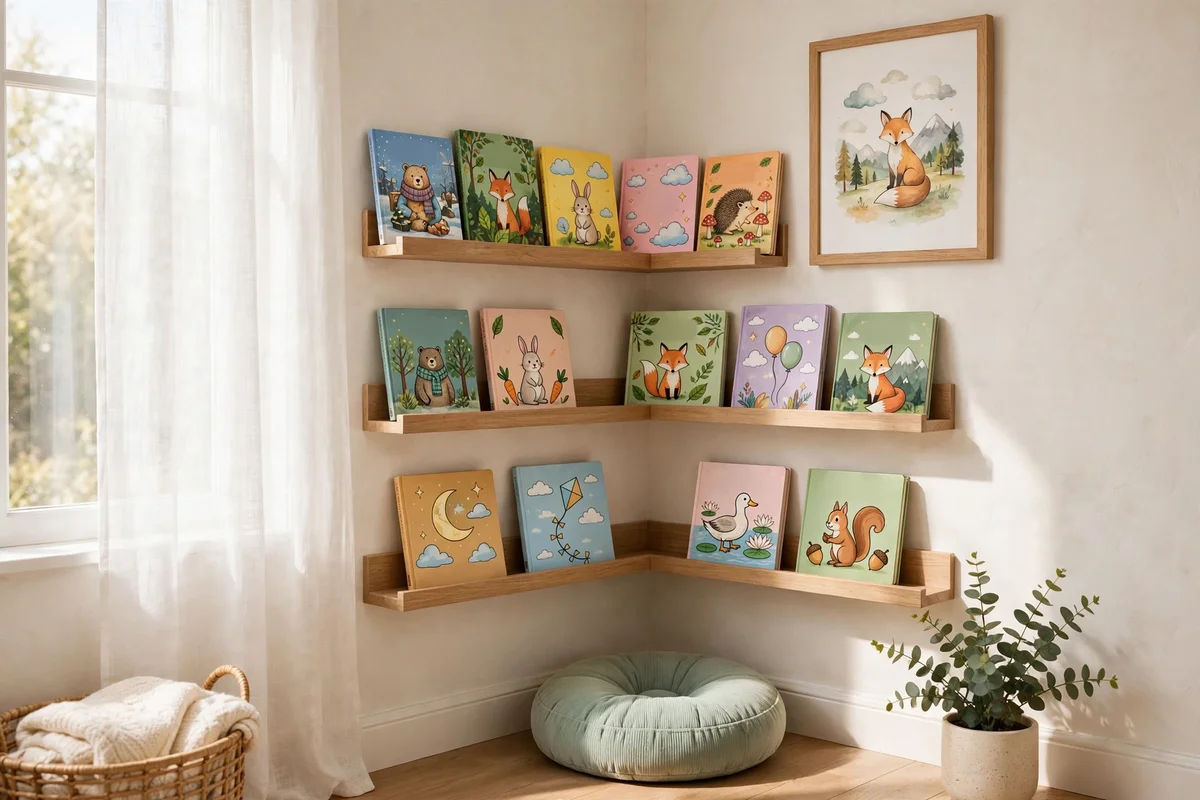
A mini library wall turns a corner's wall space into the reading corner, and it is the best choice when floor space is short. Instead of a bookshelf taking up floor, the books live on the wall, and the floor below holds a single cushion.
Floating ledges are the workhorse here. A picture ledge is a shallow shelf with a lip at the front, and books sit on it facing forward so your child chooses by the cover, not the spine. Two or three ledges stacked above a cushion, at sitting height and standing height, hold a surprising number of books in very little space. Fix them firmly into the wall — not just into plasterboard — because a ledge full of books is heavy, and a child will pull on it.
Keep the display small. A ledge holding eight to ten books looks inviting; a ledge crammed with twenty looks like a shop shelf and makes choosing harder, not easier. Rotate the books on the ledges every few weeks, and keep the rest of the books in a basket or a box elsewhere in the room. The books on the wall are the ones to read this week, and that limit is what makes the corner feel special.
Play Corners
4. The indoor play tent corner

A play tent turns a corner into a small room inside the room, and children use it for reading, quiet play, and hiding in a way that no other piece of furniture quite matches. A tent needs about 3 by 3 feet of floor, a cushion and a blanket inside, and nothing else to start with.
Choose the tent for the corner, not the other way round. A teepee-style tent fits neatly into a corner with its point toward the room, while a square playhouse tent sits flat against two walls and uses the corner more efficiently. Measure the corner before you order, and check the tent's footprint against the tape on the floor — tents are often wider at the base than the picture suggests. Leave a little space around the tent so the fabric does not rub against the wall and so your child can get in and out without squeezing past furniture.
Inside the tent, keep it simple: one cushion, one blanket, and a basket of books or soft toys. More than that and the tent becomes storage, not a hideaway. A string of battery fairy lights inside the tent makes it feel special after dark, but keep the battery pack outside the tent or fixed high up where a small child cannot chew it, and never use mains-powered lights inside a fabric tent.
5. The pillow fort corner
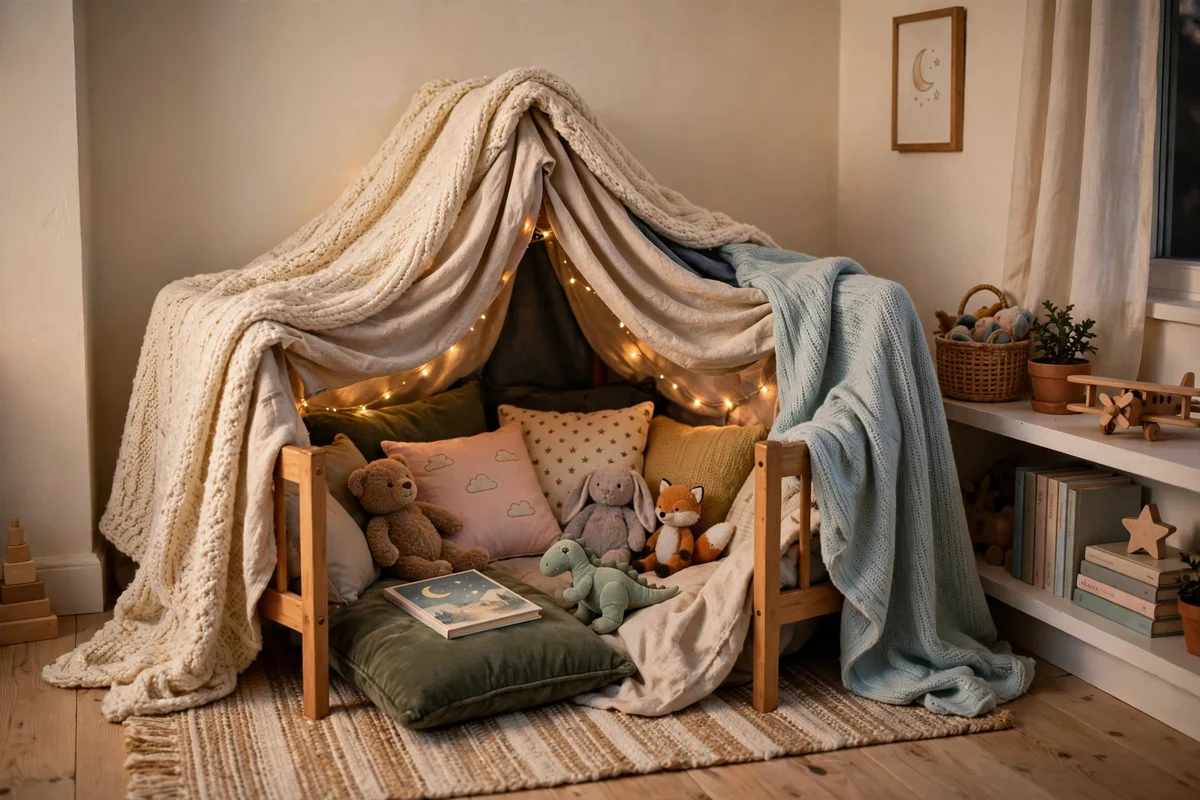
A pillow fort is the cheapest play corner there is, and the one that children build themselves, which is half the point. All it needs is a corner, a pile of cushions and blankets, and permission to make a mess for an afternoon.
The corner does the structural work: two walls to lean cushions against, and a chair or a small table to drape a blanket over as a roof. A blanket draped from the wall to a chair back makes a roof that stays up; a blanket draped over a pile of cushions falls down, which is part of the fun for about five minutes and then becomes the reason the fort is abandoned. Give the fort one sturdy anchor — a chair, a low shelf, or a couple of large cushions stacked as a wall — and let the rest be improvised.
Keep a dedicated fort kit in the corner so building does not mean stripping the beds. A basket with two or three old blankets, four or five cushions, and a string of battery fairy lights is enough. When the kit lives in the corner, the fort gets built; when the blankets have to be fetched from the airing cupboard, it does not. Washable covers matter here more than anywhere, because fort cushions get jumped on.
6. The dress-up corner
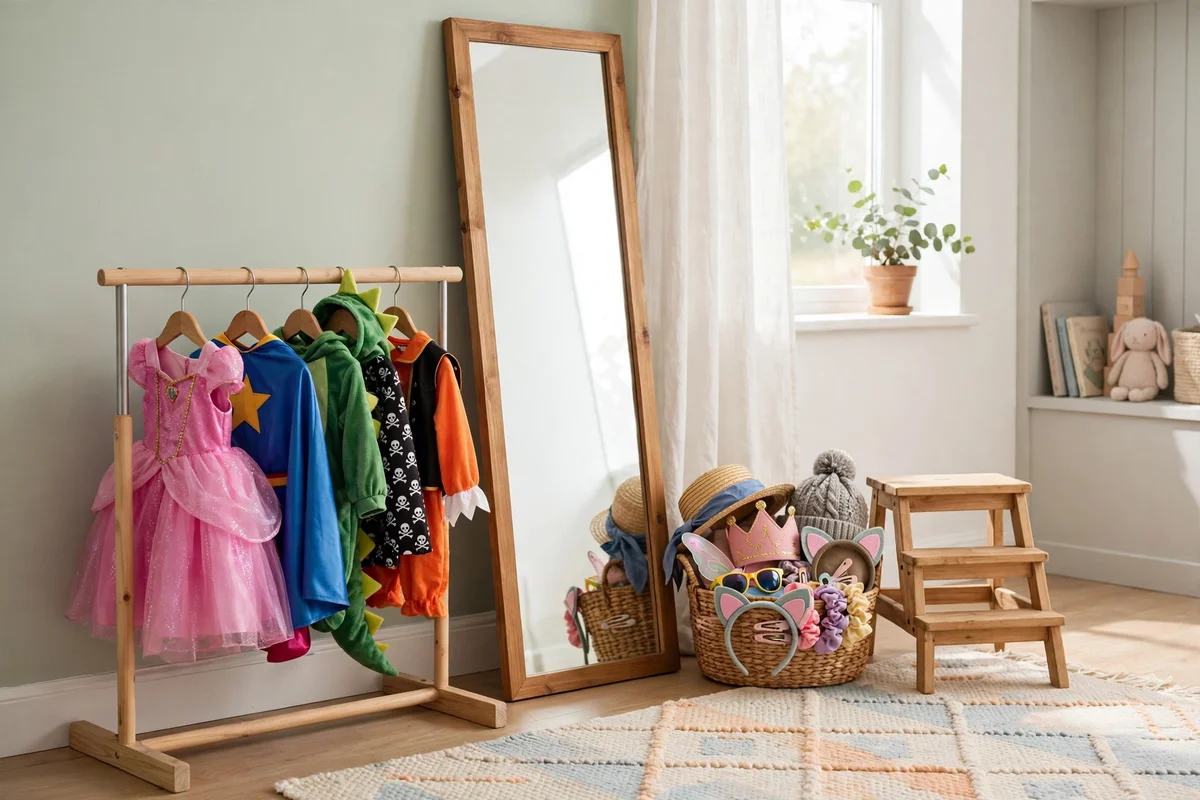
A dress-up corner is a small stage, and it needs very little: a low rail, a mirror, and a basket. The rail holds the costumes, the mirror shows the transformation, and the basket holds the hats, wands, and accessories that do not hang well.
The rail is the key purchase, and it should be child height — low enough that your child can reach the hangers and put costumes back without help. A rail that is too high means costumes end up on the floor, and a rail that is too low means long dresses drag. A freestanding rail in the corner, with one end against each wall, is stable and easy to move; a wall-mounted rail is tidier but harder to change later. Either way, anchor it or weigh it down, because a rail full of costumes will be pulled on.
The mirror should be fixed to the wall at child height, not leaning, and it should be a proper mirror rather than a toy one — a child who can see the whole costume will play longer than one who can only see their face. A small stool in front of the mirror gives a place to sit while putting on shoes or a crown, and a basket beside the stool holds the accessories. Keep the costume collection small: six to eight outfits that get worn beat twenty that get tangled. Rotate them seasonally, and store the out-of-season ones elsewhere.
7. The LEGO and building corner
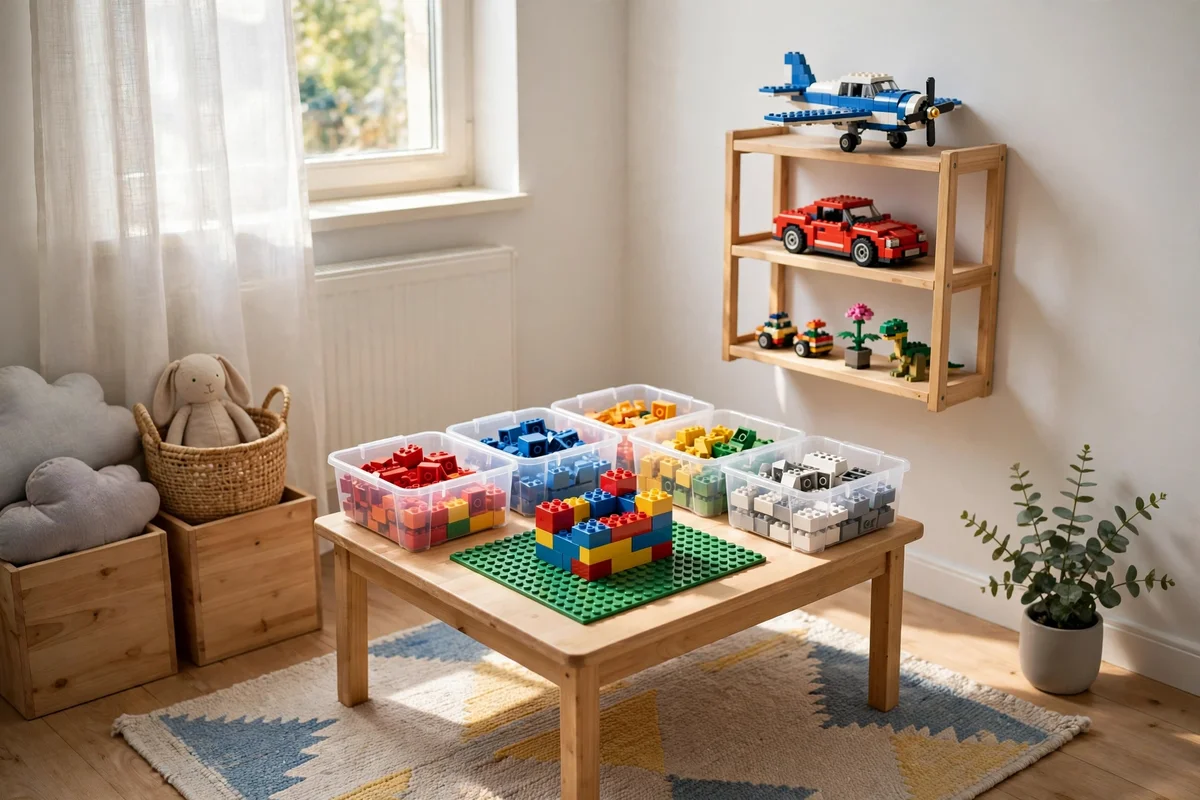
A building corner is a workbench in miniature: a low table, sorted storage, and a shelf to display what gets made. It works because building is a floor activity that spreads, and a corner with walls on two sides contains the spread.
The table should be low — knee height for your child when sitting on the floor or on a small stool — and large enough for a baseplate and a pile of bricks. A table with a rim or a tray edge helps, because bricks roll, and a rim stops them rolling onto the floor. Under the table, or beside it, put the storage: shallow bins sorted by colour or by type, with picture labels so a child who cannot read yet can still find the red bricks and put them back in the red bin. Deep bins are a mistake here, because bricks at the bottom of a deep bin never get used; shallow trays and a few small pots for tiny pieces work better.
A display shelf above the table, at your child's eye level, is what turns the corner from a building site into a place to be proud of. Finished models go on the shelf, and the rule is simple: one model on display means one model comes down. That keeps the shelf from becoming a crowded museum and gives your child a reason to finish a model properly before starting the next one.
8. The dollhouse display corner
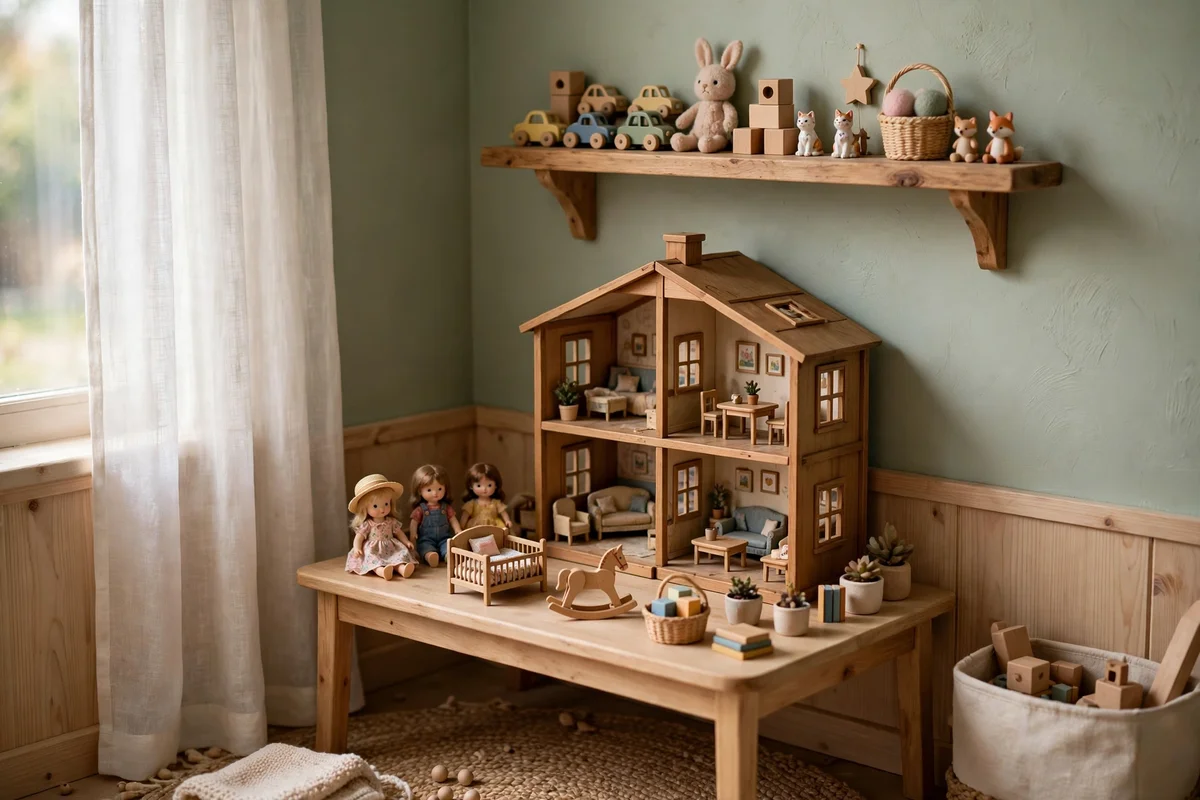
A dollhouse is both a toy and a piece of furniture, and it deserves a corner of its own rather than a spot on the floor where it gets kicked. A low table in the corner, with the dollhouse on top and its furniture and dolls stored underneath, keeps the whole game in one place.
The table should be the same height as the dollhouse's ground floor, so your child can reach inside without standing on tiptoe, and it should be sturdy enough to lean on. A table with a shelf or a basket underneath holds the dolls and the small furniture, sorted into a few small boxes — one for people, one for furniture, one for the tiny accessories that vanish first. A wall shelf above the table holds the pieces that are too precious to lose, or the ones that are currently on display rather than in play.
9. The music corner

A music corner is a small stage with an audience of one wall. It needs an instrument, a place to sit, and storage for the rest of the instruments, and it works best in the corner that is furthest from the bed, so practice does not become a bedtime problem.
A small keyboard on a low stand is the most common starting point, because it is quiet with headphones and loud without them, and it fits in a corner without dominating the room. A basket beside it holds the smaller instruments — a ukulele, a tambourine, shakers, a recorder — and a small shelf holds sheet music or songbooks at a height your child can reach. A rug under the corner softens the sound a little and marks the space, and a stool rather than a chair lets a child swivel between the keyboard and the basket without getting up.
Learn Corners
10. The study desk corner
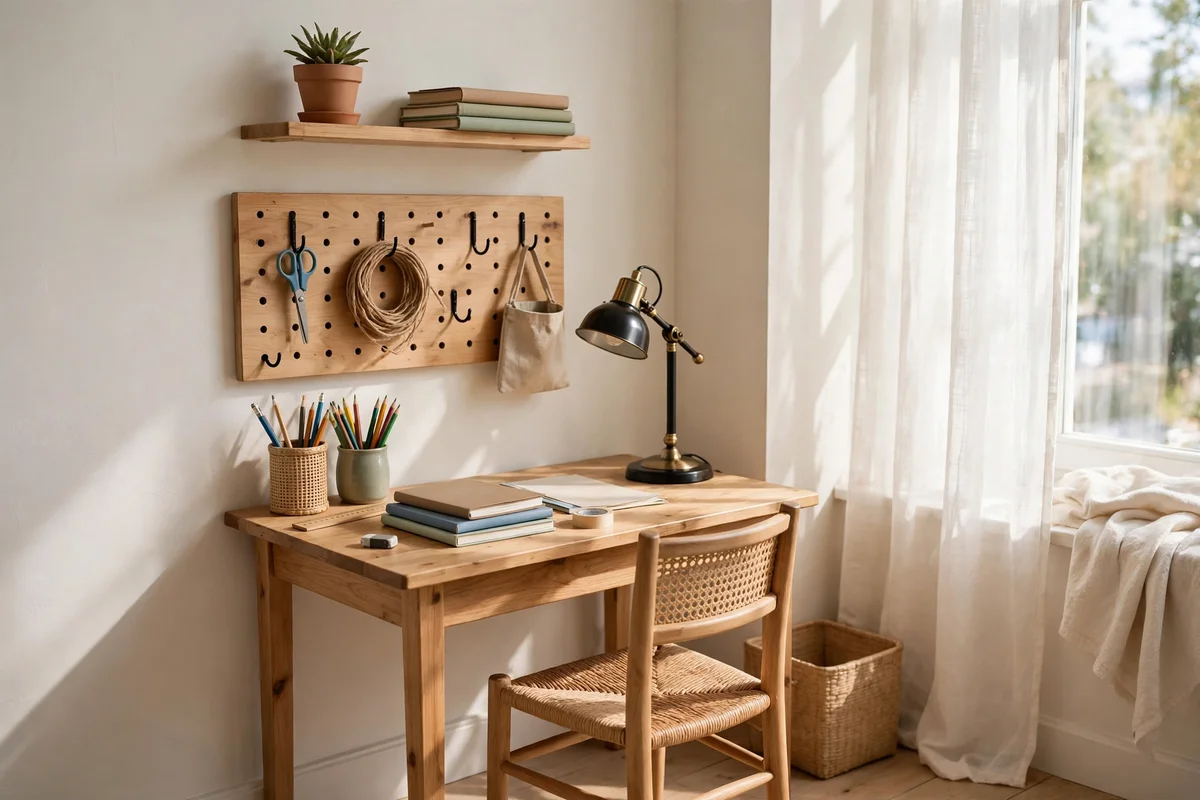
A study desk in a corner uses two walls at once, which is why it is the most space-efficient desk layout there is. The desk sits across the corner, the chair faces into the room or along one wall, and the walls above the desk hold the shelves, the lamp, and the pegboard.
The desk should be deep enough for a book and a notebook side by side — about 2 feet deep is the minimum for comfortable homework — and wide enough that a lamp, a pencil pot, and a book can all sit on it without crowding. A corner desk, shaped to fit the angle, uses the space best, but a straight desk pushed into the corner works just as well if the gap behind it is filled with a small shelf or a pencil tidy so things do not fall down the back.
Light is non-negotiable here. The desk belongs near the window if you have the choice, and it needs a desk lamp as well, because homework often happens after dark. The lamp should be on the opposite side from your child's writing hand, so their hand does not cast a shadow over the page. A socket near the desk is essential — a desk with a lamp and no socket nearby means a cable trailing across the room, which is a tripping hazard and a tidying problem.
Storage above the desk keeps the desktop clear. A shelf for books, a pegboard for scissors, rulers, and headphones, and a small pot for pencils are enough. Keep the desktop itself as empty as possible: a clear desk is a desk that gets used, and a desk covered in supplies is a desk that gets avoided. A chair that fits under the desk when it is not in use keeps the corner tidy and the walkway clear.
11. The homework pegboard corner
A pegboard corner is a study corner for a room that has no space for a desk, or for a child who does their homework at the kitchen table and only needs a place to keep their things. The pegboard hangs on the wall, and everything hangs from it.
A pegboard is a board with evenly spaced holes, fitted with hooks, small shelves, and pots. On it you can hang scissors, rulers, a pencil pot, a small clock, a calendar, headphones, and a bag for the school books that are being used this week. Below the pegboard, a single floating shelf holds the books and the homework folder, and a cushion or a small stool below that gives a place to sit while choosing what to take to the table.
The pegboard works because everything is visible. A child can see their pencil pot, their ruler, and their timetable without opening a drawer, and putting things back is a matter of hanging them on a hook rather than remembering which drawer they came from. It also uses no floor space at all, which makes it the best learn corner for a small room.
12. The art and craft corner
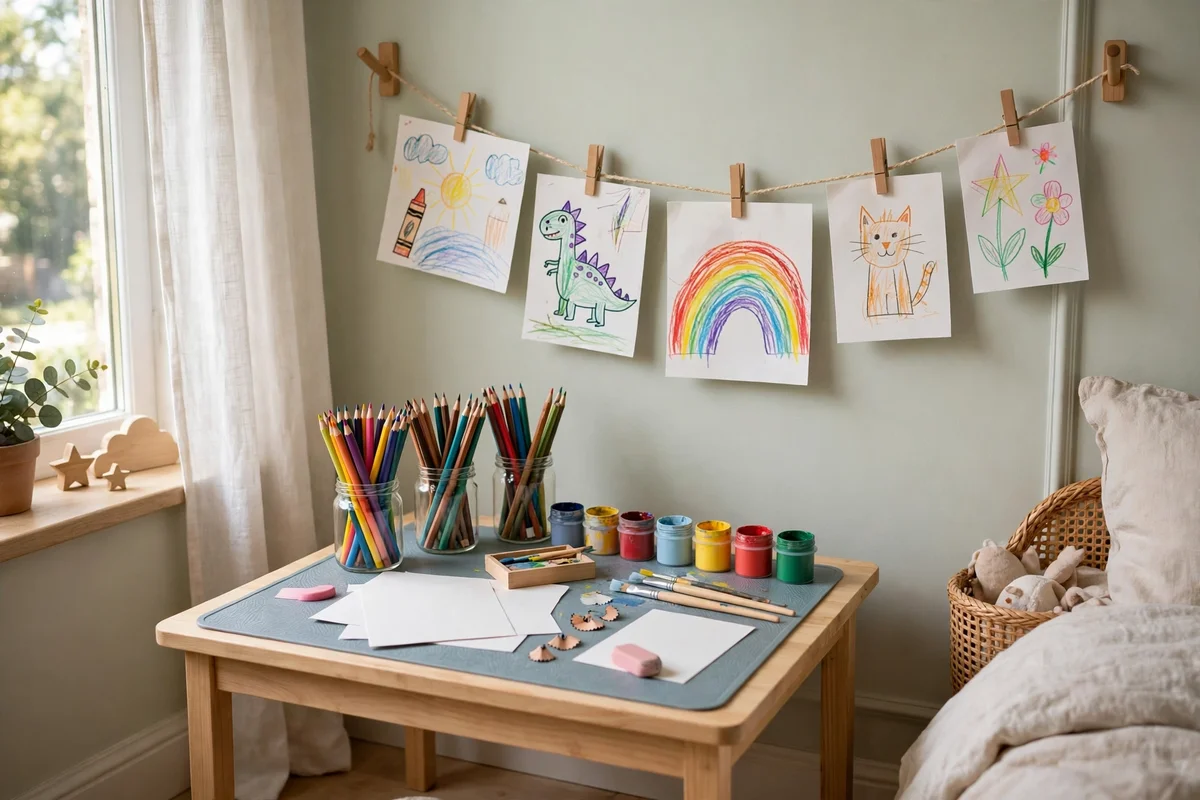
An art corner is a craft table that can get messy, and the whole point of giving it a corner is that the mess stays in one place. A small table, a chair at the right height, and storage for supplies in colour order make the space inviting and easy to reset.
The table needs a wipe-clean surface or a washable mat, because paint, glue, and felt-tip pens will reach it. A roll of paper taped to the wall at child height, with crayons in a pot beside it, gets used daily in a way a closed art cupboard does not. Supplies should be visible and sorted: pencils in one pot, markers in another, paints in a tray, paper in a stack. Children use what they can see, and they ignore what is hidden in a drawer.
Above the table, a pinboard or a washing line with pegs gives finished art somewhere to go. A piece of art on display is a piece that gets talked about; a piece in a pile is a piece that gets forgotten. Rotate the display every few weeks, and keep the best pieces in a folder rather than on the wall forever.
13. The puzzle and game corner
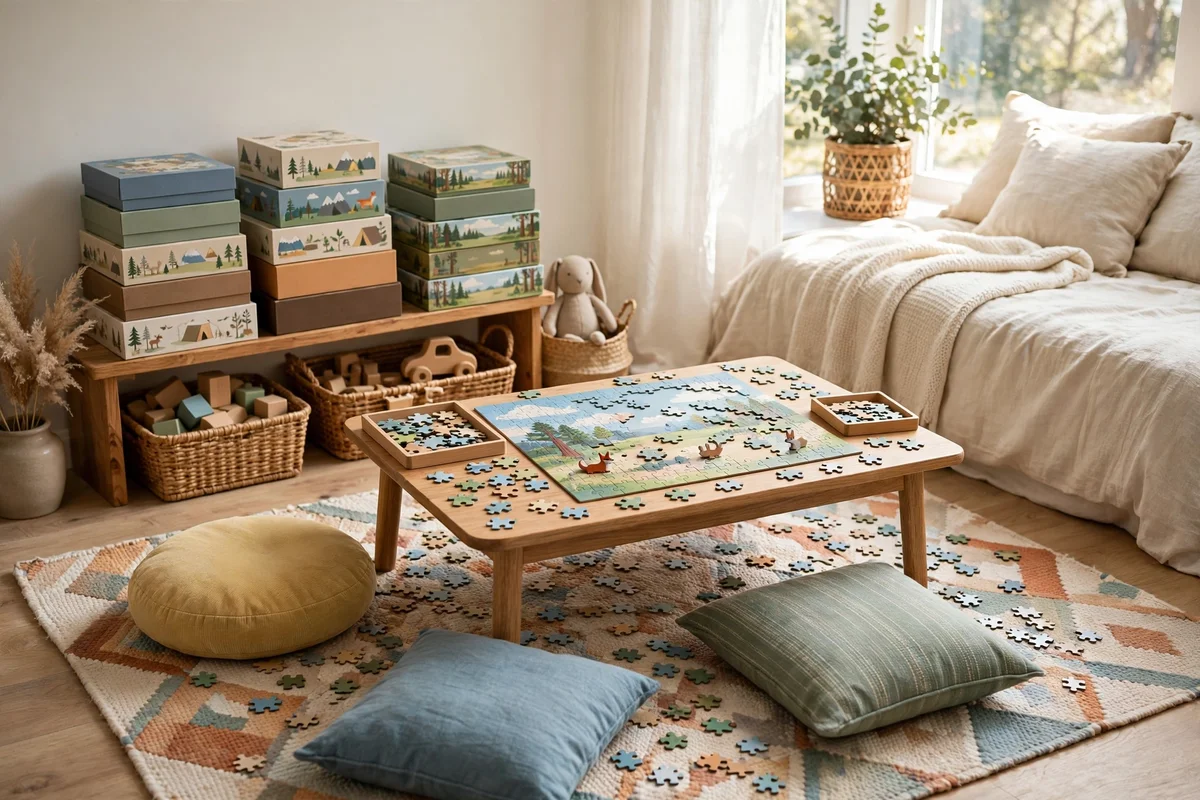
A puzzle and game corner is a low table, a rug, and a shelf of games — and the rule that a puzzle in progress stays out until it is finished. That rule is what makes the corner work, because a puzzle that has to be packed away every night never gets finished.
The table should be low enough for a child sitting on the floor, and large enough for a puzzle board and a box of pieces. A puzzle board — a flat board the puzzle is built on — lets a half-finished puzzle be slid under a bed or onto a shelf without falling apart, which is the single most useful purchase for this corner. Board games live on a low shelf beside the table, stacked on their sides like books so the game you want can be pulled out without moving the whole pile.
Calm Corners
14. The relax corner

A relax corner is a quiet place with nothing to do in it, and that is the point. It is a soft seat, a blanket, and a basket with a few quiet toys — and no screens, no homework, and no building projects. It is where a child goes to wind down, not to start something new.
The best relax corner is in the dimmest, quietest part of the room, away from the window and the door. A beanbag, a large floor cushion, or a small armchair all work, as long as the seat is comfortable enough to sit in for twenty minutes without fidgeting. A blanket folded over the arm of the chair, a basket with two or three soft toys or a book, and a soft lamp are the whole setup. Anything more than that turns a relax corner into another activity corner.
15. The night-light dream corner
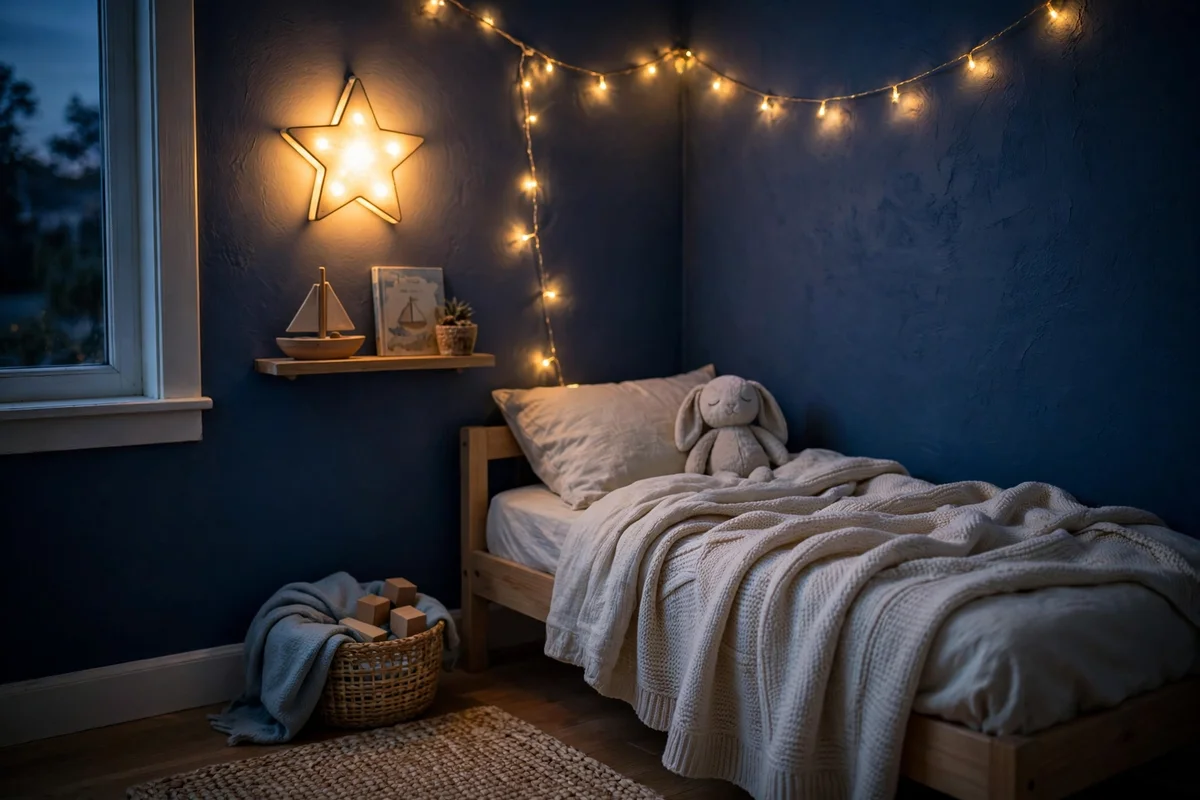
A night-light corner is the smallest corner in this article, and it is the one that matters most at 2 a.m. It is the corner by the bed, with a night light, a soft blanket, and a book — a place that makes the dark feel safe rather than scary.
The night light is the key piece, and it should be low, warm, and dim. A light that is too bright keeps a child awake; a light that is too dim does not help at all. A warm white light, fixed to the wall or on a low shelf beside the bed, gives enough light to see the room without waking the child fully. A star projector or a light that throws a pattern on the ceiling can help a child who is afraid of the dark, but it should be on a timer so it goes off by itself — a light that stays on all night is a light that disturbs sleep.
16. The meditation and quiet corner
A meditation corner sounds grand, but in a child's room it is simply a corner with a cushion, a plant, and nothing to do. It is the calm corner taken one step further: a place for breathing, for sitting still, and for the five quiet minutes before bed.
17. The hanging chair corner
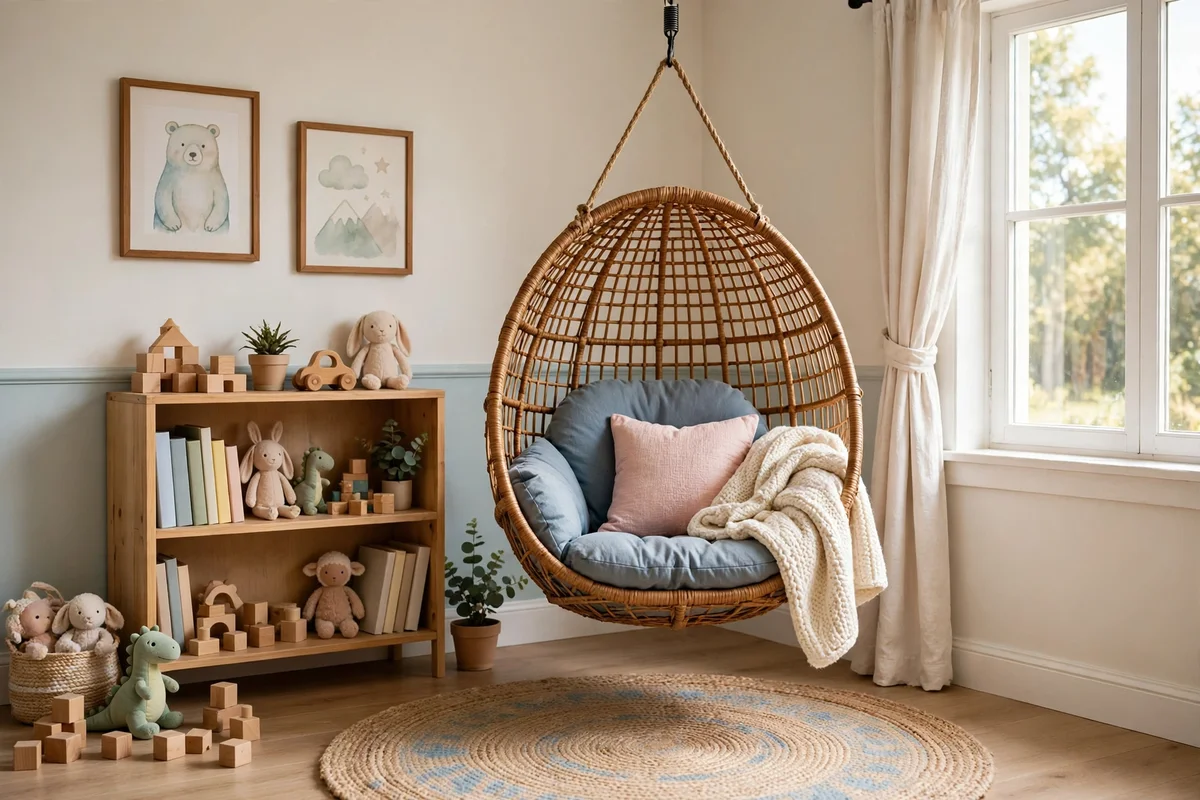
A hanging chair is a reading corner, a relax corner, and a swing all in one, and it is the corner that children remember. A woven chair suspended from the ceiling, with cushions inside and a rug below, turns an empty corner into the best seat in the room.
The ceiling fix is the part that matters most. A hanging chair must be fixed into a ceiling joist, not just into plasterboard, and the fix should be rated for far more weight than the child who will sit in it. If you are unsure where the joists are, or whether the ceiling can take the weight, get a professional to fit it — a hanging chair that falls is a serious injury, and this is not a corner to improvise. A freestanding hanging chair frame is the safer alternative in a rented home or a room with a ceiling you cannot drill into, because the frame carries the weight and the ceiling carries nothing.
Storage and Display Corners
18. The toy storage station corner
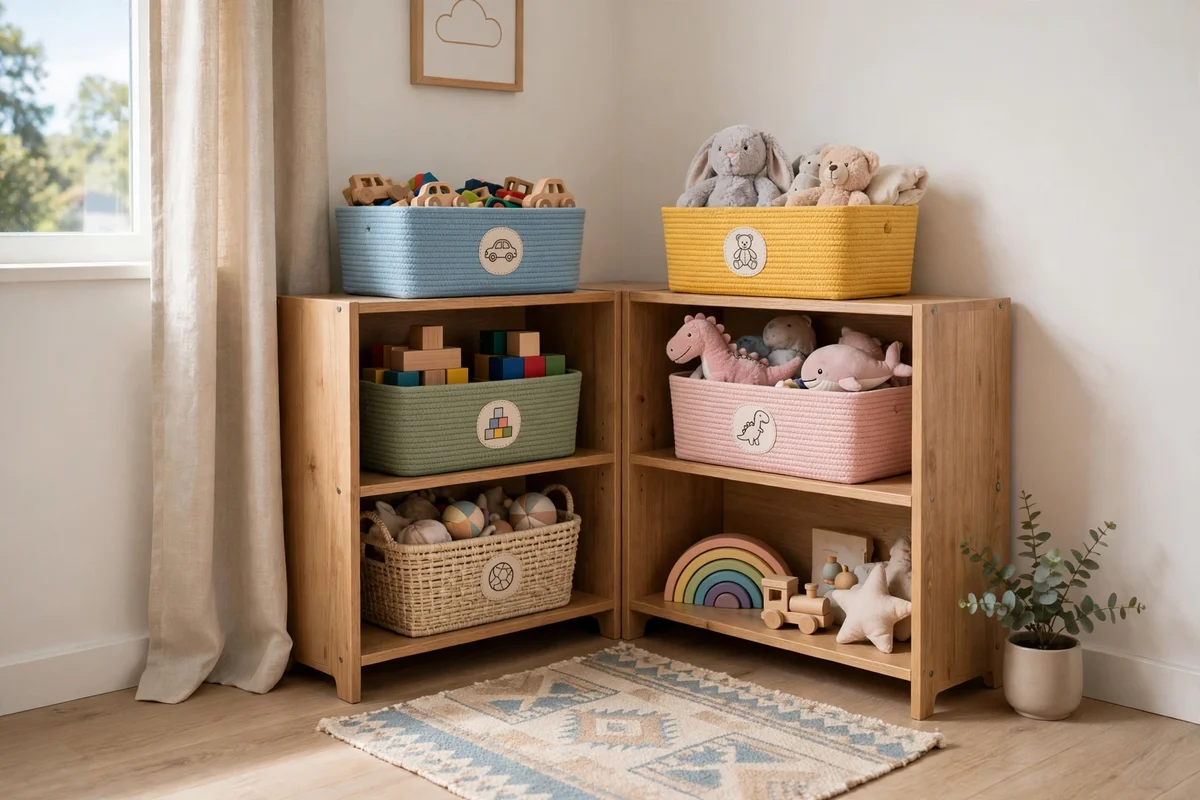
A toy storage corner is the least glamorous corner in this article and the one that makes all the others work. Without it, toys spread into every corner, and every other corner stops being a reading corner or a play corner and becomes a storage corner by default.
The storage should be low, open, and labelled with pictures as well as words, so tidying does not depend on reading. Open baskets on low shelves work better than lidded boxes for everyday toys, because a child can see what is inside and put it back without help. Shallow bins beat deep ones, because toys at the bottom of a deep bin never get played with, and a bin that is too heavy for a child to lift will be dragged, not carried.
Sort by category, not by colour: one bin for building blocks, one for soft toys, one for art supplies, one for small figures, and one for everything else. Label each bin with a picture of what goes in it, stuck to the front where a child can see it. The rule that makes the system work is one bin out at a time — a child can have the blocks out, or the figures out, but not both, and the bin goes back before the next one comes out. That rule is easier to keep when the bins are in a corner that is easy to reach and easy to see.
This corner needs about 3 by 2 feet of floor, and it belongs near the play corner, not across the room from it — toys travel the shortest distance, and a storage corner that is far from the play corner will not be used. It suits children from about age two upward, and it is the corner that should be set up first, before any other corner, because a room without storage is a room where no other corner can stay tidy.
19. The wall shelf display corner
A display corner uses the wall, not the floor, which makes it the best corner for a small room. Floating shelves, a picture ledge, or a single open shelf at your child's eye level hold the objects that matter: a favourite toy, a trophy, a rock collection, a row of small figures.
Keep the display small and at child height. A shelf that a child cannot reach is decoration for adults, not for them, and a shelf crammed with twenty objects is a shelf that never gets dusted. Five or six objects, with space between them, look better and get played with more than a crowded shelf. Rotate the display every few weeks, swapping the objects on the shelf with ones from storage, so the display feels new and the toys in storage feel new again when they come back out.
Fix the shelves firmly into the wall, and keep heavy objects low. A shelf that holds a heavy trophy at the top is a shelf that will be pulled down, and a shelf that holds light objects at the top and heavy ones at the bottom is a shelf that stays up. A picture ledge, with its lip at the front, is a good choice for small figures and books, because things cannot roll off it.
20. The plant and nature corner
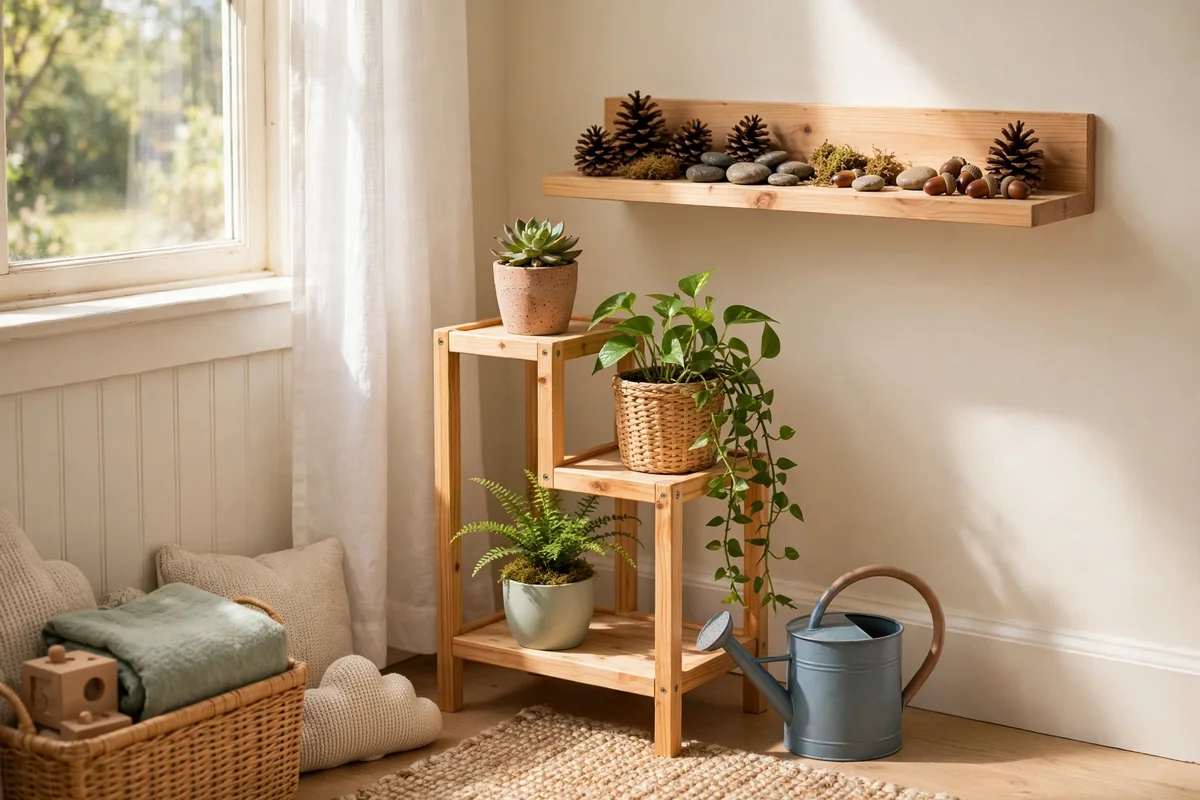
A plant corner is a living corner, and it teaches a child to care for something without needing a lot of space. A small plant stand in the corner, with two or three child-safe plants, a watering can, and a nature display shelf, is enough to start with.
Choose plants that are safe if a child touches them or puts a leaf in their mouth, and that survive a missed watering — a spider plant, a small fern, or a succulent in a sturdy pot are good starting points. Avoid plants with sharp thorns or sap that irritates skin, and keep the pots heavy enough that they cannot be knocked over easily. A watering can sized for small hands, kept beside the plant stand, makes watering a job a child can do alone, and a small chart on the wall — a simple picture of a plant and a tick box — turns watering into a routine.
Beside the plant stand, a small shelf holds the nature collection: pinecones, stones, shells, and leaves found on walks. A nature shelf is a display corner and a plant corner in one, and it gives a child a reason to bring things home and a place to put them. Keep the shelf low and the collection small, so it can be tidied without a lecture.
A Weekend Plan: Friday, Saturday, Sunday
A bedroom corner does not need a month of planning. It needs a clear order, because buying furniture before you have measured, or setting up a reading corner in a walkway, creates the rework that eats weekends.
On Friday evening, choose the corners and measure them. Stand in the doorway, watch how the room is used, and pick the one corner to start with — usually the reading corner or the storage corner, because those two get used every day. Tape out the corner on the floor, measure it, note where the sockets, switches, and radiator are, and make a list: the seat, the light, the storage, and the rug. Order or buy only what is on that list.
On Saturday, do the setting up. Move the furniture away from the corner, clean the floor and the walls, and put the corner together in this order: storage first, then the seat, then the light, then the books or toys. Storage goes first because everything else needs somewhere to live; the seat goes second because it is the largest piece; the light goes third because it decides where the seat faces; and the books or toys go last because they are the easiest thing to move. Test the corner yourself: sit in it, reach for a book, switch the lamp on and off, and walk past it to the closet. If any of those things feels awkward, move the corner now, while it is still Saturday.
On Sunday, live in the corner for a day before you start the next one. Let your child use it, watch what works and what does not, and make the small changes — a cushion moved an inch, a basket swapped for a shelf, a lamp moved to the other side — that turn a corner that looks right into a corner that works. Only then, if the first corner is working, start the second one. A room with one working corner and three empty ones is better than a room with four half-finished corners, because the first corner teaches you what the rest of the room needs.
Small Rooms and Shared Rooms
A small room needs its corners to work harder and take up less space. Use the wall, not the floor: floating ledges for books, a pegboard for homework things, a wall shelf for display, and a wall lamp for light. Skip the play tent and the large rug — in a small room, those two eat floor space the room cannot spare. A 3 by 4 foot rug is enough to mark a toddler nook, and a single floor cushion is enough seating. A canopy or a hanging chair is a better choice than a tent in a small room, because both use the air, not the floor. Keep at least one corner completely clear, so the room has somewhere for the eye to rest and somewhere for a child to stand.
A shared room needs a corner each, and a way for each child to have their own colour or their own shelf inside a shared corner. Give each child one corner that is theirs — one child's reading corner, the other's building corner, for example — and share the storage corner, with one bin colour per child so there is no argument about whose toys are whose. If the beds are on opposite walls, each bed wall can carry its own night-light corner, with the shared wall kept neutral. Keep the layout symmetrical where you can — matching lamps, matching shelves, matching baskets — because symmetry makes a shared room feel fair even when the corners are different. And keep the quiet corner and the play corner as far apart as the room allows, so one child can read while the other plays.
Corners by Age
A toddler's corners should be low, soft, and safe. A reading corner with floor cushions and a basket of board books, a toy storage corner with open baskets at floor level, and a night-light corner by the bed are enough. Keep the seating low — 8 to 12 inches high — and keep everything within reach of a small child standing on the floor. Anything hung on the wall should be fixed securely, and anything small enough to swallow should live in a lidded box out of reach.
A school-age child's room can carry more corners, because the child can tell you what they like and what they have outgrown. This is the age for the study desk corner, the art corner, the building corner, and the puzzle corner, as well as the reading corner and the play tent. It is also the age to start planning the exit: a school-age child who loves a play tent now may not at twelve, so keep the expensive parts — the desk, the shelves, the hanging chair — to pieces that can change jobs, and let the tent, the cushions, and the display be the things that change.
A tween's corners should look older, even when the job is the same. A reading corner becomes a window nook with a proper lamp and a phone charger nearby. A study corner becomes a desk with a pegboard and a shelf for school books. A calm corner becomes a hanging chair or a beanbag with headphones. The furniture does not need to change much — the cushions get bigger, the books get longer, and the display gets more grown-up — but the corner should feel like it belongs to a young person, not a small child. Let the tween choose the colours and the objects, even if you choose the furniture, because a corner a tween chose is a corner a tween will use.
Budget: Three Price Levels
A bedroom corner does not have to be expensive. The difference between the three levels below is how much is bought new and how much is rearranged, not how useful the corner is. All figures are rough ranges, not researched prices.
A refresh under $50 uses what you already have: move the cushions into a corner, put a rug you already own under them, sort the books onto a shelf you already have, add a basket for toys, and hang a picture your child has already drawn. The corner changes without any new furniture, and it takes an afternoon. A battery lamp and a second-hand cushion are the only purchases most families need at this level.
A mid-level refresh, roughly $50 to $200, adds the pieces that make the biggest difference: a proper floor cushion or a small chair, a reading lamp, a low bookshelf or a set of floating ledges, and a set of storage bins with picture labels. This is the level most families choose, because it sets the corner up properly without changing the furniture in the rest of the room.
A full setup, $200 and up, adds a desk or a hanging chair, a window seat cushion cut to fit, a play tent, and a full storage unit. This is worth doing when the room is being redecorated anyway — a new bed, new flooring, or a move — rather than as a standalone project. If you are spending at this level, spend it on the things that are hardest to change later: the desk, the shelves, and the chair. Cushions, baskets, and books can always be upgraded later, one piece at a time.
Mistakes That Make Corners Feel Messy
The most common mistake is giving a corner two jobs at once. A reading corner that is also a toy corner is neither, because the toys bury the books and the books get in the way of play. One corner, one job — and if a corner needs to do two things, it needs to be two corners, or the second job needs to move elsewhere.
The second mistake is putting the corner in a walkway. A corner that sits in the path to the bed, the closet, or the door will be stepped through, not sat in, and the cushions will be kicked aside within a day. Walk the routes before you choose the corner, and choose the corner that is out of the way, even if it is not the prettiest one.
The third mistake is forgetting the light. A reading corner with no lamp, a study corner with no socket, and a calm corner under a bright ceiling light all fail for the same reason: the light does not match the job. A dedicated lamp, at a height your child can reach, is the cheapest fix in this article, and it is the one most often skipped.
The fourth mistake is buying furniture that is too big for the corner. A desk that fits the room but not the corner, a bookshelf that blocks the closet door, a tent that touches both walls — all of them turn a corner into a problem. Tape the footprint on the floor first, and put the furniture inside the tape before you buy it, even if that means measuring in the shop.
The fifth mistake is decorating at adult eye level. Shelves a child cannot reach, a mirror hung too high, a pegboard that needs a chair to reach — all of them make a corner look good in photos and work badly in real life. Hang the shelves, the mirror, and the pegboard at your child's height, and test every shelf by asking your child to reach it.
How Corners Change As Your Child Grows
The best corners are built to change jobs. A reading corner with floor cushions becomes a study corner when a small desk replaces the cushions. A play tent corner becomes a relax corner when the tent comes down and a beanbag goes in. A dress-up corner becomes a display corner when the rail comes out and shelves go up. The walls, the light, and the storage stay the same; only the seat and the objects change.
Frequently Asked Questions
How much space does a kids reading corner need?
A usable reading nook needs at least 24 by 24 inches of clear floor — about 6 square feet — for a cushion, a book, and a child. A 3 by 4 foot rug is enough to mark out a toddler nook. An older child will want a little more room, so allow space for a cushion, a basket of books, and a lamp, and tape the footprint on the floor before you buy anything.
What is the best corner for a reading nook?
The best corner for a reading nook is the one with the best light that is also out of the main walkway — usually the corner near the window, or the corner on the bed wall. It needs a seat, a dedicated lamp, because room lighting is usually too dim for reading, and books within arm's reach. Avoid the corner by the door, which gets walked past too often, and the corner by the radiator, which is too hot for cushions and books.
How do I make a kids corner in a small bedroom?
Use the wall, not the floor: floating ledges for books, a pegboard for homework things, a wall shelf for display, and a wall lamp for light. Choose one corner and give it one job — a reading corner with a single cushion and a small rug is enough — and keep the other corners clear. A hanging chair or a canopy uses the air rather than the floor, and a 3 by 4 foot rug is enough to mark a toddler nook without taking over the room.
What should I put in a kids calm corner?
A calm corner needs very little: a soft seat, a blanket, and a basket with a few quiet toys or a book. Put it in the dimmest, quietest part of the room, away from the window and the door, and keep it nearly empty — a calm corner full of toys is not calm. A soft lamp, a plant, and a single framed picture are the only extras worth adding.
How do I keep a kids corner tidy?
Give the corner one job, give everything in it a home a child can reach, and keep the collection small. A reading corner with ten books on a shelf stays tidy; a reading corner with fifty books does not. A toy corner with one bin out at a time stays tidy; a toy corner with every bin out does not. Label bins with pictures as well as words, and make tidying part of using the corner — the book goes back on the shelf, the bin goes back on the shelf — rather than a separate job at the end of the day.
Final Checklist Before You Buy Anything
- Pick one corner and give it one job — reading, playing, learning, calming down, or storing toys.
- Walk the routes from the door to the bed and to the closet, and keep the corner out of them.
- Measure the corner and tape the footprint on the floor; check it fits a cushion, a lamp, and a child.
- Check the light: a reading or study corner needs a dedicated lamp, and a calm corner needs dim light.
- Check the sockets and the radiator, and keep soft furnishings and tents away from heat.
- Choose low seating — 8 to 16 inches high by age — and test it at your child's height.
- Put books, toys, and supplies within arm's reach, and label bins with pictures as well as words.
- Leave one corner clear, and leave some open floor space in the middle of the room.
A bedroom corner does not need to be perfect, and it does not need to be finished in one go. Start with the corner your child will use most, set it up properly with a seat, a light, and storage within reach, and let the other corners wait until the first one is working. The rooms that children love most are rarely the ones with the most furniture — they are the ones where every corner has a job, the books and toys have a home, and there is a comfortable corner to sit in. Get those three things right, and the corners take care of themselves.