Big Kids Room Ideas
Somewhere between eight and twelve, a child's bedroom stops working. The bed is too small, or the bedding still has cartoon characters on it. The toys have moved out but the homework has moved in, and there is nowhere to do it. The storage that made sense for a six-year-old — one big toy box, everything in a pile — now just means the floor is always covered. And your child has opinions now. Strong ones.
The answer is not a new theme. A big kid does not need a new character on the wall; they need a room that works like a slightly older person's room, with space to sleep, study, make things, and hang out with a friend. That is what this article is: a room plan, not a shopping list. Below are 20 ideas grouped into the order most parents actually use them — layout first, then furniture, then bedding and the floor, then storage, then the walls, then light — followed by a weekend plan, three budget levels, age-by-age differences, small and shared rooms, the mistakes to avoid, and how the room keeps growing up after you finish.
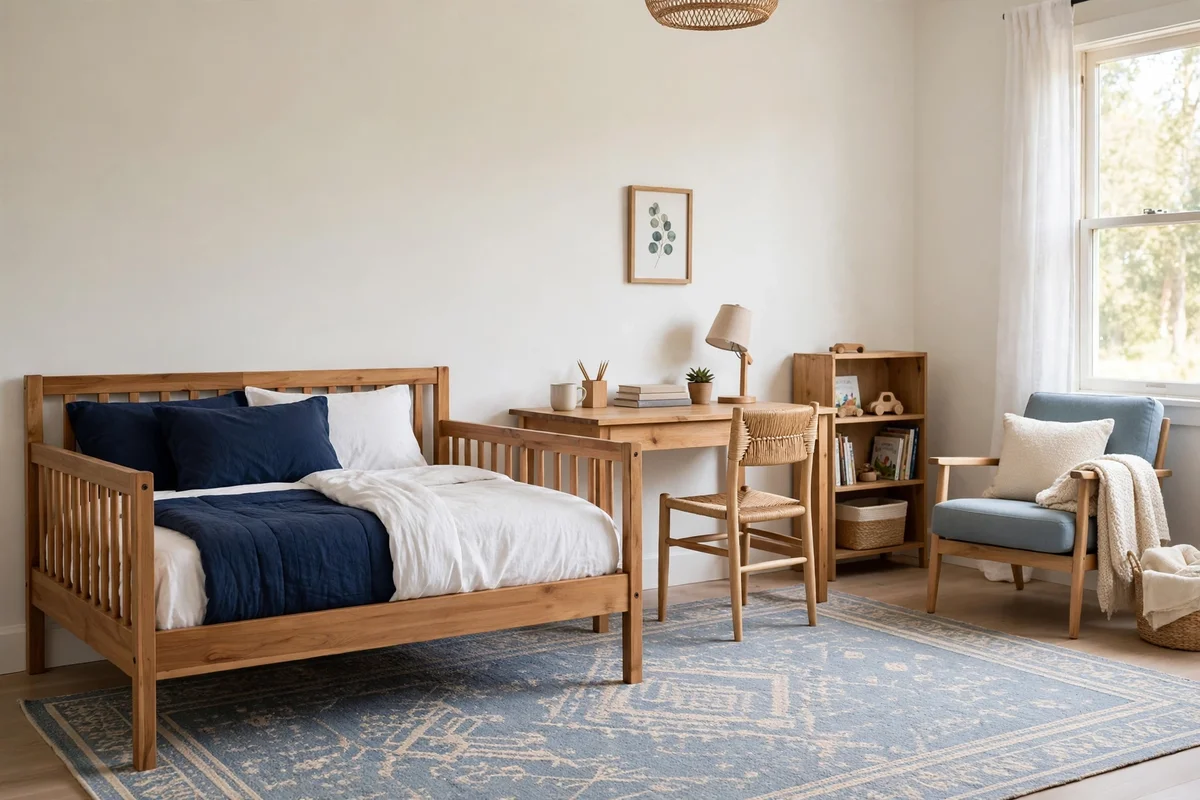
If you want the short version: keep the walls neutral and let the accents change; give the room four zones (sleep, study, hobby, lounge); buy furniture once, in adult sizes, that works at eight and still works at twelve; and build storage your child can run without you. Get those four things right and the rest is decoration.
When to Make the Change — and What to Keep
There is no single right birthday for this change, but there are clear signs it is time. Your child asks for it, usually in words like "my room feels babyish." Homework starts coming home most nights and ends up done at the kitchen table because there is no desk. Friends come over and there is nowhere for two children to sit that is not the bed. Or the room simply has no system left: everything lives on the floor because the storage was designed for a much younger child.
Any one of those signs is enough. You do not need all four, and you do not need to wait for a move, a new school year, or a birthday. The best time to redo a big kid's room is a normal weekend when you have two full days and a car for one trip to the shops.
Just as important is what not to change. A child who is losing their little-kid room is also losing something familiar, and keeping a few anchors makes the new room feel like theirs rather than like a room that was done to them. Keep the bed if it is still big enough, or keep the bedding colour they love in a plainer version. Keep one or two favourite objects on display — a soft toy, a trophy, a picture they made — and find them a proper place in the new room rather than boxing them up. Keep the reading habit if there is one: if your child reads in bed, the new bed needs a good reading lamp; if they read in a corner, that corner needs to survive the redesign.
Walk the room together before you buy anything. Ask your child to show you where they sleep, where they do homework now, where their favourite things live, and what annoys them about the room. Write down what they say. Children notice different problems from adults — a shelf they cannot reach, a drawer that sticks, a corner that is always dark — and those small problems are usually cheap to fix and make the biggest difference to how the room feels day to day.
A More Mature Palette: Neutral Walls, Changeable Accents

The single biggest difference between a little-kid room and a big-kid room is the colour plan. Little-kid rooms are usually one strong colour everywhere. Big-kid rooms work the other way around: the walls and the big furniture are calm, and the colour lives in things you can change.
Start with the walls. Warm white, pale greige, soft grey, or a very pale sage are the safest choices, because they go with almost any accent colour your child picks next year. If one accent wall feels right, keep it to a single muted tone — dusty blue, sage green, warm terracotta, or soft charcoal — rather than a bright primary colour. A muted accent wall reads as grown-up; a bright one reads as a theme, and themes are what your child is trying to leave behind.
Then choose two accent colours and one metal or wood tone, and repeat them. Navy and mustard, sage and terracotta, dusty blue and warm wood, charcoal and blush — any pair works as long as both colours appear at least twice in the room. The bedding might carry the navy, the rug might carry it again, and the mustard might show up on a cushion and a desk lamp. When a colour appears twice, it looks deliberate. When it appears once, it looks accidental.
The reason this matters is practical, not just visual. A twelve-year-old who loved navy at ten may love forest green at twelve. If the navy lives in the bedding, a cushion, and a throw, changing it costs one shopping trip. If the navy lives in the paint on four walls, changing it costs a weekend and a tin of paint. Put the colours your child loves now into the cheap, changeable layer, and keep the expensive layer neutral.
Test the palette the same way you would test any paint: look at swatches in the room in daylight and again under the bedroom lamp at night. A dusty blue that looks calm at noon can turn grey in the evening, and a warm white can turn yellow under a warm bulb. If the room faces north and gets cool light, warm up the neutrals — a creamy white rather than a bright white. If it faces south and gets strong sun, cooler neutrals will stop the room feeling washed out.
| Palette | Walls | Accents | Best for |
|---|---|---|---|
| Warm neutral + navy | Warm white, pale greige | Navy, mustard, natural wood | Rooms that need to feel calm and last years |
| Sage + terracotta | Pale sage or warm white | Terracotta, cream, light oak | South-facing rooms, children who like earthy colours |
| Grey-blue + blush | Soft grey, pale blue-grey | Dusty blush, charcoal, brushed metal | Shared rooms, children who want something softer |
| Charcoal accent + cream | Warm white with one charcoal wall | Cream, tan leather, black metal | Older children (11–12) who want a more grown-up feel |
20 Big Kids Room Ideas You Can Actually Copy
Layout and zones
1. Start with a flexible layout you can rearrange

Before you buy a single thing, decide where the big pieces go — and then decide how easily they can move. A big kid's room needs to change shape: a desk that works for homework at nine needs to become a desk with room for a laptop at twelve; a play area becomes a lounge area; a reading corner becomes a place for two friends. Furniture pushed hard against every wall, or a bed that only fits in one spot, locks the room into a single layout.
The test is simple. Stand in the doorway and ask: could two children walk past each other in here? Could the bed move to the other wall without blocking the door or the wardrobe? Is there at least one patch of open floor about a metre square where nothing lives? If the answer to any of those is no, the room is over-furnished, and the fix is usually to remove one piece of furniture rather than add one.
A good starting layout puts the bed against the longest clear wall, the desk near the window for daylight, and storage along the wall with the door, where it is easy to reach on the way in and out. Leave the centre of the room as open as you can. Children use open floor more than adults expect — for building, for games, for sprawling with a book — and a room with a clear centre feels bigger than a room the same size that is full to the edges.
When you move furniture, measure first. A twin bed is about 99 cm wide and 203 cm long; a twin XL, which is the same width but about 13 cm longer, is worth considering for a tall ten-year-old who will keep growing. A desk needs roughly 120 cm of width for homework and a laptop side by side. Write the measurements on masking tape on the floor before you move anything heavy — it takes five minutes and saves the argument about whether the desk fits under the window.
2. Give the room four zones: sleep, study, hobby, lounge
A big kid's room works when it is four small rooms in one. The sleep zone is the bed and a bedside table, nothing more. The study zone is the desk, the chair, and a shelf within arm's reach. The hobby zone is a small area for whatever your child actually does — drawing, music, building, crafts — with its own storage. The lounge zone is a place to sit that is not the bed: a chair, floor cushions, or a small sofa if there is room.
Zones do not need walls or dividers. A rug marks a zone. A bookshelf turned sideways marks a zone. A different lamp marks a zone. The point is that each activity has a home, so homework does not spread across the bed, and hobby supplies do not colonise the desk. When everything has a place, tidying is a matter of returning things to their zone, which a child can do alone in ten minutes.
3. Put the bed where sleep comes first
The bed is the biggest piece of furniture and the one that most affects sleep, so place it before anything else. The best spot is usually against a solid wall, with the headboard on the wall and the long side open, so the bed is easy to make and easy to get in and out of. Avoid putting the head of the bed under a window if you can: draughts, street light, and morning sun all land on the sleeper's face, and a child who wakes at dawn in summer will not thank you.
Keep the sleep zone calm. The wall behind the bed is not the place for the brightest colour or the busiest display. One framed print, a small shelf, or a plain wall is enough. The bedside table should hold only what is needed at night: a lamp, a book, a glass of water. A charging point for a device, if your child has one, belongs on the desk or in the hallway, not beside the pillow — a phone charging by the bed is a phone being used in bed.
A full-size or twin XL bed is worth the extra cost if the room allows it, because a child who is 150 cm tall at eleven will be taller at thirteen, and a bed that is too short is a bed that gets replaced. A solid wood or good-quality metal frame will survive years of being jumped on, sat on by friends, and used as a climbing frame. A themed bed, however much your child wants it today, is a bed you will be replacing in two years.
4. Build a homework station that actually gets used
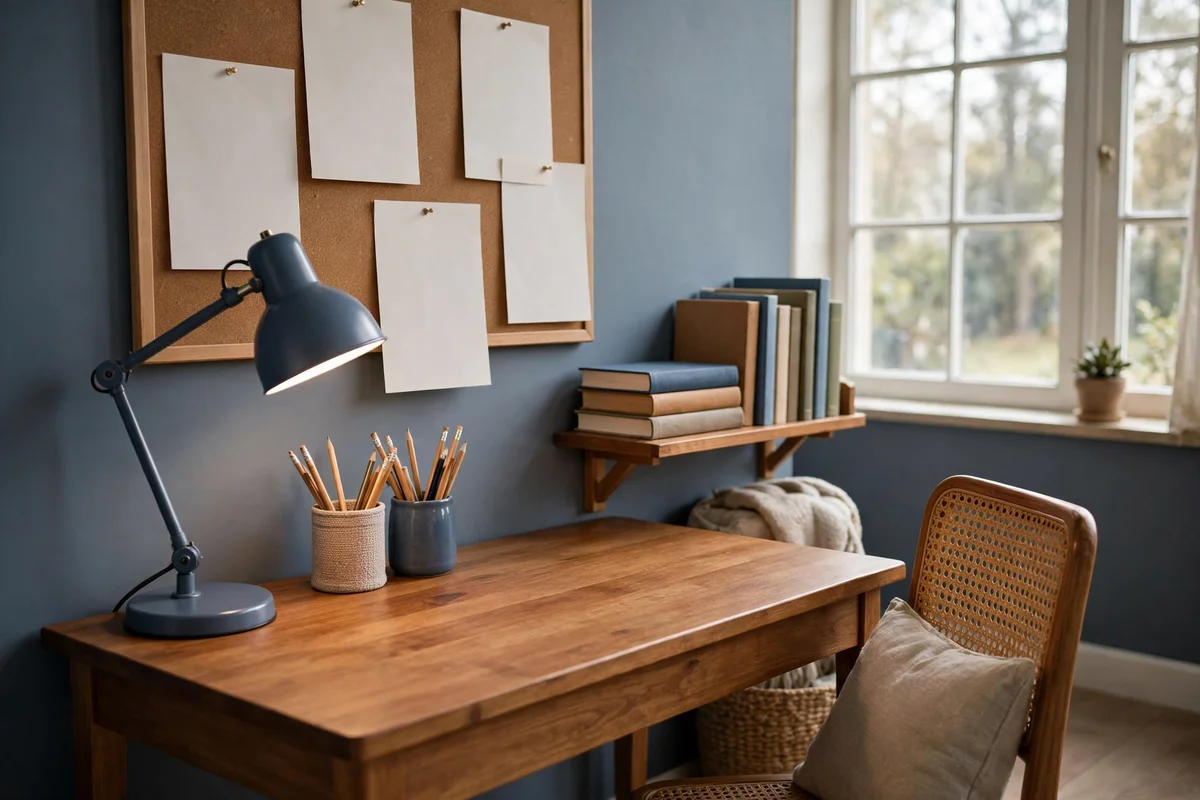
A homework station fails for boring reasons: the chair is uncomfortable, the light is wrong, the supplies are in another room, or the desk is also the dumping ground for everything else. Fix those four things and the station gets used.
The desk should be at least 120 cm wide and about 75 cm high, which is standard adult desk height — a big kid is close enough to adult height that a child's desk is already too small. The chair should be adjustable if you can manage it: seat height that lets your child's feet rest flat on the floor, with knees at roughly a right angle. A chair that is too high leaves legs dangling, which is uncomfortable within minutes; a chair that is too low makes a child hunch. If an adjustable chair is out of budget, a footrest — even a sturdy box — solves the dangling-legs problem.
Light matters more than most people think. Put the desk near the window so daylight falls on the work from the side, not from directly behind the screen or the paper, which causes glare. Add a desk lamp with a warm white bulb for evenings, positioned on the opposite side from your child's writing hand so the hand does not cast a shadow on the page. And keep supplies within arm's reach: pens, pencils, a ruler, and paper in a pot or a small drawer unit on the desk, not in a cupboard across the room. A child who has to get up to find a pencil will find something else to do instead.
Finally, protect the desk. Agree that the desk is for homework and hobbies, not for storage. A tray for incoming school papers, emptied once a week, stops the slow build-up that turns a desk into a shelf. A hook on the wall for the school bag keeps it off the floor and off the chair. These small systems are the difference between a desk that works and a desk that is photographed once and never used again.
5. Give hobbies a real zone, not a corner of the desk
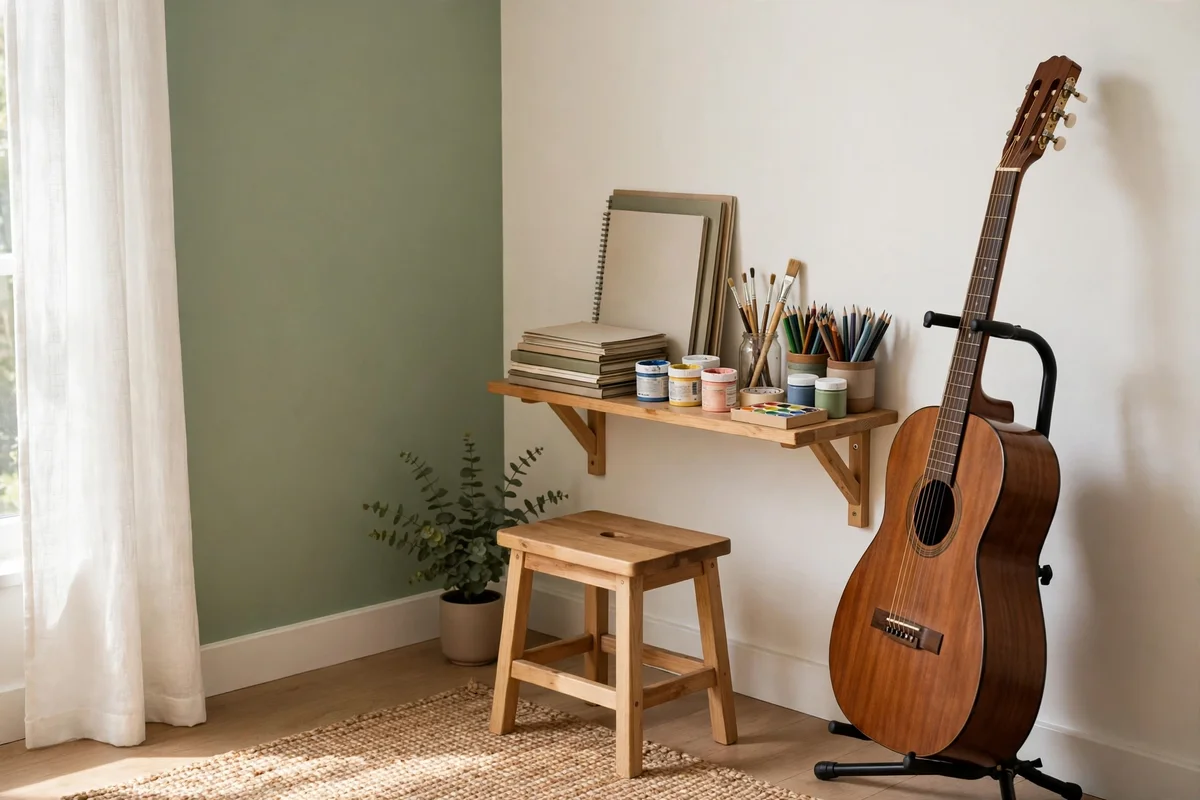
A child who draws, plays an instrument, builds models, or makes things needs somewhere to do it that is not the homework desk — because homework and hobbies have opposite rules. Homework needs a clear surface; a hobby needs a surface that can stay messy for a few days while a project is in progress. When the two share a desk, the hobby loses, because homework is daily and the hobby supplies get cleared away every evening.
The hobby zone can be small. A low table or a second-hand desk against one wall, a shelf above it for supplies, and a stool is enough. What it needs is permission to stay as it is: a model half-built, a drawing half-finished, a guitar on its stand. Give the zone a boundary — a tray, a mat, or a defined patch of table — and the mess stays inside it. Without a boundary, hobby supplies spread across the whole room, and then the hobby gets blamed for the mess.
6. Add a lounge spot for friends
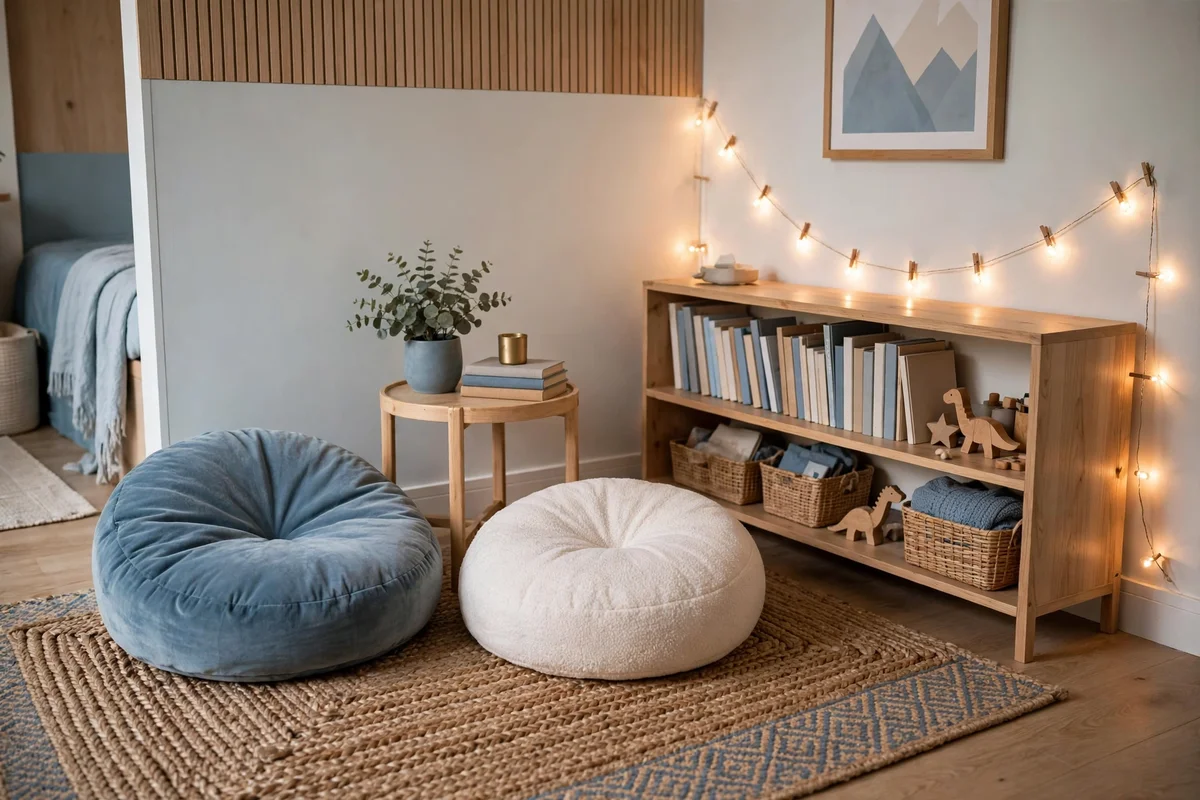
At eight, a friend sits on the bed. At eleven, a friend sits on the bed and it feels awkward. A lounge spot — somewhere to sit together that is not a bed — is one of the clearest signs a room has grown up, and it is one of the cheapest changes to make.
Two large floor cushions and a small side table on a rug are enough. A beanbag works if it has a firm filling that holds its shape; flat, floppy beanbags end up pushed into a corner and forgotten. A small armchair is better if the room has space, because it gives the lounge zone a fixed home and makes the room feel like it has a proper sitting area. A low bookshelf beside the lounge spot, with books and a couple of games, gives friends something to do without wandering into the sleep zone.
Keep the lounge zone near the door, not beside the bed. That way a friend can come in, sit down, and feel welcome without walking through the most private part of the room. It also means the bed stays a sleep place, which helps the room feel calm at night. If space is very tight, the lounge spot can be the hobby zone's stool and a cushion, pulled out when a friend visits and put away after. The point is that there is somewhere to sit together — not how much furniture it takes.
Furniture that lasts
7. Choose a bed that works at 8 and at 12
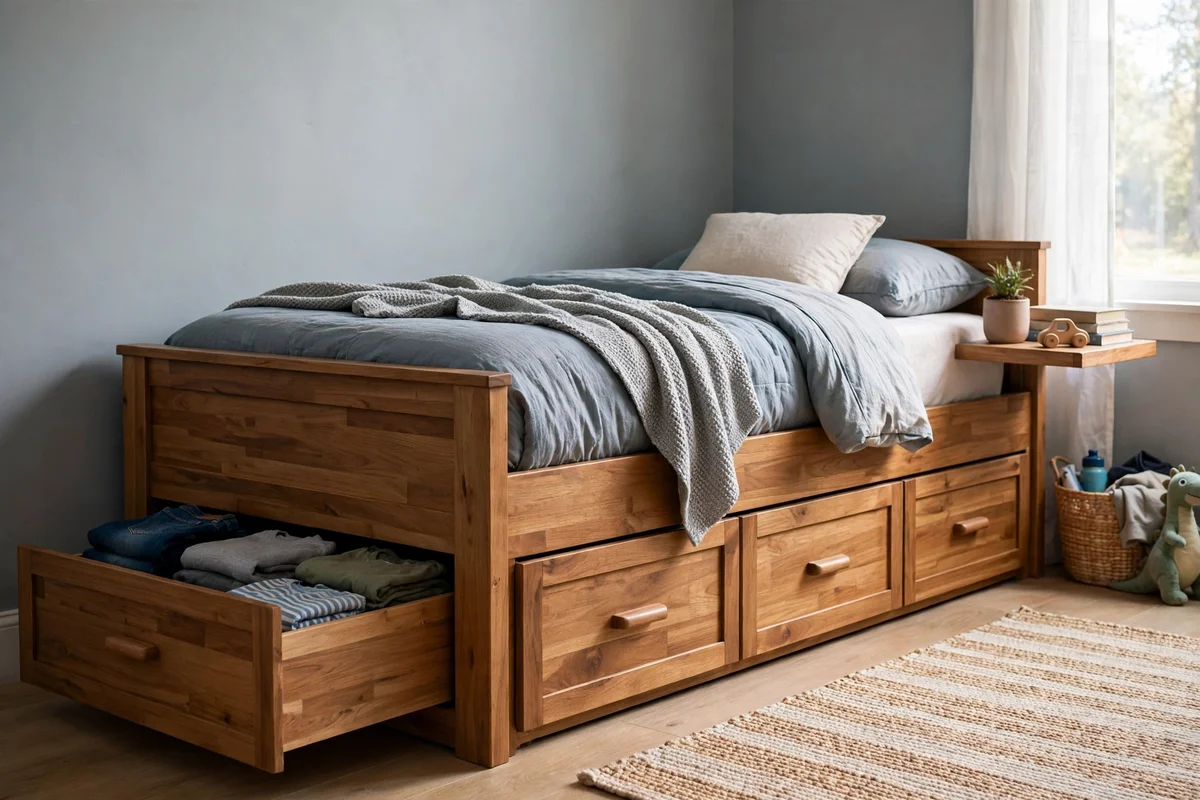
The bed is the most expensive single piece in the room, so it is the one to get right. A solid wood frame in a neutral finish — natural pine, oak, white, or grey — will suit a ten-year-old and a fourteen-year-old. A twin XL (99 cm wide, 213 cm long) is the safest size if the room can fit it: the extra length matters for a growing child, and the width is enough for reading and for a friend sitting on the end.
Consider a bed with storage underneath — drawers, or a lift-up base — if the room is short on storage. Under-bed drawers are genuinely useful for out-of-season clothes, spare bedding, and bulky hobby supplies, and they cost less than a separate chest of drawers. Check that the drawers run smoothly and that your child can open and close them alone; a drawer that sticks will simply never be used.
A headboard matters more than it looks. A solid or upholstered headboard gives a child something to lean against while reading, protects the wall from scuffs, and makes the bed look finished. An upholstered headboard in a plain, washable fabric is the comfortable choice; a wooden one is the durable choice. Either is better than no headboard, which leaves a bare wall and a bed that slides.
8. Buy the desk once

A desk bought for an eight-year-old is usually too small by eleven. A desk bought for an eleven-year-old is usually still fine at fifteen. The difference is size and sturdiness: a desk 120 to 140 cm wide, 60 cm deep, with solid legs and a surface that can take a laptop, a book, and a lamp at the same time.
Solid wood or a good-quality wood top is worth paying for, because a desk surface gets written on, leaned on, and spilled on. A wipe-clean surface or a desk mat protects it. Avoid glass tops for a child's room — they show every fingerprint and smear, and they feel cold and hard to work on. Avoid desks with built-in hutches that cannot be removed; they block light and make the desk feel like a cubby rather than a workspace. A separate small shelf above the desk, mounted on the wall, gives the same storage without the boxed-in feeling.
If the budget allows, a height-adjustable desk is the one luxury that genuinely earns its keep: it grows with your child from eight to sixteen, and it can switch to standing height for short bursts, which suits children who fidget. If it does not allow, a standard desk plus an adjustable chair is the next best thing, and far better than a small child's desk that will be outgrown in two years.
9. Pick multifunctional furniture that earns its floor space
In a big kid's room, every piece of furniture should do at least two jobs, because floor space is the scarcest resource. A storage bed stores and sleeps. A desk with drawers stores and works. A low bookshelf divides the room into zones and stores books. A trunk at the foot of the bed stores spare bedding and gives a friend somewhere to sit.
The most useful multifunctional pieces are the ones that hide storage inside something your child already uses. A bedside table with a drawer holds a torch, a book, and charging cables. A bench with a lift-up seat holds games and sports kit. A desk with a drawer unit holds homework supplies. A wardrobe with a mirror on the door saves the space a separate mirror would take.
10. Keep the big furniture neutral and let the accents change
This is the palette rule applied to furniture, and it is worth stating as its own idea because it is where most of the money goes. A bed, a desk, a wardrobe, and a chest of drawers in natural wood, white, or grey will match any accent colour your child chooses for the next five years. The same pieces painted bright blue will match one phase and fight the next.
If your child wants colour on the furniture, give it to them in one place: a desk chair in their favourite colour, a painted stool, or a single drawer front. A coloured chair is a statement that can be swapped in an afternoon. A coloured wardrobe is a statement that takes a weekend to undo. The same logic applies to handles and knobs — a set of coloured or brass knobs on a plain dresser changes the whole piece for the price of a few pounds, and changes back just as easily.
Bedding and the floor
11. Upgrade the bedding to something that looks grown-up
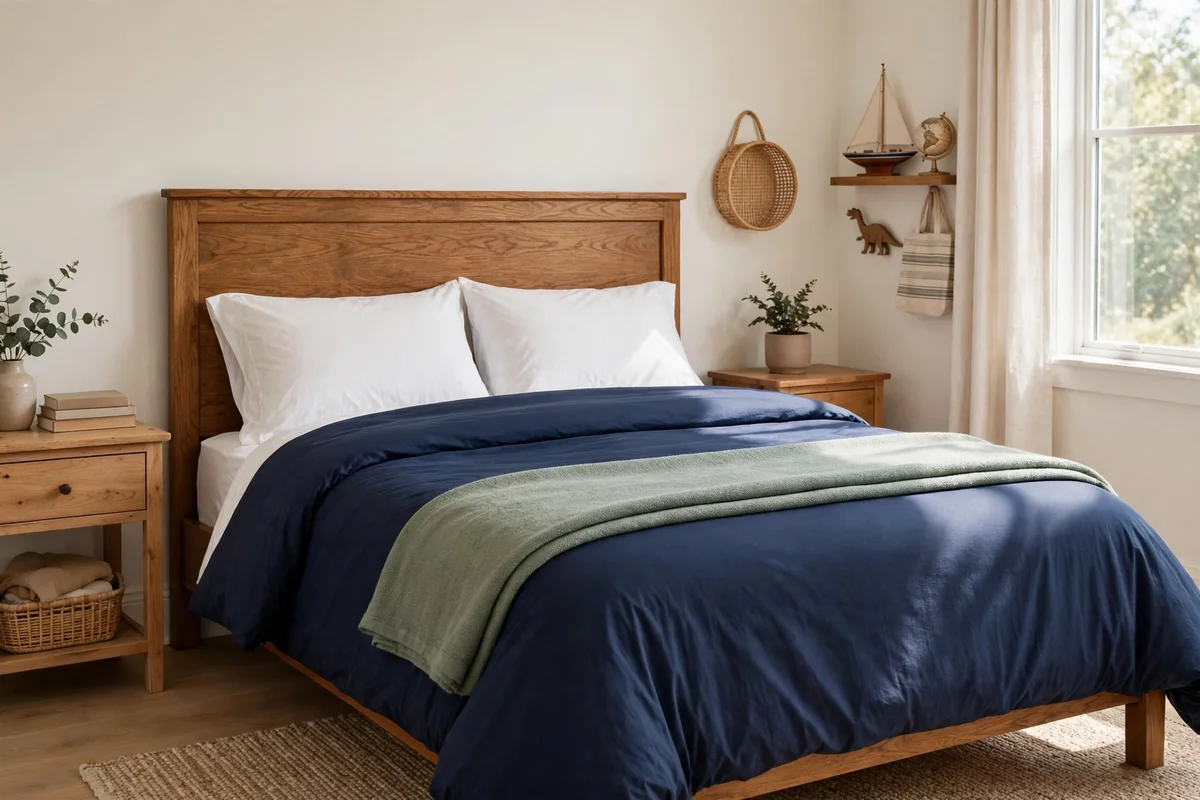
Bedding is the fastest way to make a room feel older, because the bed is the biggest surface in the room. The move is simple: plain, solid-colour bedding in the room's accent colours, with texture instead of pattern. A navy duvet cover, white or cream sheets, and a throw in the second accent colour across the foot of the bed. Add two sleeping pillows and one or two cushions — no more. A bed with six cushions looks like a display; a bed with two looks like a bed someone sleeps in.
Texture does the work that a cartoon print used to do. A waffle-weave throw, a linen-look duvet cover, a knitted cushion, and a smooth cotton sheet give the bed depth without any pattern at all. Layering helps: a flat sheet in one accent colour, folded back over the duvet, is a small detail that makes the bed look made rather than just covered.
12. Anchor the room with a large rug
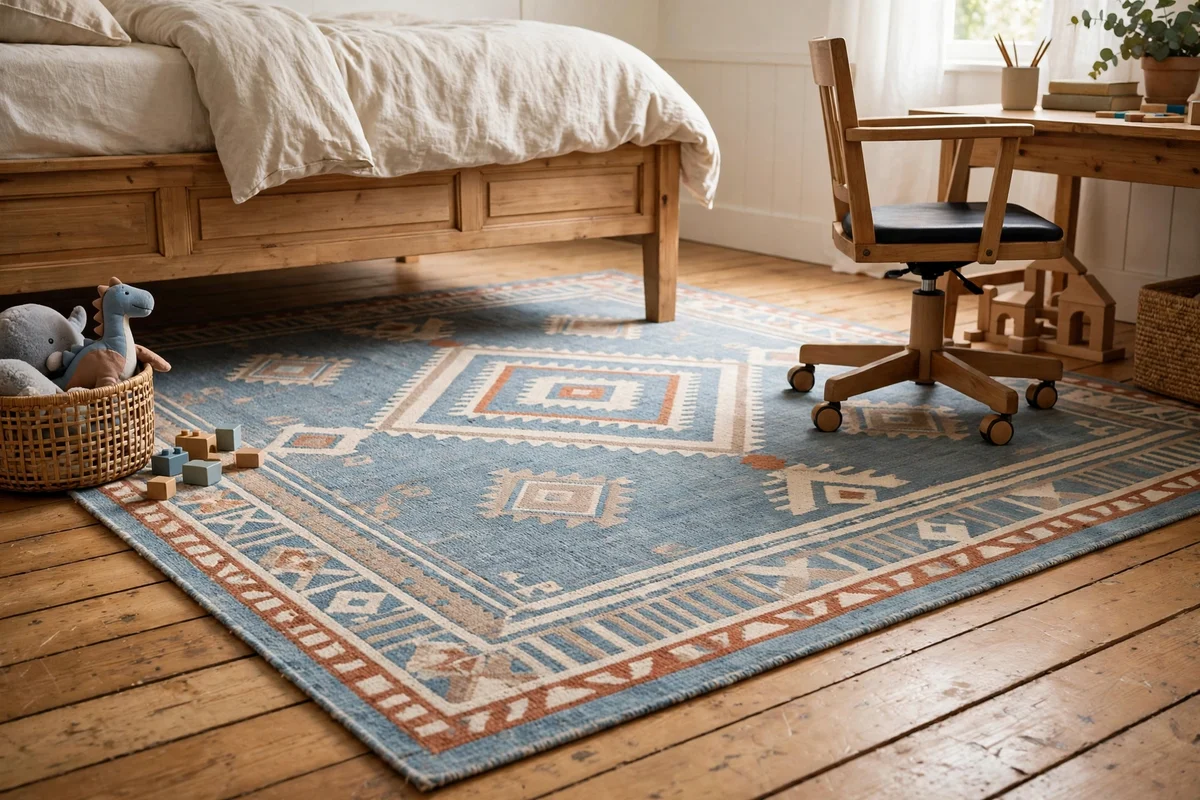
A rug does three jobs in a big kid's room: it adds a large block of colour, it marks out the play or lounge zone, and it makes the floor comfortable to sit on. The right size matters more than the pattern. A rug should be big enough to sit under the front legs of the bed and extend into the room, or big enough to define the lounge zone with all its cushions on it. A rug that is too small — a little mat floating in the middle of the floor — makes the room look smaller, not bigger. As a rough guide, a rug of about 160 by 230 cm suits most children's bedrooms; measure your room and buy the largest size that leaves a border of bare floor around the edges.
Choose a low-pile, washable rug. High-pile rugs trap crumbs and small parts from games and models, and a child's rug will be spilled on. A flat-weave or short-pile rug is easier to vacuum, easier to spot-clean, and more comfortable to build or draw on. Put a non-slip underlay underneath, even on carpet, because a rug that slides is a tripping hazard — and a child running across the room will find out faster than you will.
Pattern is optional. A plain rug in one of the room's accent colours, with patterned cushions on top of it, is the safest choice and the easiest to live with. A striped or geometric rug works if the bedding is plain; if both the rug and the bedding are patterned, the room starts to fight with itself. One patterned piece per room is enough.
Storage and the closet
13. Set up closet organisation your child can run alone
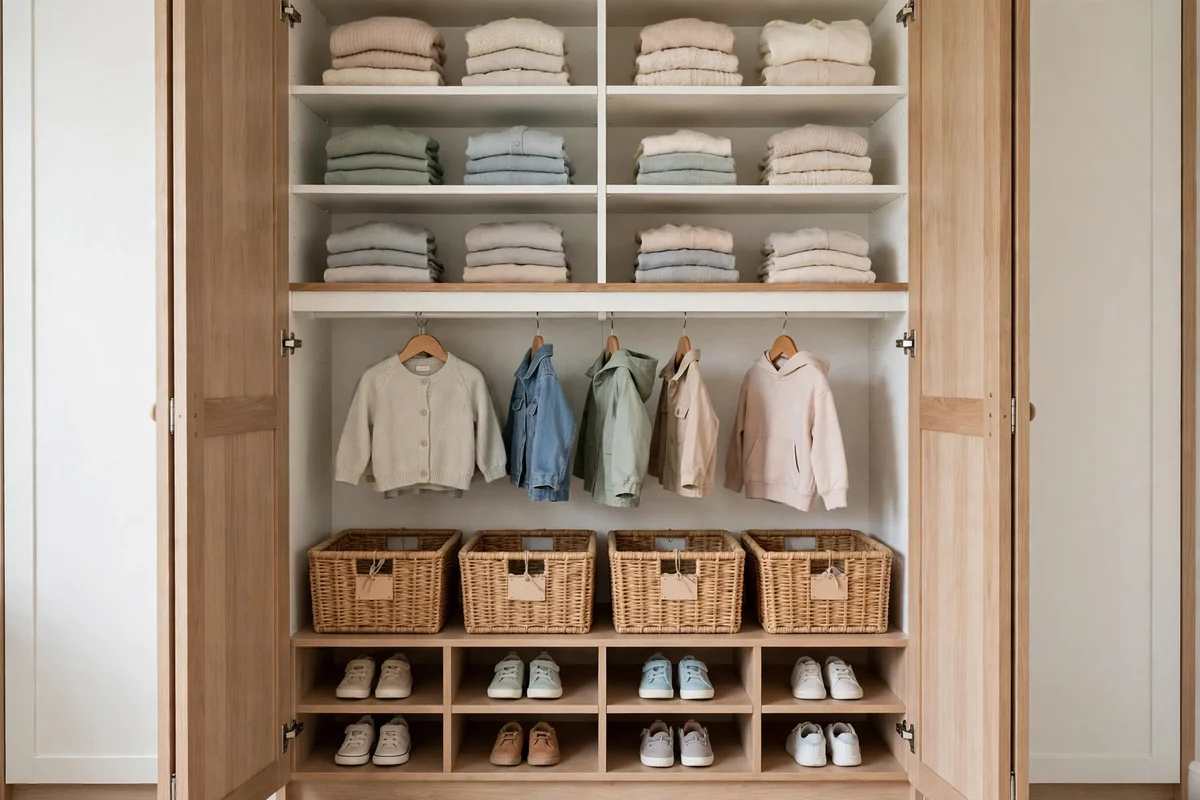
A closet that only an adult can use is a closet that stays messy. The fix is to bring everything down to your child's height and to give every category its own place. Lower the hanging rail to about 120 to 130 cm from the floor so your child can reach it — most closets have a rail at adult height and a lot of dead space below it. Add a second, lower rail for shorter items like shirts and folded trousers, or add shelves below the rail for folded clothes.
Inside the closet, use the same logic as the rest of the room: visible, labelled, and reachable. Open baskets or fabric cubes on the shelves for underwear, socks, and sports kit, each with a picture label as well as a word for younger big kids. A shoe rack or a row of cubbies at the bottom keeps shoes off the floor. A hook on the inside of the door holds tomorrow's outfit — a small habit that makes school mornings noticeably calmer, because the decision was made the night before.
14. Use open shelving and floating shelves for display and reach

Open shelving is the storage that makes a room look like it belongs to a person, not a warehouse. A low, open bookshelf holds the books your child actually reads, at a height they can reach without a chair. Floating shelves above the desk hold the things that need to be visible but not handled daily — a favourite model, a framed photo, a small plant. The rule is simple: heavy things low, light things high, and nothing on a high shelf that a child will climb to reach.
Floating shelves work best in short runs of two or three, not in a long row that covers the whole wall. A row of shelves across an entire wall reads as storage; two shelves in a cluster read as display. Leave breathing room between the objects on a shelf — three or four items per shelf, with space around each one, looks considered; a shelf packed edge to edge looks like a cupboard with its door off.
Anchor every tall or heavy piece of furniture to the wall. A bookshelf that is not anchored can tip forward if a child climbs it or pulls on it, and big kids do climb. Wall anchors are cheap, take minutes to fit, and are the single most important safety job in this whole project. Do it before the room is finished, not after, and check the anchors again once a year.
15. Make storage a system, not a pile

The difference between a tidy big kid's room and a messy one is rarely how much storage there is — it is whether the storage is a system. A system means every category of thing has a named home, the home is labelled, and your child can put things away without asking where they go.
Start by sorting everything in the room into categories with your child: school things, hobby supplies, games, books, sports kit, keepsakes, and clothes. Then give each category a container: a drawer, a basket, a bin, or a shelf. Label each container with a word and, for younger children, a picture. The labels matter more than the containers — a labelled basket is a system; an unlabelled basket is a box.
The "one in, one out" rule keeps the system working. When a new game, book, or hobby kit arrives, an old one leaves — donated, passed on, or stored elsewhere. Without a rule like this, the storage that was exactly right in September is overflowing by Christmas. And schedule a reset: ten minutes on a Sunday evening, with your child, putting everything back in its zone. A weekly reset stops the slow drift that turns a good system into a pile, and it is short enough that it does not feel like a punishment.
16. Keep one drawer that is entirely theirs
Every big kid needs one place in the room that is private and unorganised — a drawer, a box, or a shelf where they keep whatever they want, however they want, and nobody tidies it. It might hold ticket stubs, stones, notes from friends, a broken toy they will not throw away, or a collection that makes sense only to them. The contents do not matter. What matters is that the room contains one place that is fully theirs, with no adult system imposed on it.
Display the child, not the theme
17. Build a gallery wall your child curates

A gallery wall is the one piece of wall decor that gets better as a child grows, because it changes with them. Start with four or five frames in matching frames — the same frame colour, different things inside — and leave empty space for what comes next. Mix your child's own work with prints, photos, and postcards. A drawing they made, a photo of a friend, a postcard from a trip, and a print in the room's accent colours, all in the same frames, look like a collection rather than a random set of pictures.
Hang the gallery wall at your child's eye level, not adult eye level. A good guide is that the centre of the arrangement should sit at about 120 to 140 cm from the floor for a child of eight to twelve — low enough that they can see it properly and change it themselves. Arrange the frames on the floor first, take a photo of the arrangement you like, and use the photo as a guide when hanging. Leave one empty frame, or one empty space, on purpose: it is the invitation to add something new, and a gallery wall with a gap in it looks alive rather than finished.
Use frames that open easily — clip frames, magnetic poster hangers, or frames with a front that swings open — so swapping art takes a minute rather than a toolbox. If changing the art is hard, it will not happen, and the wall will freeze in time.
18. Add a pinboard or inspiration board
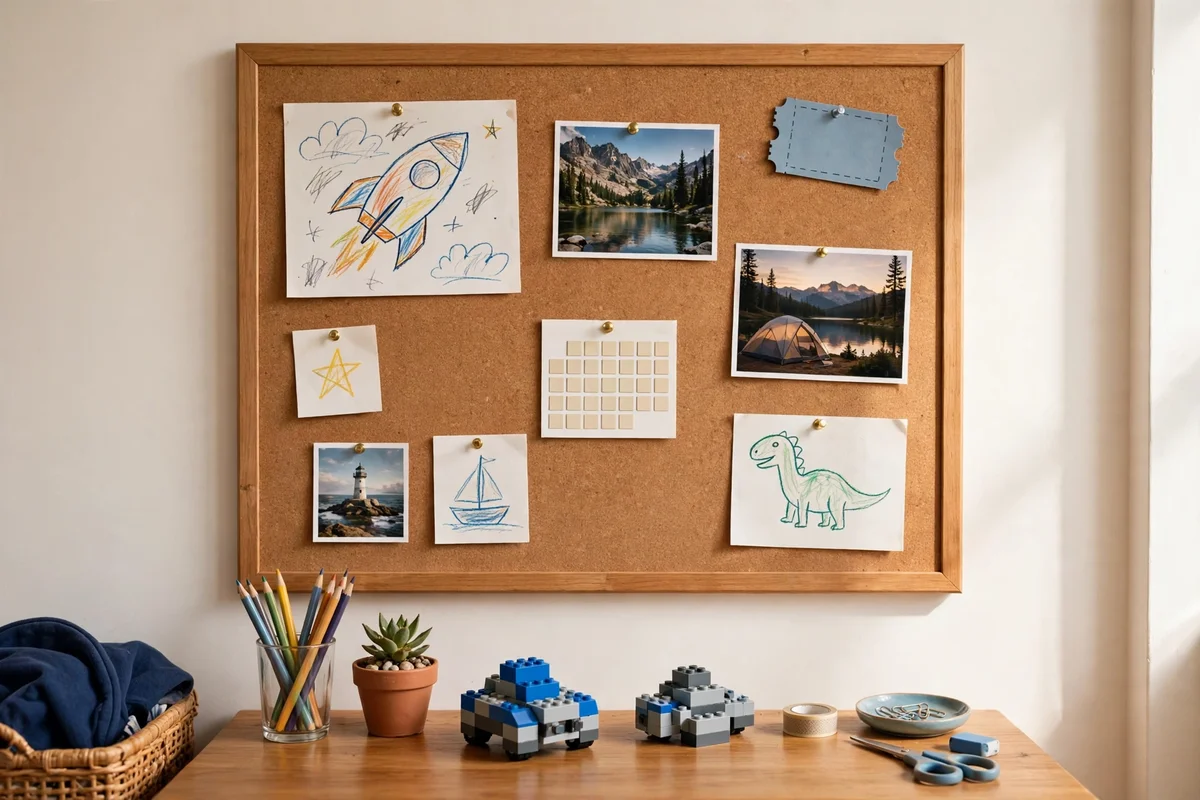
A pinboard is the working version of a gallery wall: the place for the things that change weekly. A cork board, a fabric-covered board, or a magnetic board above the desk holds the timetable, a drawing in progress, ticket stubs, photos, and reminders. It is the one wall surface that is allowed to be messy, because it is a tool, not decoration.
Keep the pinboard to a sensible size — about 60 by 90 cm is enough — and put it where your child can reach it easily, above the desk or beside the bed. A board that is too big becomes a dumping ground; a board that is too small gets ignored. Check it together once a month and take down what is out of date. An old timetable pinned up in June is not decoration, it is clutter, and clearing it takes two minutes.
A washing line with pegs, strung across one wall, does the same job for art: finished drawings pegged up in a row, swapped when a new one is finished. It suits children who produce a lot of art and want to see it all, and it costs almost nothing. Either version — pinboard or line — gives your child a place to put things that matter to them right now, without asking permission.
19. Display achievements without building a shrine

Medals, trophies, certificates, and collections deserve a place in the room — but they deserve a place, not the whole room. A single shelf for achievements, with room for a few items and space around them, celebrates them far better than a crowded display where nothing stands out. Hang medals on a small row of hooks rather than draping them over a bedpost or a door handle, where they tangle and fall. Frame one certificate — the one that matters most — and keep the rest in a folder.
Collections work the same way. A child who collects model cars, rocks, or figurines should display a few favourites on a shelf and rotate the rest, rather than displaying everything at once. Rotation keeps the display fresh, keeps the shelf tidy, and makes the collection feel special again each time it changes. Agree on a limit together — one shelf, or one row of hooks — and let your child choose what earns a place on it. The choosing is part of the pleasure.
The deeper point is that a big kid's room should show who the child is now, not who they were at six. A shelf of current achievements and current favourites tells the story of an eight- or ten- or twelve-year-old. A room full of every trophy ever won tells the story of a storage problem.
Light and atmosphere
20. Layer the lighting so the room changes with the day
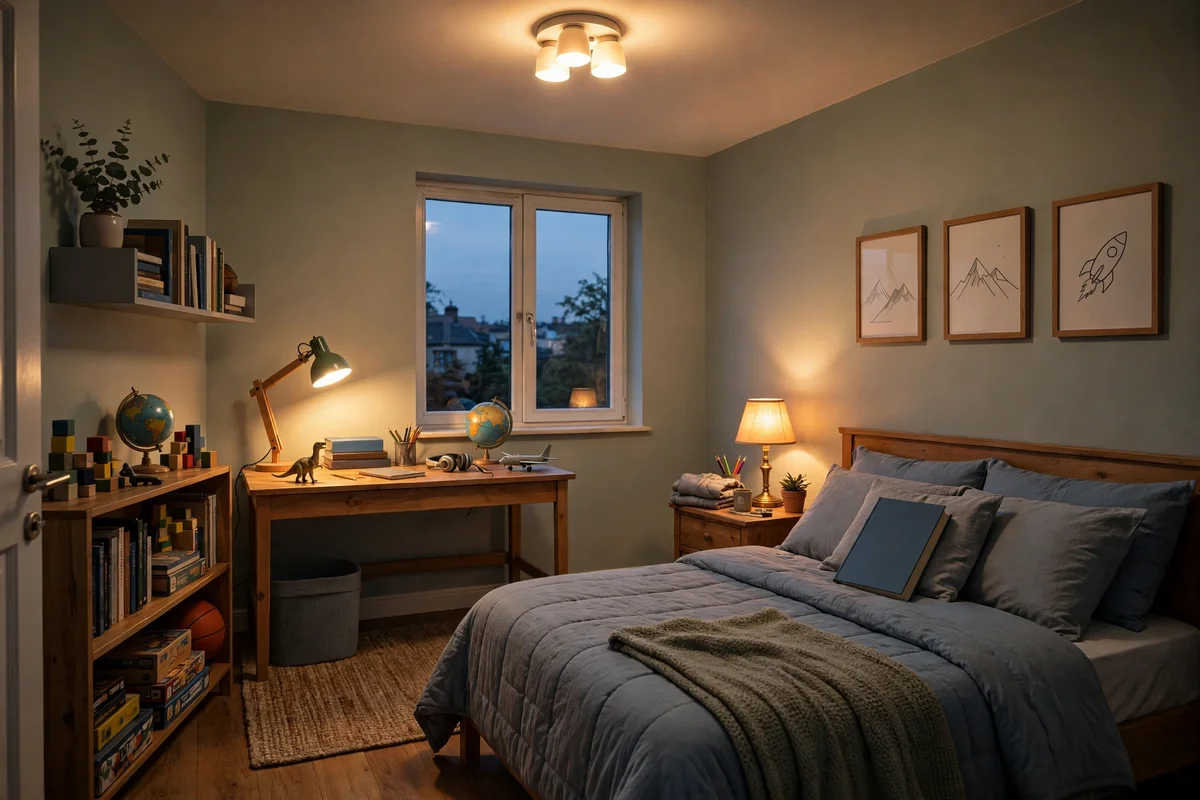
A big kid's room needs three kinds of light, and one ceiling light is not enough. The first is general light: a ceiling light that fills the whole room, bright enough for tidying and finding things. The second is task light: a desk lamp for homework and a reading lamp by the bed, both with warm white bulbs. The third is low light for winding down: a small bedside lamp, a string of warm fairy lights, or a nightlight for younger big kids who still want one.
Warm white light suits evenings better than bright white light, which can make a room feel like a classroom when it should feel like winding down. If your lighting allows it, a dimmer switch on the ceiling light is the single most useful lighting change in a child's room — full brightness for homework and tidying, low light for reading and bedtime. If a dimmer is not possible, a lamp with a dimmer, or a simple two-lamp setup where one lamp goes off at bedtime, does much of the same job.
Keep the lighting safe and simple. Cords should run behind furniture, not across the floor. Battery-operated lights are the safer choice for fairy lights and for anything inside a reading nook or a tent. A timer plug, or a lamp with a built-in timer, means the lights go off by themselves — one less thing to remember at bedtime. And check the bedtime light from the bed: sit on the bed and look around. If a bulb shines directly into your eyes, move it. A child reading in bed will not complain about it; they will just stop reading in bed.
Letting Your Child Choose — Within Boundaries
A big kid should help design their room. It is their room, and a room they helped choose is a room they will look after. But "help design" does not mean "decide everything." A child of nine choosing between every paint colour in the shop is overwhelmed, not empowered. A child choosing between two options you have already checked will work is empowered — and you will not be repainting in a month.
Give real choices in the changeable layer: which of two bedding sets, which cushion colours, which prints go on the gallery wall, which hobby supplies live in the hobby zone, what goes on the pinboard. These are decisions where either answer works, and your child can see the result the same day.
Keep the structural decisions with the adults: the bed size, the desk size, the layout, the budget, and the safety jobs like anchoring furniture. Explain why, briefly and honestly — "we are buying a bed that will still fit you at fourteen" is a reason a child understands. And set one clear boundary before shopping starts: the total budget, and the rule that the room's big pieces stay neutral so the room can change again later. A child who knows the boundary in advance argues less than a child who discovers it in the shop.
There are also choices you should not offer. Do not ask a child to choose between a themed bed and a plain bed if you are not willing to buy the themed bed. Do not ask whether they want a desk if you know they need one. An offer that is not really an offer teaches a child that their opinion does not count. Offer fewer choices, and honour every one you offer.
A Weekend Plan: Friday, Saturday, Sunday
A big kid's room can be done in one weekend if the order is right. The order matters, because painting before you have measured, or buying bedding before you have chosen the palette, creates the rework that eats weekends.
On Friday evening, walk the room together and make the decisions. Choose the palette and the two accent colours. Measure the walls and the floor, note where the sockets and switches are, and measure the bed, desk, and wardrobe you plan to keep. Make a list in three columns: keep, buy, and do. "Keep" is the furniture staying. "Buy" is the new pieces, the bedding, the rug, and the storage. "Do" is the jobs: paint, anchor furniture, hang shelves, sort the closet. Order or buy only what is on the list — a list written on Friday night is the difference between one trip to the shops and three.
On Saturday, do the messy work. Move the furniture out or into the middle of the room, protect the floor, and paint the accent wall if you have one. While the paint dries, sort the closet and the storage with your child — the three piles of keep, pass on, and outgrown. Anchor the tall furniture to the wall while it is away from the wall and easy to reach. Wash the new bedding and cushion covers so they are ready for Sunday. Do not try to hang art or arrange shelves while paint is wet; it will get marked.
On Sunday, put the room back together in this order: bed and bedding first, then the desk and chair, then the rug, then storage and bookshelves, then the hobby and lounge zones, then wall art, the gallery wall, and the pinboard last. Art goes last because it is the easiest thing to move, and you will only know where it belongs once the furniture is in place. Finish by walking to the door and looking at the room as a visitor would — the view from the door is the view that matters most, because it is the one you see every day. Then let your child put the finishing touches in place themselves: the books on the shelf, the favourites on the display, the first drawing on the pinboard. That last hour is theirs.
Budget: Three Price Levels
A big kid's room does not have to be expensive. The difference between the three levels below is how much furniture is replaced and how much is repainted or reused, not how grown-up the result feels. All three levels assume you keep the bed and the wardrobe if they are still sound.
A refresh under $50 uses what you already have: move the furniture into zones, sort the closet and the storage into labelled containers you already own, swap two cushion covers, hang a gallery wall with frames you already have, add a pinboard, and let your child choose the display. The room changes without any paint or new furniture, and it takes an afternoon. This is the right level if the furniture is fine and the problem is layout and clutter, not the furniture itself.
A mid-level refresh, roughly $50 to $200, adds the pieces that make the biggest difference: new plain bedding, a washable rug, a desk lamp and a bedside lamp, labelled storage bins, and paint for one accent wall. This is the level most families choose, because it changes the room properly without replacing the furniture. If you can only spend on three things, spend on the bedding, the rug, and the lighting — they are the three things that change how the room feels the most for the least money.
A full redo, $200 and up, adds a new desk and chair, a storage bed or a new bed, new curtains, and shelving. This is worth doing when the furniture genuinely no longer fits — the bed is too short, the desk is a child's desk, the storage is broken — rather than as a standalone project. If you are spending at this level, spend it on the things that are hardest to change later: the bed, the desk, and the storage. Bedding and art can always be upgraded later, one piece at a time. And buy second-hand where you can: a solid wood desk or dresser from a second-hand shop, repainted in a neutral colour, often costs less than a new flat-pack piece and lasts longer.
Big Kids Rooms by Age
An eight-year-old is at the start of this transition. The room should feel older than a little-kid room but still allow for play. Keep a visible play or hobby zone, keep the storage low and labelled with pictures as well as words, and keep the choices small — two options, not ten. The bed can stay a twin, the desk can be the smallest adult size, and the display should include things they made, not just things they won. At eight, the room is mostly planned by the parent, with the child choosing the accents.
A ten-year-old is in the middle of it. Homework is regular, friends come over, and hobbies are serious enough to need their own zone. This is the age for the full four-zone layout, the homework station with proper lighting, the lounge spot, and the gallery wall they curate themselves. Give a ten-year-old more say: let them choose the accent colours, the bedding, and the layout of their display. They will also have strong opinions about what stays and what goes — listen to them, especially about the things they want to keep.
A twelve-year-old is nearly a teenager, and the room should be planned as if it is one. The palette should be the most muted version, the furniture should be adult size, the hobby zone should be able to hold a laptop or a larger project, and the lounge zone should be able to hold two or three friends. At twelve, let your child lead the design within the budget and the structural boundaries, and expect them to change their mind about the accents within a year. That is not a failure of the plan — it is the plan working. The room was built so the accents could change.
Small Rooms and Shared Rooms
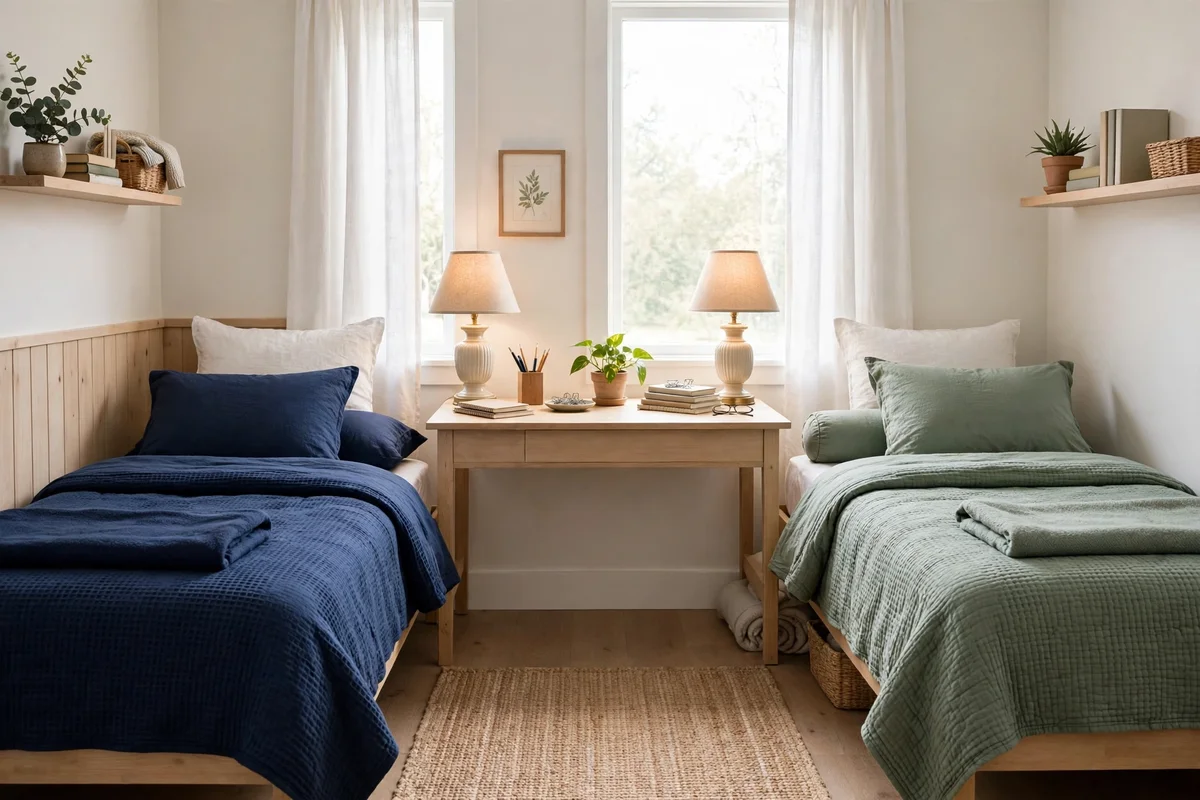
A small room needs the four zones to work harder and take up less space. Use the rug and the lighting to mark zones instead of furniture. Put the desk under the window, the bed against the longest wall, and the storage on the wall with the door. Skip the armchair and use floor cushions that stack in a corner. Use a wall-mounted bookshelf instead of a standing one, and floating shelves instead of a display unit. A mirror opposite the window bounces light around a dark corner and makes the room feel larger — a full-length mirror on the wardrobe door does this job and saves the space a separate mirror would take. Keep at least one wall completely plain, so the room has somewhere for the eye to rest, and keep the centre of the floor as clear as you can. In a small room, open floor is the most valuable thing in it.
A shared room needs a plan both children can live with, and a way for each child to have their own space inside it. The neutral palette with two accent colours works well here: give each child one signature colour — one child's bedding in navy, the other's in sage, for example — while the shared parts of the room, the rug, the curtains, and the storage, use the neutral base. If the beds are on opposite walls, each bed wall can carry its own small display in that child's colours, with the shared wall kept neutral. Colour-coded storage earns its keep twice over in a shared room: each child's bins in their own colour end most arguments about whose things are whose. Keep the layout symmetrical where you can — matching beds, matching lamps, matching shelves — because symmetry makes a shared room feel fair even when the colours differ. And give each child their own private drawer. In a shared room, one private place each is not a luxury; it is what makes sharing work.
Mistakes That Make Big Kids Rooms Feel Wrong
The most common mistake is buying a themed bed or themed furniture. A bed shaped like a car, a castle, or a racing car is exciting at eight and embarrassing at eleven, and it is the most expensive thing in the room to replace. Buy plain furniture in adult sizes and let the theme live in the bedding and the art, which cost far less to change.
The second mistake is forgetting the desk. A big kid without a proper desk does homework on the bed or at the kitchen table, and both are worse: homework on the bed blurs the line between work and sleep, and homework at the kitchen table means the room never becomes the place where work happens. A desk is not optional for a child of nine or ten; it is the piece of furniture the whole transition is built around.
The third mistake is decorating at adult eye level. Art hung too high, shelves a child cannot reach, and a pinboard above adult reach all make the room look good in photos and work badly in real life. Hang the gallery wall, the pinboard, and the hooks at your child's height, and test every shelf by asking your child to reach it.
The fourth mistake is buying storage without a system. A set of pretty baskets with no labels and no categories is just a set of boxes. The system — categories, labels, a weekly reset, one in and one out — is what keeps a room tidy. Buy the system first, in the form of a sorting session with your child, and buy the containers after you know what needs to go in them.
How the Room Keeps Growing Up
The best big kid's rooms are built to be undone in stages. When your child outgrows this version, change the cheap things first: swap the bedding for a plainer colour, take down the gallery wall and replace it with new art, change the cushion covers, and move the hobby zone to make room for a bigger desk setup. That alone removes most of what made the room feel young, and the room will already feel older.
If that is not enough, repaint the accent wall in a single colour drawn from the old palette — sage green, dusty blue, or warm cream — and keep the furniture, which will now look like adult furniture rather than part of a children's room. The storage system can stay, because labelled storage is useful at any age, and the bookshelf still looks good when the books themselves have changed.
The expensive reversals are the bed and the desk, which is why they were bought in adult sizes in the first place. A twin XL bed and a 120 cm desk do not need replacing at thirteen or fifteen. What changes is what sits on them: a laptop instead of a pencil pot, a larger bookshelf, a different lamp.
Frequently Asked Questions
When should I redo my child's room for a big kid?
When your child asks for it, when homework starts coming home most nights, when friends visit and there is nowhere to sit but the bed, or when the storage no longer fits what your child owns. Any one of those signs is enough, and the change works best as a single weekend project rather than a slow drift. There is no single right birthday — eight is the early end, twelve the late end — but the signs matter more than the age.
What size bed should a big kid have?
A twin (99 by 203 cm) is the minimum, and a twin XL (99 by 213 cm) is the safer choice if the room can fit it, because a growing child will use the extra length for years. A full-size bed (137 by 203 cm) works in a larger room and gives more space for reading, but it takes up floor that a small room may not have. Buy a solid wood or good-quality metal frame in a neutral finish, and avoid themed beds.
How do I organise a big kid's closet?
Lower the rail to 120 to 130 cm so your child can reach it, add shelves or a second rail below for folded clothes, and use labelled baskets for underwear, socks, and sports kit. Do a clear-out first — keep, pass on, and outgrown — and leave one empty shelf on purpose. A hook inside the door for tomorrow's outfit makes school mornings easier.
How can I make a small kids room feel bigger?
Keep the walls and big furniture neutral, use a large rug rather than a small one, keep the centre of the floor clear, use floating shelves instead of standing furniture, and put a full-length mirror opposite the window. Mark zones with rugs and lighting rather than with furniture, and use floor cushions that stack away instead of an armchair.
How do I let my child choose without losing control of the room?
Offer real choices in the changeable layer — bedding, cushions, gallery wall art, display — and keep structural decisions (bed size, desk size, layout, budget) with the adults. Offer two or three options you have already checked will work, rather than an open choice, and honour every choice you offer. Set the budget and the neutral-furniture rule before shopping starts.
What is the best colour for a big kid's bedroom?
Warm white, pale greige, soft grey, or pale sage on the walls, with two accent colours repeated in the bedding, rug, cushions, and art. Navy and mustard, sage and terracotta, and grey-blue and blush are all reliable pairs. Keep the brightest colours in the changeable layer, not on the walls, so the room can change again in a year or two without repainting.
Final Checklist Before You Buy Anything
- Walk the room with your child and write down what annoys them about it.
- Measure the room, the bed, the desk, and the wardrobe — and mark the layout on the floor with masking tape.
- Pick a neutral wall colour and two accent colours, and test swatches in daylight and lamplight.
- Decide the four zones: sleep, study, hobby, lounge — and where each one goes.
- Check the desk is at least 120 cm wide and the chair lets your child's feet rest flat on the floor.
- Lower the closet rail to 120–130 cm and plan labelled storage your child can run alone.
- Anchor tall furniture to the wall before the room is finished.
- Buy the paint first, then match the bedding and rug to it.
- Leave one wall plain, leave some open floor, and leave one drawer that is entirely your child's.
- Agree the budget and the choices your child gets to make before you go shopping.
A big kid's room does not need to be perfect, and it does not need to be finished in one go. Start with the layout and the four zones, get the bed and the desk right, and let the storage, the display, and the art grow over time. The rooms children love most are rarely the ones with the most furniture — they are the ones where everything has a place, there is somewhere to sit with a friend, and there is a corner that is entirely theirs. Get those three things right, and the room will grow up with them.