Active Kids Room Ideas
Children do not sit still, and a bedroom that asks them to will lose the argument every time. The couch becomes a climbing frame, the hallway becomes a racetrack, and the bed becomes a trampoline. An active kids room stops fighting that energy and gives it somewhere proper to go: a wall to climb, a mat to tumble on, a beam to balance on, and a corner to crash into safely. The room does not need to be big, and it does not need to be expensive. It needs a plan that separates moving from sleeping, and equipment that is fixed properly and padded underneath.
The short version: divide the room into three zones — Move, Calm, and Stash. The Move zone is one open patch of floor, at least six feet square, with a soft surface and nothing breakable in it. The Calm zone is the bed and a reading corner, kept quiet and separate. The Stash zone is where the gear lives when it is not being used, so the floor can be cleared in five minutes. Then add one or two active features — a climbing wall, a swing, a balance beam, an obstacle course — and stop there. A room with two good features and clear zones gets used every day; a room crammed with equipment gets used for a week and then becomes an obstacle course nobody can walk through. The ideas below are arranged in the order most parents actually use them: the three-zone plan first, the safety rules second, then the ideas grouped by what they train — climb, swing, balance, and crash — then the practical parts: room sizes, ages, shared rooms, budgets, and the mistakes that make an active room unsafe.
The Move-Calm-Stash Method
Every active room that works follows the same three-zone layout, whether it is a nursery corner or a full playroom. The Move zone is where the energy goes. Clear a patch of floor at least six feet by six feet, cover it with foam tiles or a thick rug, and keep it free of furniture, glass, and sharp corners. This is where jumping, tumbling, obstacle courses, and dancing happen. If the room is small, the Move zone can be the middle of the floor with the furniture pushed to the edges — it does not need its own corner, it needs its own clear space.
The Calm zone is the bed and a reading corner, and it exists so the room can still do its other job: sleep. Keep the bed out of the Move zone, keep the lighting there warm and low in the evening, and keep the active equipment from creeping into it. A child who has to climb over a balance beam to get into bed will not wind down, and a room that is all movement has nowhere to be quiet. A small bookshelf, a cushion, and a lamp are enough for a Calm zone; the point is separation, not furniture.
The Stash zone is storage for the gear, and it is what keeps the other two zones working. Jump ropes, balls, resistance bands, and small equipment need a home a child can reach without help — a rolling cart, a set of hooks at child height, a basket by the door. If the gear lives on the floor, the Move zone disappears under it within a week. A good rule is that the room should be convertible in five minutes: gear away, mats stacked, floor clear for sleep. If it takes longer than that, there is not enough storage or there is too much equipment.
Safety First: The Rules Before the Fun
Active play has real risks, and the safety rules are not optional extras — they are what make the room possible at all. Three rules cover most of it. First, anchor everything. Climbing walls, shelves, swings, monkey bars, and loft beds must be fixed into wall studs or ceiling joists with hardware rated for the load, not into plasterboard with ordinary screws. If you are not sure where the studs are, use a stud finder, and if you are not sure about the fixing, get a professional to do it. A climbing hold that pulls out of the wall is not a minor problem.
Second, cushion the floor. Crash mats at least four inches thick go under climbing features, swings, and monkey bars. Foam tiles or a thick rug cover the Move zone. Keep a clear fall zone — about six feet — around climbing and swinging gear, with nothing hard inside it. A child who falls should land on padding, not on a toy box or a bed frame.
Third, respect the limits. Every piece of equipment has an age range, a weight limit, and a ceiling-height requirement. Follow them. A swing hung too low, a climbing wall too high for its mat, or a loft bed under a low ceiling are all accidents waiting for a bad day. And supervise active play, especially with younger children and with any new piece of equipment. The room is designed for movement, but it is not a substitute for an adult in the house.
Check the equipment monthly: tighten bolts, check ropes and straps for wear, look for cracked holds and torn mats. A five-minute check once a month catches the wear that causes most accidents. And keep a first-aid kit in the room, where an adult can reach it without leaving the child alone.
| Safety rule | What it means in practice |
|---|---|
| Anchor everything | Studs or joists only, rated hardware, professional help if unsure |
| Cushion the floor | 4-inch crash mats under climbing and swinging gear; foam tiles in the Move zone |
| Clear fall zone | About 6 feet clear around climbing and swinging equipment |
| Follow the limits | Age, weight, and ceiling-height limits on every piece of gear |
| Check monthly | Tighten bolts, inspect ropes, straps, holds, and mats |
18 Active Kids Room Ideas
Climb
1. Create an indoor climbing wall

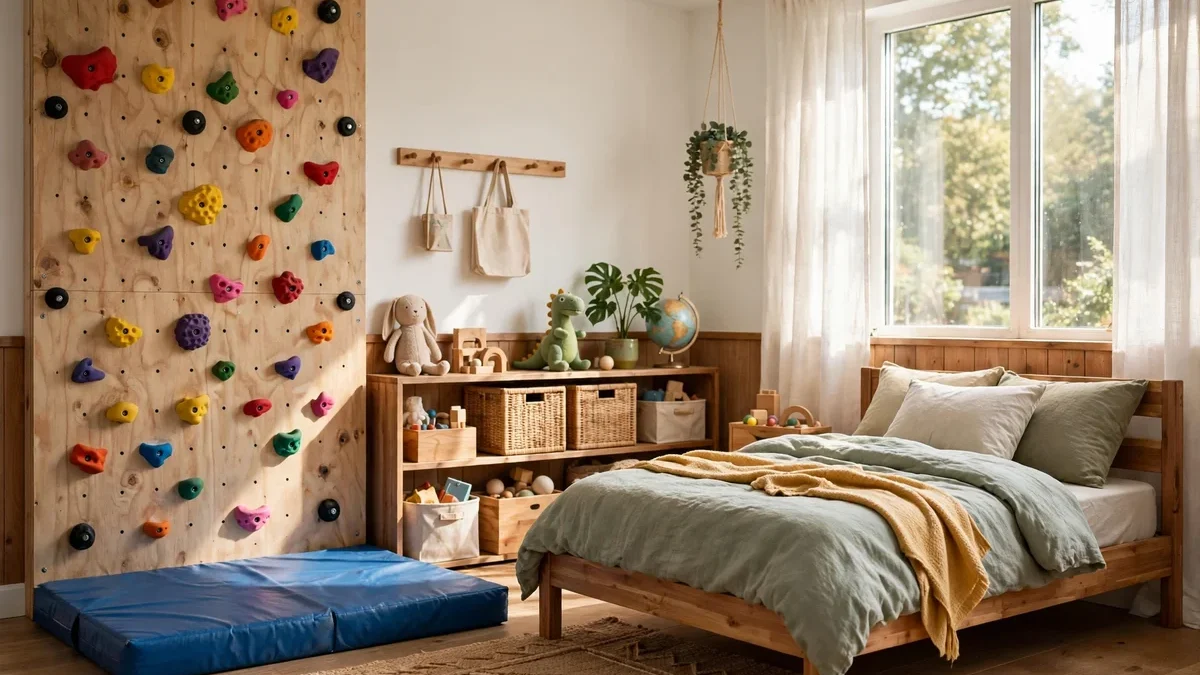
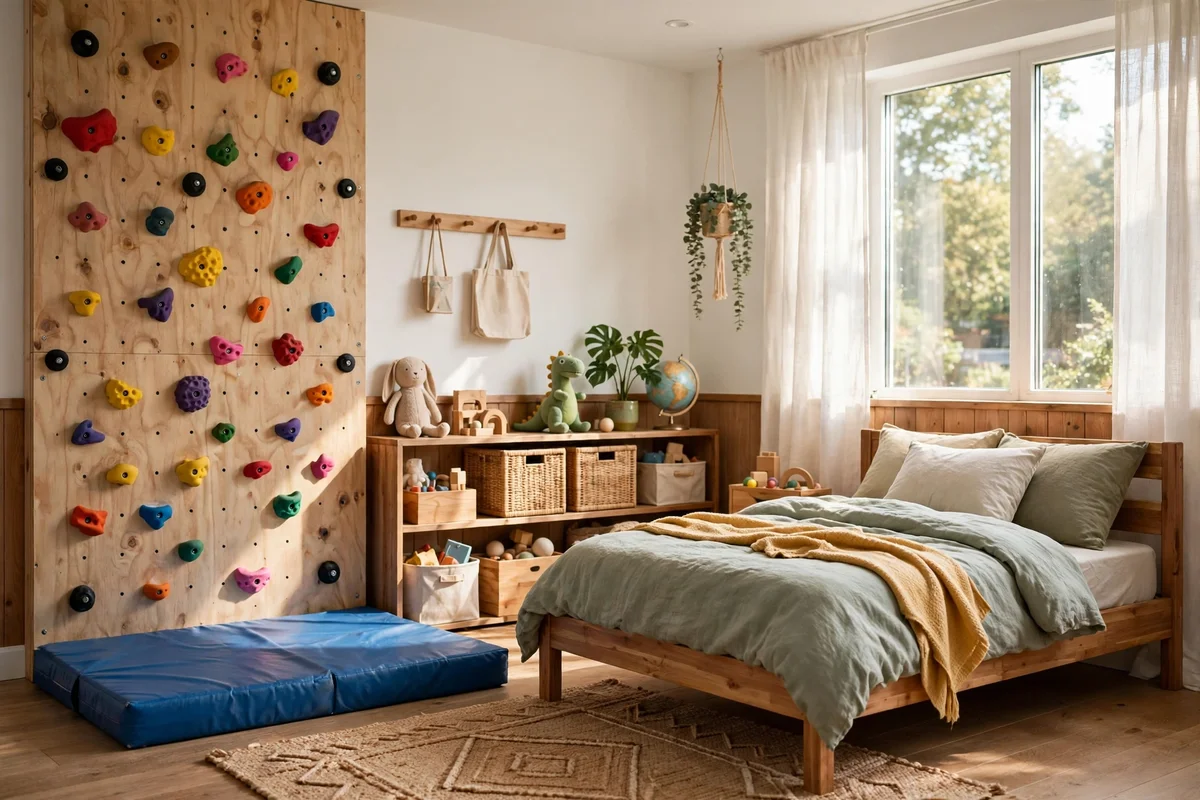
A small climbing wall is the single most exciting feature an active room can have, and it does not need to take over the room. A plywood backer panel, fixed into wall studs, with a dozen age-appropriate holds in bright colours, gives a child a daily challenge that builds strength, balance, and confidence. Start low — holds within easy reach of the mat — and add higher holds as your child grows, rather than building a tall wall on day one. Put a crash mat at least four inches thick underneath, keep a clear fall zone around it, and teach the rule that climbing happens only when the mat is in place. The wall quickly becomes the room's favourite feature, and it doubles as a feature wall: the coloured holds against a painted backer look deliberate and cheerful even when nobody is climbing. A climbing wall suits children from about age four upward, and it works in a corner as easily as across a whole wall.
2. Add a mini rock-climbing corner

A climbing corner is the small-room version of a climbing wall, and it works when a full wall feels like too much. A narrow panel in a corner, a set of soft climbing blocks, or a low ramp with holds gives toddlers and younger children a safe way to climb without needing a tall wall or a big mat. Foam climbing blocks are the best first step for the youngest climbers: they are soft, they can be rearranged into new shapes, and they double as building blocks when the climbing is done. For older children, a corner panel with holds on two walls turns an awkward corner into the most exciting part of the room. Keep the climbing height low — no higher than your child can fall from safely onto the mat below — and keep the corner clear of furniture, so a slip lands on padding and not on a toy box.
3. Install monkey bars or overhead climbing features
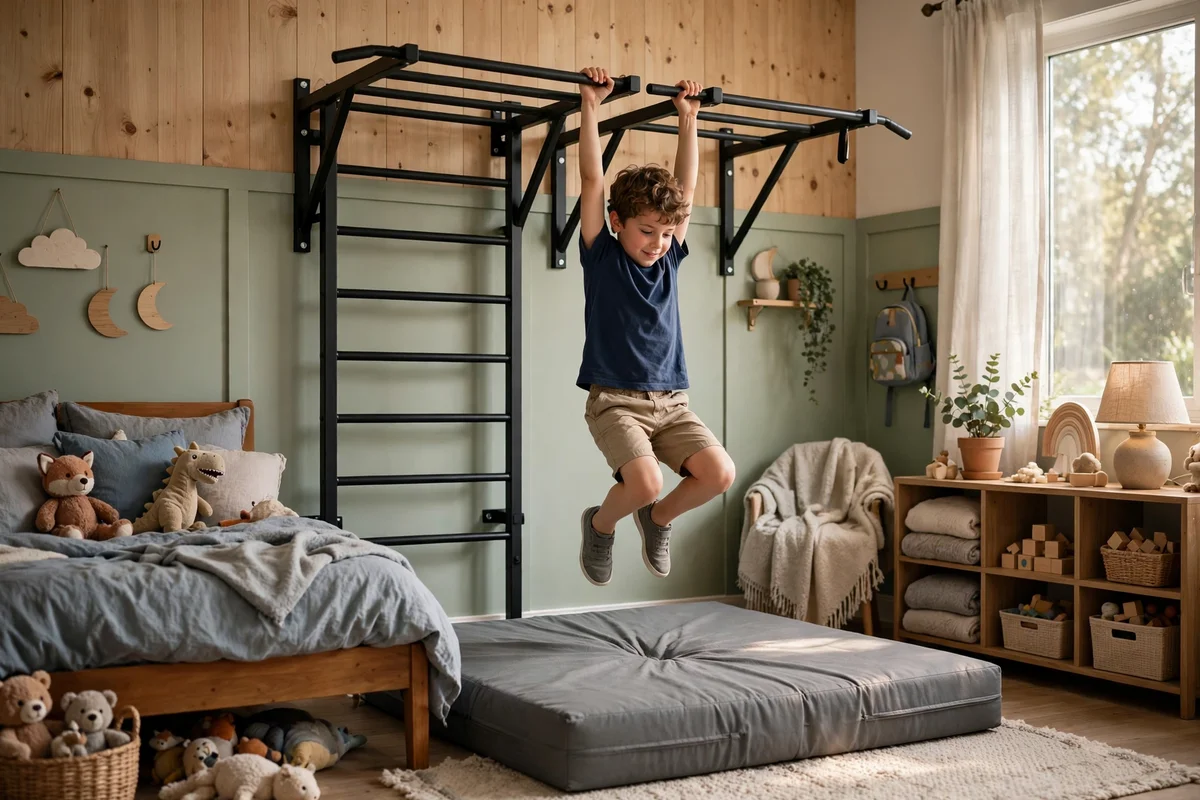
Monkey bars bring playground energy indoors, and they build upper-body strength faster than almost any other piece of equipment. A wall-mounted bar frame with rungs, or a short set of overhead bars fixed to a ceiling joist, turns one section of the room into a small gym. Install them at a height your child can reach with a small jump, with a crash mat underneath and a clear landing zone. A ramp on one side makes the flow natural: climb up, hang across, slide or jump down onto the mat. Monkey bars suit children from about age five upward, and they work best alongside a climbing wall, because the two together give a child a choice of challenge. Keep the bars away from the bed and the desk, so a swinging child cannot kick anything, and check the fixings monthly — overhead equipment takes more load than anything else in the room.
4. Build a loft play area
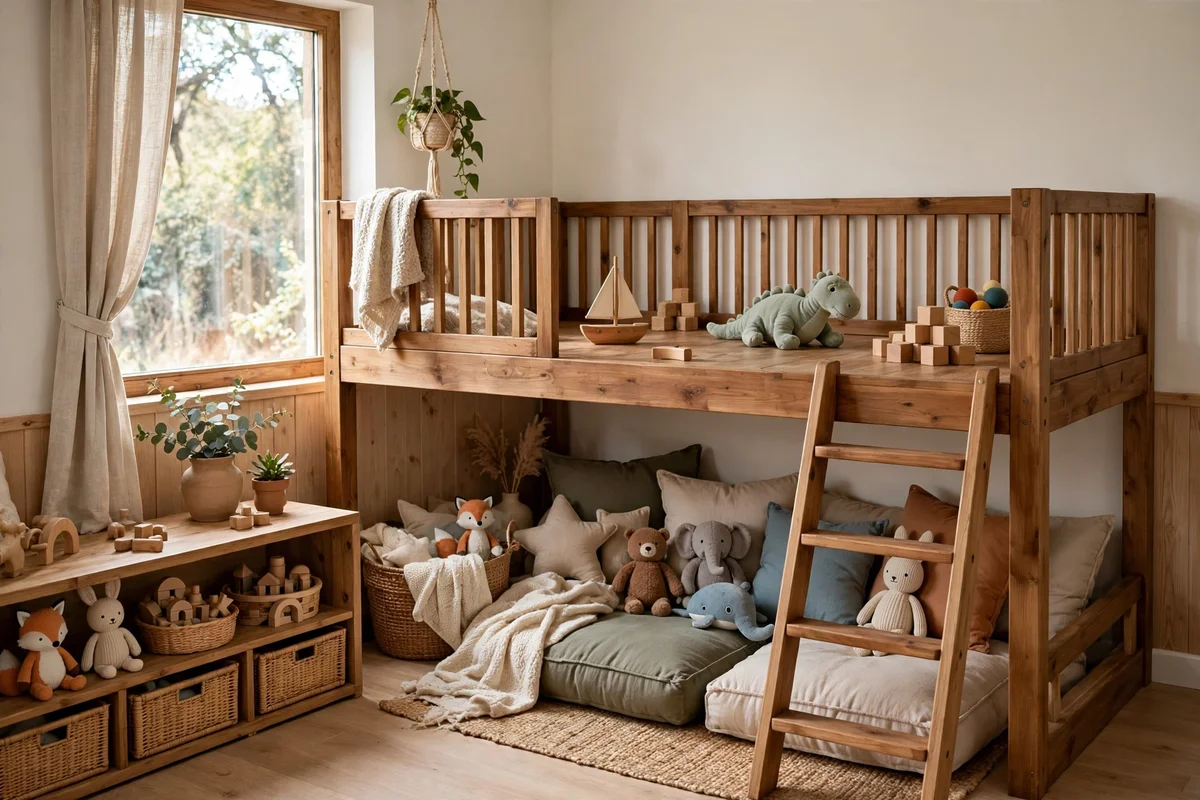
A loft turns a bedroom into two rooms: movement above, calm below. A raised platform with a ladder or a climbing wall to reach it, and a reading nook, a play zone, or storage underneath, uses vertical space the room was wasting. Lofts suit rooms with higher ceilings — you need enough headroom to sit up on the platform — and they suit children old enough to climb safely, usually from about age six. Put a guard rail around the platform, keep the ladder fixed and stable, and put a mat at the bottom of the ladder as well as under any climbing holds. The space beneath the loft is as useful as the platform itself: a curtained reading corner, a desk, or a row of storage bins all fit underneath, and the loft makes the room feel bigger than it is by giving every activity its own level.
Swing
5. Add a swing inside the room
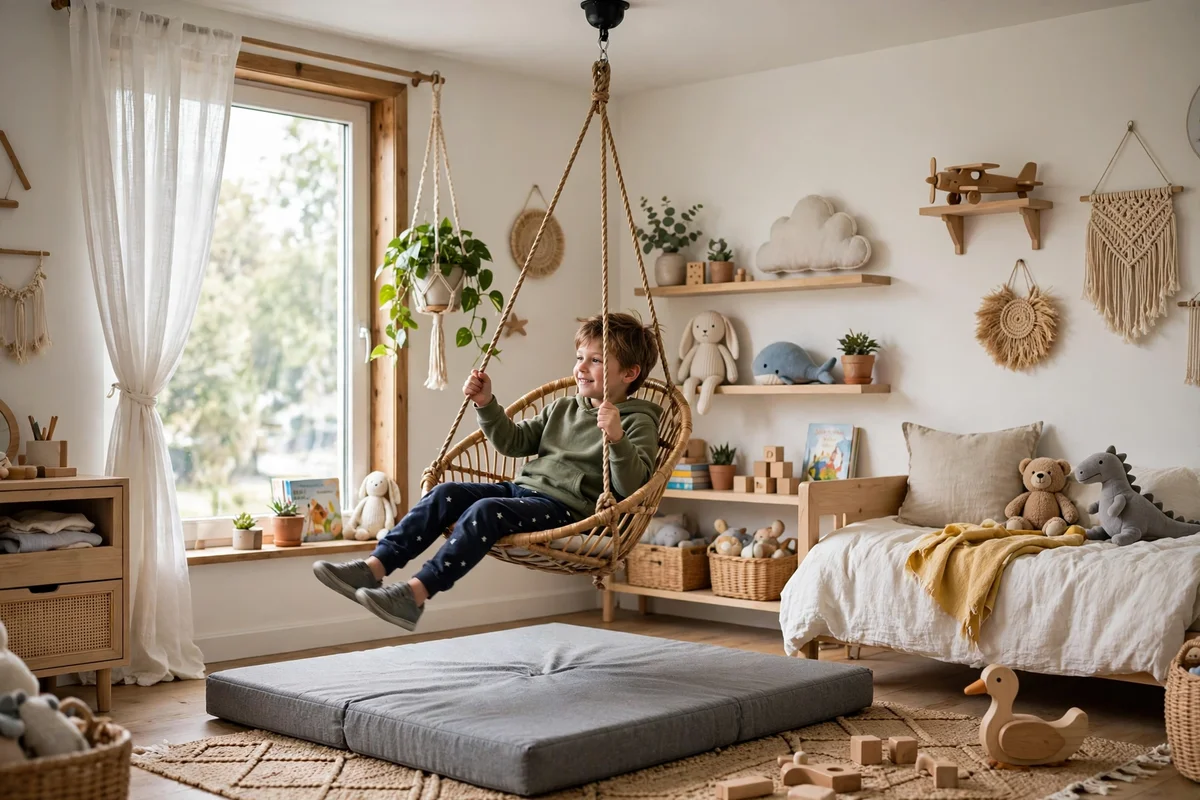
An indoor swing is the feature children use most often, because it is relaxing as well as active — a child can swing gently while reading, or pump hard to burn energy. A pod swing, a hammock chair, or a simple platform swing all work, and each suits a different child: pod swings suit children who like to curl up, hammock chairs suit readers, platform swings suit children who like to stand and pump. Hang the swing from a ceiling joist with hardware rated for the load, ideally fitted by a professional, and keep a clear swing zone around it — no furniture, no sharp corners, and a mat underneath. A freestanding swing frame is the alternative when the ceiling cannot take a mount: it holds a pod or platform swing without any drilling, and it can be moved when the room changes. Swings suit most ages, but the mount and the weight limit matter more than the child's age — follow them exactly.
6. Hang a hammock chair for reading and resting
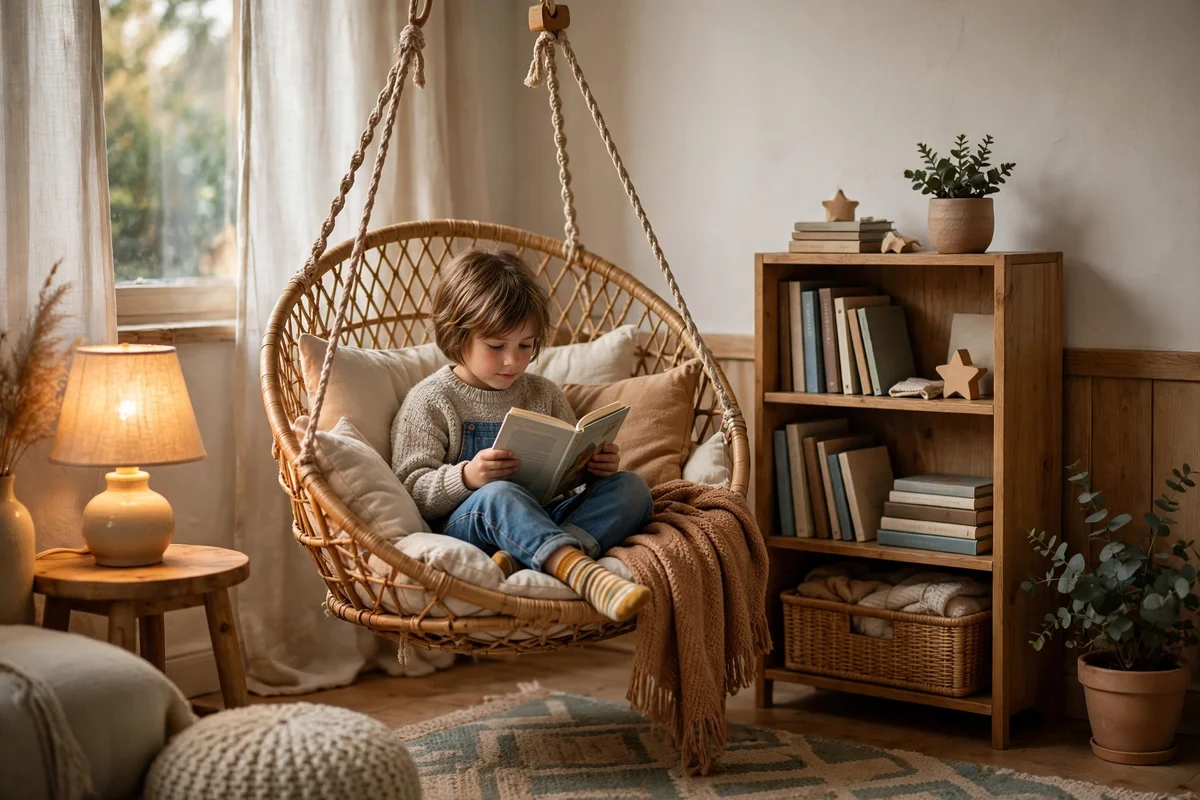
A hammock chair is the calm cousin of the swing, and it belongs in the Calm zone rather than the Move zone. Hung from a ceiling joist or a stand, it gives a child a place to read, to rest after active play, and to wind down before bed. It swings gently rather than pumping, so it suits children who find a full swing too much, and it takes up less room than a chair because it hangs rather than stands. Keep it near the bookshelf, with a small cushion and a blanket, and it becomes the reading corner itself. The same safety rules apply as for a swing: joist mounting, rated hardware, a mat or rug underneath, and a weight limit that is respected.
Balance
7. Create a balance beam challenge area

A balance beam is the quietest active feature, and one of the most useful: it builds focus, coordination, and confidence without needing much space or making much noise. A low beam — a few inches off the floor, or a line of tape on the floor for the youngest children — gives a child a daily challenge they can practise alone. Add challenges as they improve: walk backwards, carry a beanbag, balance a book on the head, or race a sibling along two parallel beams. A low-profile beam works indoors because a fall from it is a step down onto a mat, not a drop. Keep the beam in the Move zone, with a mat or foam tiles underneath, and keep it away from the bed so a wobbling child cannot fall onto the frame. Balance activities pair naturally with obstacle courses, because the beam is one station among several, and it is the station that teaches patience.
8. Design an obstacle course zone
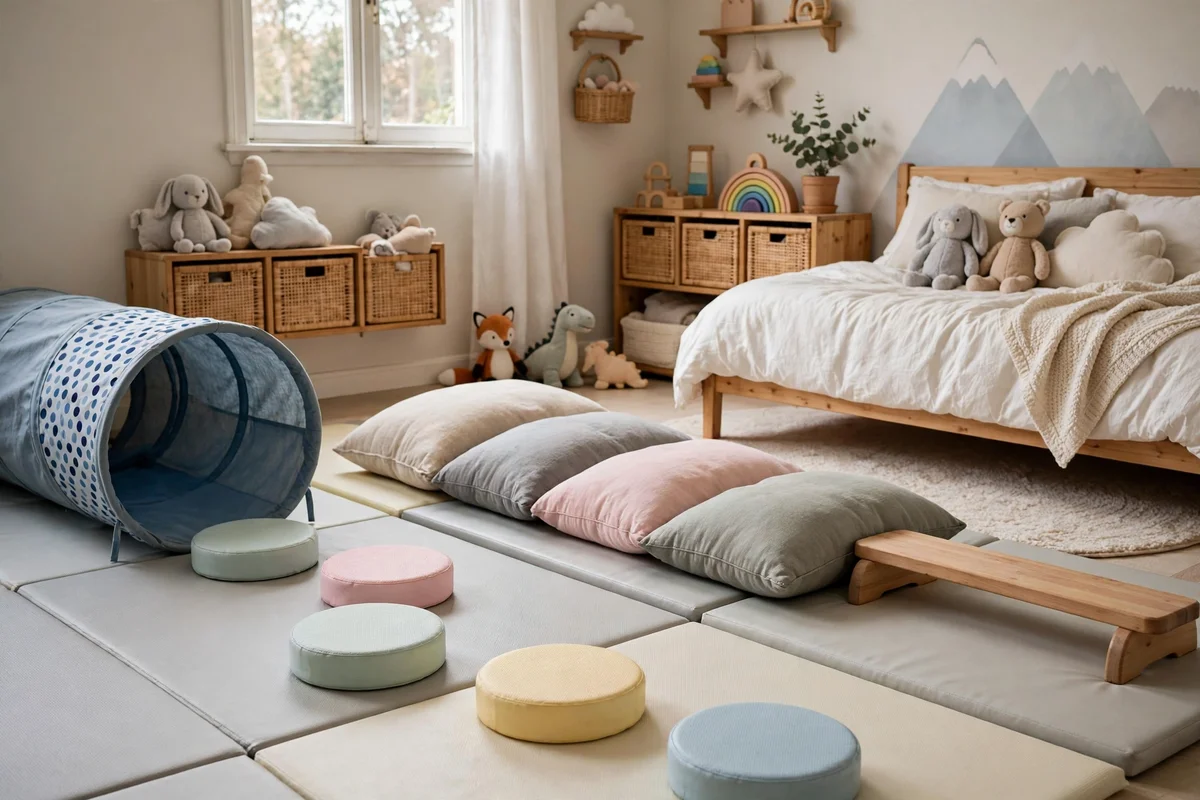
An obstacle course is not one piece of equipment — it is a route, and it is the idea that keeps an active room interesting longest, because the route can change every week. Tunnels, stepping stones, a low balance beam, cushions to jump between, and a climbing feature at one end give a child a course to run, time, and rebuild. Use painter's tape on the floor to mark the route, and let your child design it: a course a child builds themselves gets run ten times more than a course an adult builds for them. Keep the course in the Move zone, keep the floor padded, and keep the obstacles soft — cushions, foam blocks, and tunnels, not chairs and tables. An obstacle course suits every age, because the difficulty is in the design: a toddler's course is a tunnel and two cushions, a ten-year-old's course is a beam, a climbing wall, and a timed run.
9. Add floor games to encourage movement
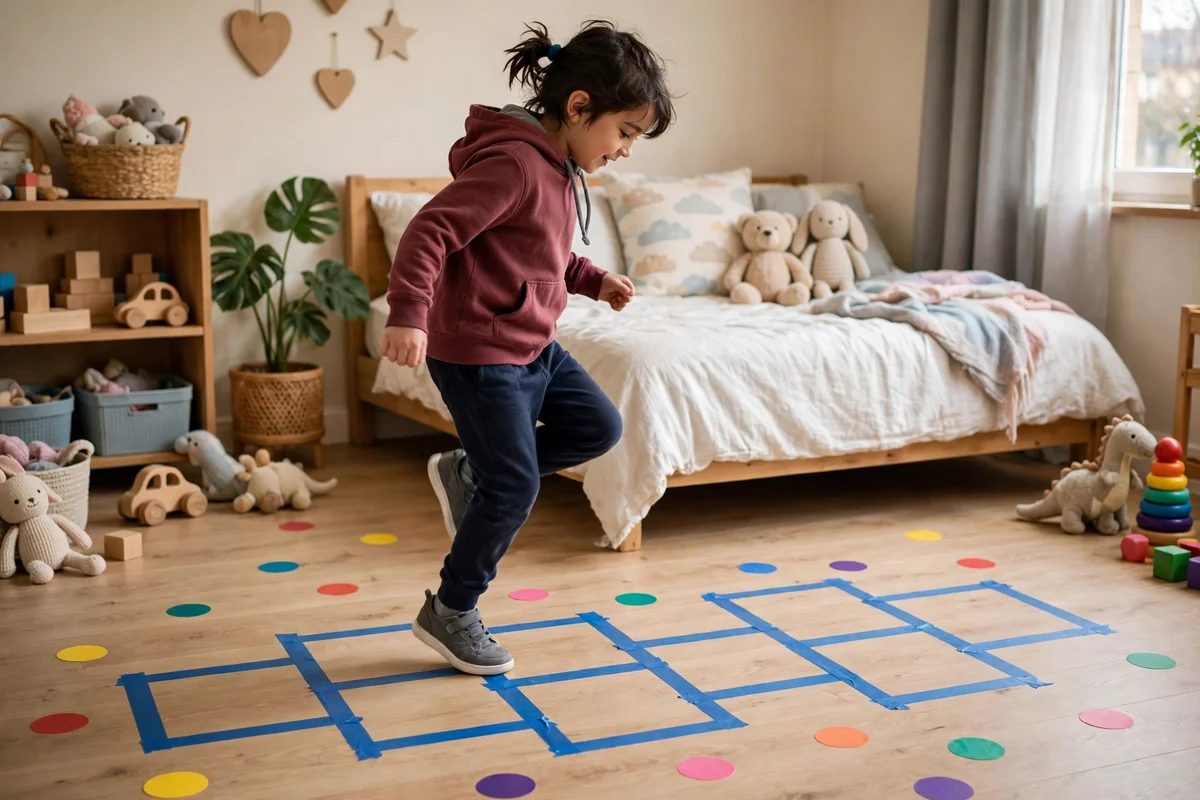
Floor games are the cheapest active feature there is, and they work in the smallest rooms. Hopscotch squares in painter's tape, a movement track around the rug, jumping spots marked with floor dots, and activity decals on the floor all turn walking across the room into a game. Children invent their own rules for floor markings faster than any adult can, and the games stay interesting because the markings can be peeled up and redrawn in a new pattern. Floor games suit small bedrooms especially well, because they need no equipment and no storage — the floor is the game. Keep the markings in the Move zone, use tape and decals that peel off cleanly, and avoid anything slippery on a hard floor.
Crash and soft play
10. Add a gymnastics mat area
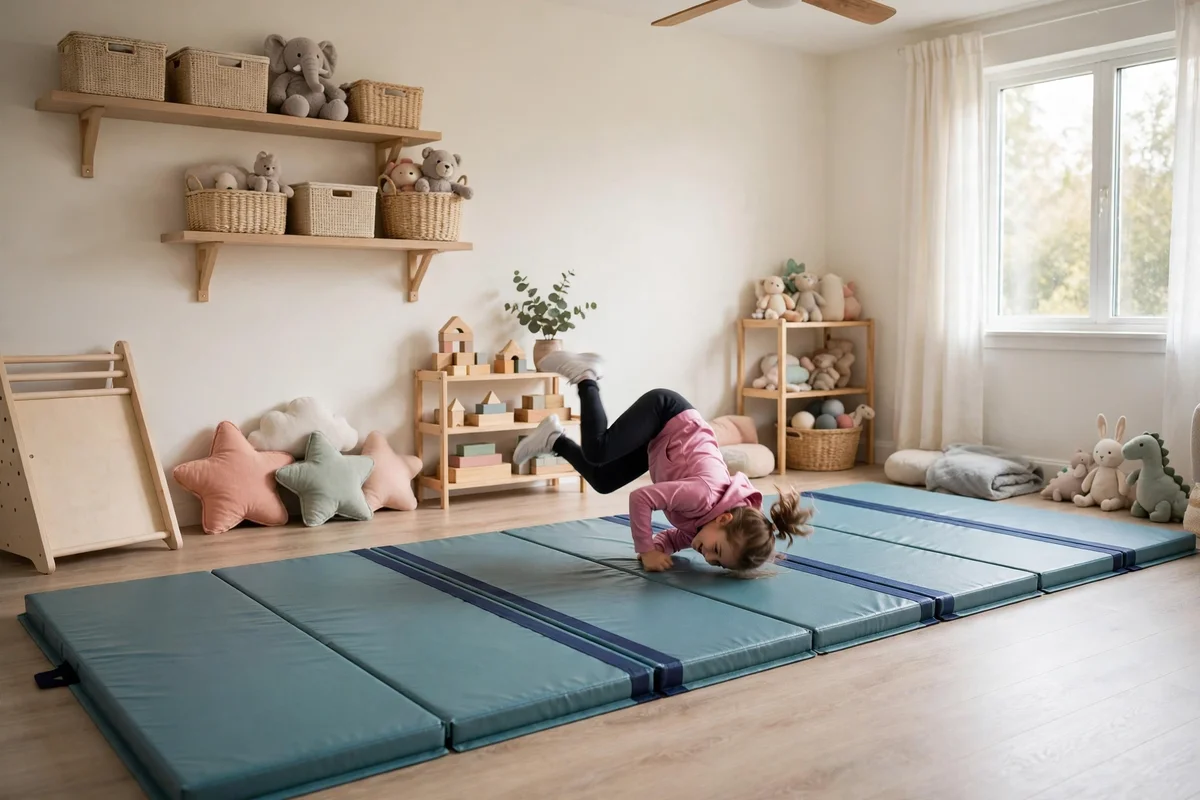
A gymnastics mat area is the foundation of an active room, and it is the first thing to buy before any climbing or swinging equipment. Folding mats, at least two inches thick, give a child a safe place to stretch, tumble, roll, and practise balance, and they protect the floor underneath. When the mats are not in use, they fold and stack against the wall, so the room can be cleared for sleep in a minute. Mats also mark the Move zone visually: a mat on the floor says "this is where movement happens" more clearly than any rule. Choose mats with a wipe-clean surface, because they will be sweated on, spilled on, and jumped on, and check that the seams lie flat so a tumbling child does not catch a foot. A mat area suits every age, from a toddler's first rolls to a school-age child's cartwheels.
11. Create a crash pad zone
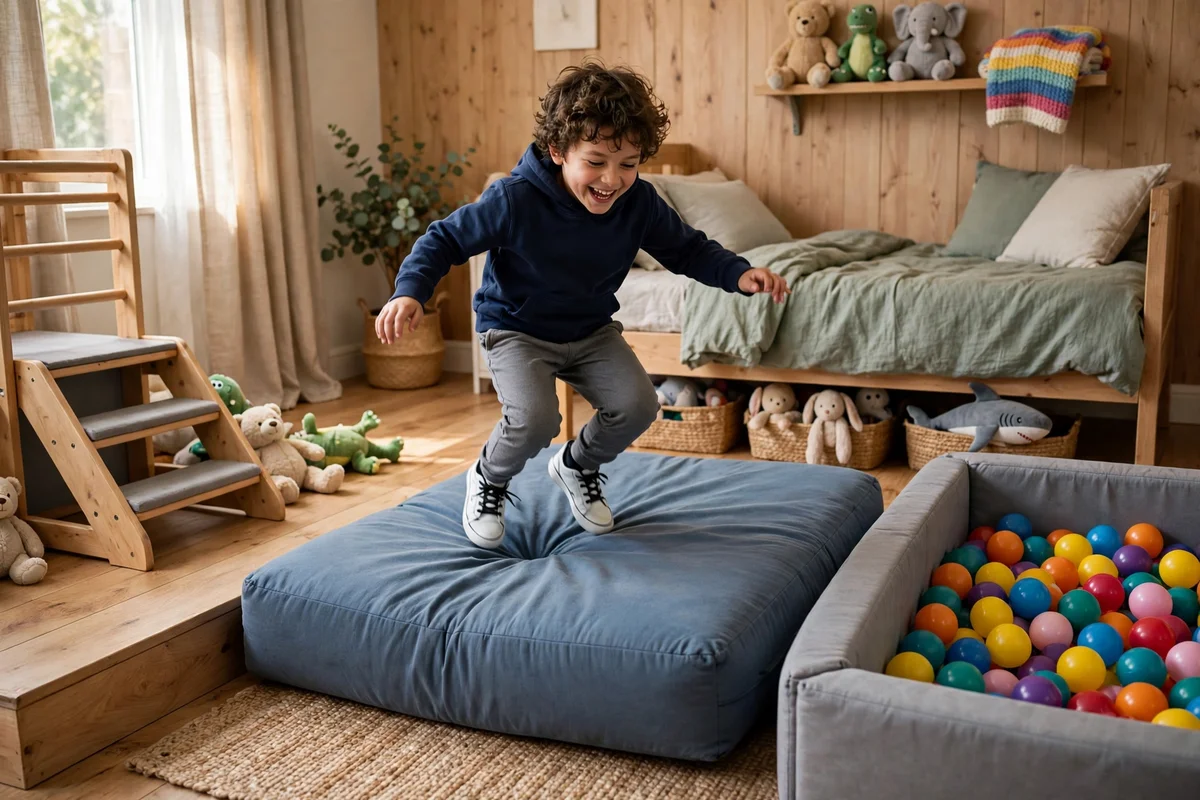
A crash pad is the soft landing that makes the rest of the room possible. A thick pad — foam, a ball pit, or a pile of large cushions — placed under the climbing wall, at the end of the slide, or in a corner of the Move zone, gives children a place to jump, fall, and land safely, which is the part of active play they enjoy most. A ball pit doubles as a crash pad and a sensory toy for younger children, and a stack of large floor cushions does the same job for older ones. Keep the crash zone clear of hard edges, and keep it big enough that a jumping child lands on padding rather than on the floor beside it. The crash pad is also the feature that makes parents relax: when the landing is soft, the climbing can be brave.
12. Set up a soft-play corner for toddlers

A soft-play corner is the toddler version of an active room, and it is built from soft shapes rather than fixed equipment. Foam climbing blocks, a small slide, a ball pit, and a low ramp give a baby or toddler a safe place to climb, crawl, and explore, and every piece can be rearranged as the child grows. A foam block that challenges a crawling baby becomes a balance block for a toddler, and a slide becomes a reading nook when the child outgrows climbing it. Keep the corner on a thick rug or foam tiles, keep the pieces low — nothing higher than the child can fall from safely — and keep small pieces away from babies who still put everything in their mouths. A soft-play corner suits ages one to four, and it is the safest way to give a very young child an active room.
Walls and floors
13. Design a multi-activity play wall

A play wall puts several activities on one wall, so the room gets more play without losing floor space. Chalkboard paint, a magnetic board, climbing holds, sensory panels, and a row of hooks for gear can all share one wall, and a child can switch between them in seconds. The wall becomes a focal point and a toy at the same time, and it suits small rooms especially well, because it uses vertical space the room was wasting. Mount everything into studs, keep the climbing holds low and over a mat, and keep the chalkboard at child height so it gets used. A play wall works best when it is planned as one design rather than assembled piecemeal: choose the activities first, lay them out on paper, and fix them in one session, so the wall reads as a single feature rather than a collection of things screwed to plasterboard.
14. Add a creative movement wall

A movement wall is a play wall with a job: it tells a child what to do next. Stretching prompts, movement challenge cards, a height chart with jumping goals, and a row of activity cards a child can pull down and follow all turn a blank wall into a daily invitation to move. Children can create their own challenges and add them to the wall, which keeps it interesting far longer than a wall an adult designed alone. Keep the cards at child height, rotate them every few weeks so the wall stays fresh, and keep the wall in the Move zone, where a child can act on a challenge immediately rather than walking across the room to do it. A movement wall suits school-age children best, because they can read the prompts and set their own goals, but a picture-based version works for younger children too.
Furniture and zones
15. Use modular furniture for flexible activities
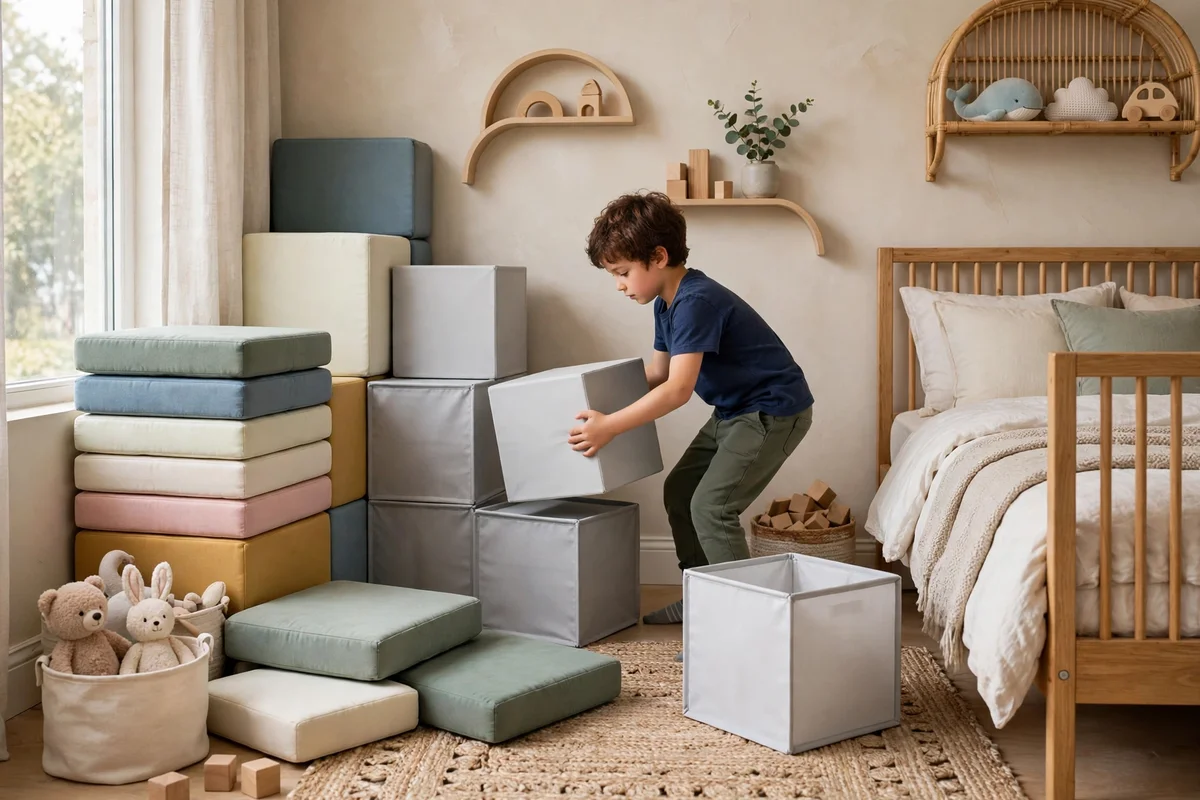
Modular furniture is what lets an active room change shape during the day. Stackable cushions, a lightweight table, movable storage cubes, and a folding mat let a child reconfigure the room for a game, a craft, or a quiet read, and then put it back. A room that can be rearranged gets played in more, because the child owns the layout rather than living in an adult's arrangement. Choose furniture a child can move safely — light, with no sharp corners and no pinch points — and keep the heavy pieces, the bed and the wardrobe, fixed in place as the room's anchors. Modular furniture suits every age, and it suits small rooms best of all, because a small room that cannot change shape feels smaller every day.
16. Create a sports activity corner
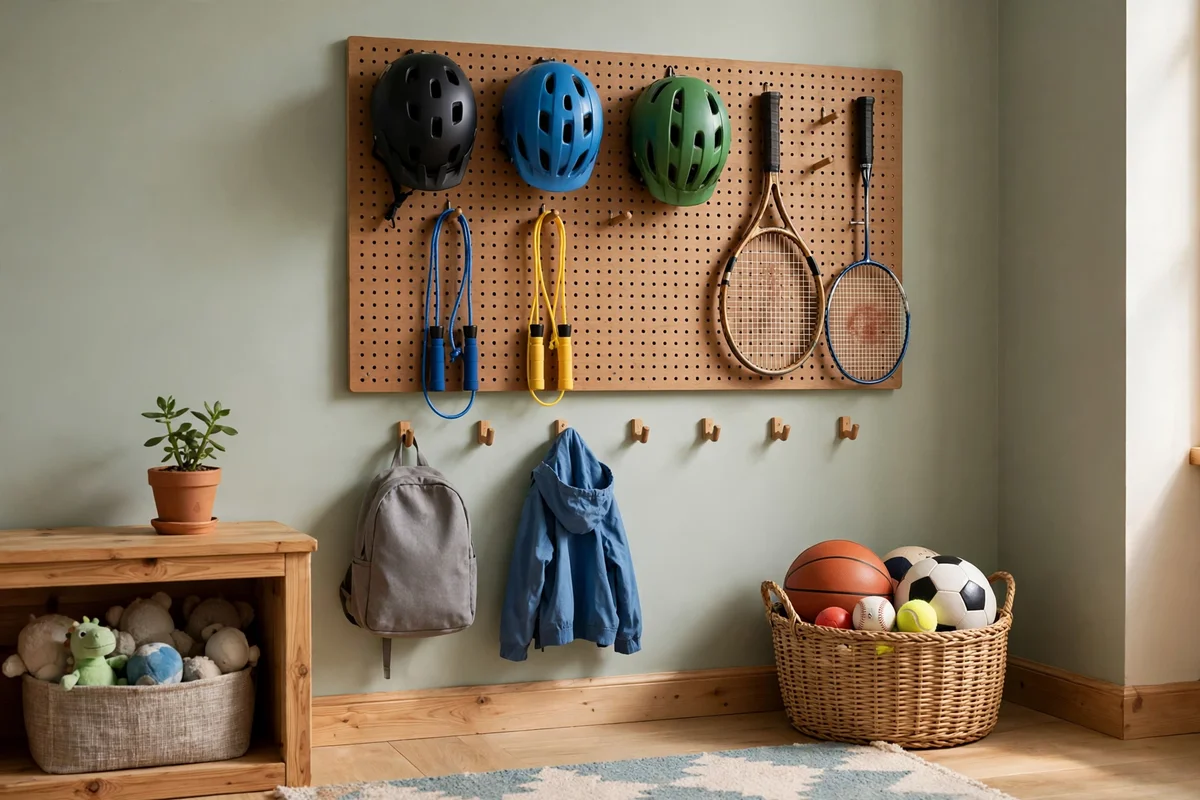
A sports corner gives a child's favourite sport a home in the bedroom, and it keeps the equipment visible so it gets used. A small basketball hoop on the back of the door, a soccer target on the wall, a pegboard with hooks for helmets, jump ropes, and rackets, and a basket for balls all fit in one corner. Mount the pegboard into studs, put the hooks at child height — about 36 to 42 inches — and keep the balls in a basket rather than loose on the floor, so the corner stays a corner rather than a spread. A sports corner suits children who already love a sport, and it works best when the sport is the child's choice rather than a parent's hope. Keep the corner in the Move zone, with a mat underneath if the sport involves jumping or throwing, and keep the equipment for one or two sports, not five.
17. Create a fitness challenge station
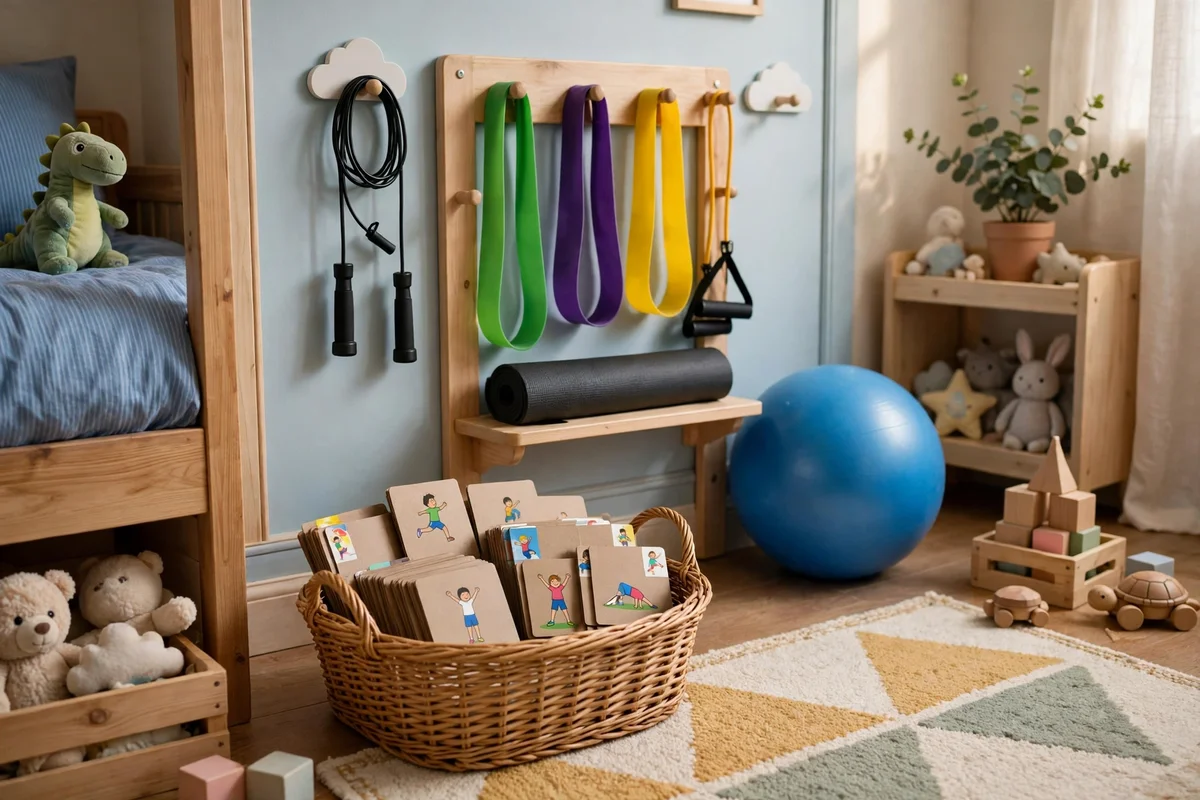
A fitness station turns exercise into a game, and it is the feature that teaches a child to challenge themselves rather than just burn energy. A basket with a jump rope, an exercise ball, resistance bands, and a set of movement cards — "ten jumps, five balances, one climb" — gives a child a routine they can follow and beat. Children can time themselves, compete with a sibling, or set a personal best and try to beat it next week. Keep the station small and the equipment light, keep the cards rotated so the routine stays fresh, and keep the station in the Move zone with a mat underneath. A fitness station suits school-age children best, because they can follow the cards and understand the idea of a personal best, but a picture-card version works for younger children too. It also suits a shared room, because two children can take turns and compare scores without needing two of everything.
18. Create a reading and movement combination space
An active room still needs somewhere to be quiet, and the best active rooms are the ones that pair movement with rest in the same space. A reading corner beside the Move zone — a cushion, a small bookshelf, a lamp, and a hammock chair — gives a child somewhere to go after the climbing is done, without leaving the room. The combination works because the two zones balance each other: the child burns energy, then reads, then burns energy again, and the room supports both without a change of scene. Keep the reading corner out of the fall zone, keep the lighting warm and low, and keep the book selection small and rotated — ten books on the shelf, swapped every few weeks, get read more than fifty books crammed together. A room that has both a place to move and a place to rest gets used all day, not just when the energy is high.
Active Rooms by Room Size
A room as small as eight by ten feet can fit two active features — a crash pad and a balance beam, or a climbing corner and a mat area — as long as the furniture is pushed to the edges and the Move zone is kept clear. A ten-by-twelve-foot room fits three features, and a twelve-by-fifteen-foot room fits four plus a calm corner. The table below is a starting point, not a rule: a child who loves climbing needs a climbing wall more than a room that fits four stations badly.
| Room size | Best setup | Stations |
|---|---|---|
| 8 by 10 feet | Crash pad, balance beam, floor games | 2 |
| 10 by 12 feet | Climbing corner, crash pad, balance beam | 3 |
| 12 by 15 feet or more | Climbing wall, swing, balance beam, crash pad, calm corner | 4 plus calm corner |
In a small room, build up rather than out: a climbing wall, a loft, and a play wall use vertical space, while a swing and an obstacle course use floor space the room may not have. In a big room, the risk is the opposite — too much empty floor with equipment scattered around it. Define the zones clearly, even in a big room, so the Move zone, the Calm zone, and the Stash zone each have edges a child can see.
Active Rooms by Age
A toddler's active room is a soft-play corner, a low climbing ramp, foam blocks, and a mat — nothing higher than the child can fall from safely, nothing hard within reach, and everything washable. Toddlers need movement as much as older children, but they need it at floor level, with an adult nearby.
A preschooler's room can add a low climbing wall, a balance beam, a tunnel, and floor games. This is the age where the Move-Calm-Stash layout starts to matter, because a preschooler can learn to put gear away and to use the mat area for tumbling. Keep the equipment low, the rules simple — "climbing only on the mat" — and the choices limited, so the room feels safe rather than overwhelming.
A school-age child's room can carry the full version: a climbing wall, a swing, monkey bars, an obstacle course, and a fitness station. This is the age for challenges, timers, personal bests, and courses the child designs themselves. It is also the age to start planning the exit: a school-age child who loves climbing now may want a desk and a reading corner more at twelve, so keep the fixed equipment to one wall and one feature, and let the rest be mats and modular furniture that can change in an afternoon.
Active Shared Bedrooms
Shared rooms can still be active, and they often need to be, because two children in one room generate twice the energy. Use vertical storage, defined activity zones, and multifunctional furniture to make it work. Give each child a zone — one child's climbing corner, the other's dance corner — and a shared Move zone in the middle for games both can play. Colour-coded storage earns its keep twice over: each child's gear in their own colour ends most arguments about whose jump rope is whose. Keep the layout symmetrical where you can — matching beds, matching lamps, matching shelves — because symmetry makes a shared room feel fair even when the activities differ. And keep the noise rule clear: active play happens in the Move zone, not on or around the beds, so one child can rest while the other plays.
A Weekend Plan: Saturday and Sunday
An active room does not need a month of planning. It needs a clear order, because fixing equipment before you have measured, or buying mats before you have cleared the floor, creates the rework that eats weekends.
On Saturday morning, choose the zones and the features, measure the walls and the floor, and buy only what is on the list: mats, fixings, and one or two pieces of equipment. Clear the room, mark the Move zone with tape on the floor, and fix the equipment that needs studs or joists — the climbing wall, the swing mount, the monkey bars. While the fixings set, lay the foam tiles or the rug in the Move zone and set up the storage. Do not let children use the equipment the same day it is fixed; let adhesives and fixings cure overnight, and check every bolt before the first use.
On Sunday, put the room back together in this order: bed and Calm zone first, then the mats and the Move zone, then the storage and the Stash zone, then the small equipment last. Test every feature yourself before your child uses it: hang from the bars, pull on the swing mount, push the climbing wall. Finish by walking to the door and looking at the room as a visitor would — the view from the door is the view that matters most, because it is the one you see every day.
Budget: Three Price Levels
An active room does not have to be expensive. The difference between the three levels below is how much is fixed and how much is freestanding, not how much fun the room is.
A starter setup under $100 uses what you already have: cushions and a tunnel for an obstacle course, painter's tape for floor games, a folding mat, and a rolling cart for gear. The room changes without any drilling, and it takes an afternoon.
A mid-level setup, roughly $100 to $500, adds the pieces that make the biggest difference: a climbing wall panel with holds, a freestanding swing frame, a low balance beam, foam tiles for the Move zone, and a crash pad. This is the level most families choose, because it gives the room real active features without any structural work. Most active rooms take about three hours to set up at this level.
A full setup, $500 and up, adds a loft, monkey bars fixed to joists, a professional swing mount, and a complete 4-station circuit with a crash zone. This is worth doing when the room is being redecorated anyway, or when the room is a dedicated playroom rather than a bedroom. If you are spending at this level, spend it on the fixings and the flooring first — the safety parts — because a cheap mat under good equipment is a false economy.
Whatever the budget, buy the mats and the fixings before the equipment, not after. A climbing wall without a mat is a decoration, and a swing without a rated mount is a hazard. Safety first is not a slogan here; it is the order of purchase.
Mistakes That Make Active Rooms Unsafe or Unusable
The most common mistake is too much equipment. A room with a climbing wall, a swing, monkey bars, a slide, and an obstacle course has no Move zone left, because the equipment ate it. Two good features and clear zones get used every day; five features and no floor get used for a week and then become an obstacle course nobody can walk through.
The second mistake is skipping the fixings. Equipment screwed into plasterboard, a swing hung from a hook rated for a plant, or a climbing wall fixed with ordinary screws will fail, and it will fail while a child is using it. If you are not sure about a fixing, get a professional. The cost of an hour of a professional's time is less than the cost of the accident.
The third mistake is forgetting the floor. A climbing wall without a crash mat, a swing over a hard floor, or a balance beam on bare boards all turn a small fall into an injury. Mats are not optional, and they are not the place to save money. Four inches thick under climbing and swinging gear, foam tiles across the Move zone, and a clear fall zone around everything.
The fourth mistake is no calm zone. A room that is all movement has nowhere to wind down, and a child who cannot wind down in their own room will wind down in yours. Keep the bed and the reading corner separate from the Move zone, and keep the active equipment from creeping into them.
The fifth mistake is ignoring the age and weight limits. A swing rated for a younger child, a climbing wall built for an older one, or a loft under a low ceiling are all accidents waiting for a bad day. Follow the limits on every piece of gear, and check them again as your child grows — a limit that was fine last year may not be fine this year.
How to Let the Room Grow Up With Your Child
The best active rooms are built to change in stages. When your child outgrows a feature, remove the freestanding parts first: the obstacle course, the floor games, the fitness station cards. That alone frees the floor, and the room will already feel older.
If that is not enough, take down the swing and the climbing holds, fill the holes, and repaint the wall. The mats can stay, because a mat area is useful at any age — for exercise, for reading, for friends sitting on the floor. The storage can stay, because gear storage is useful whether the gear is a jump rope or a laptop.
The fixed features — the loft, the monkey bars, the climbing wall backer — are the hardest to remove, which is why they belong on one wall only. A single wall can be restored in a weekend; four walls cannot. If you think the room will need to change within two years, choose freestanding equipment over fixed equipment, and mats over built-ins. A room that can change in a weekend is a room you will never regret.
Frequently Asked Questions
How much space does an active kids room need?
Less than most parents think. A room as small as eight by ten feet can fit two active features, as long as the furniture is pushed to the edges and the Move zone is kept clear. A ten-by-twelve-foot room fits three features, and a twelve-by-fifteen-foot room fits four plus a calm corner. The key is a clear patch of floor at least six feet square, not a big room.
What is the safest first piece of equipment for an active kids room?
A folding gymnastics mat. It gives a child a safe place to tumble and stretch, it marks the Move zone, and it goes under every other piece of equipment you add later. After the mat, a low climbing wall or a freestanding swing frame is the best next step — both are fixed or freestanding in a way that is easy to make safe.
Can I put a swing in a small bedroom?
Yes, if the ceiling can take it and the swing zone is clear. A pod swing or a hammock chair takes up less room than a platform swing, and a freestanding swing frame avoids ceiling work altogether. Keep about six feet clear around the swing, with a mat underneath, and keep it away from the bed and the desk.
How do I keep an active room tidy?
The Stash zone does the work: a rolling cart, hooks at child height, and baskets for gear, all in the same place, so tidying is one job rather than a hunt. The rule is that the room should be convertible in five minutes — gear away, mats stacked, floor clear. If it takes longer, there is too much equipment or not enough storage.
What age is an active kids room best for?
It works from toddlerhood to about age twelve, with the equipment changing as the child grows: soft play and foam blocks for toddlers, a low climbing wall and balance beam for preschoolers, and a full circuit — climbing wall, swing, monkey bars, obstacle course — for school-age children. After that, the same room can keep the mats and the storage and lose the fixed equipment.
How much does an active kids room cost?
A starter setup with cushions, tape floor games, and a folding mat can cost under $100. A mid-level setup with a climbing wall, a swing frame, a balance beam, foam tiles, and a crash pad usually falls between $100 and $500. A full setup with a loft, monkey bars, and a professional swing mount costs $500 and up. Buy the mats and the fixings first — they are the safety parts, and they are not the place to save money.
Final Checklist Before You Buy Anything
- Divide the room into three zones: Move, Calm, and Stash — and mark the Move zone on the floor.
- Check the ceiling height and find the studs and joists before you buy any fixed equipment.
- Buy crash mats at least four inches thick and foam tiles for the Move zone first.
- Pick one or two active features to start — a climbing wall, a swing, a balance beam — not five.
- Check the age, weight, and ceiling-height limits on every piece of gear.
- Keep a clear fall zone of about six feet around climbing and swinging equipment.
- Put the gear storage where a child can reach it, and test the five-minute tidy.
- Keep the bed and the reading corner out of the Move zone.
An active kids room does not need to be a playground, and it does not need to be finished in one go. Start with the zones and the mats, add one good feature, and let the obstacle courses and the challenges grow over time. The rooms children use most are rarely the ones with the most equipment — they are the ones where the floor is clear, the landing is soft, and there is a quiet corner to sit in when the energy runs out. Get those three things right, and the movement takes care of itself.


2 comments