
Bedside Table Ideas
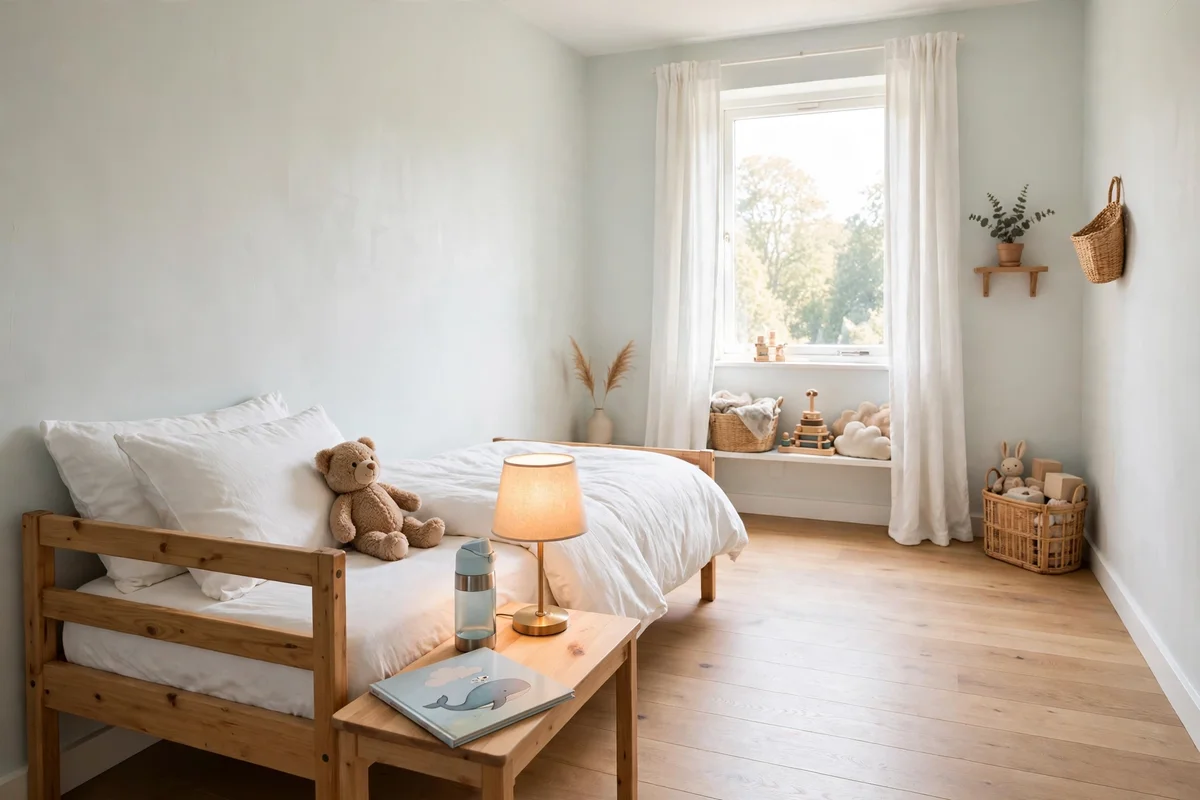
A bedside table in a child's bedroom has a different job from a bedside table in an adult's bedroom. An adult keeps a phone, a book they may or may not finish, and a lamp on theirs. A child keeps the things that make the night feel safe and the morning feel easy: the book they are halfway through, a glass of water, a torch, their glasses if they wear them, and the soft toy or comfort object they reach for without opening their eyes. The table has to hold those things within easy reach, at a height a small arm can manage in the dark, and it has to stay put when it is leaned on, climbed on, or bumped in the middle of the night.
That is why the best bedside table for a child's room is rarely the prettiest one in the shop. It is the one at the right height, with no sharp corners at head height, with a lamp that cannot be pulled down onto the bed, with cords out of reach, and with storage a child can actually use by themselves. Get those practical things right and the table will be used every single night. Get them wrong and it becomes a surface where things pile up, fall off, and get knocked over — or worse, a piece of furniture a child tries to climb.
This article is a room plan parents can copy in a weekend. It starts with what children actually keep beside the bed and how high the table should be at each age, then works through 18 ideas grouped the way parents actually shop for them: options that take no floor space at all, classic tables that work, repurposed and DIY ideas, organisation and styling, and lighting. It finishes with a weekend plan, guidance for small and shared rooms, three budget levels, the mistakes that make a bedside setup fail, and a checklist to run before you buy anything.
What Kids Actually Keep Beside the Bed
Before choosing a table, watch what your child already puts beside the bed. For a week, notice what ends up on the floor, on the bed itself, or on top of the radiator because there is nowhere else for it to go. The list is usually short, and it is the same list for most children, with small changes by age.
A toddler keeps a comfort toy, a sippy cup or small water bottle with a lid, and perhaps a board book. Nothing on a toddler's bedside table should be breakable, heavy, or small enough to be a choking hazard. A ceramic lamp, a glass, or a small ornament has no place within reach of a child under three, and anything with a cord should be well out of reach.
A school-age child keeps a chapter book or two, a glass of water, a torch, and a soft toy. This is the age when the bedside table starts to collect small treasures — a stone, a sticker sheet, a friendship bracelet, a note from a friend — and when a drawer becomes useful, because those small things need a home or they spread across the whole surface.
A pre-teen keeps a book, a phone or tablet charging, a water bottle, and often glasses, a hair tie, or a lip balm. The charging cable is the new hazard at this age, along with the habit of draping headphones and chargers across the table so they fall behind the bed. A small tray or a cable clip on the back of the table keeps the charging setup in one place.
The test for any bedside setup is simple: can your child reach everything they need without sitting up fully, and can they put it back in the dark? If the book slides off, the glass is too tall to reach safely, or the torch is buried under other things, the table is not working, however good it looks. The surface should hold the three or four things used every night, and everything else should live in the drawer, on a shelf below, or somewhere else entirely.
The Right Height by Age
The single most useful measurement in this whole article is the height of the mattress. A bedside table works best when its top is roughly level with the top of the mattress, or no more than about 5 centimetres above or below it. When the table is level with the mattress, a child can slide a hand across to find a book or a glass without sitting up and without reaching up or down. When the table is much higher, a child has to lift a glass up and over the edge, which is how water gets spilled in the dark. When it is much lower, a child has to lean down and fumble, which is how books and torches end up on the floor.
Measure the mattress top from the floor, not the bed frame, because mattresses vary. A low toddler bed with a thin mattress may have a top surface only about 30 centimetres from the floor. A standard single bed with a deep mattress is often around 55 to 60 centimetres from the floor. A high sleeper or cabin bed is a different case altogether — the bedside surface there is usually a shelf at mattress level rather than a freestanding table, because a table on the floor cannot reach a raised mattress.
| Age | Typical mattress-top height | Table-top height to aim for | Notes |
|---|---|---|---|
| Toddler, about 2–4 years | About 25–35 cm | About 25–35 cm | Very low — a low stool, a crate on its side, or a low shelf often works better than a table |
| Younger school-age, about 5–7 years | About 40–50 cm | About 40–50 cm | A small nightstand or a wall shelf at mattress level; avoid tall tables a child must reach up to |
| Older school-age, about 8–10 years | About 50–60 cm | About 50–60 cm | A standard small nightstand works; a drawer is useful at this age |
| Pre-teen, about 11–13 years | About 55–65 cm | About 55–65 cm | A standard nightstand or a slim desk-side table; allow room for a charging station |
These are rough ranges, not rules, because beds and mattresses vary so much. Measure your child's bed, write the number down, and take the tape measure to the shop or check the product dimensions before you order. A table that is the wrong height by 15 centimetres is worse than no table at all, because it trains a child to reach awkwardly every night.
Depth matters too. A bedside table in a child's room should be deep enough to hold a book lying flat — about 30 to 40 centimetres is enough for most books, a water bottle, and a small lamp. Shallower than that, and a book hangs over the edge and gets knocked off. Deeper than about 45 centimetres, and the table starts to eat floor space in a small room without adding anything useful. Width is more flexible: about 35 to 50 centimetres is enough for one child's nightly things, and wider than that usually means the surface becomes a dumping ground for toys and clothes.
Safety First: Five Checks Before You Buy
Safety is not an extra section to read after choosing a table. It decides which tables are even on the list. Run these five checks on any table, shelf, or repurposed piece before it goes beside a child's bed.
First, anchor it to the wall. Any freestanding piece of furniture a child can pull, lean on, or climb — a nightstand, a small chest of drawers, a stack of crates, a bookshelf used as a bedside table — should be fixed to the wall with a furniture anchor or anti-tip strap. Children climb furniture, especially when they are looking for something on a top shelf or reaching over the table to the window. A table that tips forward can cause a serious injury, and the fix costs very little and takes minutes. If you are renting and cannot drill, use adhesive anti-tip straps designed for rented homes, and choose low, wide pieces that are hard to tip in the first place.
Second, check the corners and edges. A bedside table sits at head height for a child lying in bed and at forehead height for a child sitting up suddenly. Sharp corners, exposed metal edges, and glass tops are a poor combination at that height. Rounded corners, a soft edge, or a table with a slightly padded top are worth choosing deliberately. If you have already bought a table with sharp corners, stick-on corner guards in a matching colour are an easy fix, and they can be removed later.
Third, keep the lamp light and fixed. A heavy ceramic or glass lamp on a bedside table is an accident waiting to happen: a child reaches for a book in the dark, catches the lamp, and it falls onto the bed or the floor. Choose a light lamp, a clip-on lamp fixed to the headboard or shelf, or a wall-mounted light instead, and keep the base well back from the front edge of the table. Battery lamps and rechargeable lamps remove the cord hazard altogether, which is a real advantage for younger children. If the lamp does have a cord, run it down the back of the table, clip it to the wall or the back leg, and keep the plug behind the table where a child cannot tug it.
Fourth, think about what can be pulled down or swallowed. Cords, curtain ties, and trailing cables should not hang within reach of the bed. Small objects — marbles, beads, small toy parts, coins — should not live on an open bedside surface in a room shared with a toddler, even if they belong to an older child. A drawer with a childproof catch, or a lidded box on a high shelf, is the right home for them. And keep medicines, creams, and anything in a small bottle off the bedside table entirely; a bedside drawer is not a medicine cabinet.
Fifth, check stability on your actual floor. A table that is perfectly steady on a shop floor can wobble on carpet, on an uneven wooden floor, or on a rug with a thick pile. Put the table where it will live, press down on the front corners, and try to rock it. If it wobbles, adjust the feet, move the rug, or choose a different piece. A wobbling table is a table that will eventually tip a glass of water onto the bed, and a child who has had water spilled on their bed once will stop trusting the table altogether.
18 Bedside Table Ideas for Kids Bedrooms
The 18 ideas below are grouped so you can skip straight to the section that fits your room. If floor space is the problem, start with the first four. If you already have a table and it is not working, start with the organisation and lighting sections. If money is tight, the repurposed ideas give you a bedside table for the cost of paint and a few screws. Each idea says who it suits, what to watch out for, and how to make it work for a child rather than an adult.
No-Floor-Space Options
These four ideas suit small rooms, rooms where the bed is pushed against the wall, and rooms where a freestanding table would block a door, a wardrobe, or a walking route. They also suit rented homes, because most of them leave only a couple of small screw holes, or none at all.
1. A floating shelf at mattress level
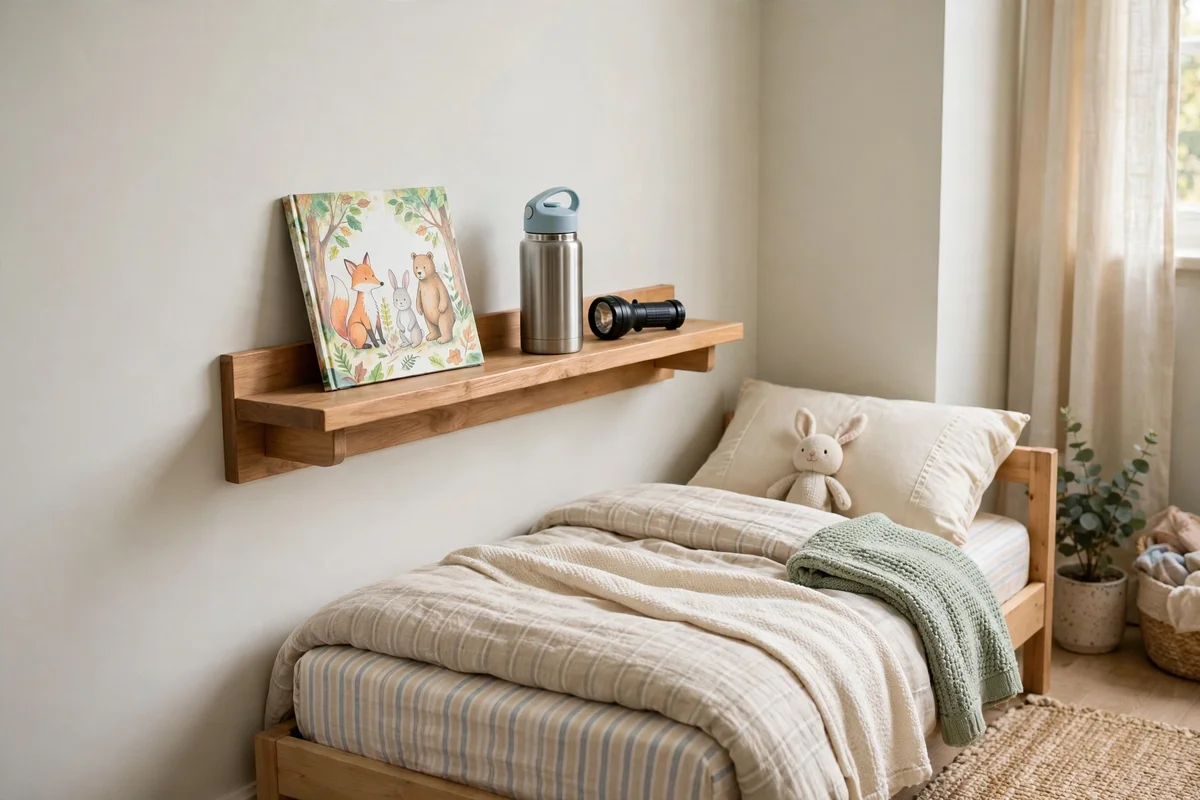
A floating shelf fixed to the wall beside the bed is the simplest bedside table there is, and often the best one for a small room. It takes no floor space, it cannot be tipped over, and it can be fixed at exactly mattress height, which is hard to achieve with a bought table. A shelf about 35 to 45 centimetres wide and 25 to 30 centimetres deep holds a book, a water bottle, and a small torch. Fix it with proper wall plugs suited to your wall type — plasterboard needs different fixings from brick — and test it by pressing down firmly on the front edge before you put anything on it. Add a small raised lip or a narrow rail along the front edge if you can, because that lip is what stops a water bottle rolling off in the night. For a younger child, fix the shelf low and keep only soft things on it; for an older child, add a second shelf above for books they are not currently reading. The one thing a floating shelf cannot do is hide clutter, so it works best for children who keep only two or three things beside the bed, or for a room where the drawer storage lives elsewhere.
2. A wall-mounted nightstand with a drawer
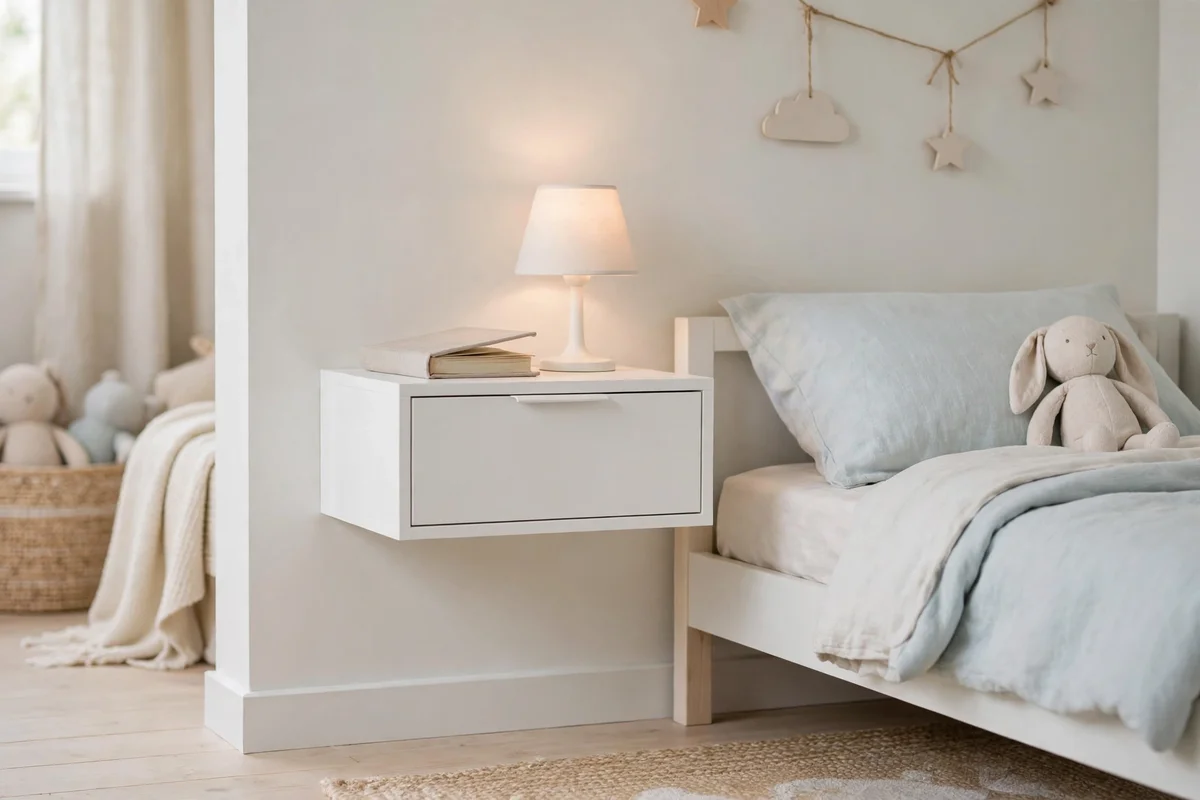
A wall-mounted nightstand is a floating shelf with a drawer underneath, and it solves the one weakness of a plain shelf: nowhere to hide the small things. The drawer holds the torch, the hair ties, the glasses case, and the little treasures, while the top holds the book and the water. Because it is fixed to the wall, it cannot tip, and because it floats, the floor underneath stays clear for cleaning and for feet getting out of bed. Choose one with a drawer that a child can open with one hand — a cut-out handle or a push-to-open drawer is easier than a small knob for little fingers — and check that the drawer cannot be pulled right out onto the floor. A soft-close drawer is worth having if you can find it, because a drawer that slams shut at midnight wakes everyone. Fix it at mattress height, anchor it with at least two fixings into a stud or solid wall, and keep the total weight on it modest: books are heavy, and a wall-mounted unit is not the place for a stack of ten hardbacks.
3. A bedside pocket organiser and hanging caddy
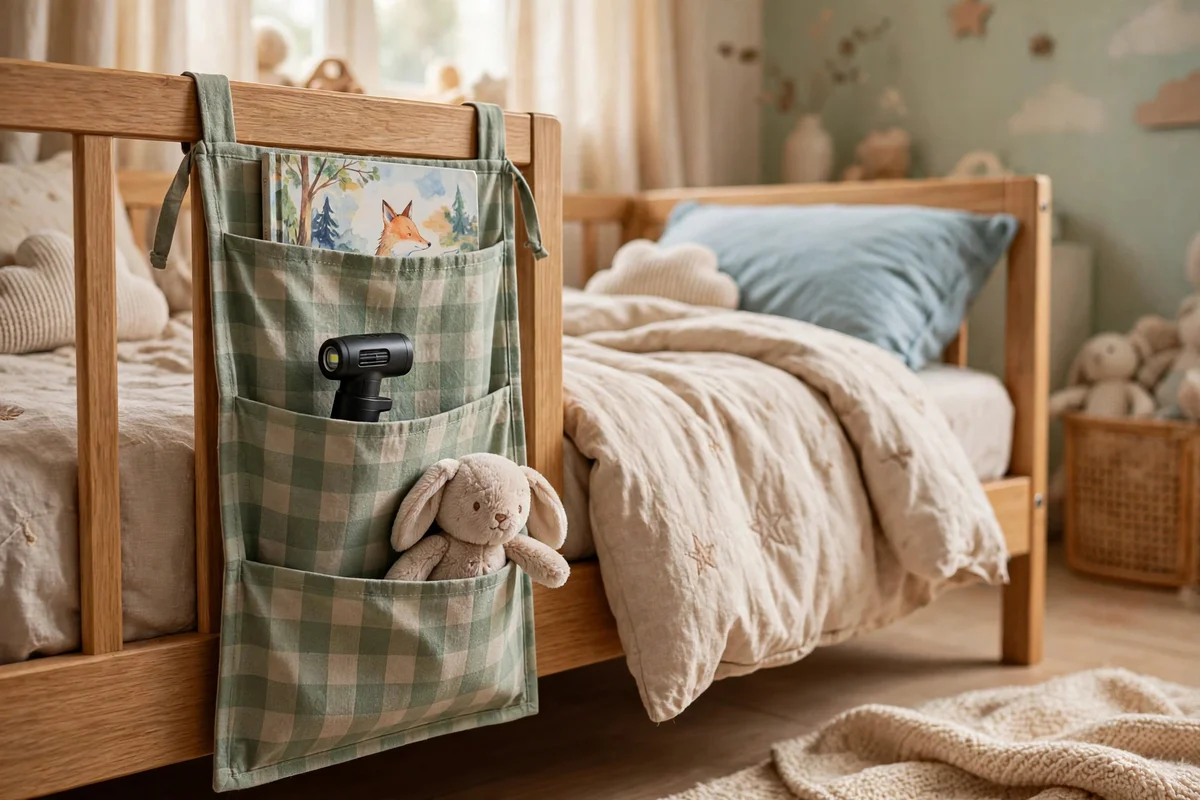
A fabric pocket organiser that hangs from the side of the bed or hooks over the headboard is the cheapest bedside table of all, and the one that travels best. It has no hard edges, nothing to tip over, and nothing to knock a glass off. The pockets hold a book, a torch, a water bottle with a lid, and a soft toy, all within reach of a child lying down. It suits toddlers and younger children particularly well, because there is nothing hard at head height, and it suits bunk beds and cabin beds where a table on the floor cannot reach the mattress. Choose one with deep pockets — a book should sit at least two-thirds inside the pocket or it will fall out — and with straps that fix firmly to the bed frame so it does not slide down. Washable fabric matters, because a pocket organiser beside a child's bed will get sticky. The trade-off is capacity: a pocket organiser holds the nightly essentials and nothing more, and a glass of water without a lid does not belong in a fabric pocket. Pair it with a small shelf or a lidded water bottle and it covers most families' needs.
4. A wall ledge plus a clip-on reading light

A narrow picture ledge, the kind sold for displaying books and prints, makes a surprisingly good bedside shelf for a child who mainly needs a place for a book and a torch. The ledge is only about 10 centimetres deep, so it holds a book standing upright, face out, which means a child can see the cover and choose what to read next. Fix two ledges, one above the other: the lower one at mattress level for the current book and the torch, the upper one for books waiting to be read. Add a clip-on reading light that clamps to the headboard or the ledge itself, so there is no lamp to knock over and no cord trailing across the table. This setup suits children who love books, rooms where the bed is against a wall with no room for a table, and families who want the bedside to feel like a small library rather than a piece of furniture. It does not suit a child who needs a glass of water beside the bed — a ledge is too narrow for a bottle — so keep a lidded bottle in the bedside pocket or on a low stool nearby if water is part of the routine.
Classic Tables That Work
These four are the closest to a traditional nightstand, but each one is chosen for a reason that matters in a child's room: a drawer a child can use, an open shelf a child can see into, or a shape that fits a tight gap beside the bed.
5. A slim two-drawer nightstand
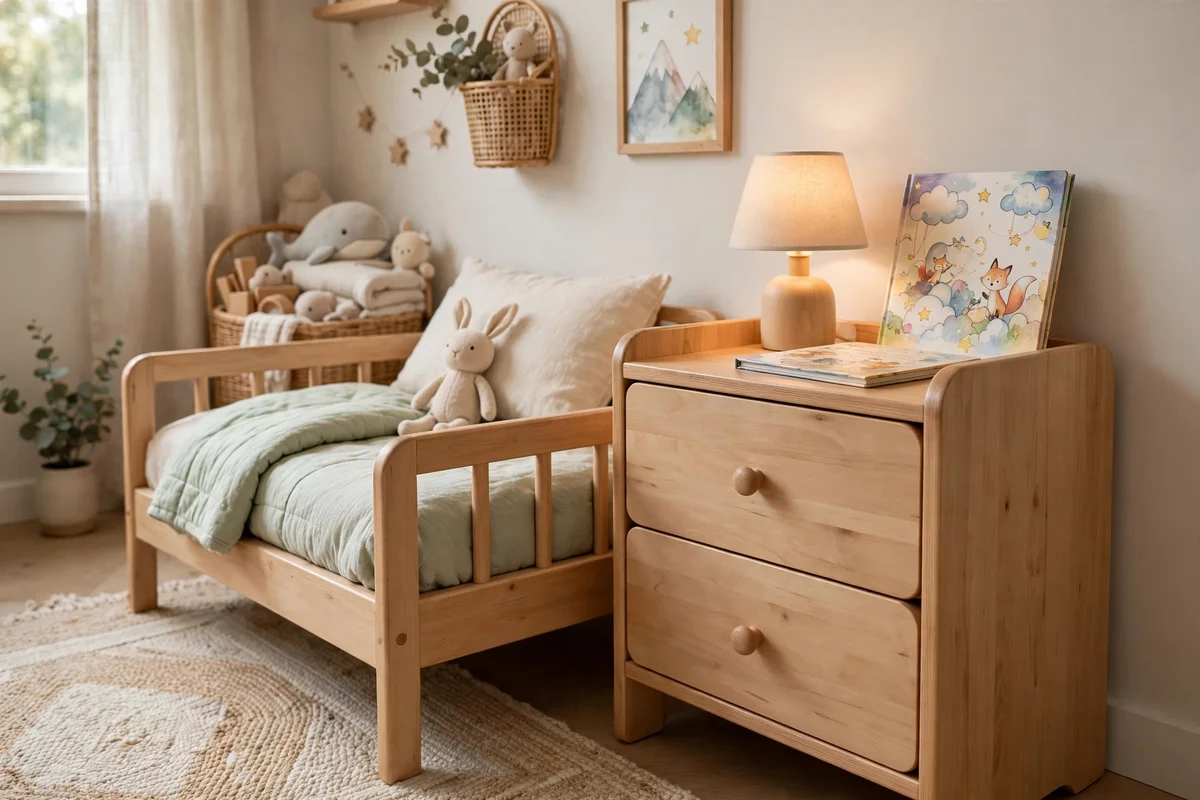
A slim nightstand, about 35 to 45 centimetres wide and 30 to 40 centimetres deep, with two shallow drawers, is the workhorse of children's bedrooms. The top holds the book, the water, and the lamp. The top drawer holds the torch, the glasses, and the small things used every night. The bottom drawer holds the things used less often — spare batteries, a notebook, the next book in a series. Two shallow drawers are better than one deep drawer, because a deep drawer becomes a jumble where nothing can be found, and a child will stop using it. Choose a nightstand with drawers that slide smoothly and cannot be pulled out completely, with handles a small hand can grip, and with no sharp corners. Anchor it to the wall, even though it looks too small to tip — small furniture tips more easily than big furniture, because a child can pull it over by leaning on it. A slim nightstand suits most children from about age five upwards, and it is the easiest option to find in shops, which means you can check the height against your mattress before you buy.
6. An open cube or cubby unit
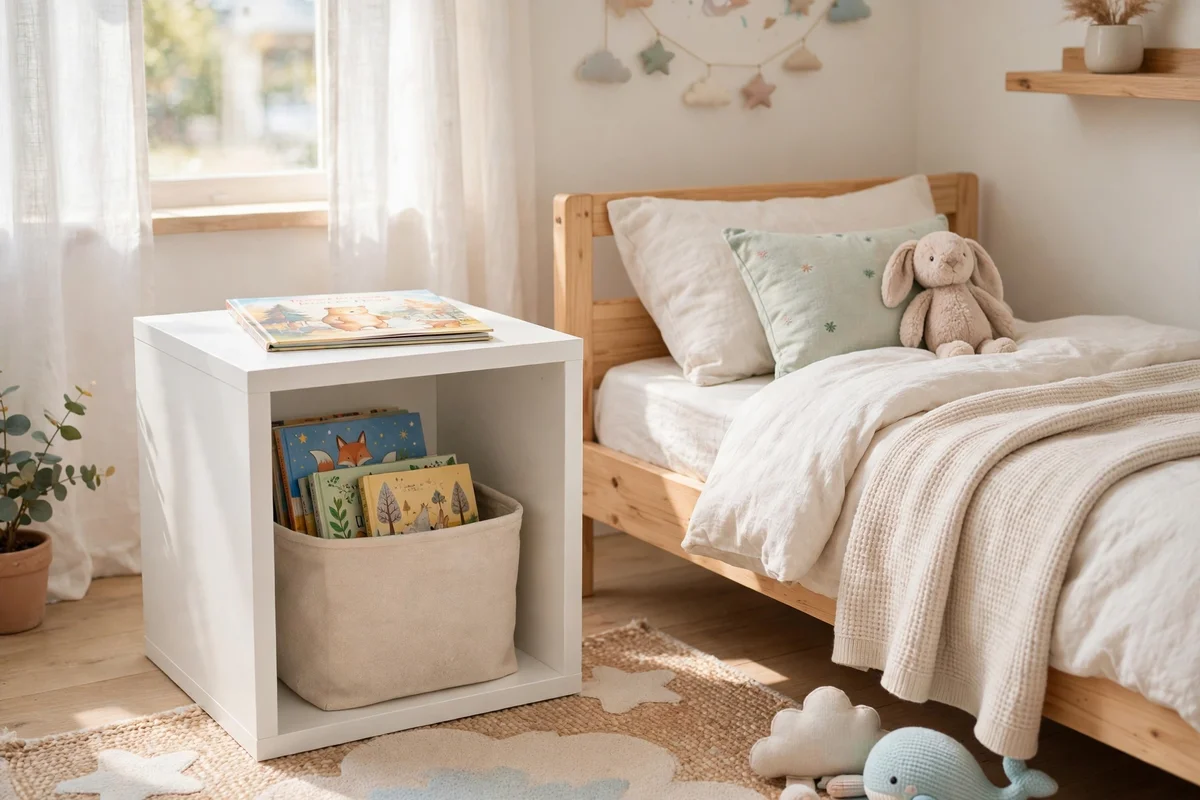
An open cube — a single square storage cube, or a two-cube unit turned on its side — works as a bedside table for children who need to see where things are. The top is the bedside surface. The open cube below holds a basket with books, a basket with soft toys, or a lidded box with the small things. Because there is no door and no drawer to open, a child can reach in and find what they want without help, which is why this option suits younger children and children who are still learning to tidy up. Use a fabric basket or a soft storage box inside the cube rather than a hard plastic box, so there are no hard edges at the height where a child reaches in. A single cube is usually the right height for a toddler or younger child's bed; a two-cube unit on its side may be too high for a low bed, so measure first. Anchor the unit to the wall, and keep heavy books on the bottom, not the top, so the unit stays stable.
7. A table with a drawer and an open shelf below
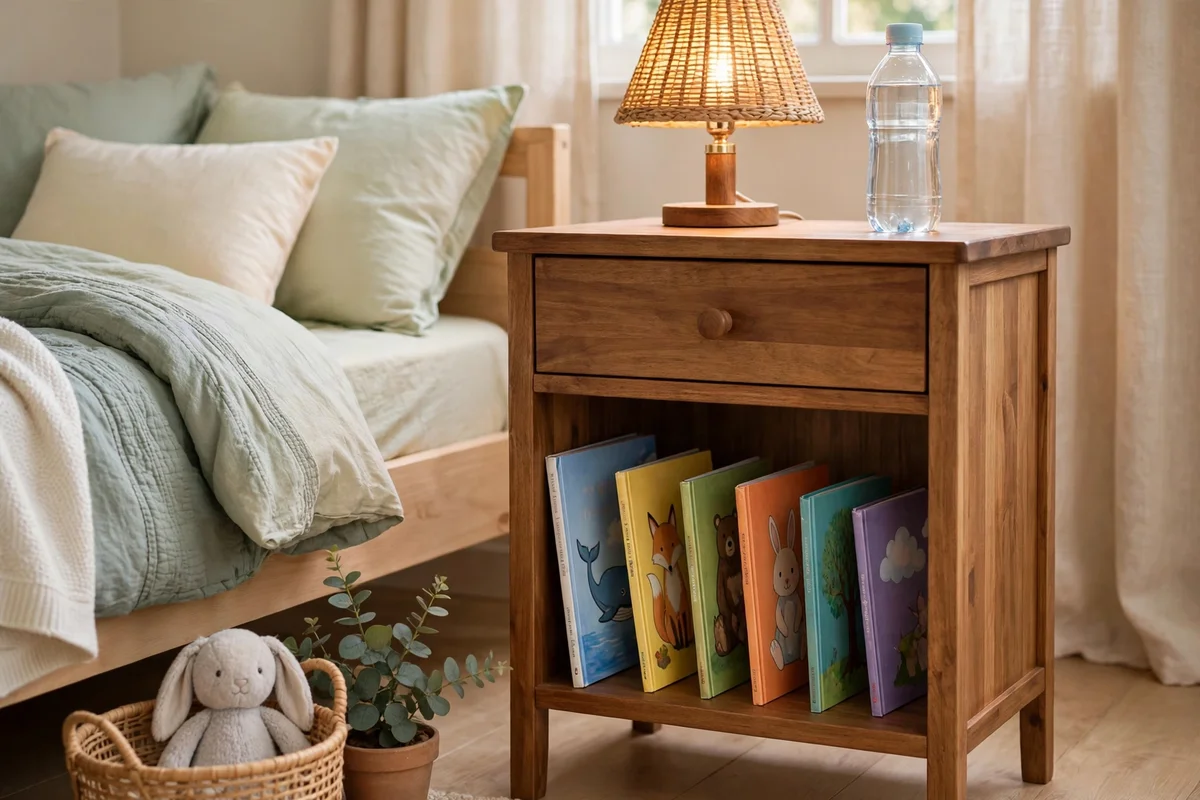
This is the combination that most families end up with after trying a plain table: a drawer on top for the small private things, and an open shelf below for the books. The drawer holds the torch, the glasses case, and the treasures. The shelf holds the current book and the next two, standing upright so a child can see the spines and choose. The top holds the water and the lamp. This layout works because it matches how children actually use the space — the things they need in the dark go on top, the things they need to find by sight go on the shelf, and the things they want to keep private go in the drawer. When you shop for one, open the drawer in the shop and check it runs smoothly when it is half full of books, because a drawer that sticks when it is loaded will be left open or abandoned. Check the shelf height too: it should be tall enough for a paperback standing upright, about 25 centimetres of clear space, or the books will have to lie flat and become a pile.
8. A C-shaped table that slides over the bed
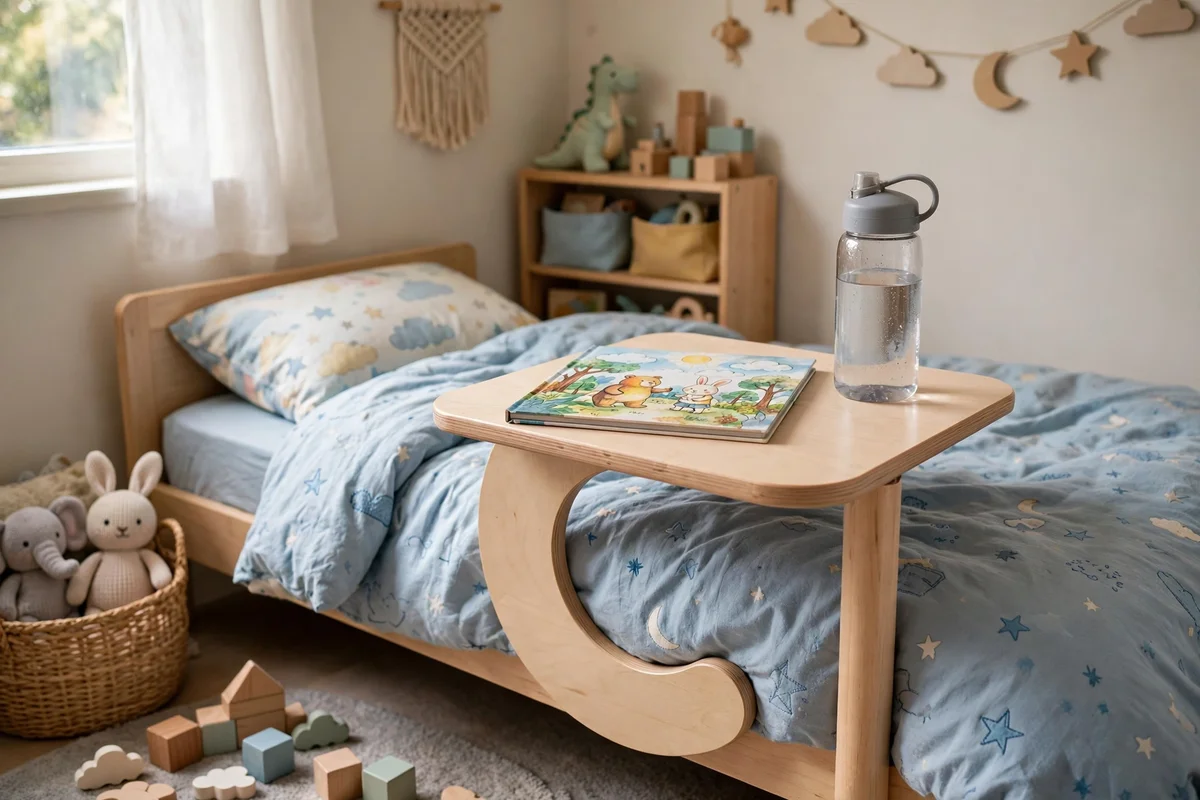
A C-shaped table, with a base that slides under the bed and a top that overhangs the mattress, looks like an adult laptop table, but in a child's room it solves a real problem: the bed is pushed against the wall on one side, and there is no gap for a table beside it. The C-shaped table slides in from the foot or the open side of the bed, and the top sits over the edge of the mattress at exactly the right height for a book and a drink. It suits a child who reads in bed and wants the book close, a small room where every centimetre of floor matters, and a child recovering from illness or injury who needs things within reach without getting up. Choose one with a wide, stable base that cannot tip when a child leans on the top, and with a top that is not so large that it covers the whole bed. The trade-off is storage: a C-shaped table has no drawer and no shelf, so it needs a small basket or a bedside pocket alongside it for the torch and the small things. It also needs to be moved out of the way in the morning, or it becomes an obstacle when a child gets out of bed.
Repurposed and DIY Ideas
These four ideas cost less than a bought nightstand, and they let a child help choose or make their bedside table, which makes them more likely to use it. Each one needs the same safety checks as a bought table — anchoring, rounded edges, stability — and each one should be checked for splinters, loose nails, and old paint before it goes into a child's room.
9. A sturdy step stool as a bedside table
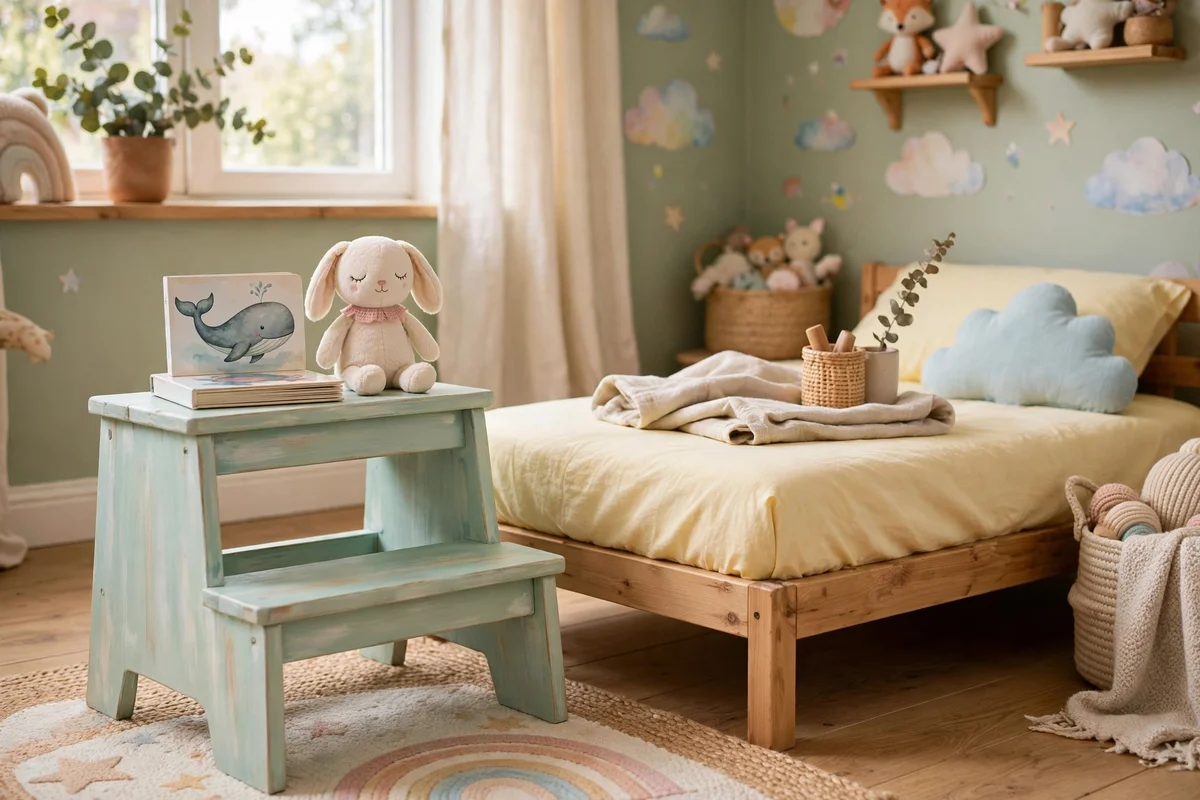
A wooden step stool, the kind with two steps, makes an excellent bedside table for a toddler or a younger child. The top step is the table surface, at just the right height for a low bed, and the lower step is a shelf for a book or a soft toy. It is low, wide, and very stable, which is exactly what a toddler's bedside table should be. Sand it smooth, paint it in a colour from the room, and add a small non-slip mat on the top step so a water bottle does not slide off. Check that the stool does not wobble, that the joints are tight, and that there are no gaps where small fingers can get trapped. The step stool also has a second life: when the child outgrows it as a bedside table, it becomes a step for reaching a bookshelf or a wardrobe rail. Do not use a folding step stool or a plastic one with a narrow base — a bedside table needs to be stable when a child leans on it in the dark, and a folding stool is not.
10. Stacked crates or a crate on its side
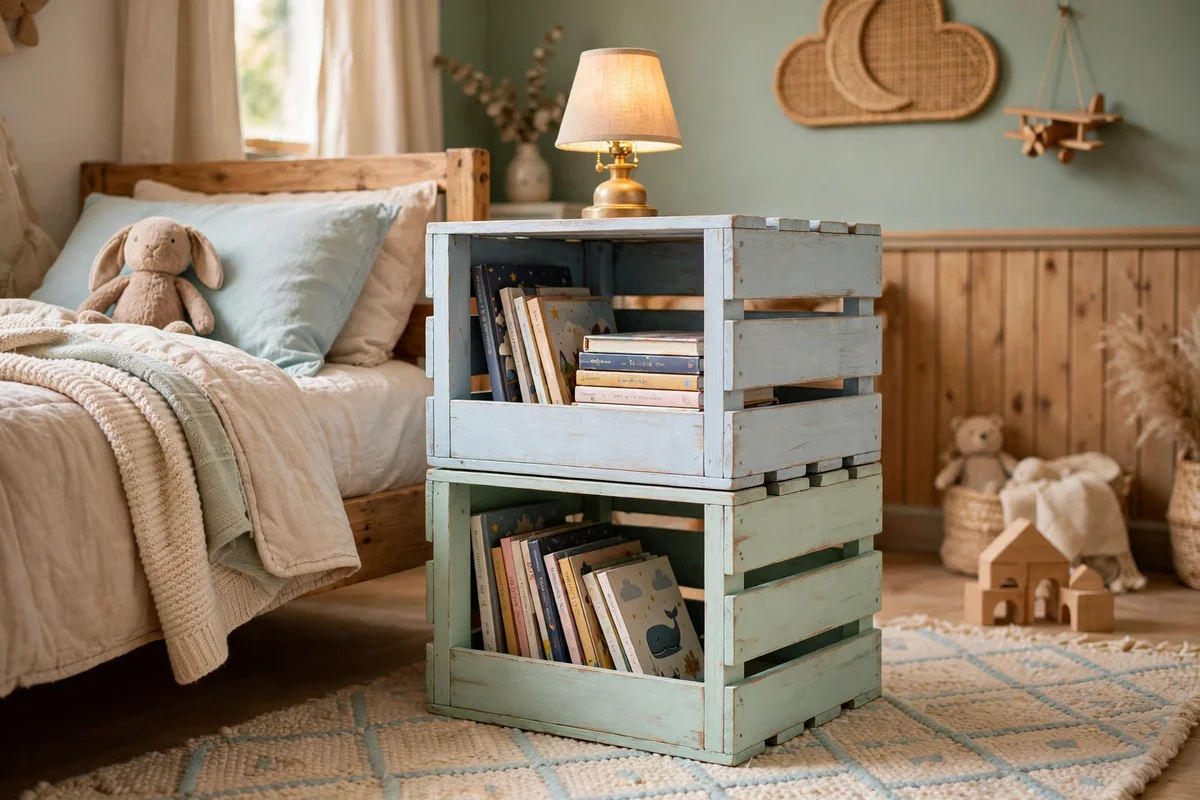
A wooden crate, or two crates stacked, is a bedside table a child can help make in an afternoon. One crate on its side, with the opening facing the bed, gives you a top surface and an open cubby in one piece. Two crates stacked give you two cubbies, one for books and one for toys. Sand the crates thoroughly — old crates can have splinters and rough edges — and paint them inside and out with washable paint, so they can be wiped clean. Fix the crates together with screws, and anchor the whole unit to the wall, because a stack of crates is light and easy to pull over. Line the cubby with a fabric basket if the child will be reaching in for books in the dark, so there are no rough edges at hand height. Crates suit a room with a rustic or handmade feel, a family on a tight budget, and a child who wants a hand in making their room. They do not suit a room where the bedside table needs to look neat and finished, because even a well-painted crate still looks like a crate, and the open cubby will always show its contents.
11. A stack of vintage suitcases
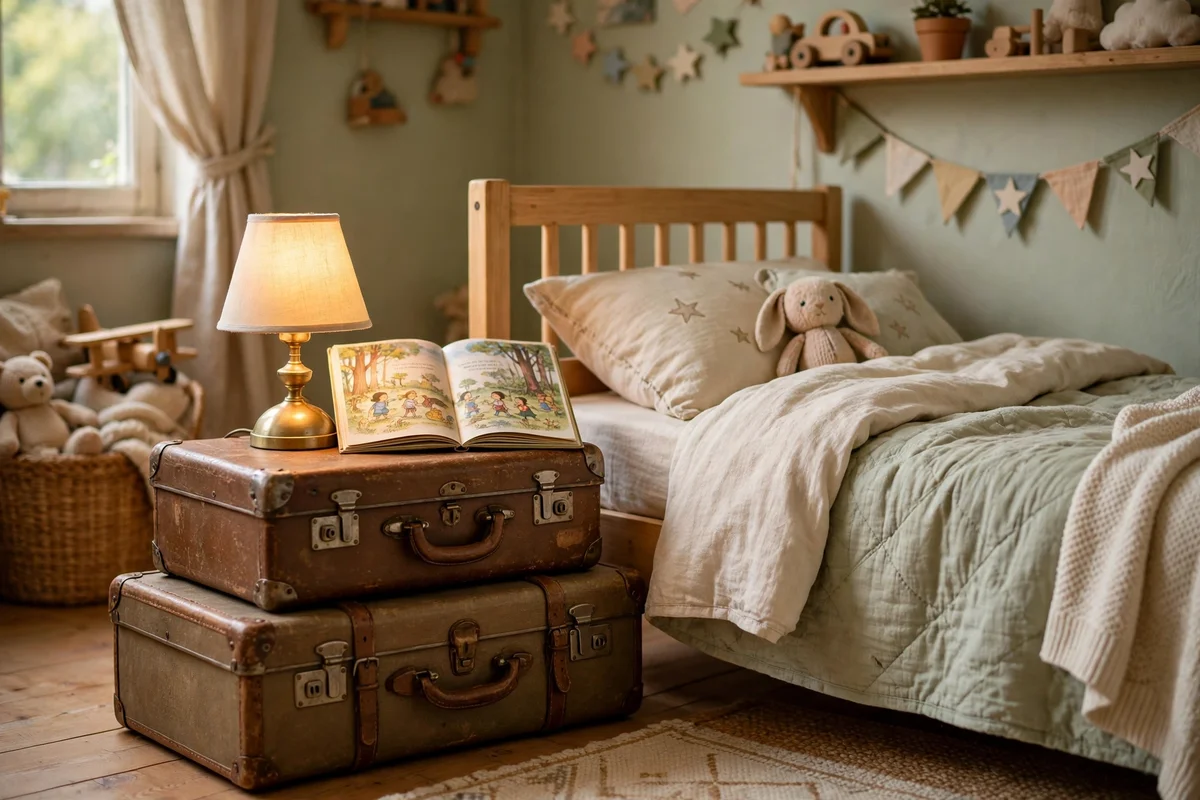
A stack of two or three old suitcases, with the largest at the bottom and the smallest on top, makes a bedside table with built-in storage that children love. The top suitcase is the table surface. The suitcases below are storage for out-of-season clothes, spare bedding, or toys that are not used every day. The suitcases should be sturdy, with lids that stay shut and clasps that a child cannot trap a finger in — tape or remove any broken clasps, and check the inside for musty smells or old lining that needs replacing. Fix the suitcases together so they cannot slide apart, and anchor the stack to the wall, because a tall stack is easy to pull over. Keep the total height at mattress level: two suitcases are usually right for a standard single bed, three may be too high for a younger child. This idea suits an older child who likes the look and has the strength to open a suitcase lid without it falling shut, and it suits a room where extra storage is genuinely needed. It does not suit a toddler's room, because the lids are heavy and the clasps are a finger-trap risk.
12. A small chair or a repurposed desk as a bedside table
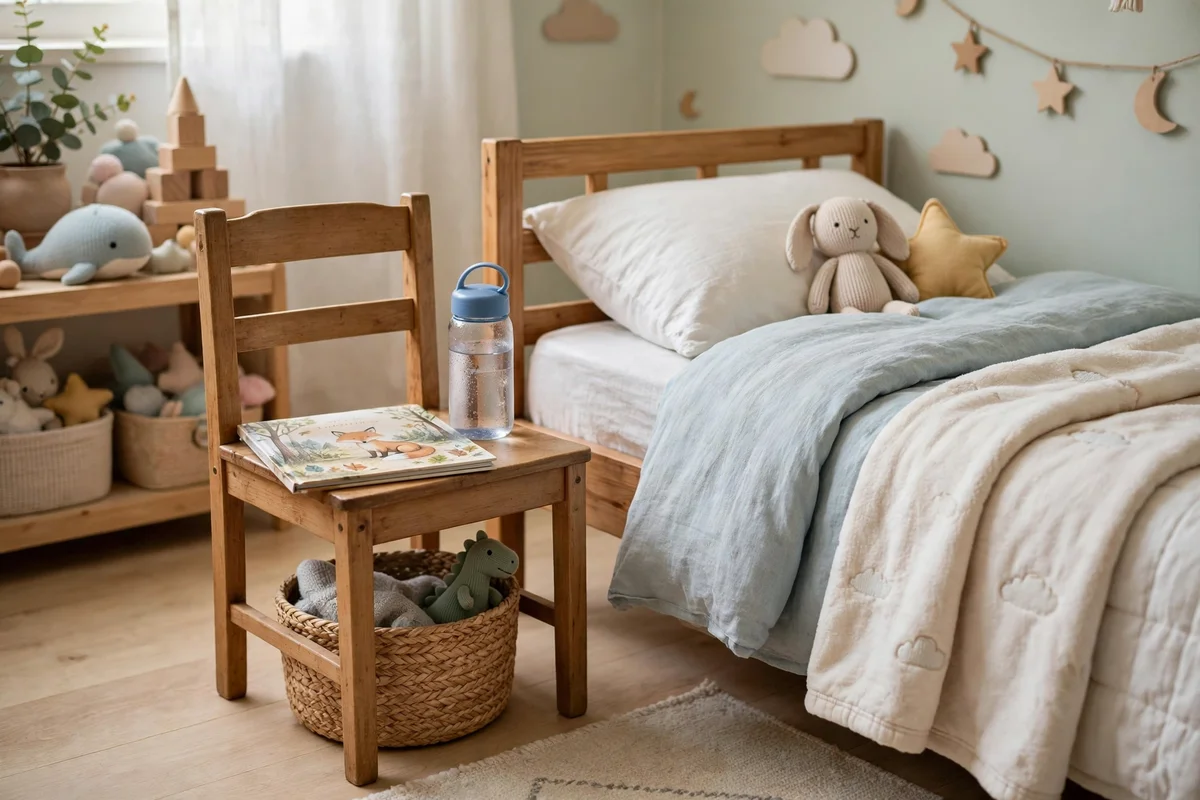
A small wooden chair, turned so the seat is the table surface and the back is against the wall, is a bedside table that many families already own. The seat holds a book and a water bottle. The rungs or the space under the seat hold a basket with the torch and the soft toy. The back of the chair gives a child something to hang a dressing gown or a book bag on. Choose a chair with a flat, wide seat and four sturdy legs, and check that it does not rock. A chair with a rush or cane seat is not suitable, because a water bottle will mark it and a child may push through it. A small desk, cut down or used as it is, works in a similar way for a pre-teen: the desk surface is the bedside table, the drawer holds the charging cables and the glasses, and the desk becomes a homework spot in the daytime. If you repurpose a desk, check the height against the mattress first — most desks are about 75 centimetres high, which is too high for a bedside table for a child under ten — and cut the legs down or choose a low child's desk instead.
Organisation and Styling
A bedside table fails more often from disorganisation than from the wrong furniture. These three ideas are about what goes where, and they work with almost any table from the sections above. If you already own a table that is not working, try these before you buy a new one.
13. The drawer-versus-top system
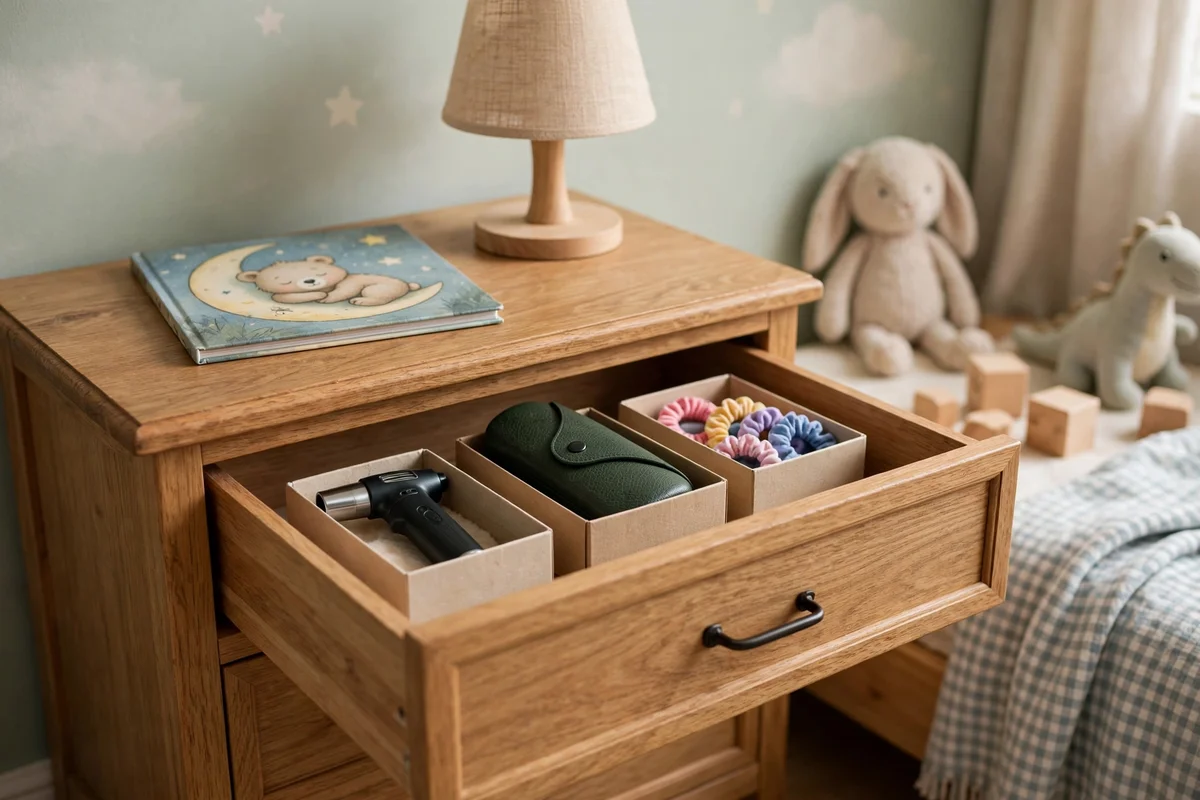
Give everything beside the bed a fixed home, and tell your child what it is. The rule is simple: the top holds only what is used in the dark — the book being read, the water, the torch, and the comfort toy. The drawer holds what is used at bedtime but not in the dark — the glasses case, the hair ties, the lip balm, the small notebook. Everything else lives elsewhere. When a child knows that the torch is always in the top drawer and the book is always on the top left corner, they can find both without turning the light on, and they can put both back without thinking. To make the system stick, use a small drawer organiser or a couple of small boxes inside the drawer, so the torch does not end up under a pile of hair ties. Label the drawer for a younger child with a picture of a torch, or with a small torch sticker on the front. Check the system once a week for the first month — if something has moved to the top of the table and stayed there, it probably belongs in the drawer, or it does not belong beside the bed at all. A system that a child can maintain by themselves is the only system that lasts.
14. A charging station for older kids
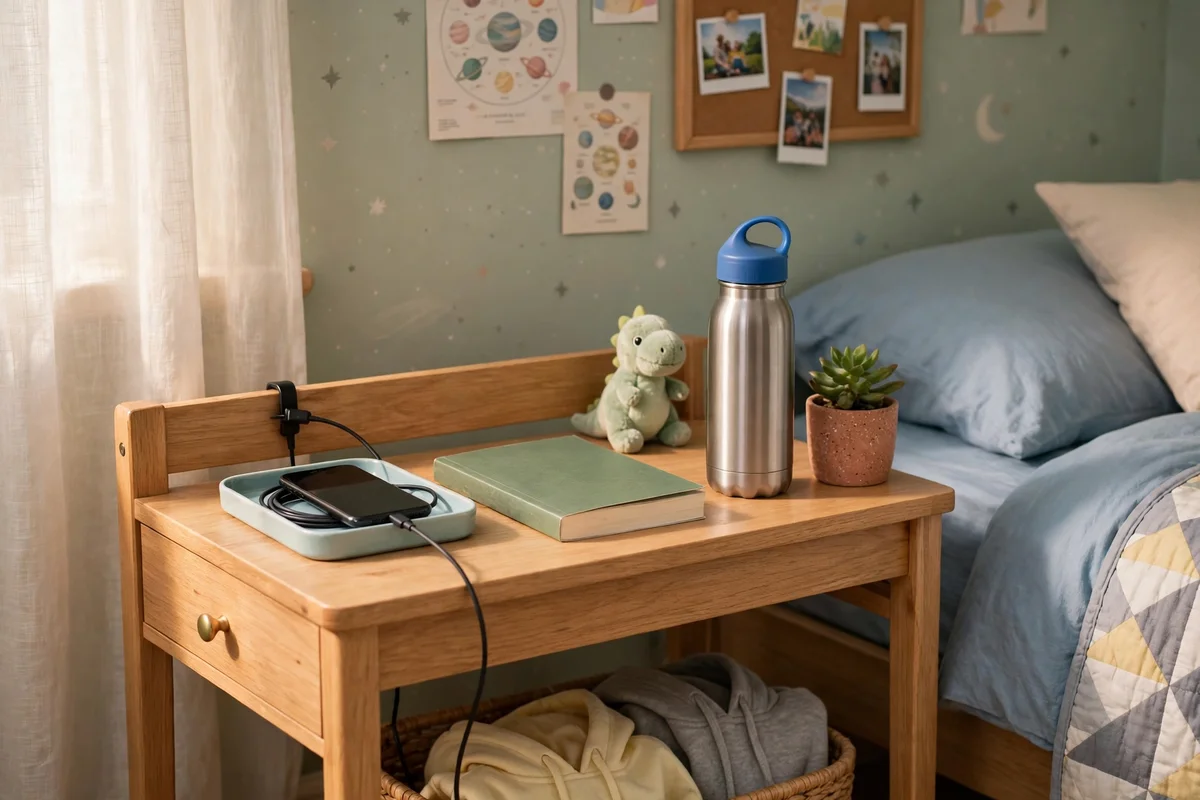
For a pre-teen, the bedside table is also a charging station, and the charging setup needs the same care as the lamp. Run a short charging cable from a socket behind the bed, clip the cable to the back of the table with a small adhesive cable clip so it cannot fall behind the bed, and put the phone or tablet in a small tray or a shallow dish on the table so it has a fixed place. A tray matters, because a phone left loose on a bedside table gets knocked off, covered by books, or left charging under a pillow, which is a fire risk. Keep the charging point away from the water bottle — water and charging cables should never share the same corner of the table — and agree a rule that the phone charges on the tray, not in the bed. A multi-device charging dock can tidy the cables, but only if it is stable and the cables are short; a dock with long trailing cables is worse than a single clipped cable. Check the cables regularly for fraying, and replace a damaged cable straight away rather than taping it.
15. Styling the top: one toy, one book, one light

A bedside table that looks calm is a bedside table that a child can use calmly, and the styling rule that achieves it is: one comfort toy, one book, and one light on top, and nothing else. The comfort toy sits at the back corner, where it can be reached without knocking anything over. The book lies flat or stands in a small book stand at the front, ready to be picked up. The light — a small lamp, a clip-on light, or a nightlight — sits at the back corner opposite the toy, well away from the front edge. Everything else — the water, the torch, the glasses — goes in the drawer or on the shelf below, and is taken out when it is needed. This sounds strict, and it is, but a crowded bedside surface is a surface where things fall off, and a child who has knocked a glass over in the dark will stop putting a glass there at all. Let the child choose which toy and which book earn the top spot, and rotate them when the book changes. A small tray under the water glass, if water does live on top, catches the drips and marks the glass's home so it always goes back to the same place.
Lighting and Reading
Light is the part of the bedside setup that most affects sleep, and it is the part parents most often get wrong by choosing a lamp that looks right for an adult. These three ideas keep the light low, warm, and within a child's control.
16. A clip-on or swing-arm reading light
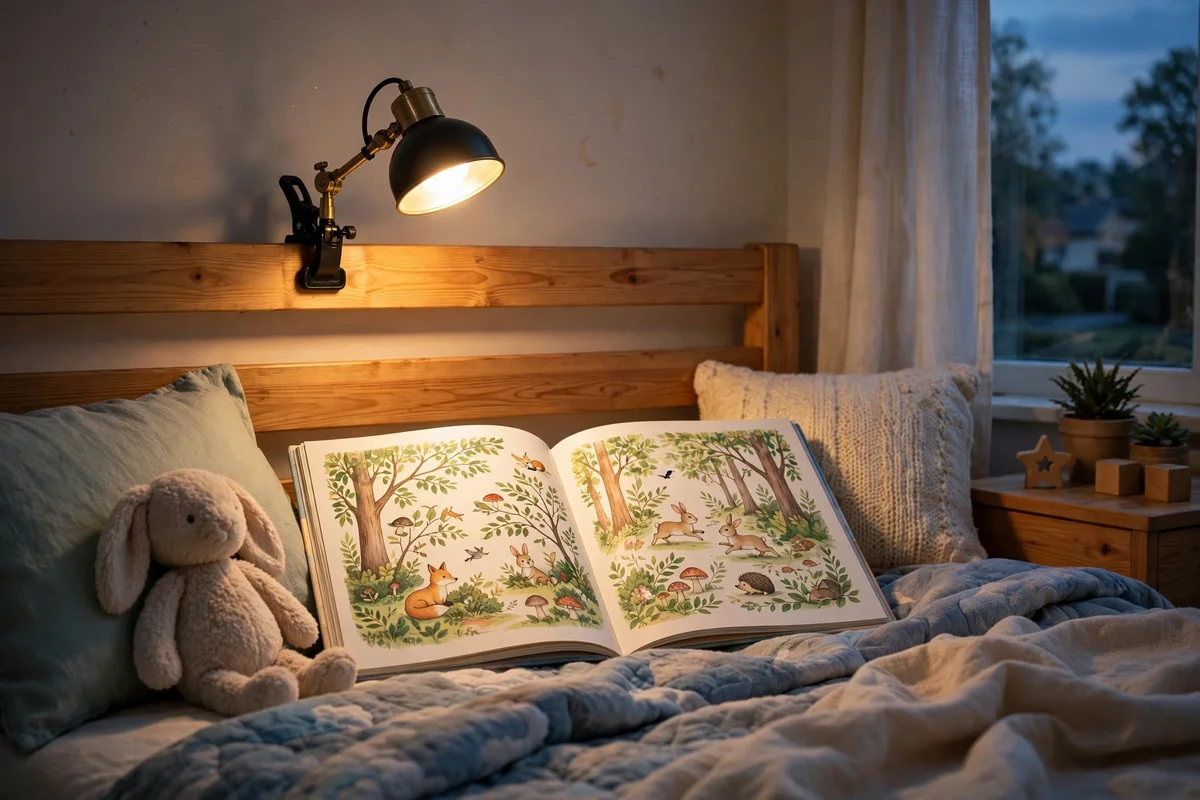
A clip-on reading light that clamps to the headboard, the shelf, or the edge of the table gives a child a light they can aim at a book without lighting the whole room, and there is no lamp base to knock over. A swing-arm wall light does the same job more permanently: it folds flat against the wall in the daytime and swings out over the bed at reading time. Either way, choose a light with a warm white bulb, a dimmer or at least a low setting, and a switch a child can reach without getting out of bed. A light that is too bright or too blue-white will keep a child awake longer, so warm and dim is the aim. For younger children, a light with a simple on-off switch is better than one with touch controls or a remote that can be lost. Fix the clip firmly and check it regularly — a clip-on light that slips will end up on the floor or in the bed. And keep the light away from curtains, bedding, and soft toys, because even a low-wattage bulb generates heat if it is covered.
17. A low, touch-friendly nightlight on the table
A small nightlight on the bedside table — a soft glowing shape, a low dome, or a lamp with a warm bulb and a fabric shade — helps a child who is afraid of the dark, and it gives them enough light to find the torch or the water without switching on the main light. Choose one that is cool to touch, stable, and light enough that it cannot hurt a child if it is knocked over. A rechargeable nightlight that can be picked up and carried to the bathroom is useful for a child who wakes in the night, and it removes the cord altogether. Avoid nightlights that project bright patterns onto the ceiling or play music, because they can be stimulating rather than calming, and avoid any nightlight with small parts that can be pulled off. Put the nightlight at the back of the table, away from the front edge, and use a timer or a light with an automatic switch-off so it does not stay on all night. A nightlight that stays on until morning can disturb sleep, even if a child says they like it.
18. A torch and book-light station

The simplest lighting idea is also the one children like most: a dedicated home for the torch. A small basket, a mug, or a hook on the side of the table holds the torch, a book light that clips onto a book, and spare batteries, all in one place. The child knows where the torch lives, can find it in the dark by feel, and can put it back in the same place in the morning. Choose a torch with a large, easy switch, a soft strap or a loop so it can be hung up, and a brightness that is enough to read by but not so bright that it dazzles. A torch with a red-light setting, if you can find one, is gentler on sleep than a white light, and a head torch is useful for a child who reads with both hands. Keep the batteries in the station, not loose in the drawer, and check them once a month — a torch with flat batteries is worse than no torch, because a child will reach for it in the dark and find it does not work. This station suits every age, and it costs almost nothing: a mug from the kitchen and a torch from a drawer are enough to start.
A Weekend Plan: Friday, Saturday, Sunday
A bedside setup does not need a month of planning. It needs a clear order, because buying a table before you have measured the mattress, or buying a lamp before you know where the socket is, creates the rework that eats weekends.
On Friday evening, measure the bed and watch what your child keeps beside it. Measure the mattress top from the floor and write the number down. Note where the socket is, whether the bed is against a wall, and whether there is room for a table or whether a shelf or a pocket organiser is the only option. Look at what is already on the floor beside the bed — that is your real shopping list. Decide the budget level from the section below, and make a list: the table or shelf, the lamp or torch, the storage, and the fixings. Order or buy only what is on that list.
On Saturday, do the fitting work. Move the bed slightly away from the wall if you need to, fix the shelf or anchor the table to the wall, and check it is stable before you put anything on it. Sand and paint any repurposed piece outside or in a ventilated space, and let it dry fully before it goes beside the bed. Fit the lamp, clip the cords to the back of the table, and test the whole setup by lying on the bed yourself: can you reach the book, the water, and the torch without sitting up? If you cannot, the height or the layout is wrong, and it is easier to fix now than after a week of use.
On Sunday, set up the drawer-versus-top system with your child. Let them choose the book and the comfort toy that go on top, put the torch in its home, and agree where the phone charges, if that applies. Walk to the door and look at the bedside as a visitor would — the view from the door is the one you see every day — and check that nothing is trailing, nothing is perched on an edge, and nothing can be pulled down. Finish by doing a night-time test: turn the main light off, switch on the bedside light, and check that your child can find the book and the water in the low light. If they can, the setup works.
Small Rooms and Shared Rooms
A small room needs the bedside to take up as little space as possible, and the no-floor-space ideas are the ones to start with. A floating shelf, a wall-mounted nightstand, or a bedside pocket organiser gives a child a bedside without taking a single centimetre of floor. If a freestanding table is the only option, choose the slimmest one you can find, and push the bed against the wall so the table sits in the gap at the foot of the bed rather than in the middle of the walking route. Keep the top to the one-toy, one-book, one-light rule strictly in a small room, because a crowded surface in a small room feels twice as crowded. Use the wall above the bedside for storage — a ledge for books, a hook for a dressing gown — so the floor stays clear. And keep at least one clear path from the bed to the door, even if that means the bedside table is smaller than you would like. A child who has to climb over a table to get out of bed will stop using it.
A shared room needs a bedside for each child, or a clear agreement about sharing one. Two beds with a table between them can work if the table is wide enough for two books, two waters, and two torches — about 60 centimetres wide is a realistic minimum — and if each child has their own side, their own drawer, or their own basket. A table between two beds with a single drawer will cause arguments; a table with two drawers, or two separate pocket organisers, one on each bed, will not. If the beds are on opposite walls, each child needs their own bedside, even if one is only a shelf or a pocket organiser, because a child who has to cross the room in the dark to reach a book will not bother. Give each child their own colour or their own small tray, so the shared table still feels personal. And keep the layout symmetrical where you can — matching lamps, matching shelves, matching heights — because symmetry makes a shared room feel fair, even when the beds are different sizes.
How the Bedside Table Changes as Your Child Grows
A toddler's bedside is about safety and softness: a low surface, no breakables, a comfort toy, and a lidded water bottle. The table itself may be a low stool or a crate on its side, and the light is a nightlight, not a reading lamp. Everything within reach should be washable and soft, and anything hung above the bed should be fixed securely.
A school-age child's bedside is about independence: a book they chose themselves, a torch they can find in the dark, a drawer they can open and close by themselves, and a reading light they can switch on and off. This is the age to introduce the drawer-versus-top system and to let the child choose the book and the toy that live on top. It is also the age when the bedside starts to collect small treasures, so a drawer or a small box matters more than it did before.
A pre-teen's bedside is about privacy and charging: a drawer for the things they do not want on display, a charging station for a phone or tablet, a water bottle instead of a glass, and a reading light they control themselves. The comfort toy may still be there, tucked at the back, but the bedside is now also a place for glasses, a notebook, and the things a pre-teen wants within reach in the morning. This is the age to move the table to full mattress height if it is not there already, and to check the anchoring again, because a pre-teen leans on furniture more heavily than a younger child.
When a child outgrows a bedside table, the change is usually gradual: the low stool becomes too low, the crate becomes too small, the pocket organiser becomes too babyish. Change the table when the height is wrong, not when the style feels young — a table at the right height with a fresh coat of paint lasts far longer than a fashionable table at the wrong height. And keep the system: the drawer-versus-top rule, the torch in its home, and the one-toy, one-book, one-light top work at every age, with the contents changing as the child grows.
Budget: Three Price Levels
A bedside setup does not have to be expensive. The difference between the three levels below is how much is bought new and how much is repurposed, not how well it works.
A refresh under $50 uses what you already have: a step stool or a chair you own, a pocket organiser, a torch and a mug for the torch station, a small tray for the water glass, and a clip-on reading light. Paint a crate or a stool in a colour from the room, add corner guards if the piece has sharp edges, and anchor it to the wall. The bedside changes without any new furniture, and it takes an afternoon.
A mid-level setup, roughly $50 to $150, adds the pieces that make the biggest difference: a slim two-drawer nightstand or a wall-mounted unit, a proper reading light, a drawer organiser, and a cable clip and tray for charging if that applies. This is the level most families choose, because it buys a table at the right height with storage a child can use, without buying a whole bedroom set.
A full setup, $150 and up, adds a matching pair for a shared room, a quality wall-mounted light, a charging dock, and a new mattress-height table in a finish that matches the rest of the bedroom furniture. This is worth doing when the bedroom is being redecorated anyway, or when two children need matching setups, rather than as a standalone purchase. If you are spending at this level, spend it on the things that are hardest to change later: a table at the right height, a lamp that is fixed and safe, and anchoring that will hold. A torch, a tray, and a drawer organiser can always be upgraded later, one piece at a time.
Whatever the budget, buy the table after you have measured the mattress, not before. A table at the wrong height is a waste of money at any price, and a repurposed stool at the right height beats an expensive nightstand at the wrong one.
Mistakes That Make a Bedside Setup Fail
The most common mistake is choosing a table at the wrong height. A table that is 15 centimetres too high or too low trains a child to reach awkwardly every night, and the glass, the book, and the torch will end up on the floor. Measure the mattress, write the number down, and check it against the table before you buy.
The second mistake is forgetting to anchor the table to the wall. A small nightstand looks too light to tip, and that is exactly why it tips: a child leans on it, pulls a drawer open, or climbs it to reach something, and the whole piece comes forward. Anchor every freestanding piece beside a child's bed, however small it looks.
The third mistake is putting a heavy lamp on the table. A ceramic or glass lamp is an accident waiting for a dark room and a reaching hand. Choose a light lamp, a clip-on light, or a wall-mounted light, and keep the base well back from the front edge.
The fourth mistake is letting the top become a dumping ground. A bedside table with ten things on it is a table where nothing can be found in the dark. Keep the top to the one-toy, one-book, one-light rule, and give everything else a home in the drawer, on the shelf, or elsewhere.
The fifth mistake is ignoring the cords. A trailing charging cable, a lamp cord hanging down the front of the table, or a cable draped across the bed is a hazard a child can pull, trip on, or chew. Clip cords to the back of the table, keep them short, and keep water and charging apart.
The sixth mistake is buying a table a child cannot use by themselves. A drawer that sticks, a handle too small for a child's hand, a shelf too high to reach, or a lamp switch a child cannot find in the dark all mean the table will be used by the parent, not the child. Test every drawer, handle, and switch with your child before the table goes into the room.
Frequently Asked Questions
What height should a kids bedside table be?
Roughly level with the top of the mattress, or within about 5 centimetres of it. Measure the mattress top from the floor — a toddler bed may be about 30 centimetres high, a standard single bed about 55 to 60 centimetres — and choose a table whose top matches that number. A table much higher or lower than the mattress makes a child reach awkwardly and spill things in the dark.
How do I stop a bedside table tipping over?
Anchor it to the wall with a furniture anchor or anti-tip strap, fixed into a stud or solid wall with the right fixings. Choose a low, wide piece rather than a tall, narrow one, keep heavy books low rather than on top, and check the table is stable on your actual floor before you put anything on it. If you rent and cannot drill, use adhesive anti-tip straps and choose the lowest, widest option that fits.
What should a child keep on their bedside table?
The nightly essentials only: the book being read, a glass or lidded bottle of water, a torch, and a comfort toy. Glasses, hair ties, and small treasures go in the drawer. A phone or tablet, for older children, charges in a tray on the table, not in the bed. Everything else — toys, clothes, school things — belongs elsewhere, or the top becomes a dumping ground.
Can two children share one bedside table?
Yes, if the table is wide enough — about 60 centimetres is a realistic minimum for two children — and each child has their own side, their own drawer, or their own basket. A single drawer shared between two children will cause arguments. If the beds are on opposite walls, each child needs their own bedside, even if one is only a shelf or a pocket organiser.
What is the best bedside table for a small kids room?
A floating shelf at mattress level, a wall-mounted nightstand with a drawer, or a bedside pocket organiser. All three take no floor space, and the shelf and the wall-mounted unit cannot tip over. A slim freestanding nightstand, about 35 centimetres wide, is the next best option if a wall fixing is not possible.
Is a lamp safe on a kids bedside table?
A light, stable lamp kept well back from the front edge is safe, but a heavy ceramic or glass lamp is not a good choice for a child's room. A clip-on reading light, a wall-mounted light, or a rechargeable battery lamp is safer, because there is nothing heavy to pull down and, with a battery lamp, no cord to tug. Whatever lamp you choose, keep cords clipped to the back of the table and away from water.
Final Checklist Before You Buy Anything
- Measure the mattress top from the floor and write the number down.
- List what your child actually keeps beside the bed — book, water, torch, glasses, comfort toy.
- Check where the socket is, and whether the bed is against a wall or in the middle of the room.
- Choose a table, shelf, or pocket organiser at mattress height, about 30 to 40 centimetres deep.
- Check the corners are rounded or guarded, and the piece is stable on your floor.
- Plan how you will anchor it to the wall, and buy the fixings.
- Choose a light lamp, a clip-on light, or a wall-mounted light — not a heavy lamp.
- Decide what goes on top, what goes in the drawer, and what lives elsewhere.
- Clip cords to the back of the table and keep water away from charging cables.
- Test the whole setup lying on the bed, in low light, before the first night.
A bedside table in a child's bedroom does not need to be expensive, and it does not need to be perfect. It needs to be at the right height, fixed so it cannot tip, and organised so a child can find a book, a drink, and a torch in the dark without waking anyone. Start with the measurement, choose the option that fits your room and your budget, and let your child choose the book and the toy that live on top. The rooms children love most are rarely the ones with the most furniture — they are the ones where the things they need at night are exactly where their hand expects them to be.


1 comment