Boho Kids Room Ideas
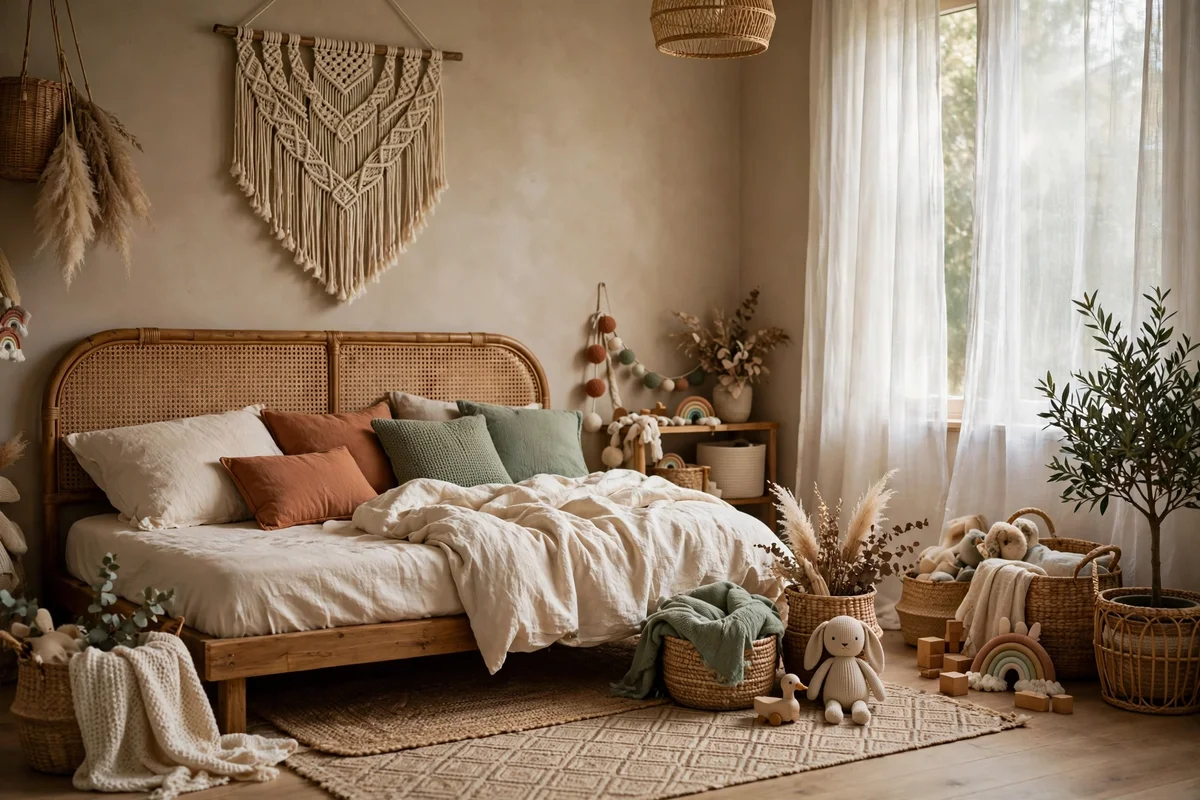
A boho kids room is the easiest kind of kids room to get right, and the easiest to get wrong. Get it right and the room feels warm, calm, and a little bit magical — a place where a child actually wants to read, play, and sleep. Get it wrong and it becomes a pile of baskets, cushions, and tassels with nowhere to sit and nothing within reach. The difference is not money. It is a plan: a palette chosen first, a few natural materials repeated through the room, and storage that is part of the decoration.
The short version: start with warm neutrals on the walls and the big furniture, add one earthy accent colour, and build the room in layers — a rug under a rug, a throw over the bedding, a cushion on the floor. Keep the furniture low and wooden, the textiles soft and washable, and the walls decorated with things your child made or chose. Do the big, dusty jobs on a Saturday, and finish with the soft layers on Sunday. The twenty ideas below are arranged in the order most parents actually use them: how to pick your style first, then the foundations, the walls, the bed, the corners where children spend their time, and finally the storage, light, and finishing touches — followed by the practical parts: small rooms, shared rooms, ages, budgets, and the mistakes that make a boho room look cluttered instead of calm.
How to Pick Your Boho Style
Boho is not one look. It is a family of looks that share the same ingredients — natural materials, warm colours, layered textiles, handmade details — mixed in different proportions. Before you buy anything, pick which member of the family you are decorating, because that one choice decides the palette, the furniture, and what you can skip.
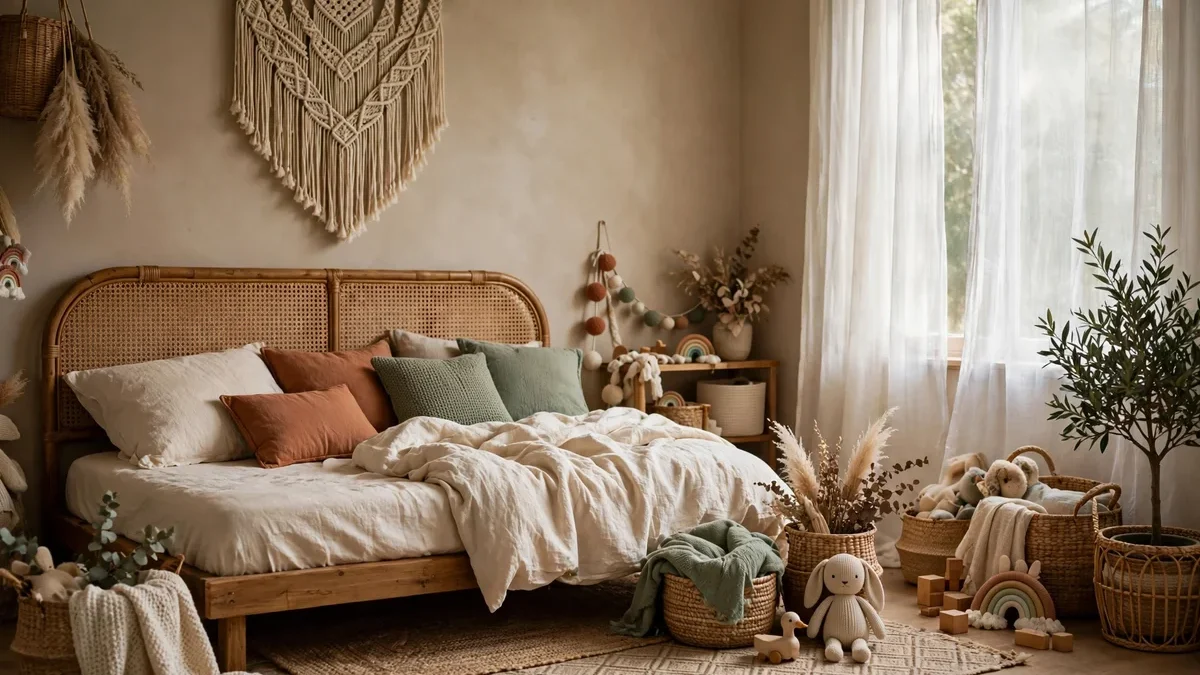
Earthy neutral boho is the calmest version and the best starting point. The walls are cream, warm white, or pale beige. The furniture is light natural wood. The colour comes from terracotta, sage, and dusty rose in small doses — a cushion here, a throw there, a rug with a muted pattern. Nothing shouts. This version suits small rooms, nurseries, children who are easily overstimulated, and parents who want a room that will still look right in five years. It is also the cheapest version, because most of it is paint, linen, and baskets rather than statement furniture.
Desert boho is the warmer, bolder cousin. Think sand, clay, rust, and mustard, with Moroccan-inspired patterns, cactus-shaped cushions, and woven textures everywhere. It suits a sunny room and a child who loves colour, and it photographs beautifully — which is one reason it is so popular online. The risk is overdoing the pattern: desert boho needs plain stretches of wall and plain bedding to balance the patterned textiles, or the room starts to feel busy rather than warm.
Woodland and nature boho brings the outdoors in: leafy greens, woodland animals, mountains and trees in the artwork, wooden toys on open shelves, and plants on high shelves. It suits a child who loves animals and being outside, and it ages well, because nature does not go out of fashion the way a cartoon character does. The risk here is theme creep — a woodland room can slide into a forest diorama if every surface gets a leaf or an animal on it. Keep the nature in the art and the toys, and keep the furniture and the walls plain.
Soft rainbow boho is the most playful version: muted rainbow colours — dusty pink, pale mustard, soft sage, gentle blue — used in wall art, cushions, and woven décor, against a neutral base. It suits younger children and shared rooms, because the rainbow gives each child a colour to claim. The rule that keeps it boho rather than just colourful is the word muted: every rainbow colour should look as if it has been washed a few times. Bright, saturated rainbow colours belong to a different style altogether.
Whichever direction you pick, write it down in one sentence before you shop: "Earthy neutral boho, terracotta accent, light wood, cream walls." That sentence is your filter. When you are standing in a shop holding a cushion that does not fit the sentence, you put it back. Most boho rooms go wrong not because the parents chose badly, but because they chose five different styles in five different shops and brought them all home.
A useful test before you commit: gather the things that will stay in the room — the bed, the dresser, the rug if you already own one — and lay your fabric samples and paint swatches next to them in daylight and again under the bedroom lamp at night. Earthy colours shift more between those two lights than most people expect. A terracotta that looks warm and rich at noon can look orange under a warm bulb, and a sage green that looks soft in the shop can turn grey at bedtime. If a swatch looks wrong in either light, pick a different shade of the same colour rather than a different colour altogether.
Four Boho Directions at a Glance
| Style | Palette | Best for | Watch out for |
|---|---|---|---|
| Earthy neutral | Cream, beige, terracotta, sage, dusty rose | Small rooms, nurseries, calm sleepers, tight budgets | Can look plain without enough texture — add rugs and throws |
| Desert | Sand, clay, rust, mustard, warm brown | Sunny rooms, colour-loving kids, statement look | Too much pattern at once — balance with plain walls and bedding |
| Woodland / nature | Leaf green, warm wood, cream, soft brown | Animal lovers, rooms that need to last years | Theme creep — keep nature in the art and toys, not everywhere |
| Soft rainbow | Muted pink, pale mustard, soft sage, gentle blue | Younger children, shared rooms | Bright saturated colours break the mood — keep every colour muted |
If you cannot decide between two directions, choose the calmer one. A calm base with one bold accent is easy to warm up later with a patterned cushion or a new throw. A bold base is much harder to calm down, because it usually means repainting. And remember that a boho room is meant to be collected over time, not bought in a single trip. The rooms that look best are the ones where a basket was added in spring, a macramé piece in summer, and a handmade picture in autumn — each one chosen, not all of them delivered on the same day.
20 Boho Kids Room Ideas
Foundations
1. Start with a warm neutral base
Every good boho kids room starts with the same foundation: warm, pale walls and light natural wood. Cream, ivory, warm white, or pale beige on the walls, and a wooden bed frame, dresser, and bookshelf in a light finish. This base does three jobs at once. It makes a small room feel bigger and brighter, because pale walls bounce the light around. It gives every colour you add later somewhere calm to sit against, so a terracotta cushion looks intentional instead of random. And it means the room can change direction in a year or two with new textiles alone, without repainting or replacing furniture.
If the walls are currently a cold white or a strong colour, a single coat of warm white is the cheapest transformation in this whole article. Choose a washable paint, because the lower half of a kids room wall gets touched, leaned on, and bumped by toys. Keep the ceiling white and the skirting boards the same warm white as the walls, so the room reads as one calm envelope. The base is meant to be quiet — the personality comes from the layers on top of it.
2. Choose an earthy colour palette — and stick to it
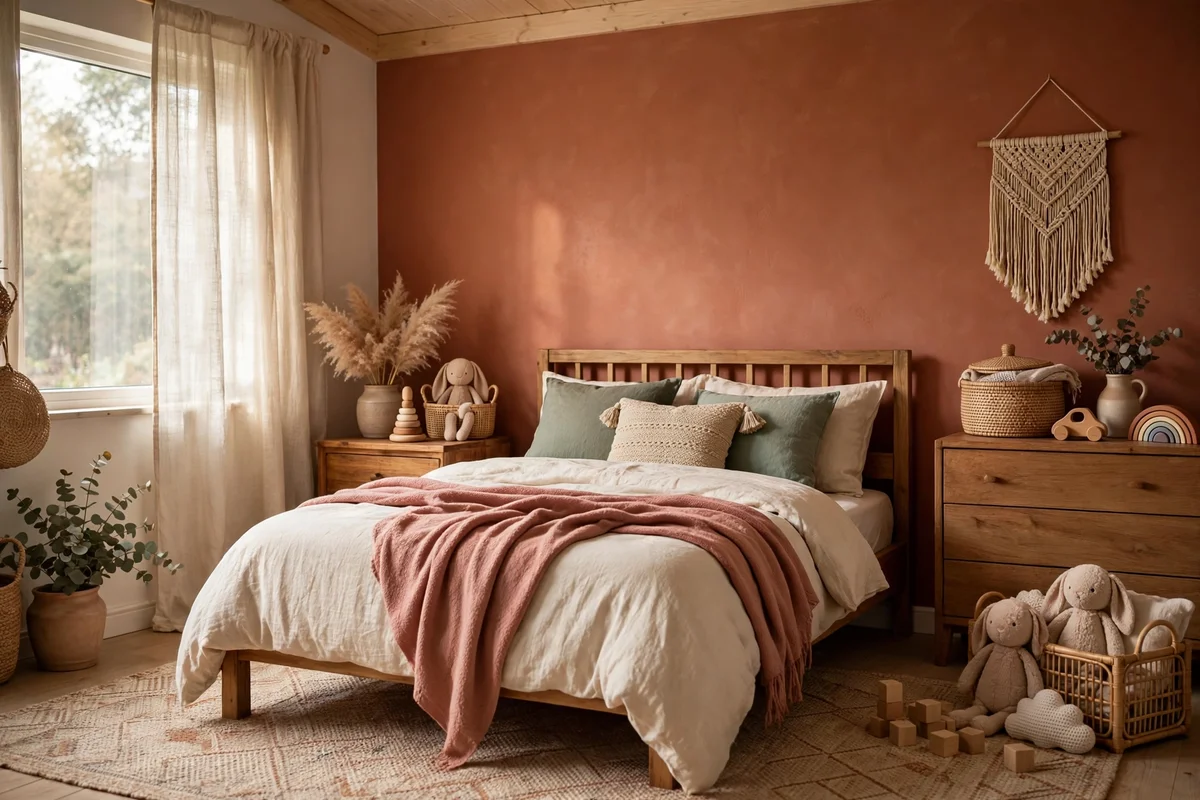
Colour is what makes a boho room feel boho, and the palette is small on purpose. Warm beige, cream, and soft white form the base. Terracotta, rust, sage green, mustard, and dusty rose are the accents. Pick two accents at most — terracotta and sage, for example, or dusty rose and mustard — and repeat them through the room: the rug has one, the bedding has the other, the cushions mix both. A palette with two accents and one neutral base looks designed. A palette with five accents looks like a jumble sale.
The trick to choosing is to start from something you already own and love. A favourite blanket, a rug you already have, a print your child picked — take one colour from it and build around it. Test your two accents as paint swatches on the wall, in patches at least as big as a sheet of paper, and look at them morning and evening. Terracotta deepens beautifully in evening light; mustard can turn brassy under a warm bulb; sage can go grey in a north-facing room. When the palette is settled, write it on a card and keep it in your pocket when you shop. If a cushion or a basket is not in the palette, it does not come home, however pretty it is. That discipline is what separates a boho room from a room full of boho things.
For the wall itself, one accent wall in a soft earthy tone can anchor the room — terracotta behind the bed, or sage behind the reading corner. Our guide to accent wall ideas for kids rooms covers paint, peel-and-stick wallpaper, wood slats, and murals, including which wall to choose and which finishes survive in a kids room.
3. Layer natural fiber rugs
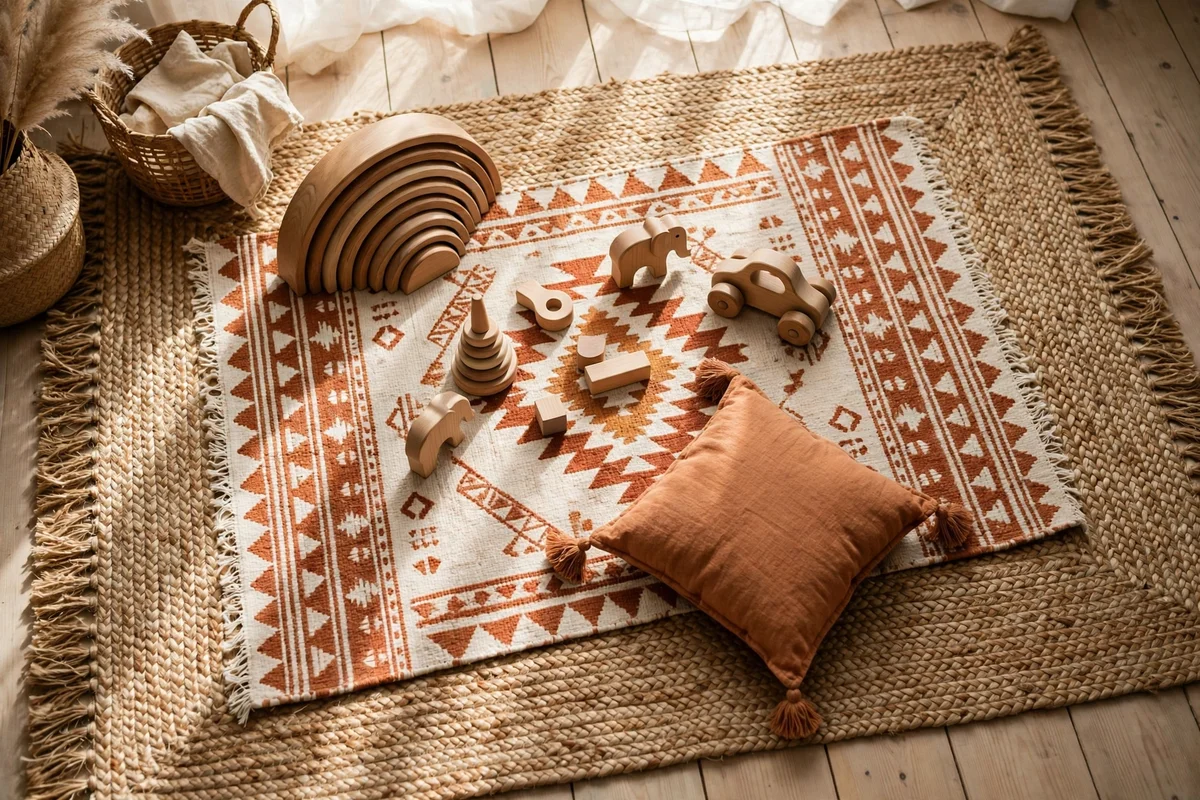
Rugs do more work in a boho kids room than almost anything else. They warm up a hard floor, define where play happens, and add the first layer of texture the eye notices when you walk in. The boho way to do it is to layer: a large, plain rug underneath — jute, sisal, or flat-weave cotton in a natural tone — and a smaller patterned rug on top, in your accent colours. The large rug should be big enough to sit under the bed and stretch into the play area. The small rug marks the spot where your child actually sits: the reading corner, the floor-seating area, or the middle of the room.
Layering works because the two rugs do different jobs. The plain base rug is the practical one: it protects the floor, softens footsteps, and covers a large area cheaply. The patterned top rug is the decorative one, and because it is small it can be bolder than you would dare on a full-size rug. Keep the top rug washable or easy to shake out, because it is the one that will catch crumbs, paint, and muddy feet. Leave bare floor around the edges — a rug covering the whole floor makes the room feel smaller, not cosier.
4. Use natural wood furniture
Natural wood is the backbone of a boho kids room. A light wooden bed frame, a simple dresser, a low bookshelf, and a small bedside table in the same pale wood give the room a warmth that painted furniture never quite manages, and they suit every boho direction, from earthy neutral to woodland. Wood also ages gracefully: a scuff on a wooden dresser looks like character, while a chip on a painted one looks like damage. Choose pieces with visible grain and simple shapes rather than ornate carving — boho furniture is honest and unfussy, not fancy.
Secondhand wood furniture is a gift to a boho room. A vintage dresser with a few marks, a wooden chair from a flea market, or a bookshelf sanded back to bare wood all fit the collected-over-time feeling that boho is built on, and they usually cost far less than new. If you buy secondhand, check that drawers open smoothly, that shelves are fixed securely, and that tall pieces can be anchored to the wall — a child climbing a bookshelf is a real risk, and a wall anchor costs almost nothing. Sand any rough edges, and leave the wood unpainted so the grain stays visible. If the bedside table is on your list, our bedside table ideas cover sizes, heights, and storage that work beside a child's bed.
5. Add rattan furniture

Rattan is the material most people picture when they hear the word boho, and for good reason: it is light, warm, and textured, and it makes a room feel airy even when the furniture is substantial. A rattan bed frame is the statement piece — woven headboard, light frame, cream linen bedding — and it pairs with almost any palette. If a full rattan bed is more than the budget allows, a rattan chair, a rattan bookshelf, or a rattan toy-storage unit gives you the same feeling for far less. One or two rattan pieces are enough. Three or four can make the room look like a rattan showroom rather than a bedroom.
Rattan needs a little care in a kids room. Check that the weave is tight and that no sharp ends stick out where a child could catch a finger or a sleeve. Keep it out of direct damp — a rattan chair beside a leaking window, or a basket used for wet bath toys, will not last. And remember that rattan is light, so a tall rattan shelf should be anchored to the wall like any other tall furniture. Bought well and placed well, rattan is one of the few boho pieces that genuinely grows with a child: a rattan chair that holds a toddler's picture books will hold a ten-year-old's novels just as happily.
Walls
6. Hang macramé wall hangings
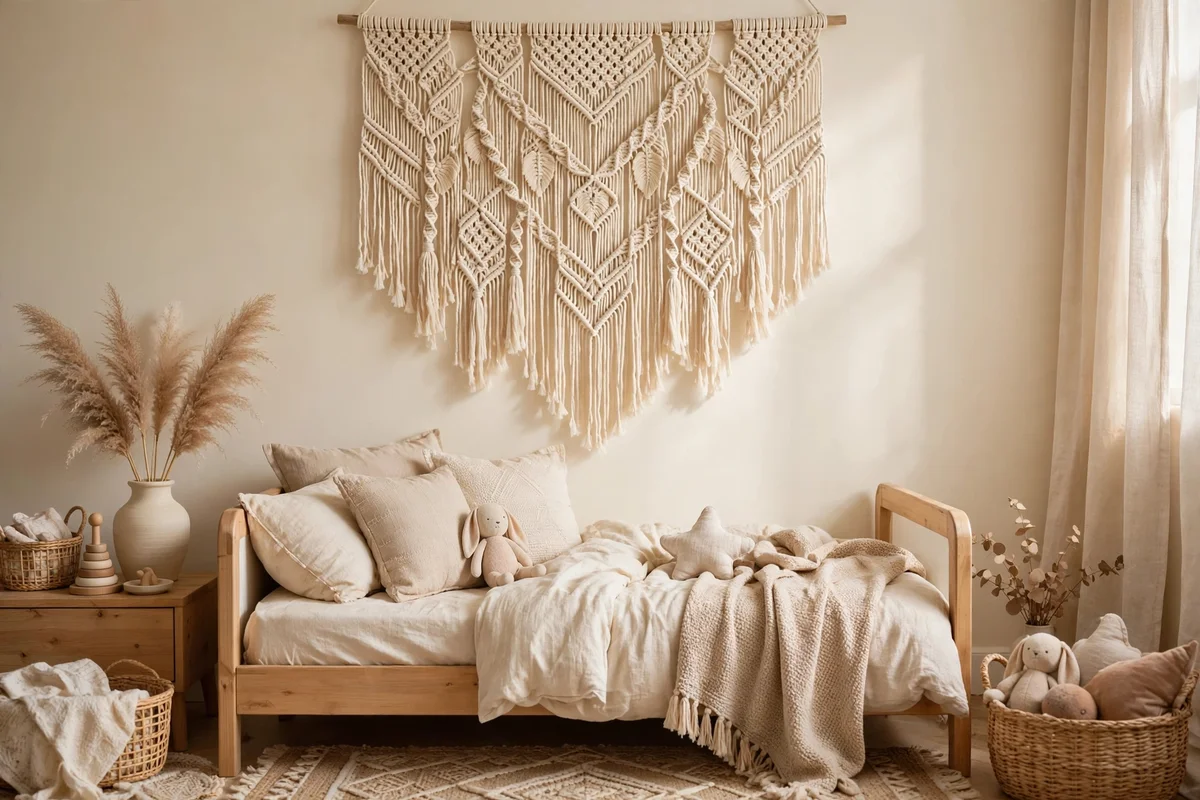
Macramé is the quickest way to make a blank boho wall feel finished. A large woven hanging above the bed, a smaller one above the dresser, or a row of small ones along the reading corner adds texture and softness without any colour at all — cream cotton cord against a cream wall reads as texture, not decoration, which is exactly why it works in a calm room. Handmade pieces carry the most character, and macramé is one of the few wall decorations a parent and an older child can genuinely make together in an afternoon, with cord, a wooden dowel, and a free tutorial.
Hang macramé where it will not be pulled. Above the bed is the classic spot, but only if the hanging is well out of reach of a child standing on the bed. Above a dresser or a desk, or on the wall of the reading corner, is safer and just as effective. Keep the dowel or branch fixed with two solid hooks, not adhesive strips, because a macramé piece is heavier than it looks. And keep it to one or two hangings — macramé on every wall reads as clutter, which is the opposite of what it is for.
7. Display woven wall baskets
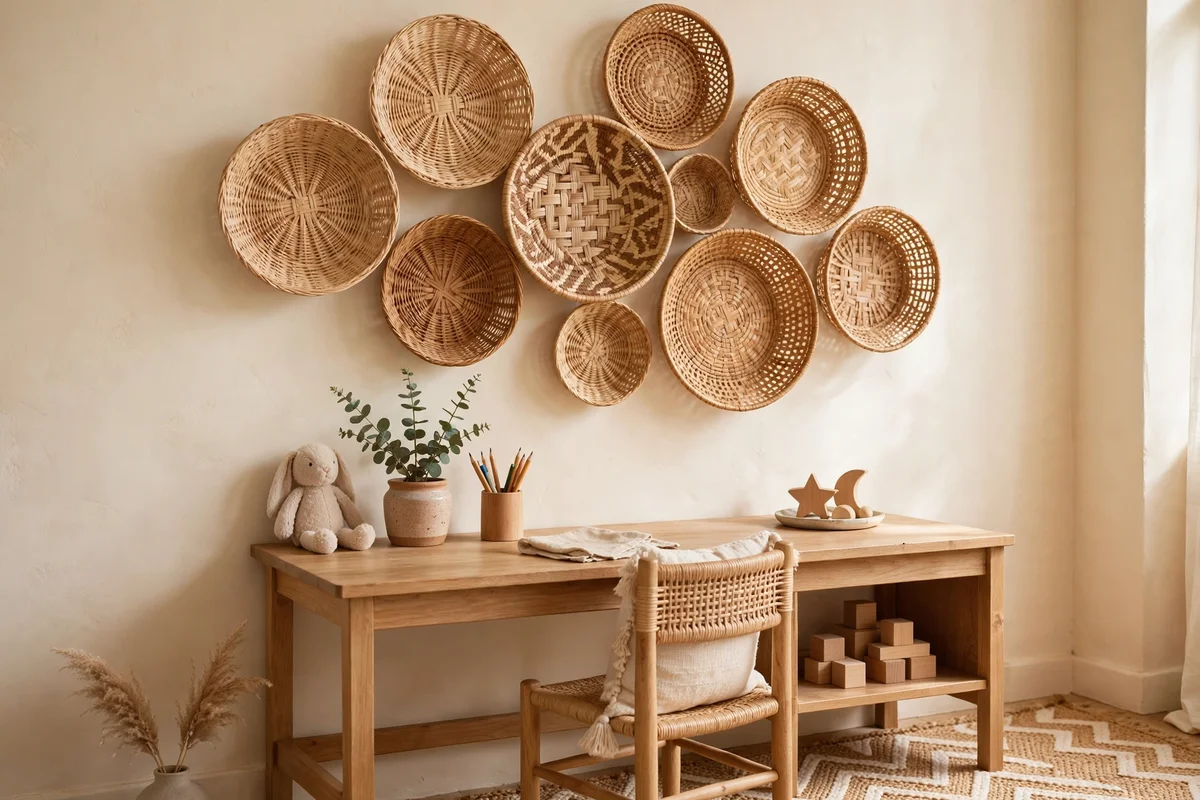
Wall baskets are macramé's bolder cousin: the same natural material, but with shape, shadow, and pattern. A cluster of flat woven baskets in different sizes and tones — natural seagrass, warm tan, a darker woven disc — arranged above the bed, the desk, or the dresser, gives a plain wall dimension that a flat picture never will. The arrangement matters more than the baskets themselves. Start with the largest basket slightly off-centre, build outward with smaller ones, and leave uneven gaps rather than a perfect grid. A perfect grid looks like a shop display. An organic cluster looks collected, which is the whole point.
Buy baskets that are flat or shallow, made for the wall, rather than deep storage baskets hung up as an afterthought — deep baskets stick out, catch dust, and fall off. Fix each one with a proper hook or a small nail, and check the fixings monthly. Wall baskets also solve a real decorating problem: they fill a wide, empty wall above a low bed or a long dresser where a single picture would look lost and a gallery wall would look busy.
8. Display handmade artwork and nature prints
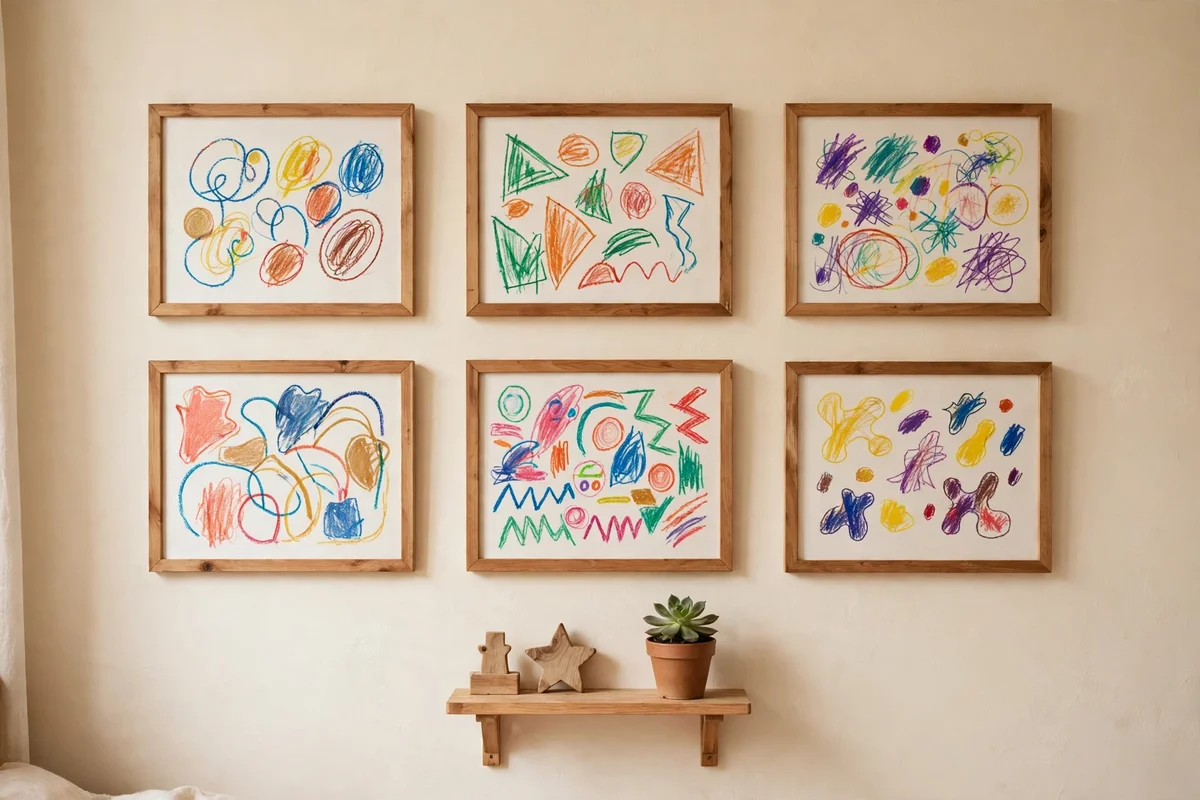
Boho rooms are meant to look personal, and nothing makes a room personal faster than art that belongs to the child who sleeps in it. Frame your child's drawings in simple matching frames — the same frame colour, different art inside — and hang them at your child's eye level, not adult eye level, so the wall belongs to them. Mix in one or two nature prints — mountains, leaves, a woodland animal, a botanical study — to give the display structure and to echo the nature side of boho. A clip frame or a magnetic poster hanger lets you swap the art without tools, which matters when the display changes every few weeks.
The rule that keeps a display of children's art looking designed rather than chaotic is the frame. Matching frames, even cheap ones, turn a pile of drawings into a gallery. Without them, the same drawings look like paper stuck to a wall. Leave one empty frame in the arrangement, so there is always room for the next piece your child is proud of. And keep the display to one wall. Art on every wall competes with itself, and a boho room needs at least one calm wall for the eye to rest on. If your child loves making art and you want more display ideas, our artsy kids room decor ideas cover gallery walls, art ledges, and display systems that grow with a young artist. If animals are the obsession, the nature-print idea pairs naturally with animal-themed bedroom ideas for kids who love wildlife — a single animal print or a wooden animal on a shelf is enough to nod to the theme without turning the room into a zoo.
Bed and textiles
9. Choose soft linen bedding
Bedding is the biggest textile in the room, so it sets the tone more than any cushion or throw. Linen is the boho choice: it looks relaxed even when it is not perfectly smooth, it gets softer with every wash, and its natural texture does half the decorating work on its own. Choose linen or a linen-look cotton in warm neutral shades — cream, natural flax, soft white — and let the colour come from the cushions and the throw instead. A white or cream duvet with a terracotta throw and two sage cushions reads as boho. A patterned duvet in four colours reads as busy, and it fights with everything else in the room.
Linen has one practical drawback: it creases. If creases bother you, a cotton-linen blend gives you most of the texture with fewer wrinkles, and a linen-look cotton is cheaper still. Whatever you choose, make sure it is washable at a normal temperature and that you own two sets, because kids bedding gets washed often and a bed with no clean set is a problem at nine o'clock at night. Keep the bedding mostly plain and let one patterned pillowcase — stripes, a small floral, a simple geometric — be the single pattern on the bed.
10. Layer pillows, throws, and quilts

Layering is the skill that makes a boho bed look inviting rather than just made. Start with the plain linen bedding, add a quilt or a knitted blanket folded across the foot of the bed, and finish with a throw draped over one corner — not folded in a perfect rectangle, but loose, as if someone just put it down. Then the pillows: two sleeping pillows in plain cases, and two or three decorative cushions in front, in different sizes, fabrics, and patterns, all inside your two accent colours. A velvet cushion, a woven cushion, and a small patterned one together give more texture than three matching cushions ever will.
The number matters. Two or three cushions on a single bed is generous. Five or six is a pile that has to be moved every night before the child can get into bed, and within a week the pile will be living on the floor. Keep the decorative cushions small enough for a child to carry, and keep the throw light enough to wash easily. At bedtime, the cushions come off and go into a basket beside the bed — which is also why a basket beside the bed is one of the most useful things in this whole article.
11. Add a canopy above the bed
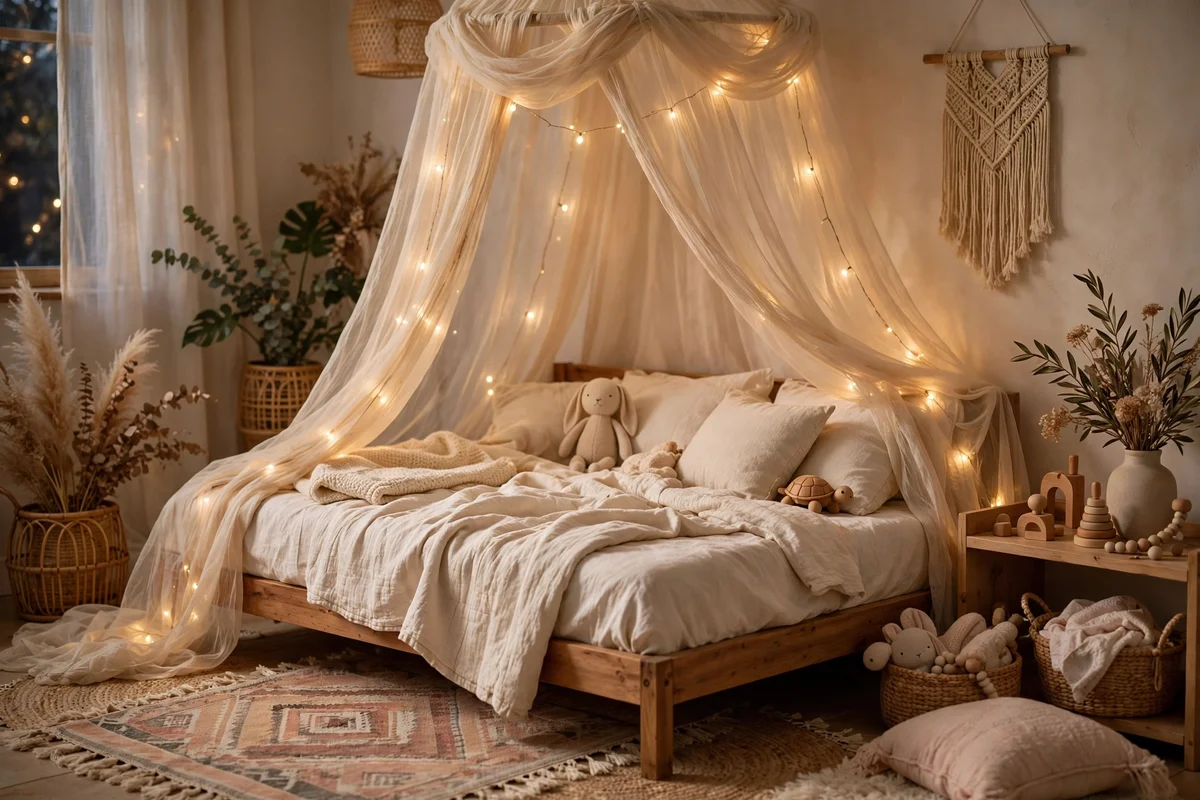
A canopy is the single fastest way to make a plain bed feel magical. Lightweight fabric — cotton voile, muslin, or sheer linen in cream or white — draped from a hoop or a ceiling mount above the bed creates softness and height, and it gives the sleeper a sense of privacy that many children love. It needs no theme and no colour: the fabric itself is the decoration. Hang it so it falls behind and beside the bed rather than across the face, so the child can see out of it and you can see in. And keep it light. A heavy canopy in a dark fabric turns a bed into a tent, and a tent is hot, dark, and hard to check on at night.
Safety comes first with a canopy, as with any fabric hung above a bed. Fix the mount properly into the ceiling or the wall — adhesive hooks are not enough for anything a child might pull. Keep the fabric well away from any lamp or light fitting, and keep cords, ties, and tassels short and out of reach, because anything that can loop is a risk around a small child's neck. Wash it when you wash the bedding — a canopy collects dust fast.
12. Mix patterns carefully
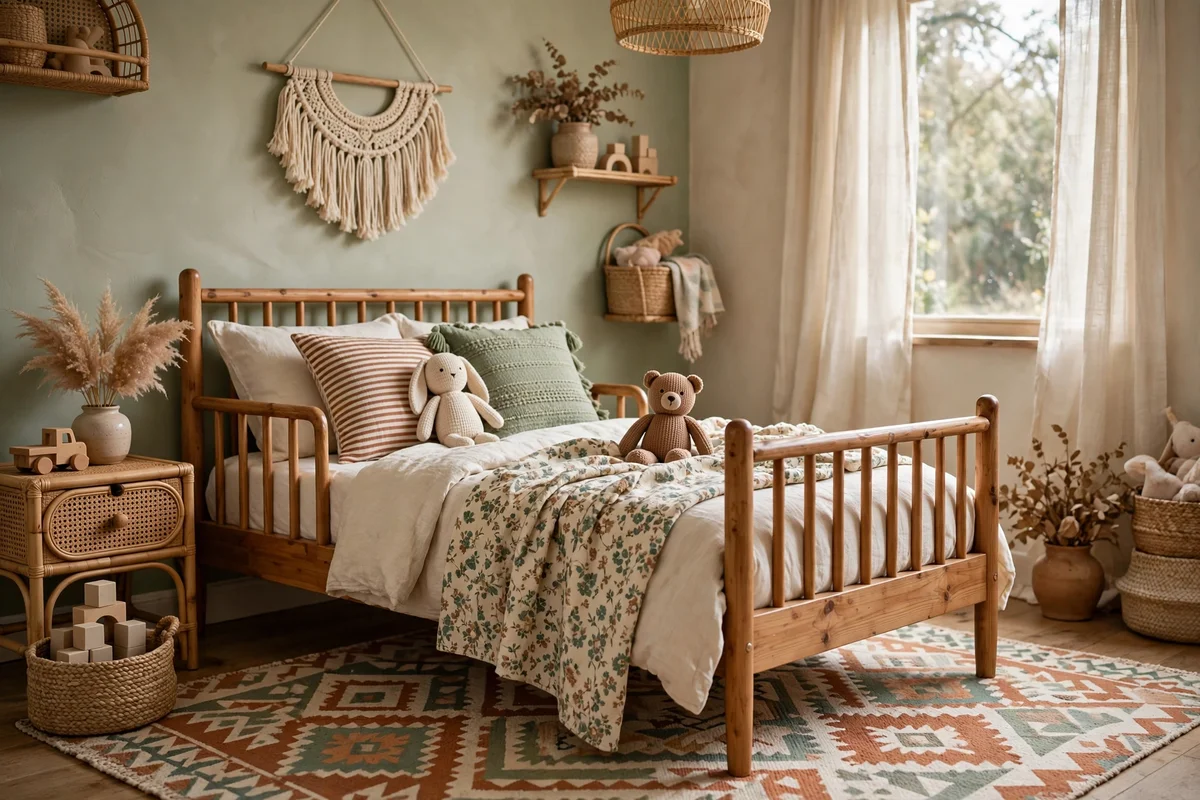
Boho embraces pattern, but it embraces it on a leash. Stripes, florals, geometric prints, and simple tribal-inspired designs can all live in the same room — provided they share a colour palette. A striped cushion, a floral throw, and a geometric rug all work together when every one of them is drawn from the same terracotta, sage, and cream palette. The moment a pattern brings in a colour from outside the palette — a bright blue, a hot pink — the mix starts to argue with itself.
A practical way to mix is the one-pattern rule: one large pattern, one medium pattern, and one small pattern, and nothing else patterned in the room. The rug is usually the large pattern. The bedding or a throw is the medium one. A cushion is the small one. Everything else — the walls, the other cushions, the curtains — stays solid. If you are unsure whether two patterns work together, hold them side by side in daylight. If your eye jumps between them, they are fighting. If in doubt, drop a pattern rather than adding one. A boho room with too few patterns looks calm. A boho room with too many looks restless, and restless is the last thing a bedroom should feel.
Corners and play
13. Create a cozy reading nook
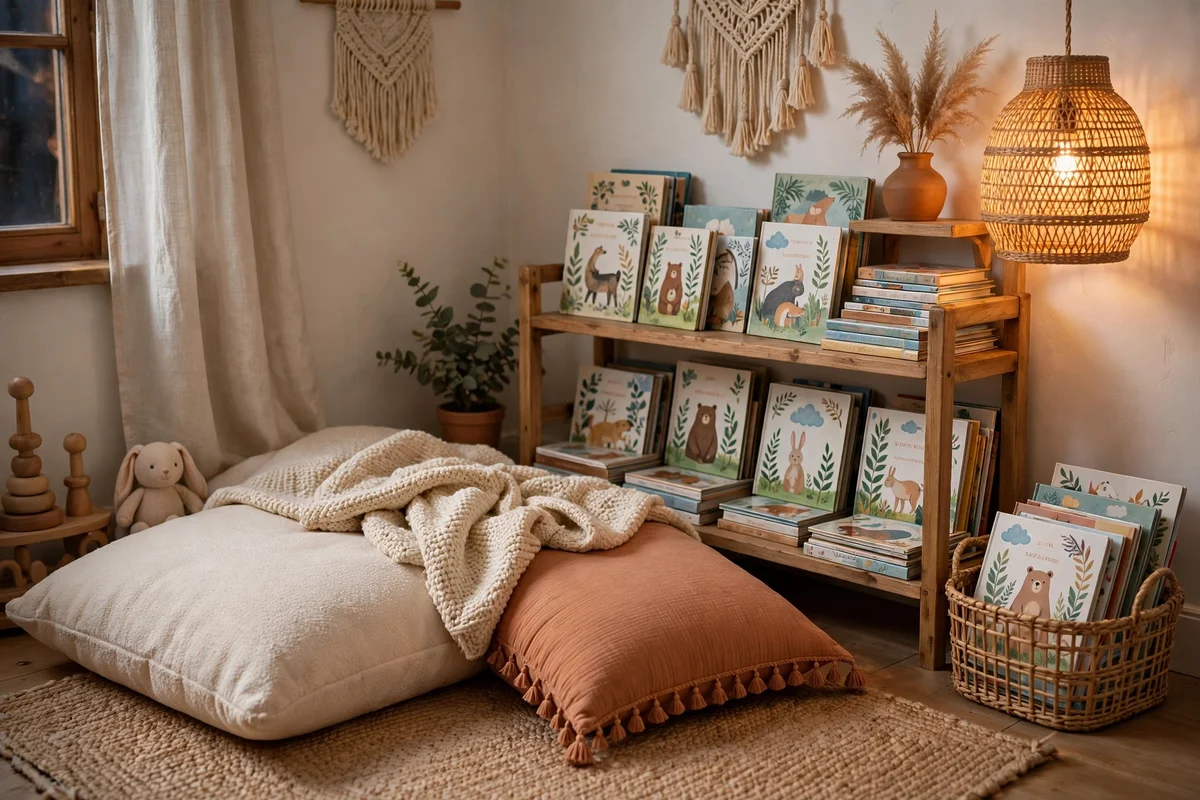
Every boho kids room needs a corner that belongs to quiet time. A reading nook does not need furniture or a budget: a corner of the room, a pile of floor cushions, a soft throw, and a low basket or a small shelf of books within reach. Add a small lamp or a string of warm lights if the corner is dark, and a rug underneath so the floor is comfortable to sit on. That is the whole nook. The reason it works is that it is defined — a child can see where the reading place starts and ends — and low, so a small child can get into it without help and without climbing.
Place the nook in the quietest corner of the room, away from the door and away from the toy storage, because a reading corner next to the toy box becomes a second play area within a week. Keep the book selection small and rotate it: ten books on the shelf, the rest in a basket elsewhere, swapped every few weeks. A shelf groaning with books looks impressive and gets ignored; a small shelf with ten books gets read. And let the child help build it. A nook a child helped arrange is a nook they will actually use. For more ways to shape a corner like this, see our cute bedroom corner ideas for kids — the same corner can hold a reading nook, a small desk, or a display shelf, and the article covers which corner suits which use.
14. Build a floor seating area
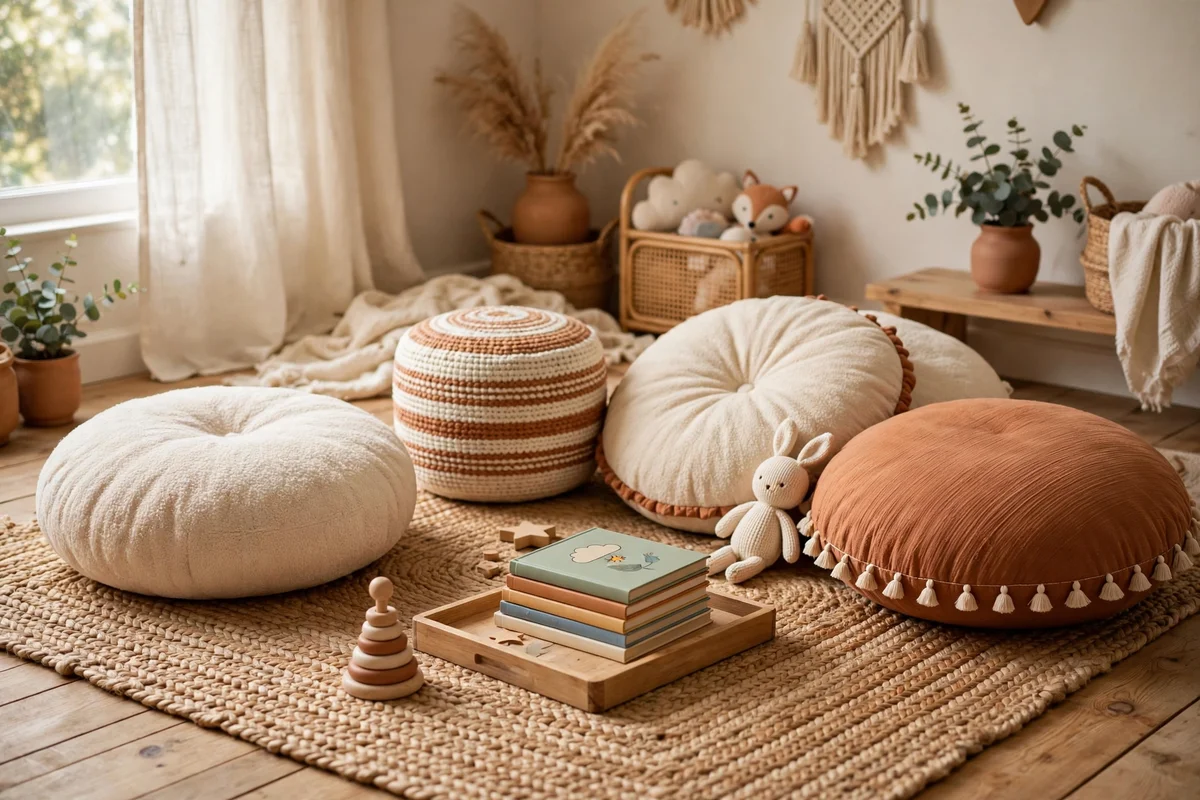
Not every child wants to sit on a chair, and boho is the style that takes that seriously. A floor seating area — large floor cushions, a woven pouf or two, and a low tray or a small table for books and drawing — gives a child a place to sit, sprawl, and play that feels relaxed rather than formal. It is also the most flexible seating in the house: cushions can be dragged to the reading nook, stacked for a game, or lined up for a friend who comes over. Choose cushions with removable, washable covers in your palette, and fill them firmly enough that they hold their shape. A flat cushion is a mat, not a seat.
Keep the floor seating on the rug, not on bare floor, and keep it away from the bed, or the cushions will migrate onto the bed and stay there. One pouf and two or three large cushions is enough for most rooms; more than that and the floor disappears. This is also the area where a low table earns its keep: a tray on short legs, or a small wooden table at floor height, gives a child somewhere to draw, do a puzzle, or eat a snack without balancing things on their lap.
15. Set up a teepee play space
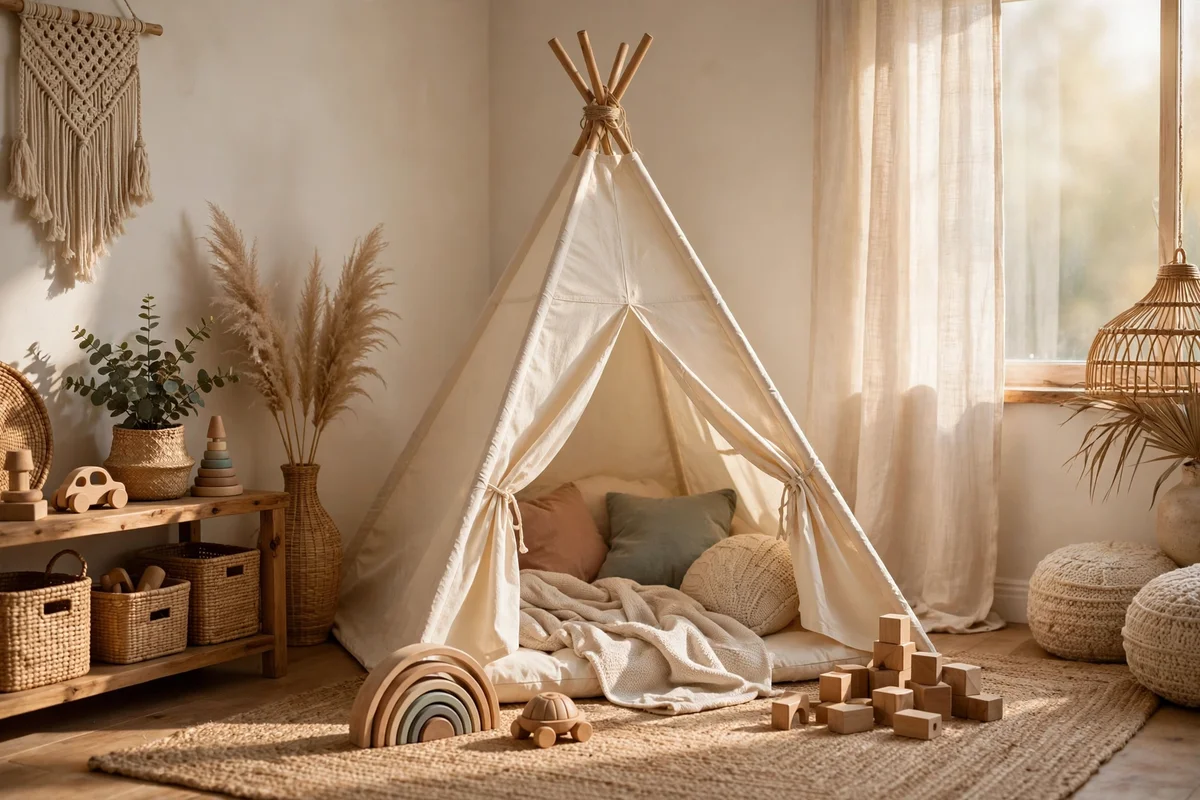
A teepee is the boho play space: a canvas tent in cream or natural cotton, set up in a corner with cushions and a soft blanket inside, that gives a child a hideaway of their own. Children use it for reading, quiet play, and imaginary adventures, and it adds a layer of texture and height to the room that no other single piece provides. Choose a teepee that stands on its own poles without needing to be tied to a wall, and place it where it does not block the door, the window, or the route to the bed. A teepee that has to be walked around becomes an obstacle within days.
Keep the inside simple: two cushions, one blanket, and a small basket of books or soft toys. A teepee stuffed with toys becomes a storage cupboard, not a hideaway, and a child will stop going inside it. Check the poles regularly — they loosen with use — and make sure the fabric is washable or at least wipeable, because the inside of a teepee gets grubby fast. And be honest about the size of the room: a teepee needs roughly a square metre of floor plus space to get in and out. In a very small room, a canopy over the bed gives the same hideaway feeling without taking any floor at all.
16. Add a hanging chair
A hanging chair is the piece children fight over. A woven macramé or rattan chair, hung from a ceiling beam or a sturdy stand, becomes the favourite spot in the room within a day: a place to read, to daydream, and to swing gently while thinking. It adds a playful element without making the room feel childish, and it suits every age from toddler to pre-teen, which is rare for a single piece of furniture. If the ceiling cannot take the weight, a freestanding stand does the same job and can be moved when the room changes.
Safety is not optional here. A hanging chair must be fixed to a ceiling joist or a beam, never to plasterboard alone, and the fixings must be rated for far more than the child's weight, because children swing. If you are not confident about the fixing, use a stand, or ask someone who is. Keep the chair away from walls and furniture a swinging child could hit, and put a rug underneath, both for comfort and to soften a fall. And check the weight limit as your child grows — a chair that held a five-year-old may not hold a ten-year-old. Bought and hung properly, a hanging chair is the one boho piece that children will genuinely miss when it eventually goes.
Storage, light, and finishing touches
17. Use woven storage baskets

Storage is where boho rooms usually fail, because baskets look beautiful and fill up fast. The fix is to give every basket a job and a limit. One large basket beside the bed for the bedtime cushions and the throw. One medium basket in the reading nook for books. One large basket for soft toys, and one for dress-up clothes. When a basket is full, something comes out before anything else goes in. That rule, enforced for a month, is worth more than any storage system you can buy.
Choose baskets in natural materials — seagrass, rattan, cotton rope — in sizes a child can actually carry when they are empty, and with handles a small hand can grip. Open baskets work better than lidded ones in a kids room, because a lid is a barrier a child will not bother with: toys go on the floor instead of under the lid. Keep baskets on the floor or on low shelves, never on high shelves a child cannot reach, and never use a basket with a lid for anything a child needs independently. A row of three matching baskets along a wall looks intentional.
18. Mix old and new furniture
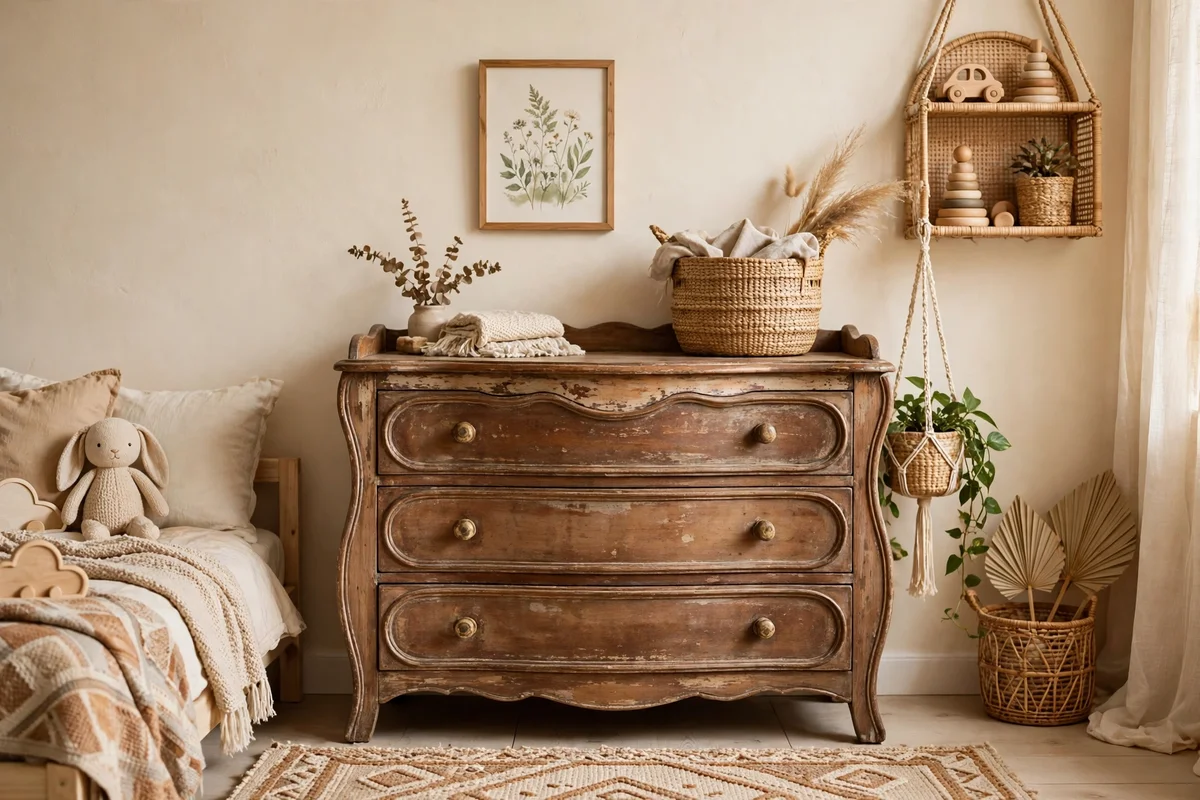
A boho room should look collected over time, not delivered in one go, and the easiest way to get that feeling is to mix old and new. A vintage-inspired dresser with curved edges or a weathered finish beside a new wooden bed. A flea-market chair re-covered in a plain linen slipcover. A modern bookshelf holding a basket your grandmother used. The mix gives the room depth and a story, and it is usually cheaper than buying everything new. It also teaches a child, quietly, that old things have value — a lesson that lasts longer than any decorating trend.
The mix works when the old and the new share something: the same wood tone, the same palette, or the same simplicity of shape. A dark mahogany dresser next to pale pine furniture will clash, but a pale vintage dresser next to a pale new bed will look like they were always together. If a secondhand piece is the wrong colour, sanding it back to bare wood or giving it a wash of the wall colour usually fixes it in an afternoon. Check every secondhand piece for safety before it goes into a child's room: no peeling paint, no loose joints, no sharp edges, and nothing that cannot be anchored to the wall if it is tall enough to climb.
19. Add plants — real or not — safely
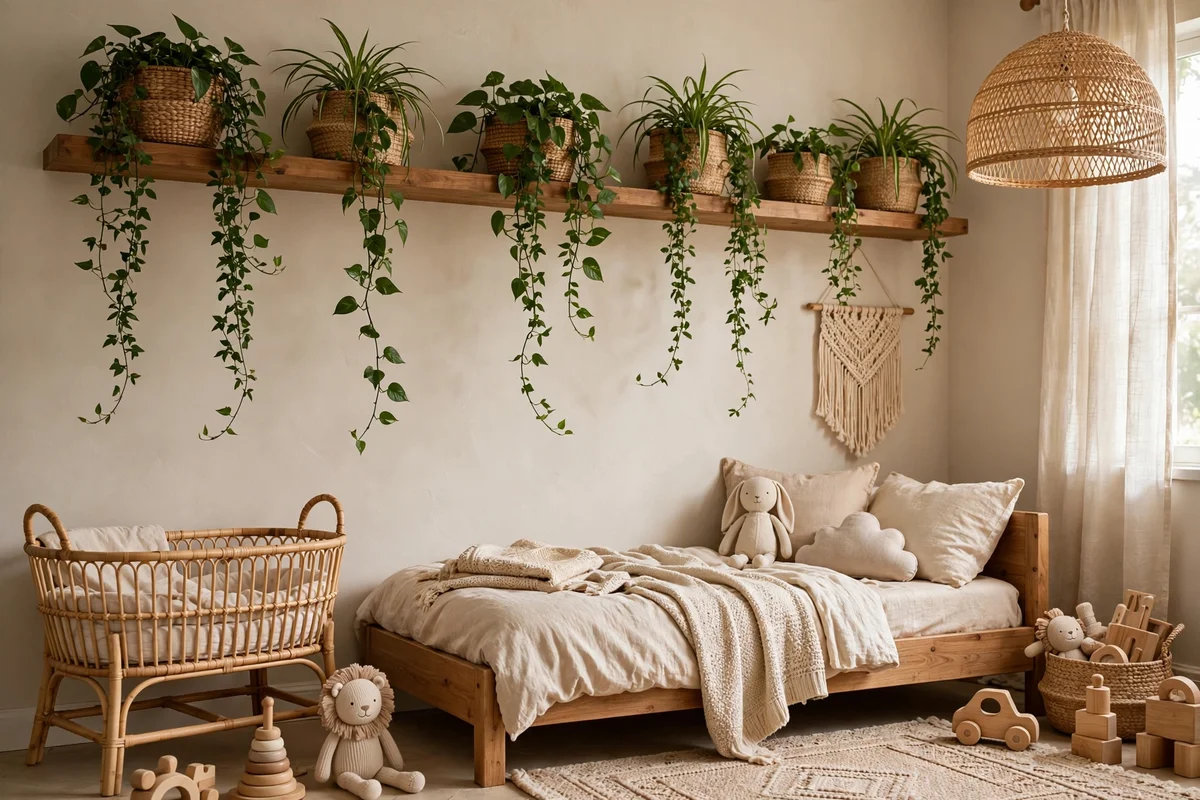
Plants bring a boho room to life in a way nothing else can: green against cream and terracotta, trailing leaves softening a shelf, a small potted plant on a desk. But a kids room is not a greenhouse, and the safety rules matter more than the look. Choose child-safe, non-toxic varieties, keep real plants on high shelves or hanging planters well out of reach of small children, and never put a plant within reach of a cot or a toddler's bed. A child who can reach a plant will pull it down, eat the soil, or both. If you are unsure whether a plant is safe, use a good-quality faux plant instead. Modern faux plants look convincing from a metre away, need no watering, and cannot be eaten.
Faux plants also solve the light problem: a dark corner that would kill a real plant holds a faux one happily. Mix the two if you like — a real plant on the windowsill where it gets light, faux trailing plants on a high shelf — and keep the pots in your palette: terracotta, cream ceramic, or woven basket covers. One or two plants are enough. And keep the watering can out of reach, because a child with a watering can and a rug is a flood waiting to happen.
20. Layer curtains and string lights

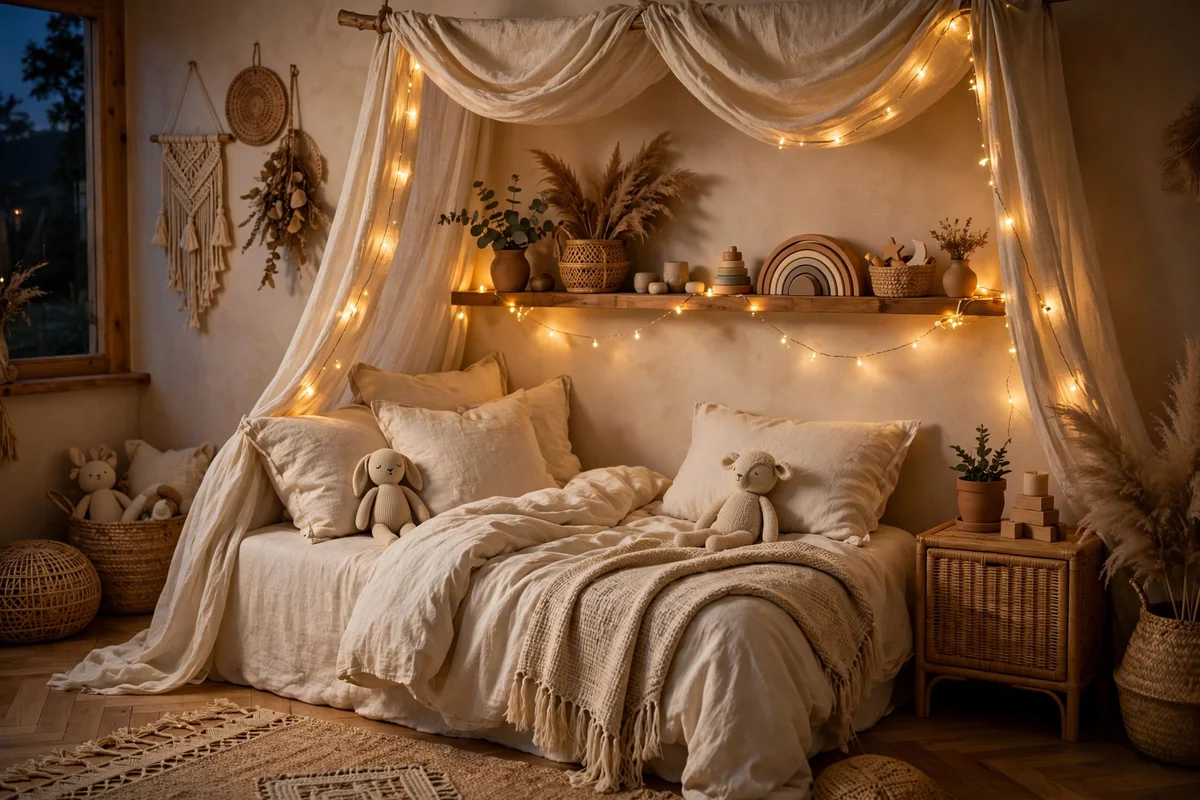
The last layer of a boho room is the light, and it is the layer that changes the room most after sunset. Start with the curtains: sheer white or cream curtains under heavier linen panels in a warm neutral. The sheers soften the daylight and give privacy during the day; the heavier panels close at night and add texture to the wall. Hang the curtain rod higher than the window frame and wider than the window itself, so the curtains frame the window rather than covering it, and let them fall to the floor — short curtains look unfinished in a boho room.
Then the evening light. Warm string lights — warm white, never cool white or coloured — draped along a shelf, around a canopy, or across the reading corner, give the room a gentle glow that makes bedtime feel calm rather than abrupt. Battery-operated lights with a timer are the safest choice: no trailing cables, and they switch themselves off. Keep the lights out of reach of small children, keep them away from fabric canopies and curtains, and never leave them on overnight. One set is enough — the goal is a soft glow, not a light show.
Small Rooms, Shared Rooms, and Nurseries
A small room needs boho to work harder and take up less space. Choose the earthy neutral direction, because pale walls and light wood make a small room feel bigger. Use the layers on things that already have to be there: the rug under the bed, the throw on the bed, the baskets that hold the toys. Skip the teepee and the hanging chair in a very small room — both need floor space the room cannot spare — and get the hideaway feeling from a canopy over the bed instead. Keep at least one wall completely plain, so the room has somewhere for the eye to rest. A small room with every wall decorated feels smaller, not cosier.
A shared room needs a boho scheme both children can live with, and a way for each child to have their own colour inside it. A neutral base — cream walls, light wood, a plain rug — works well here, because it belongs to neither child. Give each child one signature colour inside the shared palette: one child's bedding in sage, the other's in dusty rose, while the baskets, throws, and wall art use both colours together. If the beds are on opposite walls, each bed wall can carry its own small accent — a macramé piece in one child's colours, a cluster of wall baskets in the other's — with the shared wall kept neutral. Colour-coded baskets end most arguments about whose toys are whose. And give each child one shelf or one basket that is theirs alone, not shared, because a shared room still needs a private corner.
A nursery boho room should be soft and low. Pale walls, a plain linen cot sheet, a jute rug beside the cot, and one gentle feature — a macramé hanging well out of reach, a row of soft wall baskets, or a nature print — are enough. Keep the wall behind the cot plain or very pale, because strong colour behind a baby's head is stimulating at exactly the time you want calm. Everything within reach of the cot should be washable and firmly fixed, and nothing with cords, tassels, or loose fabric should hang above or beside it. A nursery boho room is also the one most worth choosing with the next five years in mind: a cream wall, light wood, and a sage accent work for a baby and still work for a five-year-old, while a themed wall does not. For the youngest children, our baby girl room ideas cover the nursery-age details — cot placement, soft colours, and the pieces that carry over into the toddler years.
Boho Rooms by Age
A toddler room can be softer and lower, because toddlers use the room for play as much as sleep. Low furniture, a floor bed with a canopy or a soft rug beside it, floor cushions at toddler height, and baskets they can reach themselves all suit this age. Keep the decoration above their reach and the playthings below it: wall baskets high, toy baskets low. Avoid anything with cords, long tassels, or small detachable parts within reach, and keep plants and string lights well out of the way. The dangerous things go high and the fun things go low.
A school-age child's room can carry the fullest version of boho, because the child can tell you what they like and what they have outgrown. This is the age for the reading nook they helped build, the teepee, the gallery wall of their own art, and the hanging chair. It is also the age to involve them in the work: a school-age child can help choose between two cushions, arrange the wall baskets, and pick which drawings go in the frames. Let them choose between options you have already approved — "terracotta or sage?" — rather than facing the whole shop, and the room will feel theirs without becoming a colour you regret.
A pre-teen's room needs the boho to feel grown-up, not themed. Earthy neutrals, natural wood, a rattan chair, a macramé hanging, and one bold accent colour all work, because they read as design rather than decoration. This is the age where a teepee and a wall of rainbow cushions start to feel young, and where the room should be chosen so it can stay for several years. If the room will need to change within two years, choose textiles over furniture and decals over wallpaper: a room that can change with new cushions and a new throw is a room you will never regret. When the time comes to make the room feel older and bigger, our big kids room ideas cover the transition — larger beds, desk space, and storage that suits a child who is growing fast.
A Weekend Plan: Saturday and Sunday
A boho kids room does not need a month of planning. It needs a clear order, because buying cushions before you have chosen the palette, or hanging macramé before you have painted, creates the rework that eats weekends.
On Saturday morning, choose the style direction and the two accent colours, measure the room, and buy only what is on the list: paint if the walls need it, the large rug, the bedding, and any furniture. Move the furniture away from the walls, protect the floor, and do the messy work — paint the walls, hang the curtain rod, fix the shelves and the wall baskets, and anchor any tall furniture to the wall. While the paint dries, wash the new bedding and cushion covers so they are ready for Sunday. Do not try to hang art or arrange cushions while paint is wet; it will get marked.
On Sunday, put the room back together in this order: bed and bedding first, then the rugs, then the large furniture, then the baskets and storage, then the textiles — throws, cushions, curtains — and the wall art and macramé last. Art goes last because it is the easiest thing to move, and you will only know where it belongs once the furniture is in place. Finish by walking to the door and looking at the room as a visitor would — the view from the door is the one you see every day. If it looks busy, take one thing out and look again. Boho rooms are finished by taking things away, not by adding more.
Budget: Three Price Levels
A boho kids room does not have to be expensive. The difference between the three levels below is how much is painted and how much is bought new, not how good the result looks.
A refresh under $50 uses what you already own plus a few soft things: a set of cushion covers in your accent colours, a throw, a basket or two, and a tin of warm white paint if the walls need it. Rearrange the furniture, layer the rugs you already have, and frame three of your child's drawings. The room changes without any new furniture, and it takes an afternoon.
A mid-level refresh, roughly $50 to $200, adds the pieces that make the biggest difference: a large jute rug, a set of linen or linen-look bedding, a macramé hanging, a rattan chair or a set of wall baskets, and a pair of layered curtains. This is the level most families choose, because it changes the room properly without changing the furniture.
A full redo, $200 and up, adds a rattan bed frame, a vintage dresser, a teepee or a hanging chair, and a full set of layered textiles. This is worth doing when the room is being redecorated anyway — a new bed, a move, or a child moving into a bigger room — rather than as a standalone project. If you are spending at this level, spend it on the things that are hardest to change later: the bed, the rug, and the large furniture. Cushions, throws, and wall art can always be upgraded later, one piece at a time.
Whatever the budget, buy the textiles after you have chosen the palette, not before. A cushion bought because it was pretty and on sale is the most common way a boho room ends up with five colours instead of two. And buy secondhand first: a boho room built from a flea-market dresser, a basket from a charity shop, and a rug found online will look more collected — and cost far less — than the same room bought new in a single trip.
Mistakes That Make Boho Rooms Look Wrong
The most common mistake is too much stuff. Boho embraces layers, but layers are not clutter. A room with a rug on a rug, five cushions, three throws, four baskets, two macramé pieces, and a wall of baskets has stopped being layered and started being crowded. Leave open space: bare floor around the rugs, a plain stretch of wall, a clear top on the dresser. The empty space is what makes the layered parts look deliberate.
The second mistake is too many colours. A boho palette is two accents and a neutral base. A third accent can work if it is used in one place only — a single mustard cushion in a terracotta and sage room — but a fourth colour, or the same colour in five different shades that do not match, turns the palette into noise. If the room feels wrong and you cannot say why, count the colours. There are usually too many.
The third mistake is pattern fighting pattern. A patterned rug plus patterned bedding plus a patterned throw plus patterned cushions is four patterns arguing. Pick one patterned piece — the rug or the bedding — and keep the rest solid colours drawn from the same palette. Solid colours let the pattern breathe, and the room feels calm instead of busy.
The fourth mistake is ignoring safety and function. A macramé hanging a child can grab, a tall shelf that is not anchored, a plant a toddler can reach, a canopy with long cords, or string lights draped over fabric are all decorations that create risk. And a room with beautiful baskets a child cannot open, or a reading nook with no light, is a room that looks good in a photograph and does not work on a Tuesday. Decorate the room your child actually lives in, not the room in the picture.
The fifth mistake is buying everything at once. A boho room bought in a single trip looks like a showroom, because every piece is new, matching, and from the same shop. Buy the big things first, live with the room for a few weeks, and then add one piece at a time. The room will look better, and you will spend less on things you later regret.
How to Let the Room Grow Up With Your Child
The best boho rooms are built to be undone in stages. When your child outgrows the theme, change the cheap things first: swap the rainbow cushions for plain ones in a single accent colour, take down the teepee, replace the themed prints with nature prints or plain art, and change the throw. That alone removes most of the young feeling, and the room will already feel older.
If that is not enough, repaint the accent wall in a single colour drawn from the old palette — sage, warm cream, or soft terracotta — and keep the wooden furniture, the rattan chair, and the baskets. The storage and the bookshelf can stay, because they were never really part of the theme.
The expensive reversals are the rattan bed frame and the full-room repaint, which is why the bed and the walls should be chosen in the calmest version of the style you like. A cream wall and a light wooden bed can carry a toddler's rainbow cushions and a pre-teen's plain linen with equal ease. A room that can change with new textiles is a room you will never regret, and it is the reason boho, done well, lasts longer than almost any other kids room style. If you want a broader view of how kids rooms change as children grow, the aesthetic kids room ideas guide shows how the same calm base carries different looks at different ages.
Frequently Asked Questions
What colours go in a boho kids room?
Warm neutrals for the base — cream, ivory, beige, soft white — and two earthy accents, such as terracotta and sage, rust and mustard, or dusty rose and sage. Keep every colour muted rather than bright, and repeat the two accents through the room in the rug, the bedding, and the cushions, so the palette looks planned rather than random.
Is boho good for a small kids room?
Yes, and the earthy neutral version suits a small room best. Pale walls, light wood, layered rugs, and soft textiles make a small room feel calm and bright rather than cramped. Skip the teepee and the hanging chair if floor space is tight, and get the cosy feeling from a canopy over the bed and a reading nook in the corner instead.
How do I do a boho kids room on a budget?
Start with paint and textiles. A tin of warm white paint, cushion covers in your accent colours, a throw, and a couple of woven baskets can change a room for under $50. Add a large jute rug and linen bedding next, in the $50 to $200 range. Buy furniture secondhand, and add one piece at a time rather than buying everything in a single trip.
Are plants safe in a kids room?
They can be, with rules. Choose child-safe, non-toxic varieties, keep real plants on high shelves or in hanging planters out of reach of small children, and never put a plant within reach of a cot or a toddler's bed. If you are unsure about a plant, or the room is dark, use a good-quality faux plant instead — it looks convincing, needs no water, and cannot be eaten.
How do I keep a boho kids room from looking cluttered?
Leave open space on purpose: bare floor around the rugs, a plain stretch of wall, a clear dresser top. Give every basket a job and a limit, keep the palette to two accents, and follow the one-pattern rule — one large pattern, one medium, one small, and everything else solid. If the room looks busy, take one thing out and look again.
Can a boho room work for a boy?
Yes. Boho is built on natural materials, warm colours, and layered textures, and it suits any child. Earthy neutrals with a sage or rust accent, natural wood furniture, and a woodland or desert direction all work. Let the child's interests choose the accents, not the label on the style.
What is the easiest first step?
Paint the walls warm white if they need it, lay a large natural-fiber rug, and put plain linen bedding on the bed with two cushions in one accent colour. Those three changes — walls, rug, bedding — set the whole room, and everything else in this article layers on top of them.
Final Checklist Before You Start
- Pick your boho direction — earthy neutral, desert, woodland, or soft rainbow — and write it down in one sentence.
- Choose two accent colours and a neutral base, and test swatches in daylight and lamplight.
- Measure the room and the bed wall, and note where the sockets, windows, and doors are.
- Anchor tall furniture to the wall before anything else goes on the shelves.
- Buy the rug and the bedding first; cushions, throws, and wall art come after.
- Keep plants, string lights, and anything with cords out of reach of small children.
- Give every basket a job and a limit — when it is full, something comes out first.
- Leave at least one wall completely plain, and leave bare floor around the rugs.
- Live with the room for a few weeks before adding the next piece.
A boho kids room does not need to be perfect, and it does not need to be finished in one go. Start with the walls, the rug, and the bed, add the baskets and the storage, and let the art and the handmade pieces grow over time. The rooms children love most are rarely the ones with the most decoration — they are the ones where the bed is comfortable, the books are within reach, the toys have a home, and there is a quiet corner to sit in. Get those four things right, and the boho layers take care of themselves.