Blue Kids Room Ideas
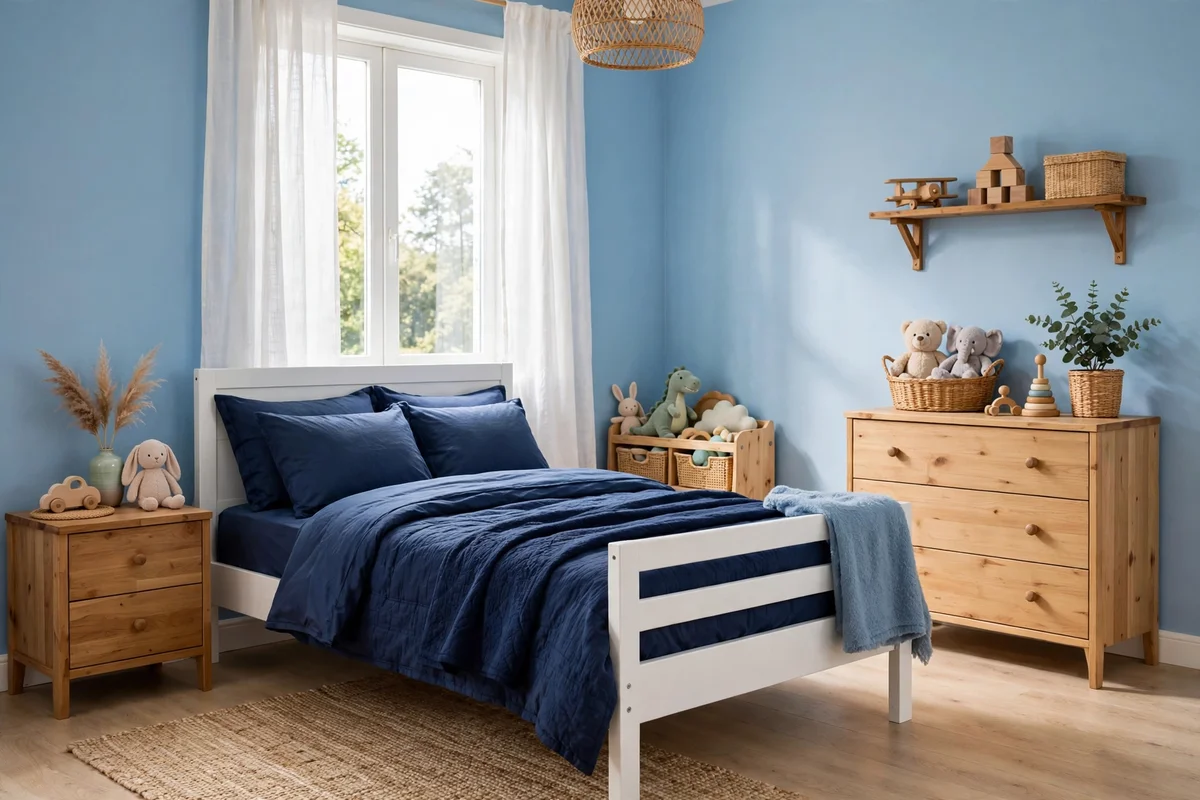
Blue is the colour parents reach for most in a kids room, and it is easy to see why. It feels calm at bedtime and cheerful in the morning, it suits toddlers and teenagers alike, and it works with almost everything a room already has — white furniture, natural wood, grey bedding, colourful toys. A blue room rarely looks like a mistake, which is more than can be said for most colours. The risk with blue is not that it goes wrong, but that it goes boring: four walls of the same flat blue, a matching blue duvet, and nothing else to look at. The ideas below avoid that by treating blue as a family of shades, not a single colour, and by spreading it around the room in paint, fabric, wood, and light.
The short version: pick one blue first — sky blue for a bright room, dusty blue for a calm one, navy for a bold one — and use it on the biggest surface, usually the walls or the bed. Then repeat that same blue twice more in smaller things, like a rug and a cushion, and add a second, lighter blue so the room has depth. Warm the whole scheme up with natural wood, because blue on its own can feel cold. The ideas below are arranged in the order most parents actually use them: how to pick your blue first, then the three rules that keep a blue room from looking flat, then the twenty ideas grouped by walls, bed, zones, storage, and finishing touches, then the practical parts — small rooms, shared rooms, ages, budgets, and the mistakes that make a blue room look wrong.
Pick Your Blue First
Every blue room starts with one decision, and it is worth making before you buy anything: which blue is the main one. The shade you choose sets the mood of the whole room, and it decides what the other colours in the room need to do. A room built around sky blue feels bright and open, a room built around navy feels cosy and dramatic, and a room built around dusty blue feels quiet and restful. None of them is better than the others. The right one is the one that suits the room you have and the child who sleeps in it.
Start with the light. A south-facing room with big windows can carry a deep navy or a rich teal without feeling dark, because the daylight balances it. A north-facing room, or a small room with one small window, needs a lighter blue — sky blue or powder blue — because a dark blue in a dark room can feel heavy by the afternoon. Stand in the room at the time your child actually uses it most, usually late afternoon and early evening, and look at the light then, not at noon. The evening light is the light the room has to work in.
Then think about what is already in the room. Blue pairs naturally with white and with natural wood, so a room with a white bed and a wooden dresser is already halfway to a blue scheme. Blue also pairs well with grey, which softens it, and with warm colours like mustard, terracotta, and soft coral, which stop it feeling cold. If the room already has a rug, curtains, or bedding you plan to keep, hold your blue swatches against them. A blue that looks perfect on a paint chart can clash with a rug you already own, and it is always easier to change a paint shade than to replace a rug.
Involve your child in the choice, but keep it simple. Show them three blues — a light one, a mid-tone one, and a dark one — and let them pick a favourite. Three choices is enough for a real opinion without turning the decision into an argument. If they pick navy and the room is small and dark, you can still use their navy, just on one wall or on the bedding, with a lighter blue on the other walls. The child gets their colour, and the room still gets its light.
Blue also works as the accent in an otherwise calm palette, which is worth remembering if a whole blue room feels like too much. White walls, pale wood, and a soft neutral rug can carry a room on their own, with blue doing the interesting work in the bedding, the cushions, and the art. That approach suits families who like a quieter look, and it is the easiest blue room to change later, because only the textiles need swapping. For more on keeping a kids room calm and uncluttered while still giving it personality, see Aesthetic Kids Room Ideas.
Test your chosen blue on the wall itself before you commit. Paint three patches, each at least as big as a sheet of paper, on the wall that will carry the colour, and look at them in daylight and again under the bedroom lamp at night. Blue shifts more between those two lights than most colours do: a dusty blue that looks soft at noon can turn grey at bedtime, and a navy that looks rich in daylight can turn almost black under a warm bulb. If a shade looks wrong in either light, try a lighter or warmer version of the same blue rather than jumping to a different colour altogether.
Three Rules for a Blue Room That Does Not Look Flat
Blue rooms go flat for the same three reasons, and all three are easy to avoid once you know them. The first rule is that one blue leads. Pick a main blue and let it be the biggest blue in the room — on the walls, or on the bed, or on the largest piece of furniture. Every other blue in the room is a supporting shade, lighter or darker than the main one, and used in smaller amounts. When two blues are the same size and the same strength, they compete, and the room looks like two half-finished ideas instead of one finished one.
The second rule is to repeat your main blue three times. Once is an accident, twice is a coincidence, and three times is a plan. If the walls are sky blue, repeat that sky blue in the bedding and again in the rug, or in the curtains and a cushion. The repeats do not need to match exactly — a sky blue wall, a slightly deeper sky blue throw, and a pale sky blue cushion all read as the same family. What matters is that the eye finds the colour in more than one place, so the room feels connected. Use different materials for the repeats — paint, fabric, wood, paper — because the same colour in different textures looks richer than the same colour in the same material three times over.
The third rule is to warm blue up with wood. Blue is a cool colour, and a room with blue walls, white furniture, and grey bedding can feel cold, especially in winter and in a north-facing room. Natural wood fixes that: a wooden bed frame, a wooden dresser, a wooden bookshelf, or even a woven basket adds the warmth the blue is missing. The wood does not need to be dark — pale pine and light oak work just as well as a deep walnut, and they keep the room feeling bright. If the room has no wood at all, a woven rug, a rattan basket, or a cork pinboard can do the same job. The point is that something warm and natural sits next to the blue, so the room feels lived in rather than painted.
A useful test once the room is done: stand in the doorway and count the blues. You should be able to see your main blue in three places, a lighter or darker blue in at least one more, and something warm — wood, cream, mustard, terracotta — in at least two. If you can only see one blue, add a cushion or a throw in a second shade. If you can see five blues and no warm colour at all, take one blue thing out and put a wooden basket or a cream cushion in its place. Small adjustments like these are what separate a blue room that feels designed from one that just happens to be blue.
Five Blue Shades: Which One Suits Your Room?
Not all blues behave the same way on a wall. A sky blue that makes a small room feel bigger can look washed out in a bright room, and a navy that looks dramatic behind a white bed can swallow a small room whole. The table below compares the five shades used most in kids rooms, so you can match the shade to the room you actually have rather than the room in the photograph.
| Shade | Best for | Watch out for |
|---|---|---|
| Sky blue | Small rooms, nurseries, north-facing rooms; feels bright and open | Can look pale and washed out in very bright, south-facing rooms |
| Dusty blue | Calm bedrooms, reading corners, rooms that need to feel restful | Can turn grey under warm lamplight, so test it at night |
| Navy | Big rooms, accent walls, older children; adds drama and depth | Darkens a small or north-facing room; needs white or wood to balance it |
| Teal | Playrooms, modern rooms, children who want something bolder than blue | Can clash with warm reds and oranges, so keep the rest of the palette cool or neutral |
| Powder blue | Nurseries, shared rooms, very light and airy looks | Shows scuffs and marks easily, so use washable paint and keep it off the lowest part of the wall |
If you cannot decide between two shades, use both. A dusty blue wall with navy bedding, or a sky blue wall with a teal cushion, gives the room the depth that a single shade cannot. Just remember the first rule: one blue leads, and the other supports it. And if the room is shared by two children, a mid-tone dusty blue or powder blue is usually the safest main shade, because it is the easiest for two different tastes to agree on.
20 Blue Kids Room Ideas
Walls
1. Paint the walls sky blue
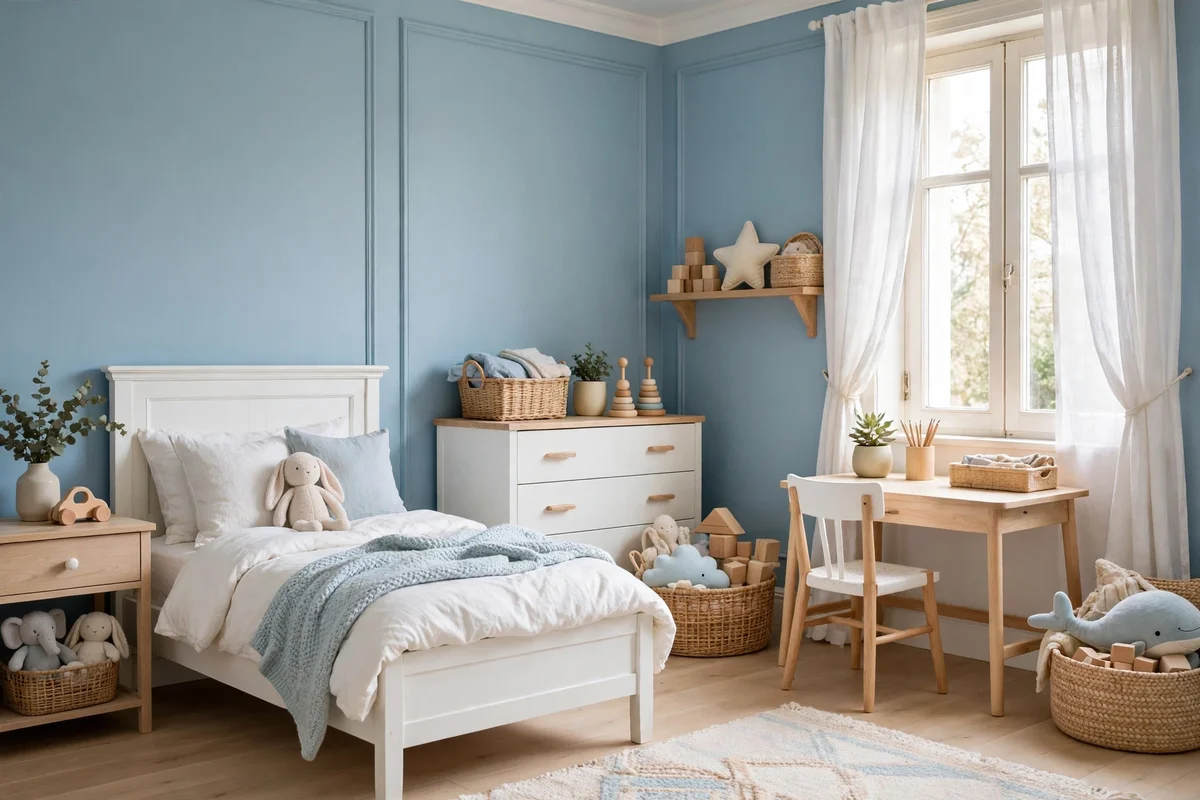
Sky blue walls are the simplest blue room there is, and often the best one. A soft, clear sky blue makes a room feel bigger and brighter, which is why it suits small rooms and north-facing rooms so well. It also suits a nursery or a young child's room, because it reads as fresh and gentle rather than themed, and it will still look right when that child is several years older. Paint all four walls the same shade if the room is small — a single colour on every wall makes a small room feel calmer and more spacious than a feature wall does. Use a washable, low-sheen paint, because walls at a child's height get touched, leaned on, and bumped by toys. Keep the furniture white or pale wood, and let the bedding carry the next shade of blue, so the walls stay the lightest blue in the room and everything else sits a little deeper against them.
2. Paint one navy accent wall
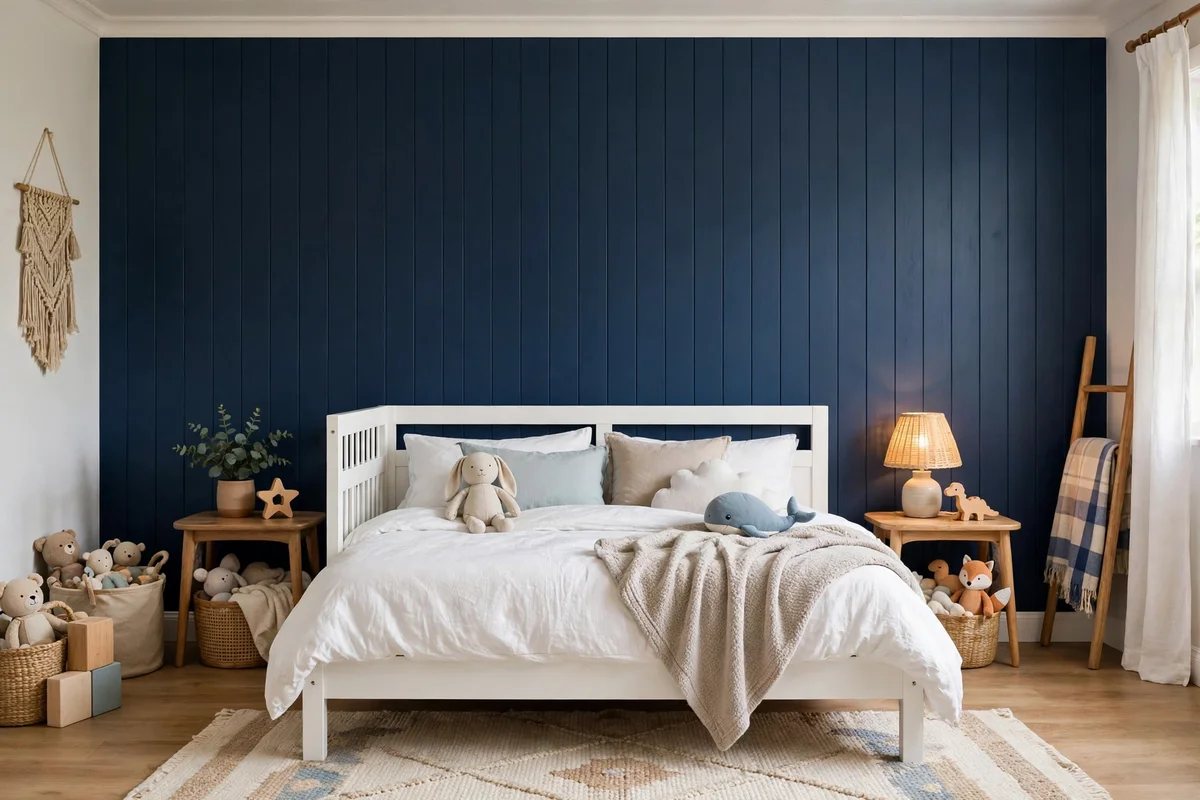
A single navy wall gives a blue room its drama without the commitment of painting the whole room dark. The wall behind the bed is the natural choice: the navy frames the bed, the white bedding stands out against it, and the room gets a focal point the moment you walk in. Navy works best in a room with good daylight or a big window, because the dark colour needs light to keep it from feeling heavy. Keep the other three walls white or warm cream, and repeat the navy twice more — in the bedding and in a cushion, or in the rug and a storage basket — so the wall has company. If you want more ideas for choosing the wall and the finish, the accent wall guide covers paint, wallpaper, and wood in detail: Accent Wall Ideas For Kids Rooms. One warning: navy shows every scuff and fingerprint, so keep a small pot of the same paint for touch-ups, and choose a washable finish.
3. Layer blue shades on the walls
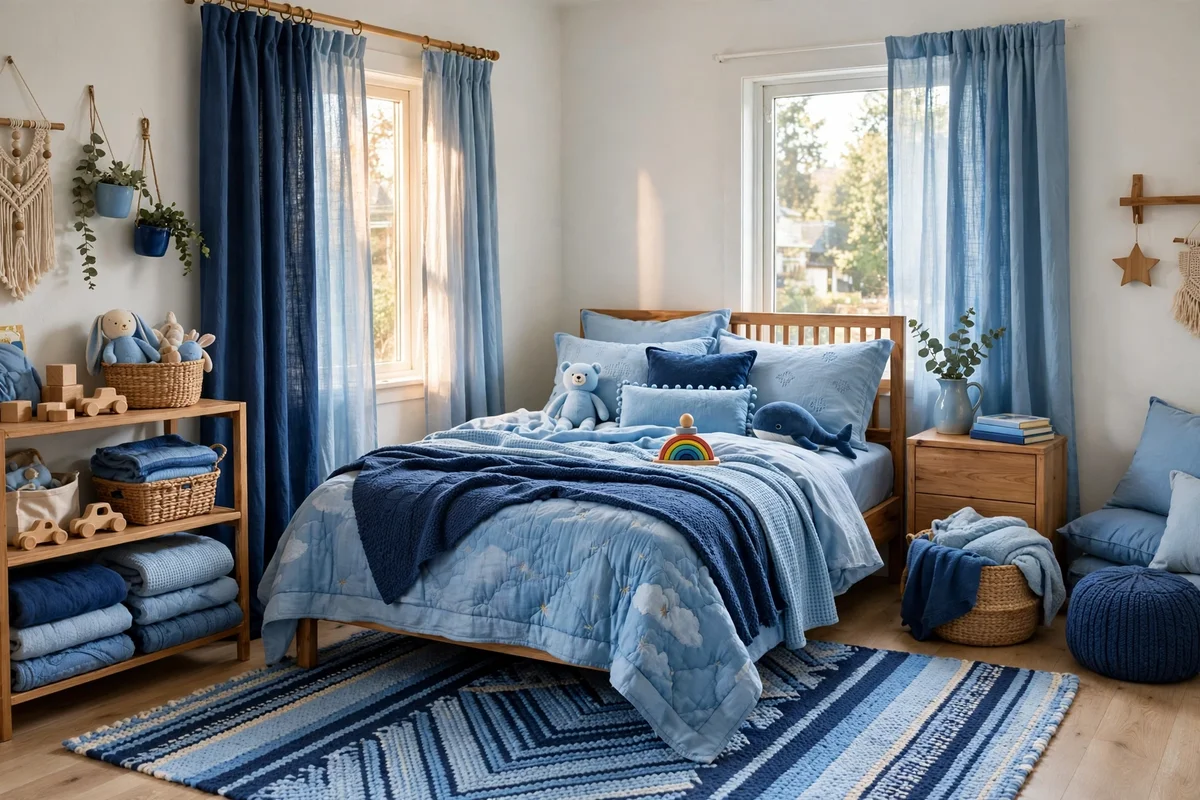
Instead of one flat blue, layer two or three shades on the walls themselves. A half-wall is the easiest version: paint the lower half in a mid-tone dusty blue and leave the upper half white or powder blue, with a clean taped line between them. The lower half hides scuffs far better than white paint does, which matters at toy height, and the two-tone look gives the room a designed feel without any pattern at all. A bolder version paints a wide stripe or a colour-blocked band across one wall — a navy band at picture height, or a sky blue arch behind the bed. Mark the lines with a spirit level and painter's tape, and paint up to the tape in one session so the edge stays crisp. Keep the bedding mostly plain when the walls are layered, because a patterned duvet and a two-tone wall together can start to argue.
4. Pair blue walls with natural wood
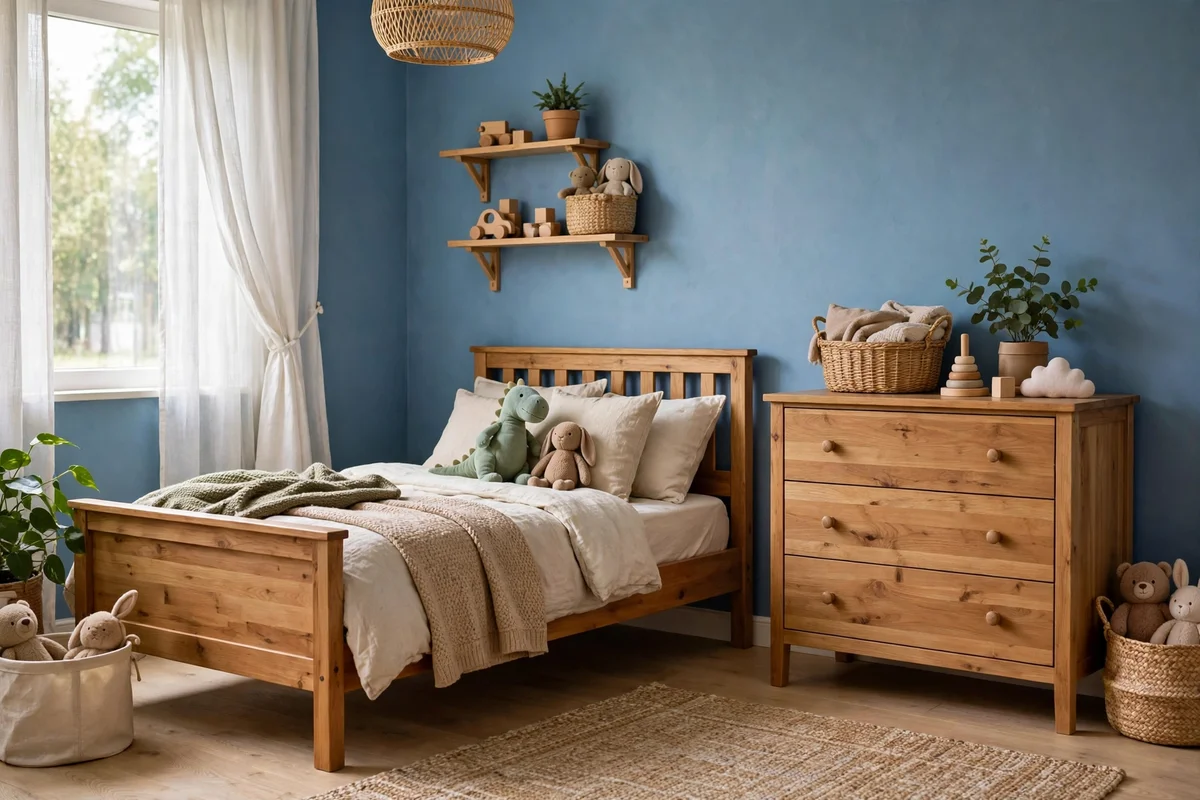
Blue and natural wood are one of the most reliable combinations in a kids room, because the wood warms up exactly what the blue cools down. Paint the walls a mid-tone blue — dusty blue or a soft sky blue — and let the bed frame, the dresser, and the bookshelf stay in pale pine or light oak. The wood does not need to match perfectly; in fact, two slightly different pale woods look more natural together than one perfectly matched set. If the furniture is currently white, a wooden bookshelf, a wooden toy chest, or a woven basket is enough to add the warmth. This combination suits every age, from a nursery to a pre-teen's room, because it reads as calm and grown-up rather than themed. Add a cream or warm white rug under the bed to soften the floor, and the room will feel cosy even on a grey winter morning.
5. Try blue and grey together
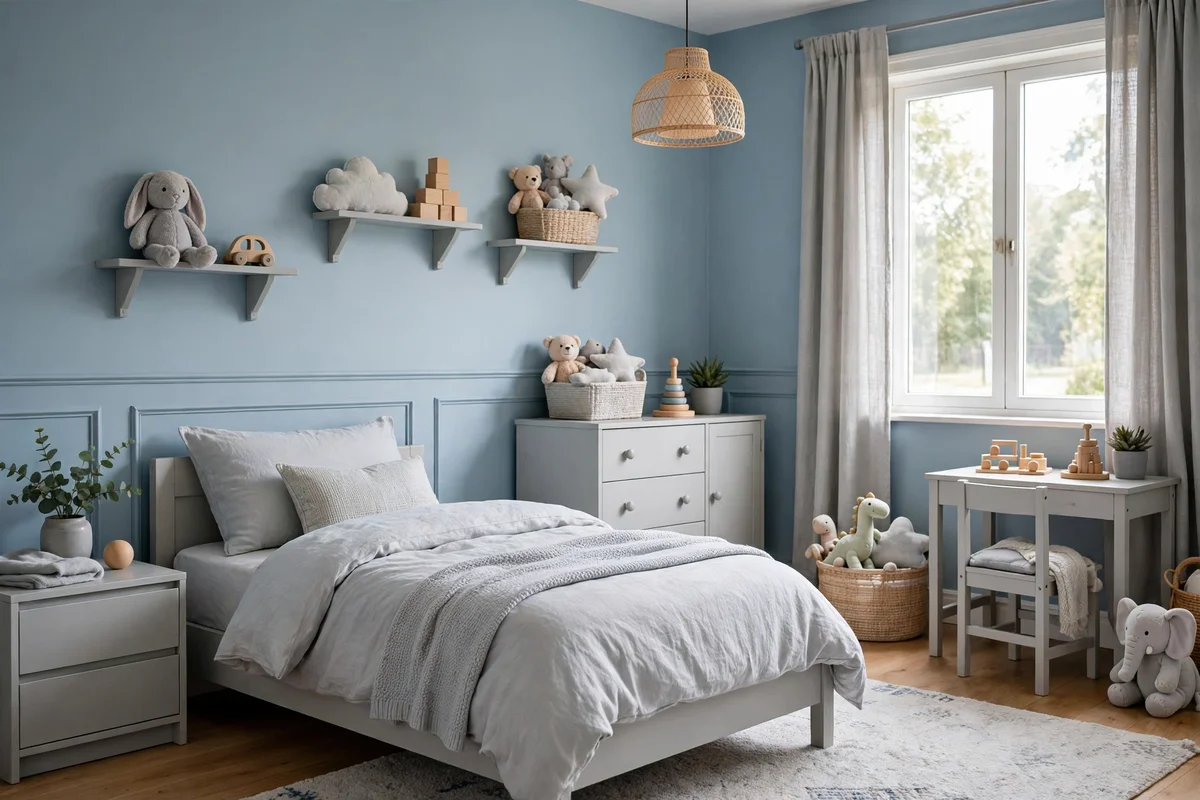
Blue and grey is the combination for a room that needs to feel calm and a little bit grown-up. Paint the walls a soft blue and use light grey for the bedding, the curtains, and the rug, or reverse it — grey walls with blue bedding and blue cushions. Either way, the grey takes the edge off the blue, and the blue stops the grey from feeling dull. This pairing suits shared rooms particularly well, because it is neutral enough for two children with different tastes, and each child can add their own colour on top of it. Keep the grey light rather than dark, especially in a small room, and add one warm element — a wooden bed frame, a mustard cushion, a woven basket — so the room does not feel cold. A blue and grey room is also one of the easiest to update later: swap the blue cushions for green or coral ones, and the whole room changes without repainting a wall.
Bed & bedding
6. Dress the bed in blue and white stripes
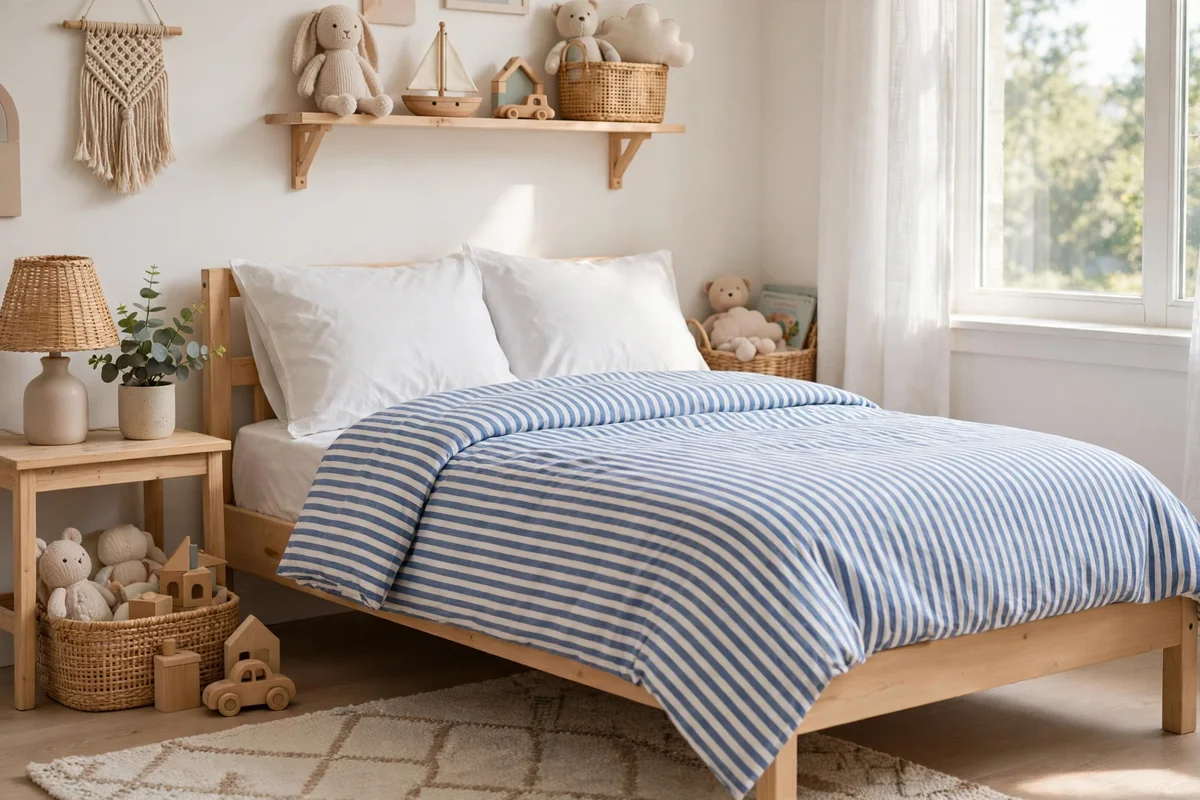
Blue and white striped bedding is the fastest way to make a bed the centre of a blue room. The stripes do the work of a pattern without needing any other decoration on the bed, and they suit every style from coastal to classic to sporty. Use the stripes on the duvet cover and keep the pillowcases plain white, so the bed does not look busy, or use a striped pillowcase against a solid blue duvet for a quieter version. Stripes also hide small marks better than a solid colour does, which is a genuine advantage in a child's bed. Pair striped bedding with plain walls — white, cream, or a very pale blue — because striped bedding and a patterned wall together are too much pattern in one place. A plain navy or white throw folded across the foot of the bed finishes the look and gives your child something to pull up on a cold night.
7. Keep the bedding solid blue
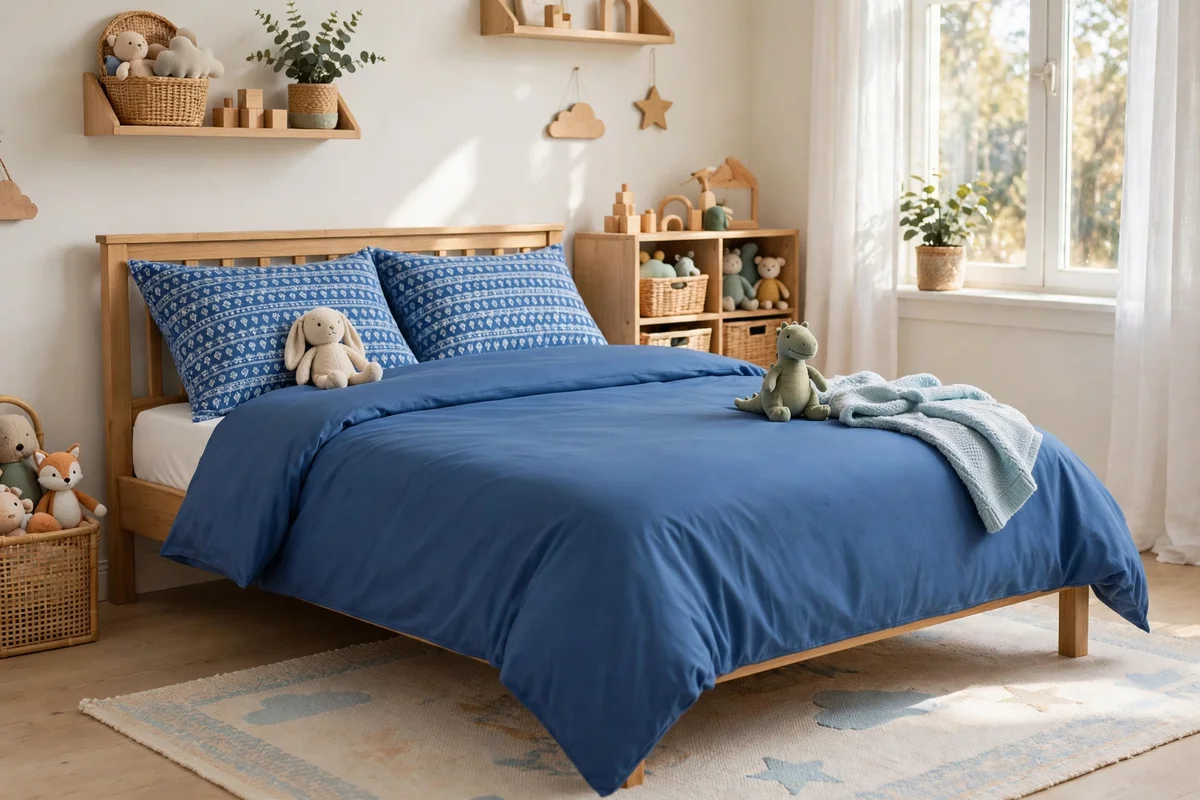
A solid blue duvet is the calmest option for the bed, and it is the one that lets the rest of the room do the talking. A deep navy duvet against white walls makes the bed the focal point; a soft dusty blue duvet in a blue-walled room makes the whole room feel like one quiet scheme. Solid bedding is also the most flexible, because it works with any pattern elsewhere — a patterned rug, a gallery wall, a striped cushion — without clashing. Choose a duvet cover in a fabric that washes well and feels soft, and buy two covers in the same shade if you can, so the bed can be remade on laundry day without changing the look of the room. Add one patterned pillow — gingham, geometric, or a simple stripe — and one plain cushion in a lighter blue, and the bed will look finished without looking fussy.
8. Mix patterns on the bed
If a solid duvet feels too plain and stripes feel too neat, mix two patterns on the bed. A gingham pillowcase with a geometric-patterned throw, or a plaid cushion against a striped duvet, gives the bed a collected, lived-in feel. The trick is to keep both patterns in the same blue family and to keep one of them small — a small gingham or a fine stripe — so the two patterns sit at different scales and do not fight each other. Everything else on the bed stays plain: white sheets, a solid duvet, plain pillowcases. This idea suits older children who have opinions about their bedding, because it lets them choose a pattern they like without the whole room having to match it. It also suits a room where the walls are plain, because the bed becomes the patterned piece in the room and the walls stay calm around it.
9. Paint the bed frame blue
A blue bed frame is a good middle step between painting the walls and changing the bedding: it adds a strong block of blue without touching a single wall. A wooden bed frame painted dusty blue or navy becomes the centrepiece of the room, especially against white walls, and it is much easier to repaint later than a whole wall is. If you are painting a frame your child already has, sand it lightly first, use a primer made for wood, and finish with a washable satin paint that can handle being climbed on. A blue headboard on its own works just as well as a whole blue frame, and it is even easier to change. Pair a blue bed frame with white or cream bedding and a wooden bedside table, so the blue has something warm next to it, and repeat the same blue in a cushion or a storage basket on the other side of the room.
Zones & corners
10. Build a blue reading nook
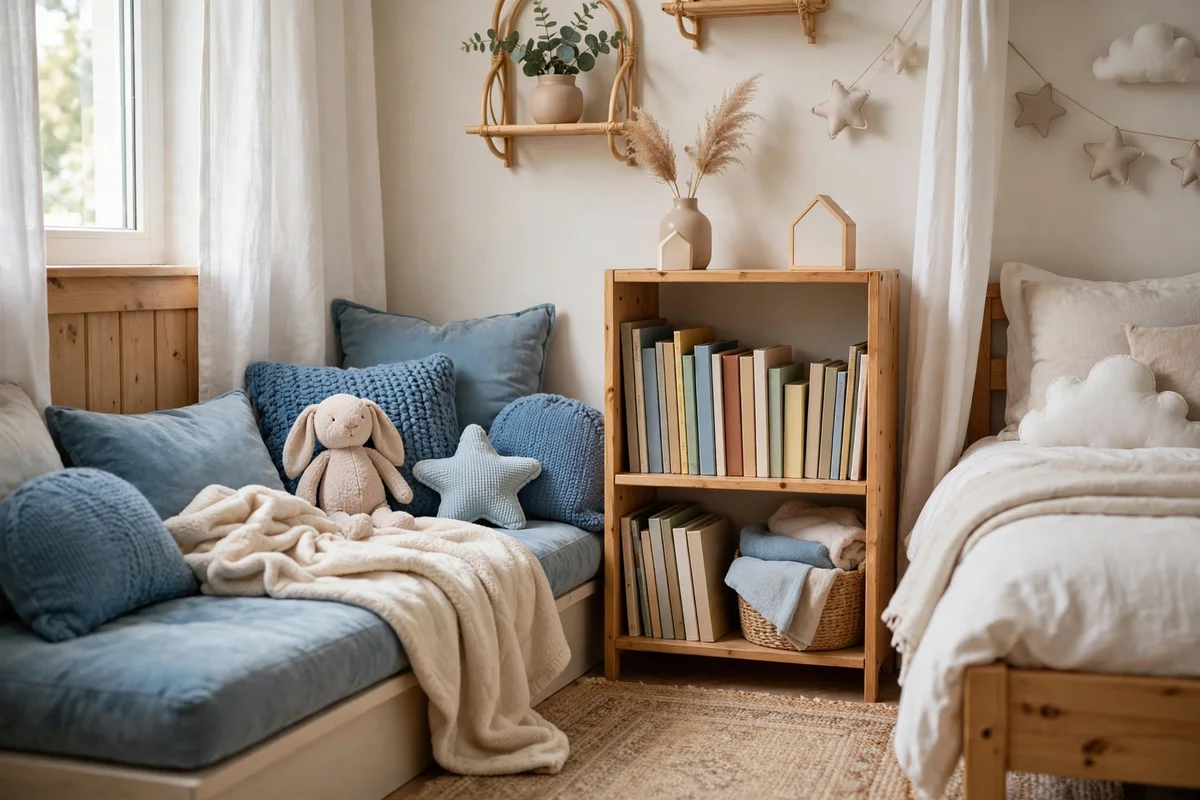
A reading nook is the corner of a blue room that children actually use, and it is the easiest zone to build. Pick a corner with decent light, ideally near a window, and fill it with blue: a floor cushion or a small bean bag in dusty blue, a soft blanket in navy, and a low bookshelf or a wall-mounted shelf with the books facing out so the covers show. A string of warm fairy lights or a small lamp makes the corner inviting in the evening, and a small rug in a lighter blue marks the nook as its own place. Keep the books at your child's height and rotate them every few weeks, so the nook stays interesting. This corner works in any size of room, because it needs no more than a square metre, and it works for every age — a toddler's picture books and a ten-year-old's novels both live happily on the same low shelf.
11. Go for a space or ocean adventure theme
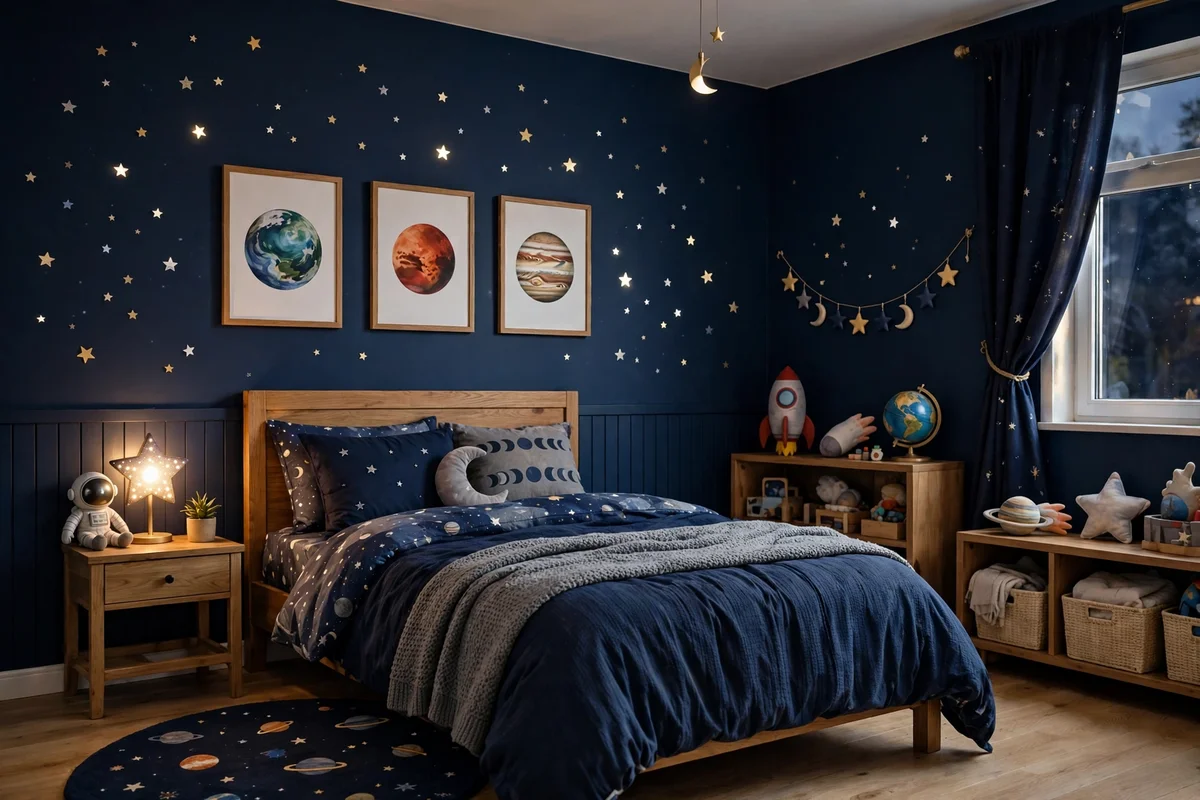
Deep navy is the perfect base for an adventure theme, because it is already the colour of the night sky and the deep sea. For a space theme, paint one wall navy, add star decals and a few planet prints, and keep the bedding dark blue with a star-patterned throw. For an ocean theme, use a lighter blue on the walls, add wave or fish prints, and use striped textiles that hint at the seaside. Either way, the theme lives in the decorations, not in the paint: decals, prints, and bedding can all be changed in an afternoon when your child moves on to a new interest. That matters, because adventure themes are loved fiercely and outgrown quickly. If you want a fuller adventure scheme to build on, see Adventure Themed Kids Room Ideas. Keep the furniture plain and the storage simple, so the theme can change without the room needing to be redecorated from scratch.
12. Make a blue sports corner
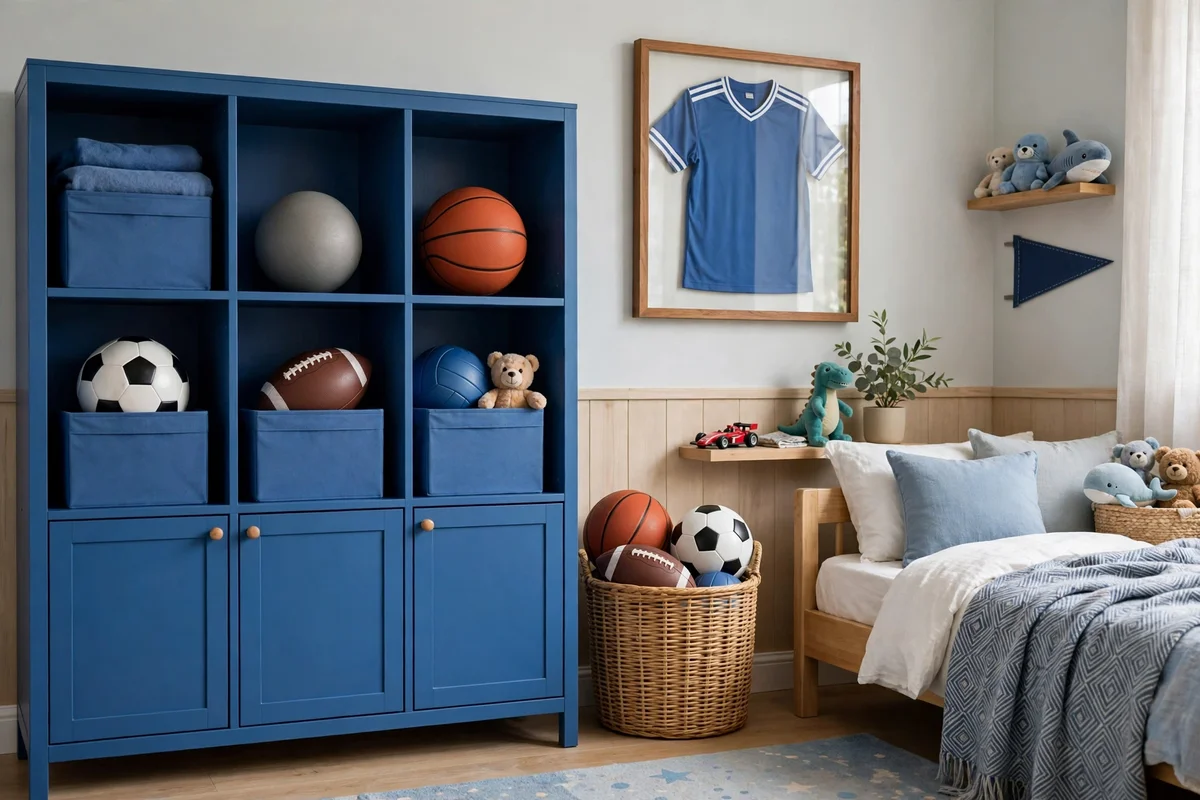
A sports corner gives an active child a place for their kit that is part of the room rather than a pile on the floor. Use blue storage — a blue basket for balls, a blue bin for kit, a blue hook rail for bags — and let the sport itself provide the colour and personality: a framed shirt, a poster, a shelf for trophies or medals. A small patch of floor space with a blue rug or a gym mat marks the corner as a place for play, not just storage. Keep the corner near the door if you can, so kit goes straight from the corner to the car and back again, and keep the storage open and easy to reach, because a lid that is hard to open is a lid that never gets used. For more ways to build movement into a bedroom, see Active Kids Room Ideas. The sports corner works best when it is one clear zone in a calm blue room, rather than sports equipment spread across every surface.
13. Create a coastal corner
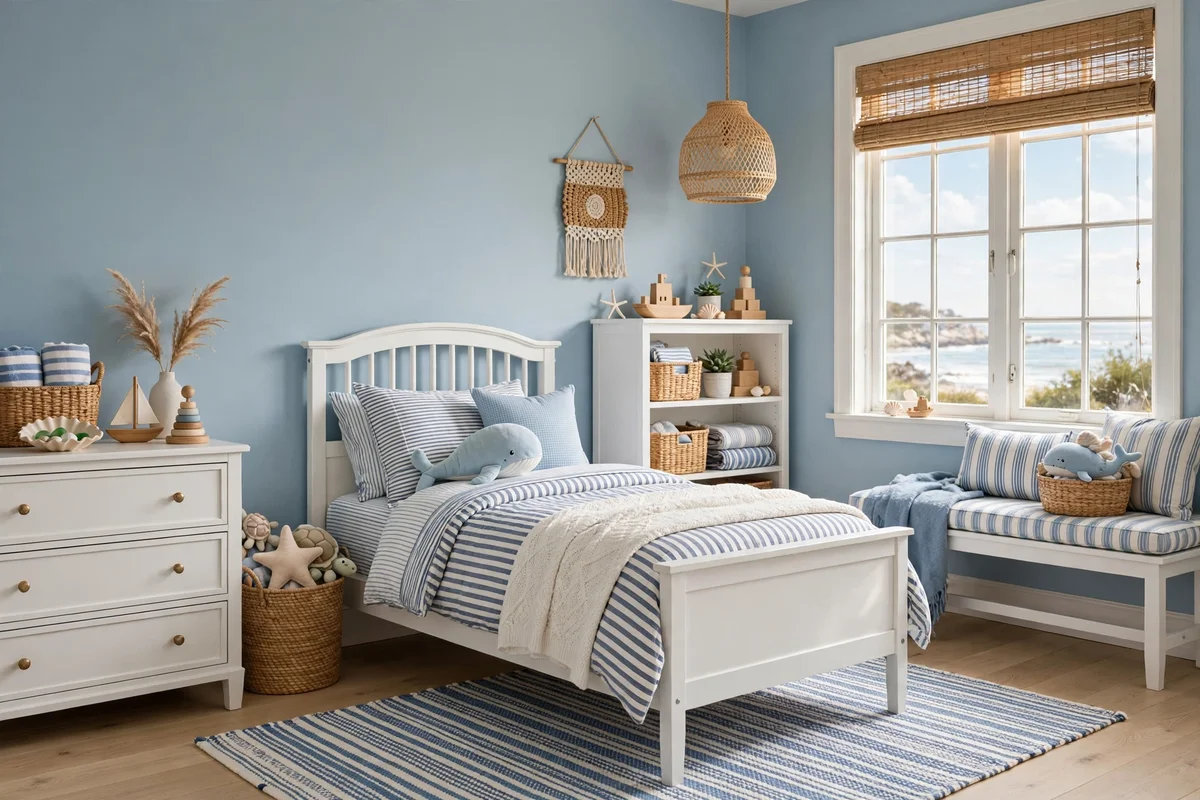
A coastal corner brings the seaside into a blue room without turning the whole room into a beach. Use soft blue and white — striped textiles, a whitewashed wooden shelf, a woven basket — and add one or two seaside details, like a shell collection in a jar, a rope-handled basket, or a framed print of the sea. This corner suits a reading chair, a window seat, or the end of the bed, anywhere your child can sit and the coastal details can be seen without taking over the room. Keep the blue pale here — powder blue or a very soft sky blue — because a coastal look depends on light and air, and a dark navy would make it feel heavy. Natural textures do most of the work: woven, linen, pale wood, and white. If the whole room is already blue, a coastal corner is simply the lightest, brightest part of it, and it gives the room a place for the eye to rest.
Storage & display
14. Use blue storage baskets
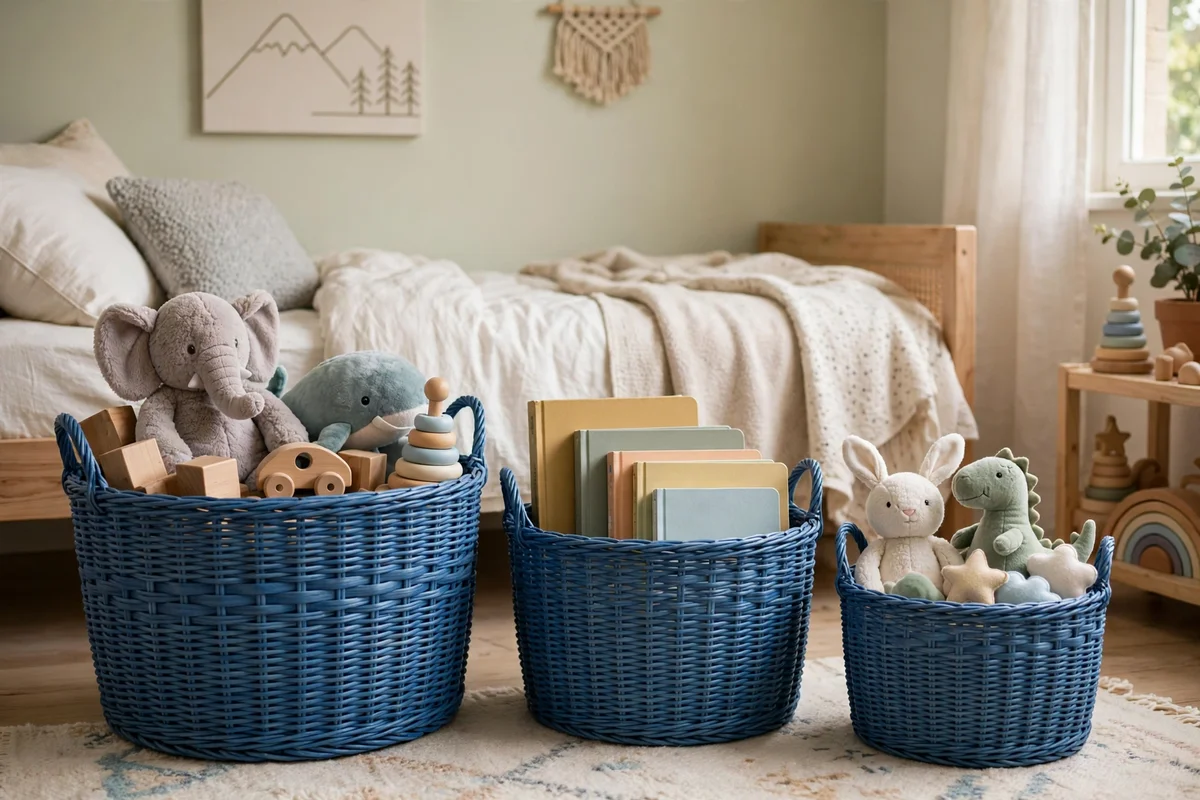
Blue storage baskets are the hardest-working idea in this list, because they add colour and solve the toy problem at the same time. Woven baskets in dusty blue or navy hold toys, books, and dressing-up clothes, and they look good sitting on a shelf or under a bed. Fabric bins in a lighter blue work on open shelving, where they hide clutter behind a tidy front. Label the baskets with pictures rather than words for younger children, so they can tidy up on their own, and keep the baskets at a height your child can reach — storage a child cannot reach is storage a parent has to manage. Use two shades of blue across the baskets rather than one, so the storage looks like part of the scheme rather than a matching set. A row of blue baskets under a window or along a low shelf can carry most of the blue in a room all on its own.
15. Paint the dresser blue
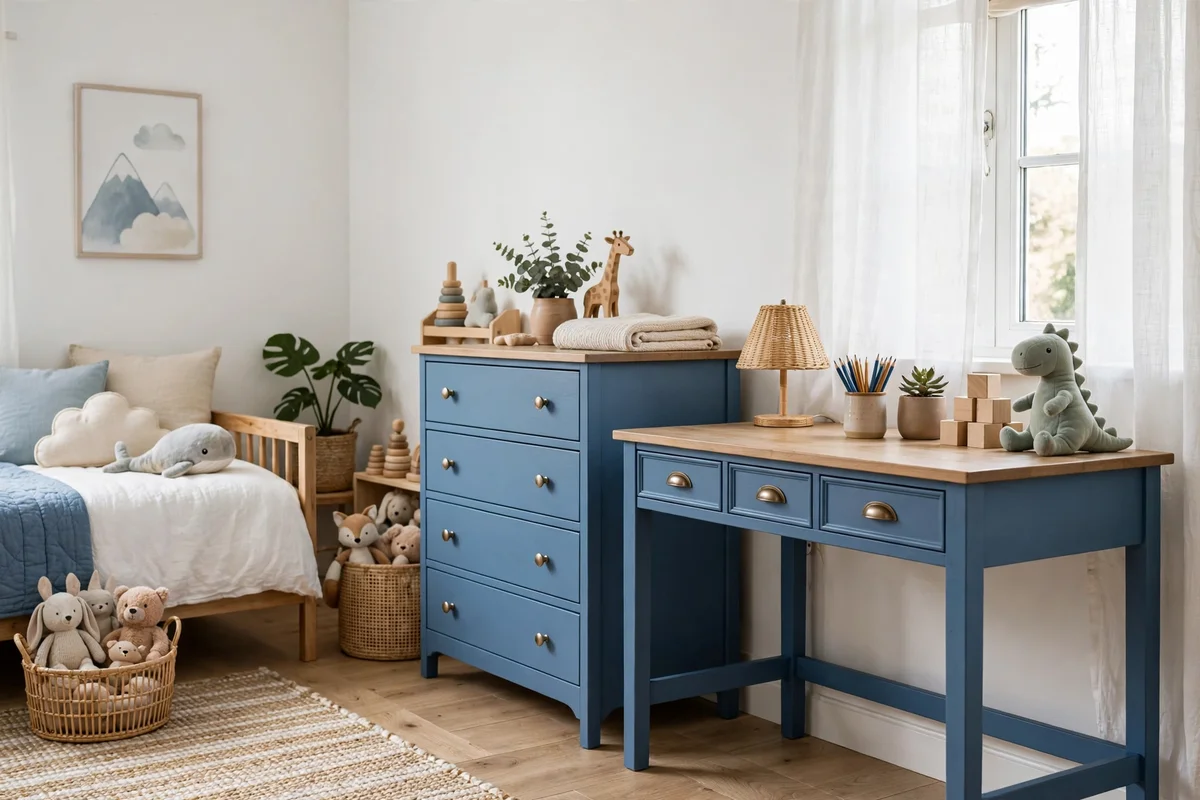
A blue dresser is the single piece of furniture that can carry a blue room. Paint a wooden dresser in dusty blue or navy, and it becomes the feature piece, even in a room with white walls. If the dresser is the only blue furniture in the room, it works best against a white or pale wall, where it stands out, and with plain bedding, so the room does not have two competing features. Swap the handles for wooden or brass ones to warm it up, and keep the top clear except for one or two things — a lamp, a small plant, a framed photo — so the dresser reads as furniture, not as another shelf. The same idea works for a desk or a bedside table, and it is a good project for a second-hand piece: a plain wooden dresser from a charity shop or a marketplace listing, sanded and painted, costs far less than a new one and looks just as good.
16. Hang blue wall art
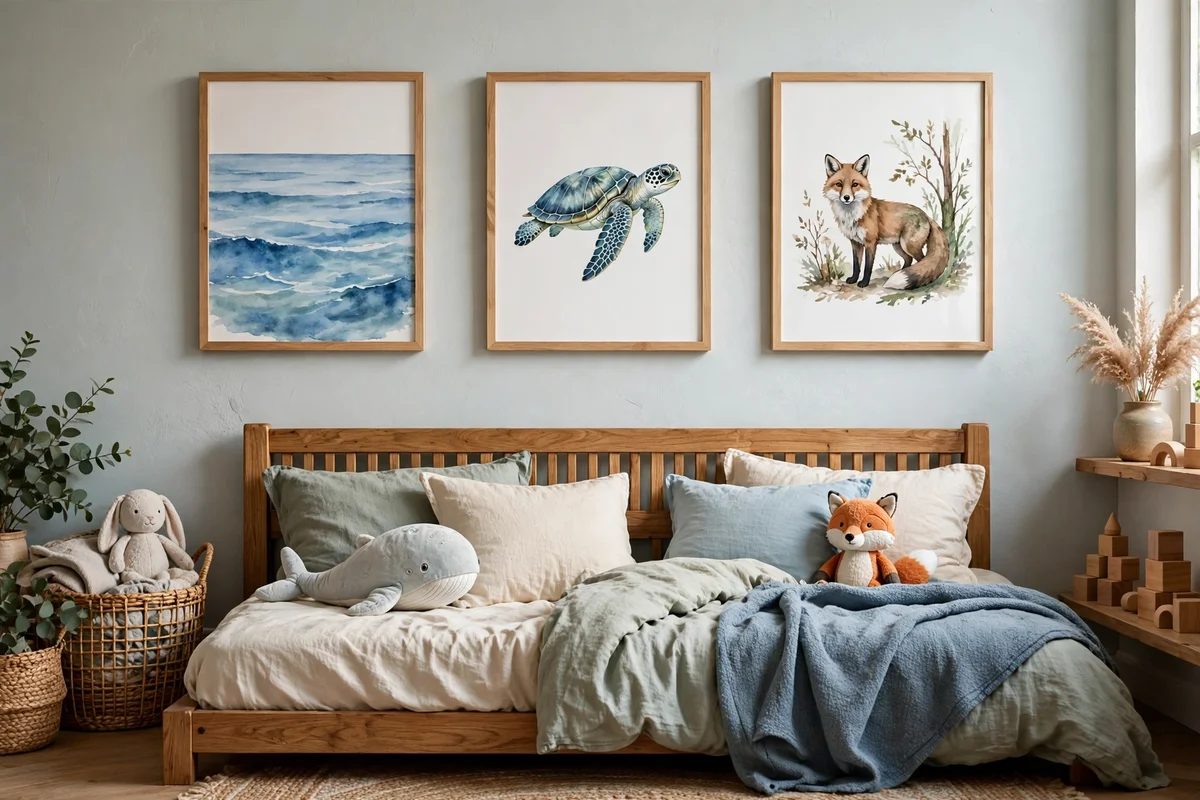
Blue wall art is the easiest way to add blue to a room without painting anything. Framed prints of the ocean, whales, birds, maps, or abstract shapes in blue tones give a white wall colour and personality, and they can be swapped in minutes when your child outgrows them. Use matching frames — the same colour and the same width — so the art looks like a collection rather than a random assortment, and hang the frames at your child's eye level, not adult eye level, so the wall belongs to them. One large print above the bed has more impact than six small ones scattered around the room, but a small cluster of three prints in a row works well above a desk or a dresser. Leave space in the display for your child's own drawings: a clip frame or a magnetic rail lets their art join the wall without tools, and it is the piece of art they will care about most.
17. Build a blue gallery wall
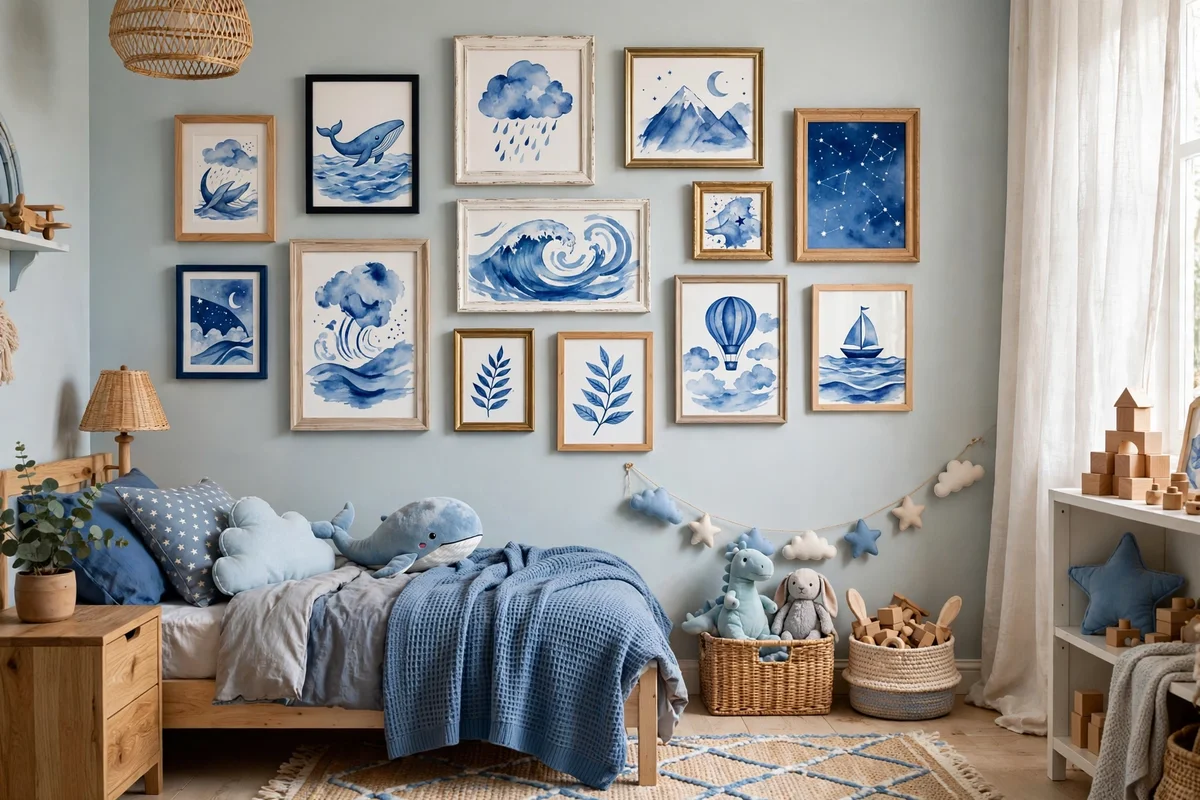
A gallery wall is wall art with room to grow. Start with four or five framed pieces in blue tones — prints, photographs, and your child's drawings mixed together — and leave empty space for more. Arrange the frames on the floor first, take a photo of the arrangement you like, and hang them using the photo as a guide. Keep the spacing between frames even, about a hand's width apart, and mix one or two larger pieces with several small ones. The gallery wall suits the wall opposite the bed, where your child can see it from under the covers, or the wall beside the desk, where it becomes a backdrop for homework. Because the art changes while the frames stay the same, a gallery wall is one of the few blue ideas that genuinely grows with your child: the blue frames stay, and the pictures inside them change from sea creatures to maps to band posters over the years.
Light & finishing touches
18. Lay down a big blue rug
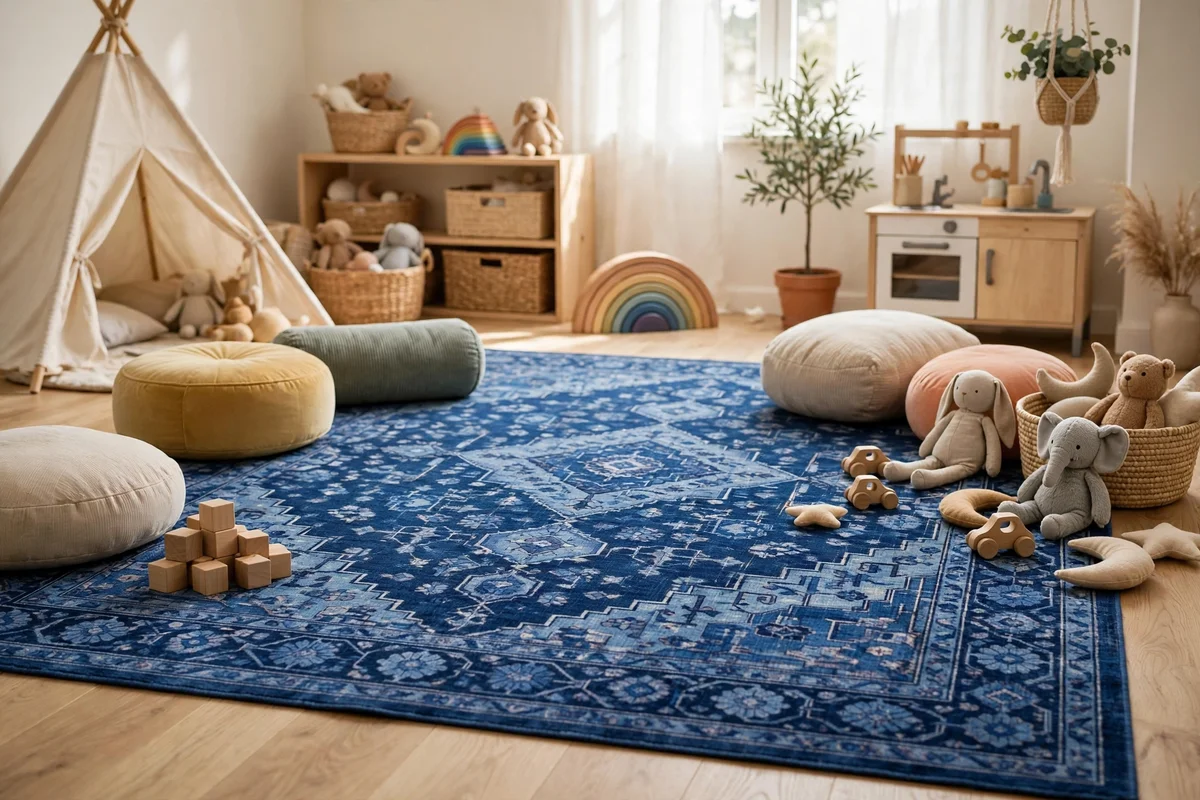
A big blue rug anchors a blue room in a way nothing else does. It defines the play area, softens the floor, and carries a large block of colour low down in the room, which balances blue walls or blue bedding higher up. Choose a rug big enough that the bed and at least one other piece of furniture sit partly on it — a rug that floats in the middle of the floor looks lost, while a rug that connects the furniture makes the room feel pulled together. A patterned rug in blues and cream works well in a room with plain walls and plain bedding, while a solid dusty blue rug works better in a room that already has pattern elsewhere. Pick a rug that can be washed or cleaned easily, because a kids room rug will be spilled on, and avoid a very pale blue for the main play area, where it will show every mark within a week.
19. Light the room in blue and warm white
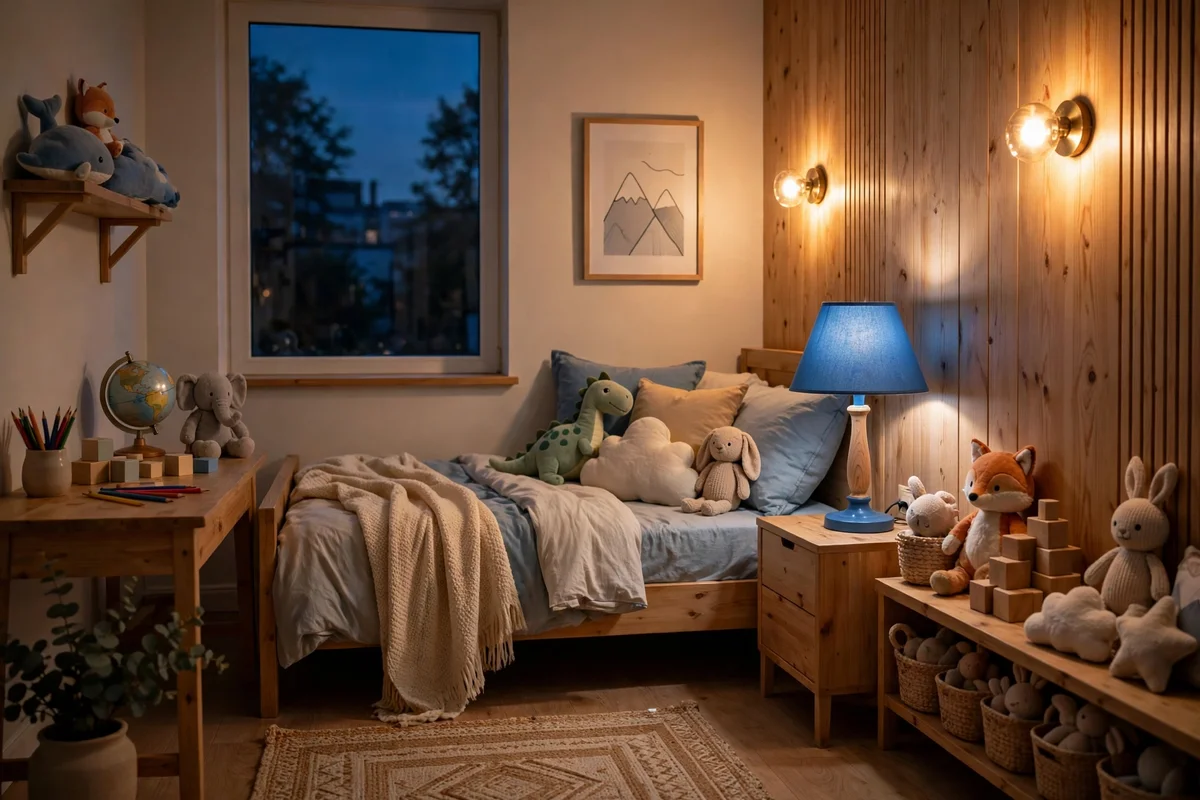
Lighting is the finishing touch that makes a blue room feel cosy after dark, and it is the one most people forget. A blue table lamp on the bedside table adds a small block of colour and a pool of warm light for reading. A wall light or a string of warm fairy lights along a shelf softens the blue walls in the evening, when a blue room can otherwise feel cool. Use warm white bulbs, not cool white and not coloured bulbs: warm white keeps the blue looking like blue, while cool white can make it look grey and coloured bulbs can make the room feel like a party when it should feel like a bedroom. A small night light in a soft blue glow suits younger children who are nervous about the dark, and a dimmer or a lamp with two brightness settings lets the same light work for reading and for sleep.
20. Finish with blue curtains and soft furnishings
Curtains are the last big piece of blue in a room, and they frame the window the way a picture frame frames a print. Blue curtains in a solid dusty blue or a simple stripe soften the hardest edge in the room — the window — and they give you a way to add blue without touching the walls or the bed. Hang them from a wooden or brass rail, and let them fall to the floor rather than stopping at the sill, because full-length curtains make a room feel taller. Match the curtains to the lightest blue in the room rather than the darkest, so the window stays bright, and repeat the curtain colour in one small thing — a cushion, a throw, a lampshade — so the window does not look like the only blue thing in that corner. Then add the small soft furnishings: a cushion or two, a throw across the bed, a floor cushion in the reading nook. These are the cheapest blues in the room and the easiest to change, so they are the right place to try a bolder shade, like teal, before committing to it anywhere bigger.
Small Rooms and Shared Rooms
A small room needs blue to work harder and take up less space. Use the lightest blue the room can carry — sky blue or powder blue on the walls — and keep the darkest blue for small things, like the bedding or a cushion, rather than a whole wall. A navy accent wall can still work in a small room, but only if the room has good daylight and the other three walls are white. Skip the gallery wall and the full mural in a very small room, and use the blue on things that already have to be there: the bedding, the rug, the storage baskets. Vertical stripes, whether painted or in a curtain, make a low ceiling feel taller, and a mirror opposite the window bounces light into a dark corner. Keep at least one wall completely plain, so the room has somewhere for the eye to rest.
A shared room needs a blue both children can live with, and a way for each child to have their own colour inside it. A mid-tone dusty blue or powder blue on the walls works well here, because it is less likely to feel like one child's taste imposed on the other. Give each child one signature colour inside the shared scheme: one child's bedding in navy, the other's in teal, while the walls stay the dusty blue both accept. If the beds are on opposite walls, each bed wall can carry its own small accent — a painted arch, a strip of blue wallpaper, a cluster of decals in that child's colours — with the shared wall kept neutral. Colour-coded storage earns its keep twice over in a shared room: each child's baskets in their own shade of blue end most arguments about whose toys are whose, and the room still reads as one scheme from the door.
Rooms by Age
A nursery in blue should be soft and low. Powder blue or pale sky blue walls, white furniture, and a blue and white striped blanket are enough. Keep the wall behind the cot plain or very pale, because strong colour behind a baby's head is stimulating at exactly the time you want calm. Everything within reach of the cot should be washable, and anything hung above it should be fixed securely. A soft blue nursery is also the easiest to grow up: the same walls work for a toddler and still work for a five-year-old, while a themed mural may not.
A toddler room can be bolder, because toddlers use the room for play as much as sleep. Low furniture, a floor bed with blue bedding, decals at toddler height, and a reading nook they can reach on their own all suit this age. Keep the design to one or two blue ideas, because toddlers change their minds fast and a room with five ideas is a room that needs redoing five times as often. Blue storage baskets at floor level are worth more in a toddler room than any wall decoration, because they are the difference between a room that can be tidied in five minutes and one that cannot.
A school-age child's room can carry the strongest version of a blue scheme, because the child can tell you what they like and what they have outgrown. This is the age for the navy accent wall, the space theme, the sports corner, and the gallery wall with their own art. It is also the age to involve them in the work: a school-age child can help paint a dresser, stick decals, and choose between two blues with genuine opinions. Let them choose between options you have already approved — "navy or teal?" — rather than facing the whole paint chart, and the room will feel theirs without becoming a colour you regret.
A pre-teen's room needs the blue to feel grown-up, not themed. Dusty blue walls, a blue painted dresser, a gallery wall, and plain navy bedding all work, because they read as design rather than decoration. This is the age where a space mural or a wall of decals starts to feel young, and where the blue should be chosen so it can stay for several years. If the room will need to change within two years, choose decals over wallpaper and bedding over paint. Future you will be grateful.
Weekend Plan: Friday to Sunday
A blue room does not need a month of planning. It needs a clear order, because painting before you have measured, or buying bedding before you have chosen the blue, creates the rework that eats weekends.
On Friday evening, choose the main blue and the second shade, measure the walls, and make the shopping list: paint or wallpaper, bedding, baskets, and any art or frames. Order or buy only what is on the list. If you are painting, buy the paint after you have chosen the bedding, not before — paint comes in thousands of shades and bedding in dozens, so it is easier to match paint to bedding than bedding to paint, and a paint sample pot costs far less than a duvet set bought in the wrong shade.
On Saturday, do the messy work. Move the furniture away from the walls, protect the floor, and paint the walls or the dresser. While the paint dries, wash the new bedding and cushion covers so they are ready for Sunday. Do not try to hang art or arrange shelves while paint is wet; it will get marked. If you are not painting at all — if your blue room is bedding, baskets, and art — Saturday is the day to wash everything, build any flat-pack furniture, and paint the dresser if you are doing that.
On Sunday, put the room back together in this order: bed and bedding first, then the rug, then storage, then wall art and lighting last. Art goes last because it is the easiest thing to move, and you will only know where it belongs once the furniture is in place. Finish by walking to the door and looking at the room as a visitor would — the view from the door is the view that matters most, because it is the one you see every day.
Budget: Three Rough Ranges
A blue room does not have to be expensive. The difference between the three ranges below is how much is painted and how much is bought ready-made, not how good the result looks. These are rough ranges only, not researched prices — costs vary by where you shop and what you already own.
A refresh under $50 uses paint you already own or one tin of emulsion for a single wall, a set of removable decals, a blue cushion or two, and art your child has already made in clip frames. The room changes without any new furniture, and it takes an afternoon. This range suits a rental, a room that only needs a lift, or a first try at blue before committing to more.
A mid-level refresh, roughly $50 to $200, adds the pieces that make the biggest difference: a full room of paint in your chosen blue, a new duvet set, a blue rug, a set of storage baskets, and a painted dresser. This is the range most families choose, because it changes the room properly without changing the furniture. Spend this range on the things your child touches every day — the bed, the rug, the storage — rather than on decoration alone.
A full redo, $200 and up, adds new furniture in blue or wood, built-in shelving, a mural or patterned wallpaper, and layered lighting. This is worth doing when the room is being redecorated anyway — a new bed, new flooring, or a move — rather than as a standalone project. If you are spending at this level, spend it on the things that are hardest to change later: the bed, the storage, and the wall finish. Bedding and art can always be upgraded later, one piece at a time.
Whatever the budget, buy the paint after the bedding, not before, and buy one sample pot before you buy the full tin. A sample pot on the wall for two days tells you more than any number of swatches held up in a shop.
Mistakes That Make a Blue Room Look Wrong
The most common mistake is using only one blue. Four walls, a duvet, and a rug all in the same flat shade look like a paint sample rather than a room. Add a lighter blue and a darker blue, even in small things, and the room gains the depth it was missing. A navy cushion on a sky blue bed, or a powder blue throw on a dusty blue wall, is often all it takes.
The second mistake is forgetting to warm the blue up. A room with blue walls, white furniture, grey bedding, and a grey rug can feel cold, especially in winter. Add wood, cream, mustard, or terracotta somewhere — a wooden bed frame, a woven basket, a warm cream cushion — and the blue will feel cosy instead of chilly. If the room feels cold and you cannot say why, the missing warm element is usually the reason.
The third mistake is too much pattern. Striped bedding plus patterned wallpaper plus a patterned rug is three patterns arguing. Pick one patterned piece — the bedding or the wallpaper or the rug — and keep the rest solid colours drawn from the same palette. Solid colours let the pattern breathe, and the room looks calmer for it.
The fourth mistake is ignoring the light. A navy wall in a dark, north-facing room can feel heavy, and a powder blue wall in a bright, south-facing room can look washed out. If the wall feels wrong and the colour looked right in the shop, the light is usually the reason. Swapping a dark blue for a lighter shade of the same blue, or adding a warm lamp, often fixes it without redecorating.
The fifth mistake is putting the blue where it cannot be seen. A mural hidden behind a tall bookshelf, decals placed where the bed will cover them, or a gallery wall behind a door that is always open wastes the work. Arrange the furniture on paper first, mark where the bed, the desk, and the shelves will sit, and put the blue where it will actually be visible from the door and from the bed.
How the Room Grows Up
The best blue rooms are built to be undone in stages. When your child outgrows the theme, change the cheap things first: peel off the decals, swap the bedding for a solid colour, take down the themed prints, and change the cushion covers. That alone removes most of the theme, and the room will already feel older.
If that is not enough, repaint the accent wall in a single colour drawn from the old design — dusty blue or warm cream — and keep the blue dresser or the wooden furniture, which will now look like a single feature rather than part of a theme. The storage baskets and the bookshelf can stay, because they were never really part of the theme at all.
The expensive reversals are the mural and the full-wall wallpaper, which is why they belong on one wall only. A single wall can be repainted or re-papered in a day; four walls cannot. And blue itself is the easiest colour to grow up with: a dusty blue wall that suited a five-year-old still suits a twelve-year-old, especially once the bedding and the art have changed. If you think the room will need to change within two years, choose decals over wallpaper and bedding over paint. A room that can change in a weekend is a room you will never regret.
Frequently Asked Questions
What is the best blue for a kids bedroom?
There is no single best blue — it depends on the room. Sky blue suits small or north-facing rooms because it feels bright. Dusty blue suits bedrooms that need to feel calm and restful. Navy suits big rooms and accent walls, where it adds drama without darkening the space. Test three shades on the wall itself, in daylight and lamplight, before you commit, and pick the one that looks right in both.
Is blue only for boys bedrooms?
No. Blue suits any child, and the idea that it belongs to boys is long out of date. Dusty blue, powder blue, and teal work just as well in a girl's room as in a boy's, and blue pairs with pink, coral, mustard, and lilac as easily as it pairs with grey and white. Let your child's taste decide, not the colour's reputation.
Can I do a blue room in a rental?
Yes. If you cannot paint, build the blue room from things you can take with you: blue bedding, a blue rug, blue storage baskets, blue curtains, and framed art hung with removable hooks. Removable decals add blue to the walls without touching the paint, and a blue painted dresser is yours to take when you move. The room can be fully blue without a single painted wall.
How do I stop a blue room looking cold?
Warm it up with wood and warm neutrals. A wooden bed frame, a woven basket, a cream rug, or a mustard cushion all add the warmth blue is missing. Warm white light bulbs help too — cool white light can make blue look grey, while warm white keeps it looking like blue. If the room still feels cold, add one warm colour, like terracotta or mustard, in a cushion or a throw.
What colours go with blue in a kids room?
White and natural wood are the safest partners, and they suit every shade of blue. Light grey softens blue and suits shared rooms. Mustard, terracotta, and soft coral warm blue up and suit rooms that feel cold. Green works with dusty blue and teal in a nature-inspired room. Avoid pairing navy with black, which can make a room feel dark, and avoid using more than one strong accent colour alongside blue, or the room starts to look busy.
How much does a blue kids room cost?
A paint-and-textiles refresh can cost under $50 if you already own the paint. A proper refresh — paint, a new duvet set, a rug, and storage baskets — usually falls between $50 and $200. A full redo with new furniture, shelving, and lighting costs $200 and up. These are rough ranges only, not researched prices. The cheapest way to start is with bedding and baskets, because both can be changed in an afternoon if the shade does not work.
Final Checklist Before You Start
- Pick your main blue first — sky, dusty, navy, teal, or powder — and test it on the wall in daylight and lamplight.
- Choose one blue to lead, and repeat it three times in the room, in different materials.
- Warm the blue up with natural wood, cream, or a warm accent colour.
- Decide which wall, if any, carries the dark blue, and measure it before you buy paint.
- Buy the paint after the bedding, not before, and buy one sample pot first.
- Arrange the furniture on paper, so the blue is visible from the door and from the bed.
- Keep one pattern only — the bedding, the wallpaper, or the rug — and keep the rest solid.
- Leave at least one wall completely plain, so the room has somewhere for the eye to rest.
A blue room does not need to be perfect, and it does not need to be finished in one go. Start with the shade and the bed, add the storage and the rug, and let the art grow over time. The rooms children love most are rarely the ones with the most colour on the walls — they are the ones where the bed is comfortable, the toys have a home, and there is a cosy corner to sit in. Get those three things right, and the blue takes care of itself.