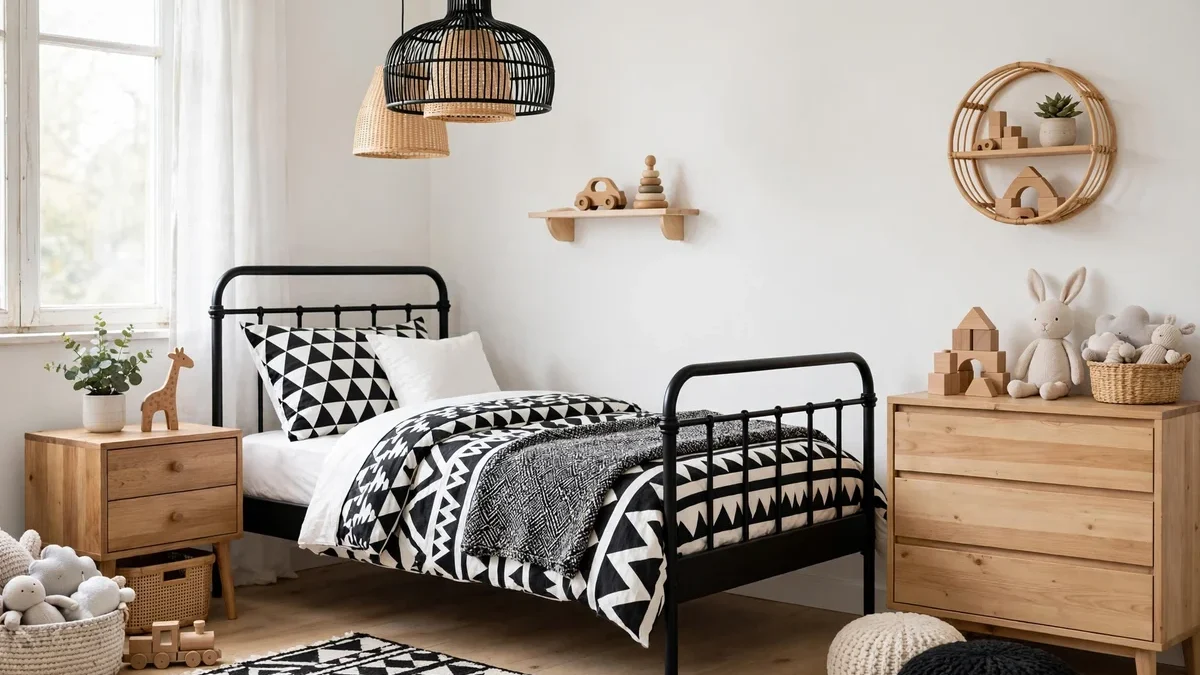
Black And White Kids Room Ideas
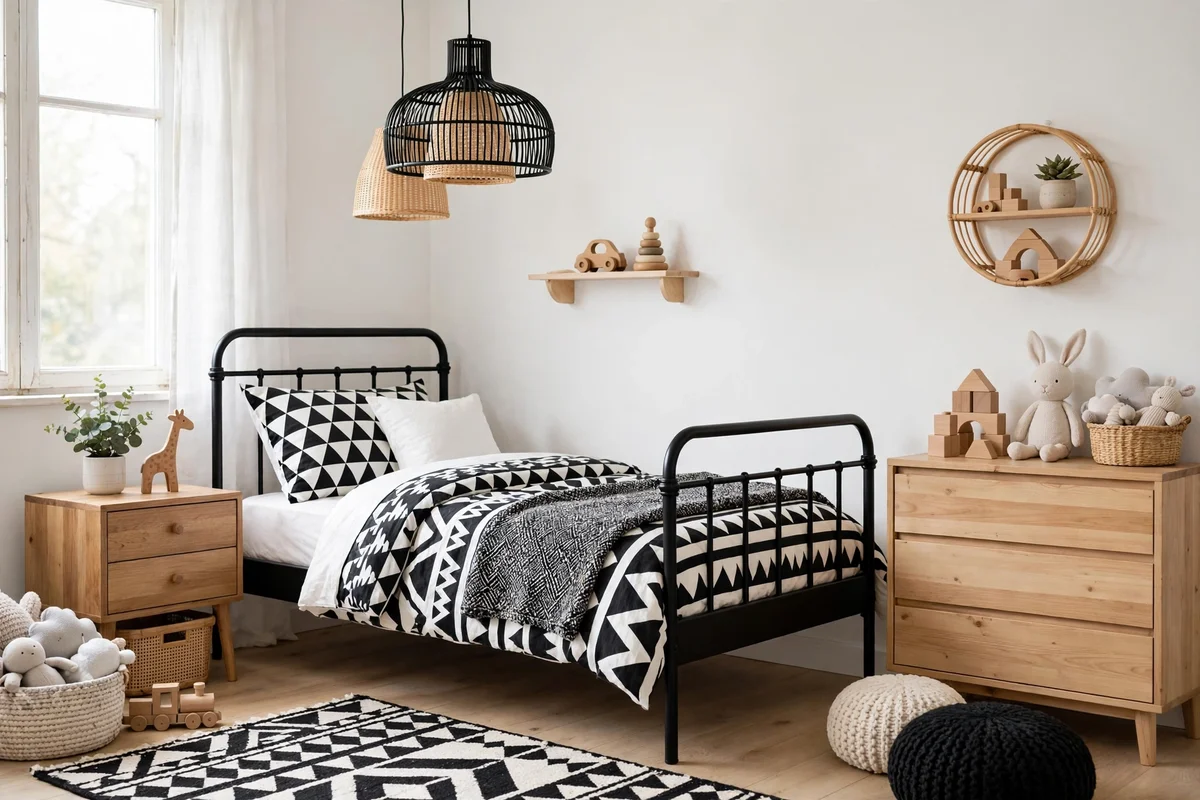
Black and white is the most forgiving palette a kids room can have. It never clashes with a new favourite toy, a school art project, or a duvet set bought on sale, because every colour in the world looks good against black and white. A red fire truck, a pink dollhouse, a green dinosaur — all of them sit happily in a monochrome room, where they would fight with a pink wall or a blue carpet. That is the practical reason parents keep coming back to this palette, and it is also the reason it lasts: when your child's tastes change, the room does not have to.
The other reason is that black and white is calm. A bedroom with two colours and a lot of white space feels restful at bedtime in a way a room with four bright colours does not, and children who find it hard to settle often sleep better in a room that is visually quiet. The white keeps the room bright, the black gives it definition, and the textures — wood, wool, linen, woven baskets — keep it from feeling cold or stark. Done well, a black and white kids room does not look severe or grown-up. It looks clean, cosy, and ready for whatever gets added to it next.
The short version: let white lead and black follow. Keep roughly seventy percent of the room white or pale, and let black take the remaining thirty percent in lines and shapes — a bed frame, a rug, a row of frames, a set of handles — rather than in big blocks of colour. Add one pattern, one softener (wood or grey), and at most one accent colour, and the room will look finished without any single piece having to do too much. The ideas below are arranged in the order most parents actually use them: how to choose the approach first, then the rules that keep the palette balanced, then twenty ideas grouped by walls, furniture, patterns, storage, and light, then the practical parts — small rooms, shared rooms, ages, budgets, and the mistakes that make monochrome look wrong.
How to Choose the Right Approach
A black and white room can lean in three directions — modern, farmhouse, or playful — and choosing the direction first makes every later decision easier, because it tells you which black to use and which textures belong. A modern room uses crisp black, clean lines, and very little decoration: a black metal bed frame, a geometric rug, plain white walls, and one bold pattern. A farmhouse room softens the black with natural wood, woven baskets, and linen: the black appears in a wooden bed frame, a set of baskets, or a row of hooks, and the wood does the warming. A playful room lets the pattern do the talking: stripes, spots, checkerboard, and a chalkboard wall, with the black and white acting as a stage for your child's drawings and toys. None of these is better than the others; the right one is the one that matches the furniture you already own.
Light decides how much black the room can take. A bright room with a big window can carry a black feature wall, a black bed frame, and a black rug without feeling dark, because the daylight balances it. A small room, or one with a single small window, needs the black kept to lines and details — frames, handles, a cushion, a lampshade — and the walls kept white, or the room will feel smaller than it is. Stand in the doorway at midday and again in the evening, and look at the room the way a visitor would. If the room already feels dark at noon, it needs white, not black. If it feels washed out and characterless, it needs black.
Age matters too. A nursery in black and white works when the black is kept high and soft — a patterned cot sheet, a black and white mobile, a framed print above the changing table — and the surfaces a baby touches stay pale and soft. A toddler's room can take bolder patterns, because toddlers use the room for play as much as sleep, and a striped wall or a chalkboard panel gives them something to look at. A school-age child's room can carry the strongest version of the palette, because the child can tell you whether they want spots, stripes, or a checkerboard, and a pre-teen's room suits the calmest version — mostly white, black in the furniture and the frames — because it reads as design rather than decoration.
The 70/30 Rule: White Leads, Black Draws the Lines
Every black and white room that works follows the same ratio, whether its owner knows it or not: roughly seventy percent white and pale tones, roughly thirty percent black. The white is the background — the walls, the ceiling, the bedding, the rug, the large pieces of furniture — and the black is the drawing on top of it: the lines that give the room its shape. A black bed frame draws the outline of the bed. A black rug draws the outline of the play zone. Black frames draw the outline of the gallery wall. Black handles draw the outline of the dresser. When black is used as a line, the room feels graphic and intentional. When it is used as a block — a whole wall, a whole set of furniture, a whole carpet — the room starts to feel heavy, and the white has to work twice as hard to lift it.
The easiest way to check the ratio is to squint at the room from the doorway. If what you see is mostly pale with black shapes in it, the ratio is right. If what you see is mostly dark with pale shapes in it, the black has taken over, and the fix is almost always to swap one black thing for a white one — a white duvet cover instead of a black one, a white storage bin instead of a black one, a pale rug under the black bed — rather than to redecorate. When a monochrome room feels wrong, the ratio is the first thing to check.
Two softeners keep the ratio from feeling stark. The first is wood. Natural wood — a pine bed frame, an oak shelf, a woven basket, a wooden toy — warms the black and white in a way no other material does, and it is the reason most black and white kids rooms in real homes have wooden furniture rather than black furniture. The second is grey. A soft grey sits halfway between black and white, and it is useful in exactly the places where pure black is too strong and pure white is too plain: a grey throw on the bed, a grey cushion on the reading chair, a grey rug under the desk. Grey also rescues a room where the black has gone slightly too far, because swapping one black cushion for a grey one pulls the whole room a step back toward the middle. And texture does the same work as colour here: a knitted throw, a linen cushion, a woven basket, and a soft rug make a monochrome room feel cosy rather than clinical, because the eye reads texture as warmth even when the colours stay the same.
A calm palette like this is also the reason monochrome works as a base for everything else in the room. A black and white room is a calm room, and calm rooms are the ones children settle in most easily. If you want a broader look at calm, considered palettes and how they are put together, the Aesthetic Kids Room Ideas guide is a useful companion — monochrome is the calmest palette in it, and the same rules about light, texture, and restraint apply.
Modern, Farmhouse, or Playful: Pick Your Style
| Style | The black | The white | The softener | Best for |
|---|---|---|---|---|
| Modern | Crisp black metal, matte finishes, geometric shapes | Plain white walls, white bedding, pale floor | One grey or wood accent, minimal decoration | Older children, pre-teens, small rooms that need clean lines |
| Farmhouse | Black-stained wood, black baskets, black hooks and handles | Warm white walls, linen bedding, cream rug | Natural wood everywhere, woven textures | Nurseries, younger children, rooms with wooden furniture already |
| Playful | Bold stripes, spots, checkerboard, chalkboard | White walls as a blank stage, white furniture | One bright accent colour, your child's own art | Toddlers and school-age children, playrooms, shared rooms |
20 Black And White Kids Room Ideas
Walls & paint
1. Start with white walls
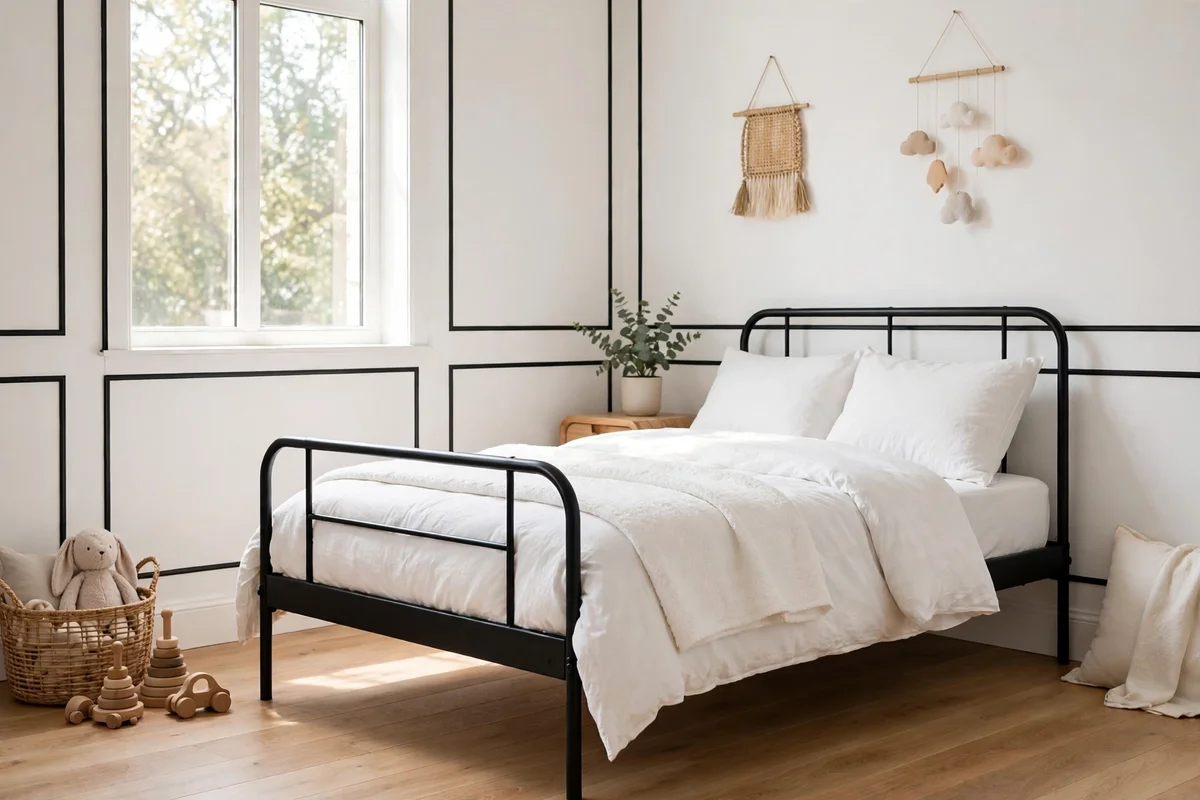
White walls are the foundation of the whole palette, and they do more work than any other single decision. They bounce the daylight around the room, they make a small room feel bigger, and they give every black shape in the room something clean to stand against. The practical side matters too. A washable white paint on the lower half of the walls — or on the whole wall, if you can find a good washable finish — survives fingerprints, toy scuffs, and the occasional crayon far better than a coloured paint does, because a mark on white can be wiped or touched up without a visible patch. Keep the ceiling white and the skirting boards white, and choose a warm white rather than a brilliant one if the room gets cool light, because a warm white feels cosy where a brilliant white can feel clinical. If the walls are already white, you have already done the hardest part; if they are not, one weekend of painting is the cheapest transformation in this whole list.
2. Paint one black feature wall
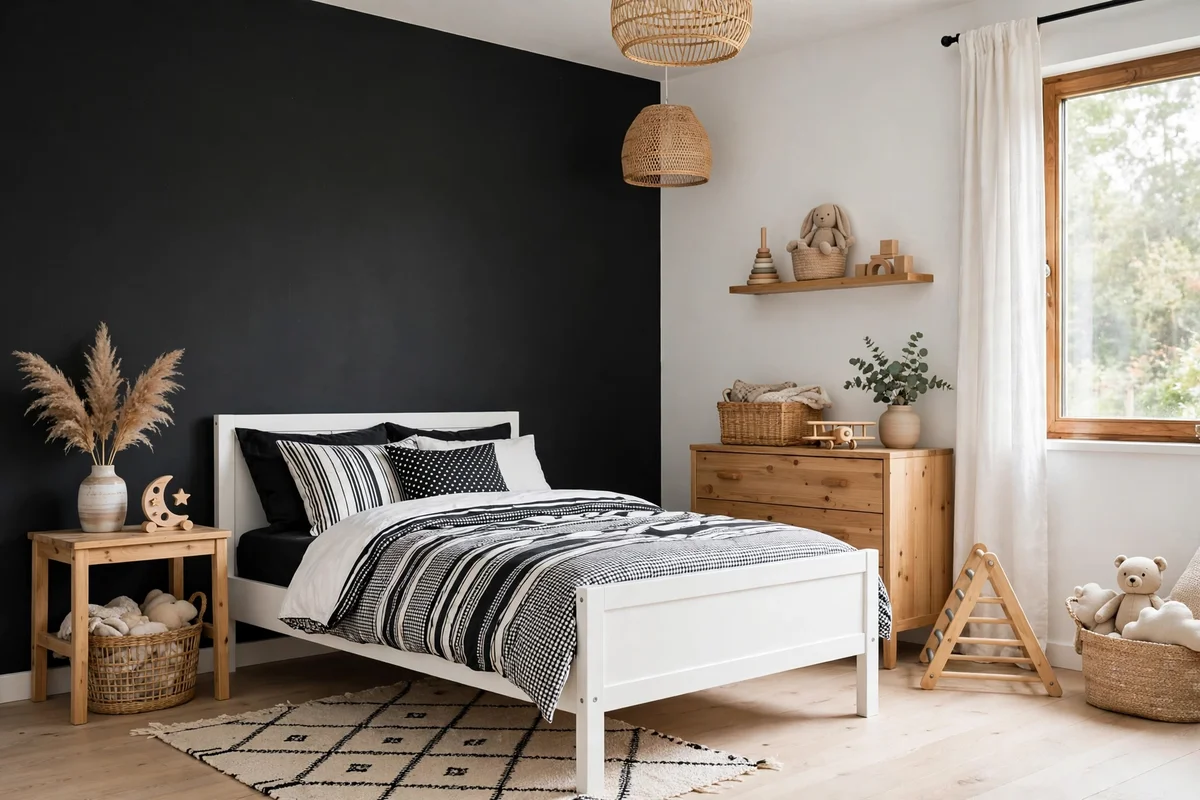
One black wall, behind the bed, is the boldest move in this list and the one that changes a room most dramatically for the least money. A matte black wall frames a white bed the way a picture frame frames a photo. The rules are simple: one wall only, the wall behind the bed, and a matte or very low-sheen finish, because gloss black shows every fingerprint and every bump in the plaster. Paint two thin coats and let the first dry fully before the second, or the finish will drag. Keep the other three walls white and the bedding mostly white, so the black wall reads as a backdrop rather than a cave. If a whole black wall feels like too much, paint the wall behind the bed only as far as the bed is wide, with a strip of white on either side — it reads as a framed panel rather than a full wall, and it is easier to repaint later. For the wider question of which wall to feature and which finishes last, the Accent Wall Ideas For Kids Rooms guide covers choosing the wall, measuring it, and the finishes that suit a kids room.
3. Add stripes to one wall
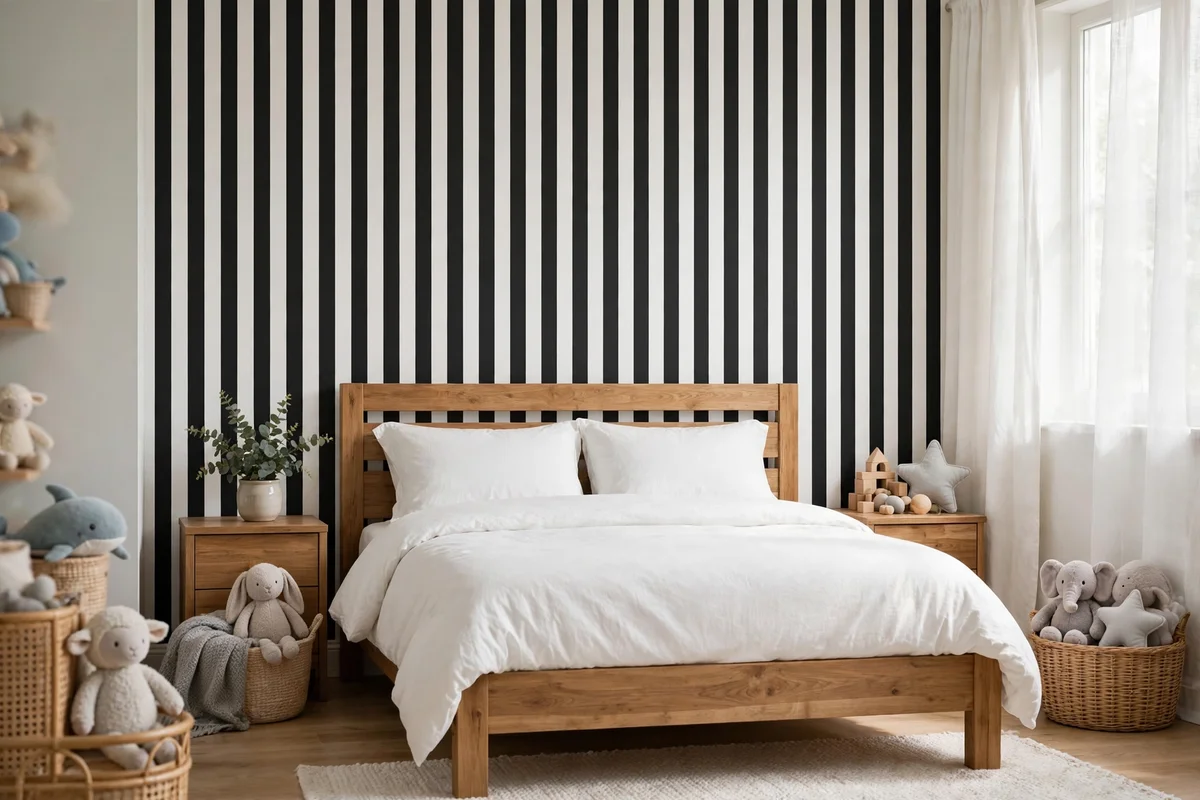
Stripes are the most forgiving pattern in a black and white room, because they are easy to paint, easy to live with, and easy to change. Vertical stripes make a low ceiling feel taller, which suits small rooms and rooms with a low bed. Horizontal stripes make a narrow room feel wider. A wide stripe in black and white feels bold and modern; a narrow stripe feels softer and more traditional, and suits a nursery or a younger child's room. The method is straightforward: paint the wall white first, let it dry, then mark the stripes with a spirit level and painter's tape, press the tape down firmly so paint cannot bleed underneath, and paint the black stripes one at a time, peeling the tape off while the last coat is still slightly tacky for the cleanest edge. Keep the stripes to one wall — the bed wall is the natural choice — and keep the bedding and the rug plain, because stripes plus a patterned duvet plus a patterned rug is three patterns arguing.
4. Try a geometric pattern
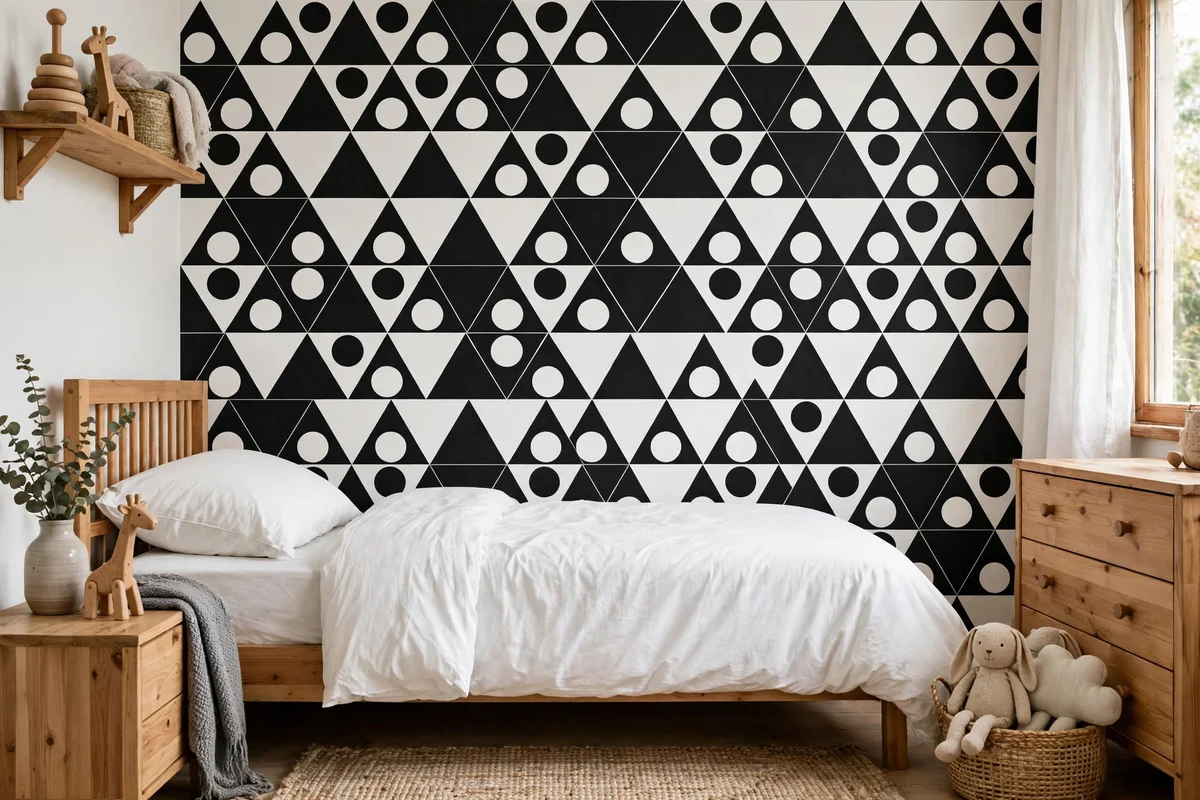
Geometric patterns — triangles, circles, arches, diamonds, and checkerboard squares — give a black and white room its personality, because geometry is where the palette stops being plain and starts being a design. The trick is scale: large shapes suit a big wall and an older child, small shapes suit a small wall and a younger child, and mixing two sizes of the same shape looks intentional where mixing two different shapes can look messy. Painter's tape and a pencil are enough for triangles and stripes; a stencil does the work for circles and arches; and decals are the no-commitment version, because they peel off when the pattern has run its course. Keep the pattern to one wall and one shape family, and let the rest of the room stay plain. A geometric wall behind a plain white bed with plain white bedding looks designed. The same wall behind a patterned duvet and a patterned rug looks busy, and the pattern gets the blame for a problem the bedding caused.
5. Paint one piece of furniture black
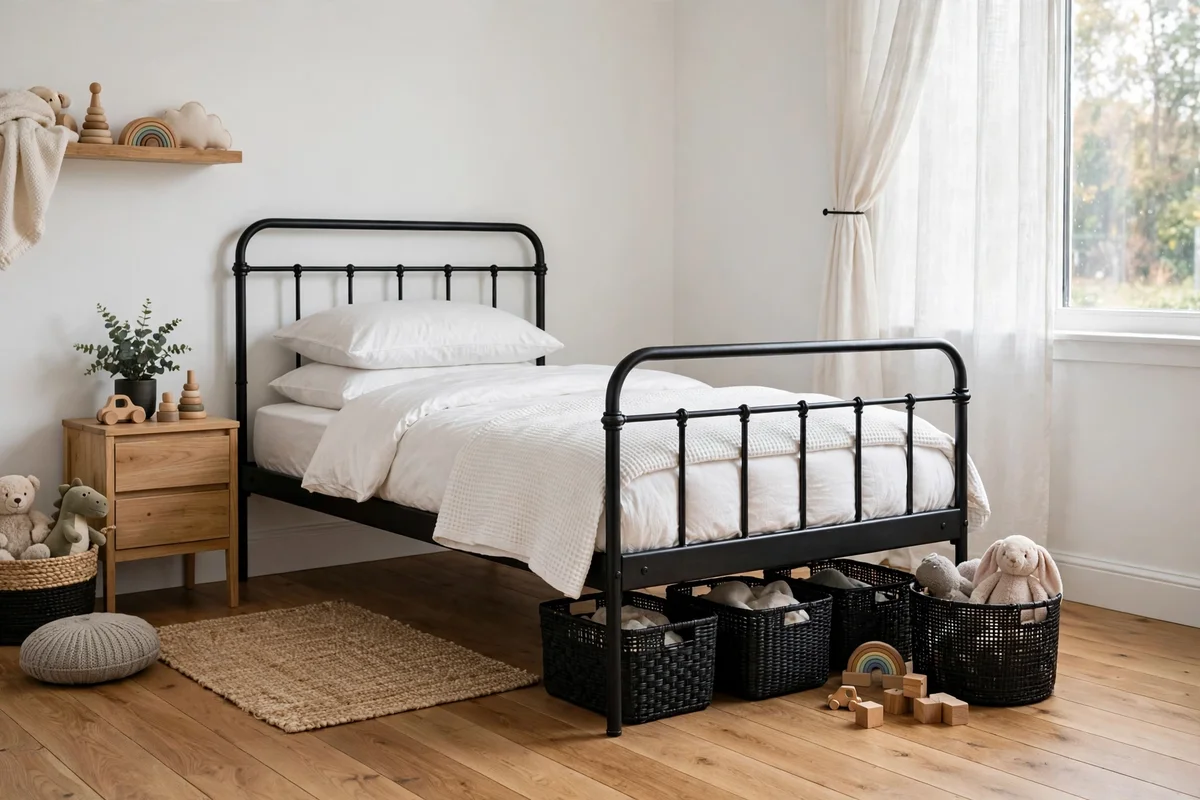
If a black wall feels like too much, paint one piece of furniture black instead and get most of the same effect with none of the commitment. A bed frame painted matte black anchors the room the way a black wall does, but it can be repainted white in a weekend if the palette changes. A dresser painted black with white handles, or a bookshelf painted black against a white wall, does the same job on a smaller scale. The method is simple but worth doing properly: sand the piece lightly, wipe off the dust, use a primer if the wood is dark or varnished, and apply two thin coats of a durable paint made for furniture, letting each coat dry fully. A finish made for furniture matters, because a bed frame and a dresser get knocked, leaned on, and climbed, and ordinary wall paint chips on edges within weeks. And if the piece is one your child climbs on or pulls themselves up on, fix it to the wall with an anti-tip kit before you paint it — the paint is cosmetic, the fixing is safety, and the fixing should come first.
Furniture
6. Balance black furniture with white
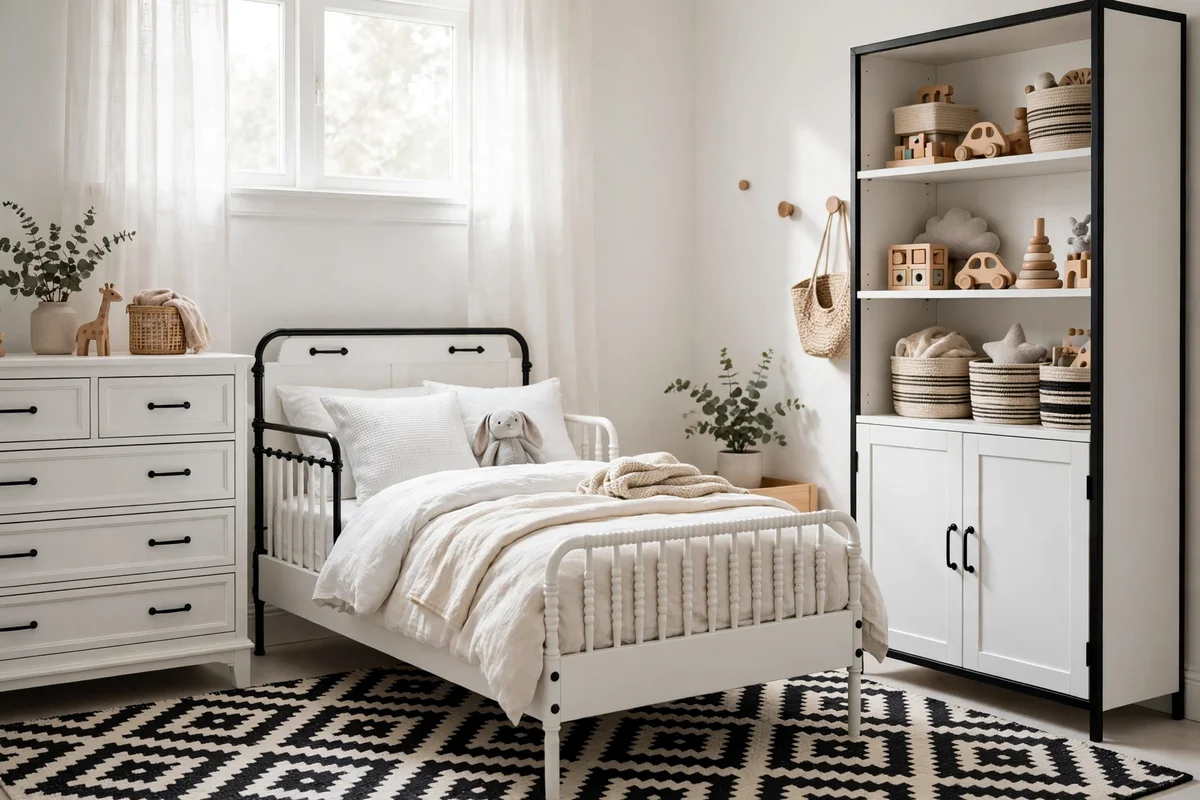
A black bed frame needs white furniture around it, or the room tips toward dark. A white dresser, a white bookshelf, and a white desk beside a black bed keep the ratio honest: the black draws the lines, the white holds the space. The reverse works too — a white bed with a black dresser and a black bookshelf — but one direction usually suits the room better, and it is the direction that matches the biggest piece of furniture. If the bed is black, the storage goes white. If the bed is white, one storage piece can go black. Give white furniture black details — black handles, black knobs, a black frame around a white noticeboard — so it belongs to the palette rather than just sitting in it. And keep the handles and knobs consistent across the room: the same black handle on the dresser, the wardrobe, and the desk makes three separate pieces of furniture read as one set.
7. Dress the bed in black and white
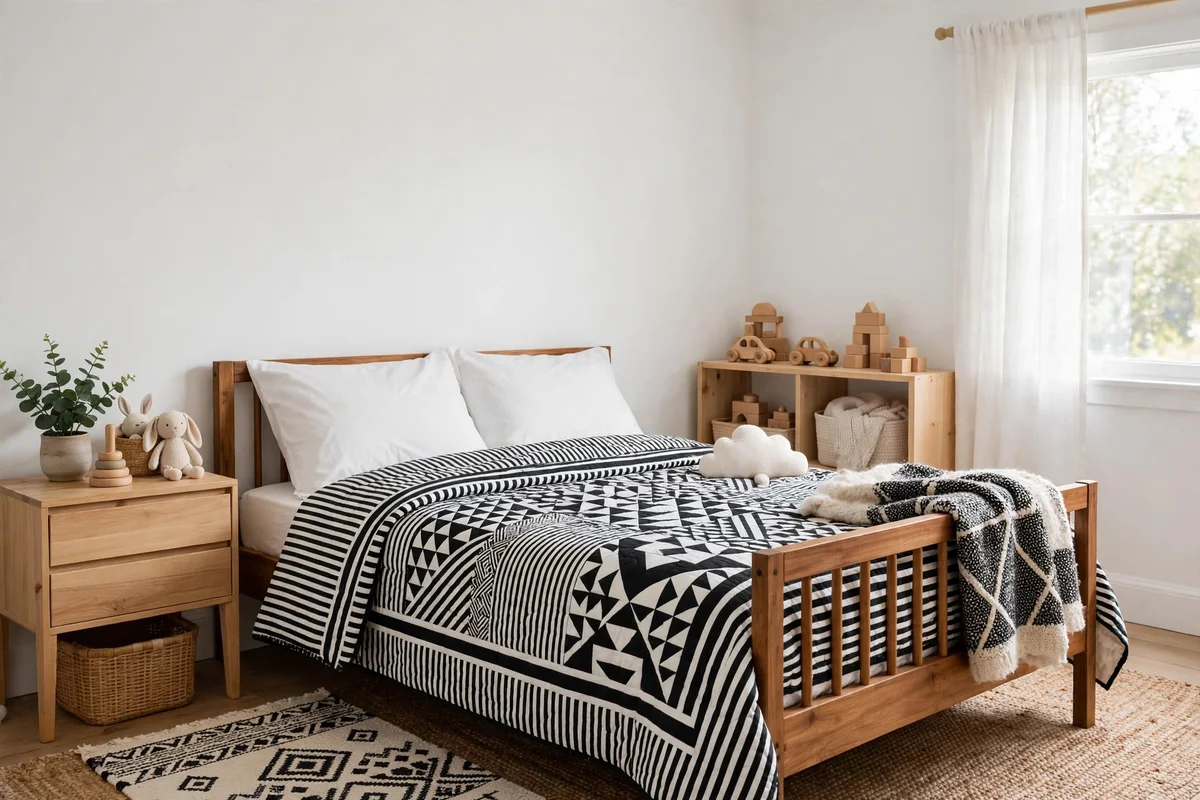
Bedding is the fastest way to change a black and white room, because the bed is the biggest soft surface in it and the duvet cover can be swapped in a minute. A black and white striped duvet, a geometric print, or a checkerboard pattern all work, but the rule is one pattern on the bed, not two: a patterned duvet with plain white pillowcases and a plain throw, or a plain white duvet with one patterned cushion and a black throw at the foot of the bed. The second version is the calmer one, and it suits a child who finds it hard to settle, because the bed reads as mostly white with a black accent rather than mostly pattern. The first version is the bolder one, and it suits a playroom or a room where the bed is the feature. Either way, the bedding should be washable and easy to change, because a kids duvet gets washed often, and a pattern that only looks good when it is perfectly smooth will look tired within a week.
8. Ground the room with a black and white rug
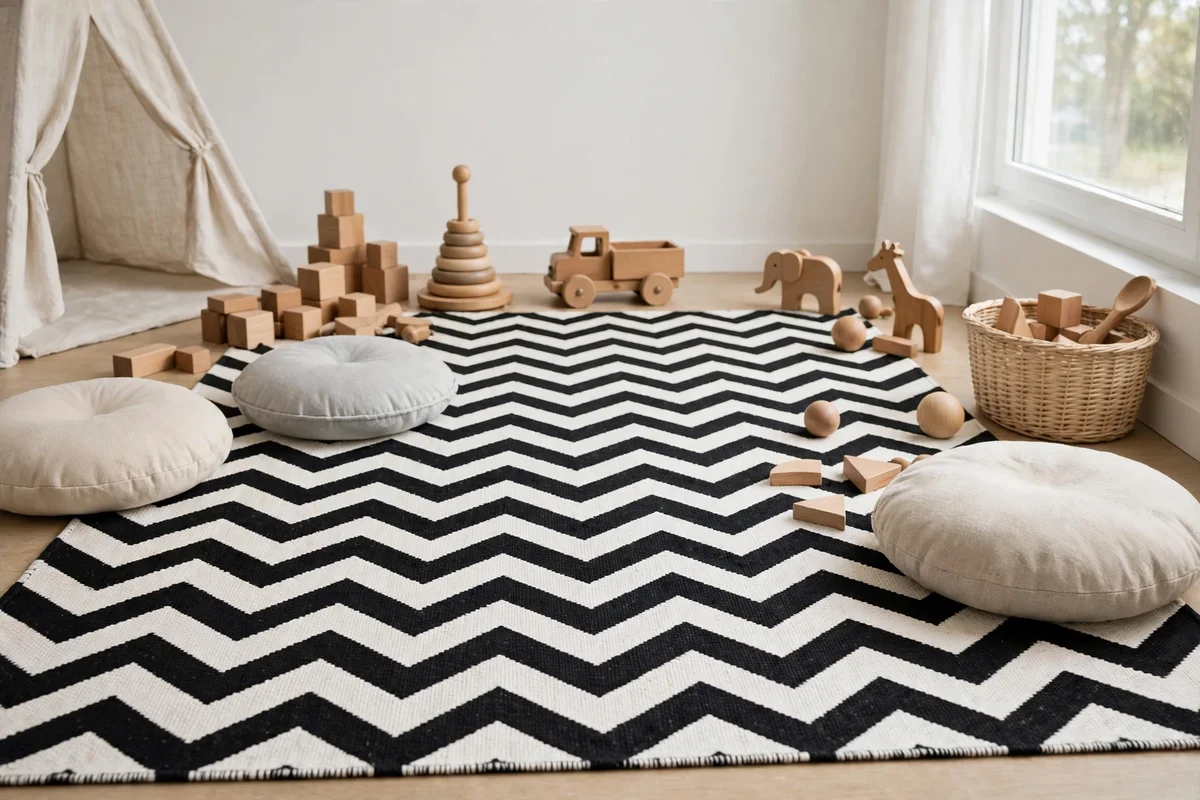
A rug does two jobs in a black and white room: it defines a zone, and it softens the floor. A black and white rug under the bed marks the sleep zone; the same rug in the middle of the floor marks the play zone; a smaller one beside the bed marks the spot where feet land in the morning. Chevron, stripes, and geometric patterns all work, and the rug is the one place in the room where a bold pattern is safe, because it sits low and the eye reads it as a floor rather than a wall. Choose a rug that can be washed or spot-cleaned, because a kids rug gets juice, paint, and mud on it, and a rug that cannot be cleaned becomes a rug that gets rolled up and hidden. And size it generously: a rug that is too small for the zone it marks looks like a mat that escaped, while a rug that reaches under the front legs of the bed or the desk anchors the furniture to the floor and makes the whole arrangement look planned.
9. Build a gallery wall in matching black frames
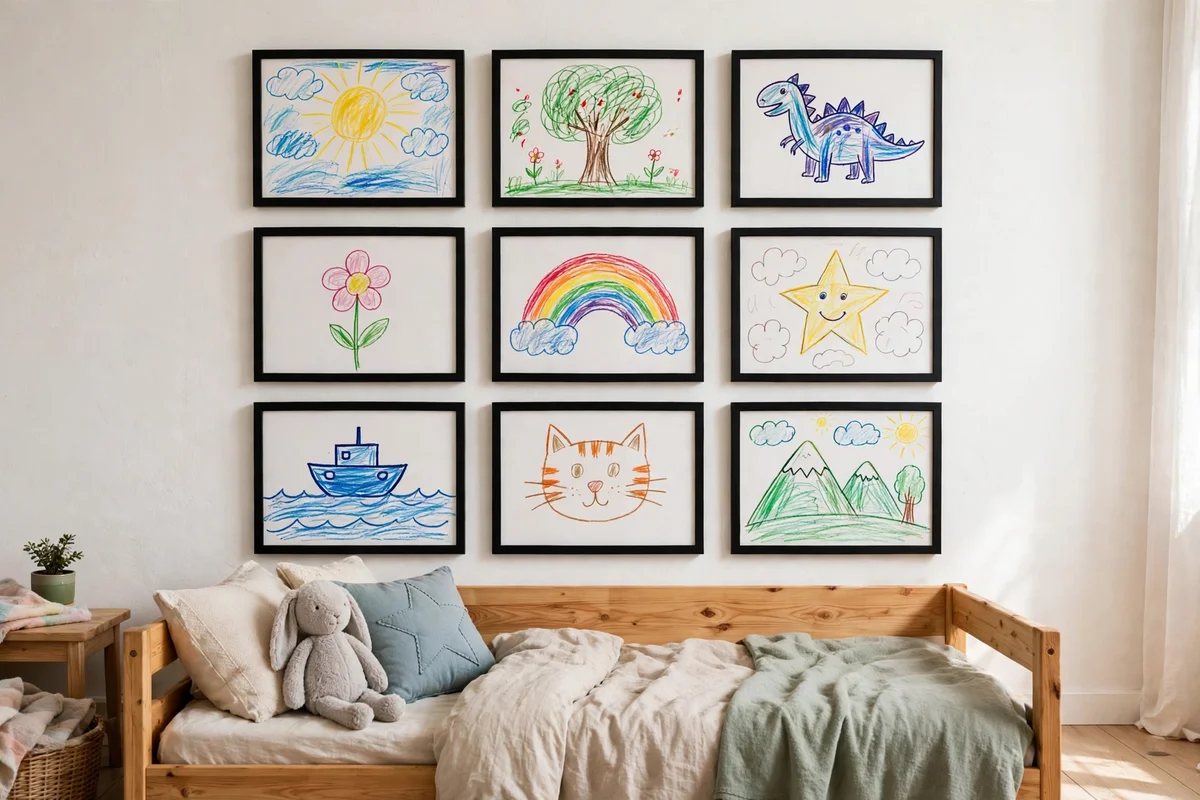
A gallery wall is the black and white idea that grows with your child, because the wall stays the same while the art on it changes. Start with three or four framed pieces in matching black frames — the same frame, different art inside — and leave empty space for your child's own drawings. A clip frame or a magnetic poster hanger lets you swap art without tools, which matters when the display changes every few weeks. Arrange the frames on the floor first, take a photo of the arrangement you like, and hang them using the photo as a guide. Keep the frames at your child's eye level, not adult eye level, so the wall belongs to them. Mix one or two larger pieces with several small ones, keep the spacing between frames even — a hand's width apart is a good rule — and use proper picture hooks for anything heavy, because a frame that falls off a painted wall takes paint with it. If you want ideas for the art itself — what to draw, what to frame, and how to display a child's work so it looks intentional rather than cluttered — the Artsy Kids Room Decor Ideas guide covers the display side of a kids room in more depth.
Patterns & textiles
10. Use black open shelving
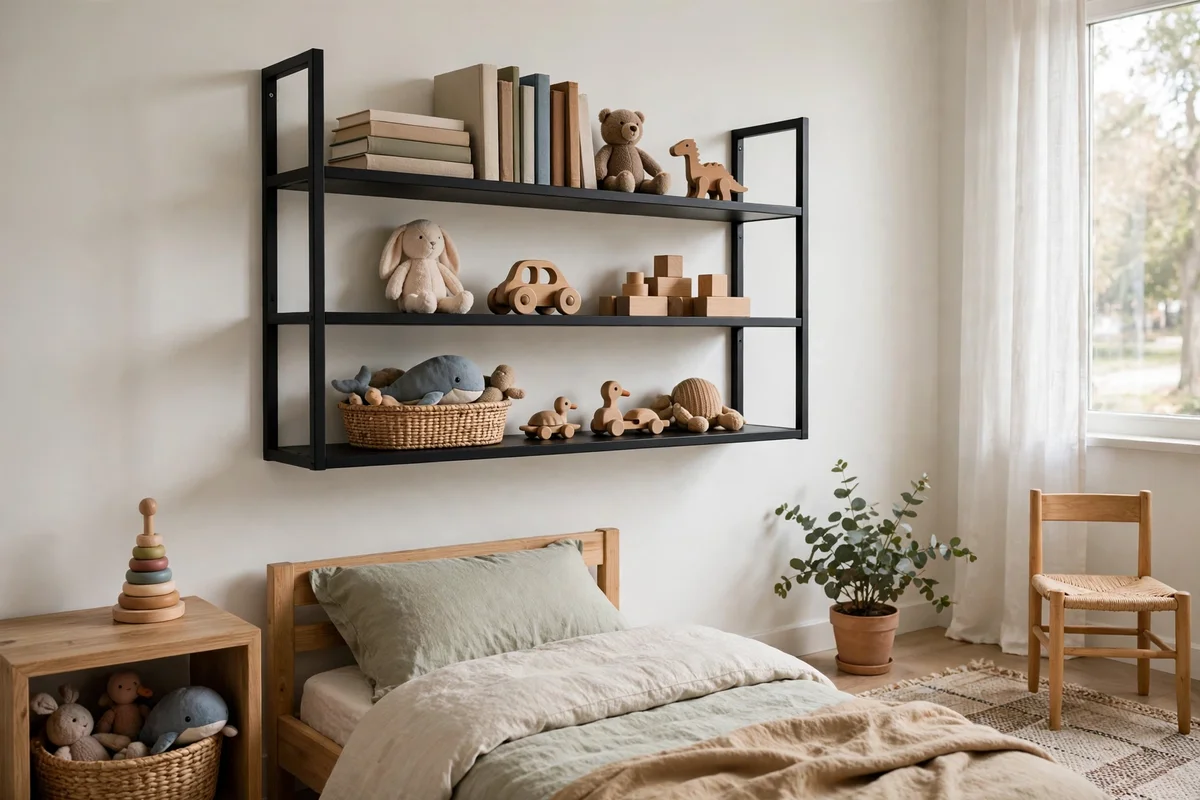
Black open shelves on a white wall do three things at once: they store books and toys, they draw a strong horizontal line across the room, and they frame whatever sits on them. A shelf of colourful books against a black shelf edge looks brighter than the same books on a white shelf, because the black makes the colours pop. Keep the shelves low enough for your child to reach, and keep them shallow enough that nothing can hide at the back. The rule for styling them is simple: books standing upright in a row, one or two objects per shelf, and empty space between groups, so the shelf reads as a display rather than a pile. Too many objects on a black shelf looks cluttered faster than on a white one, because the black edge draws the eye to every item. Fix the shelves to the wall properly with the right fixings for the wall type — plasterboard needs different fixings from brick — and never let a child climb them. A shelf that holds books is furniture; a shelf a child can pull down is a hazard, and the fixing is the part that matters most.
11. Make a monochrome reading corner
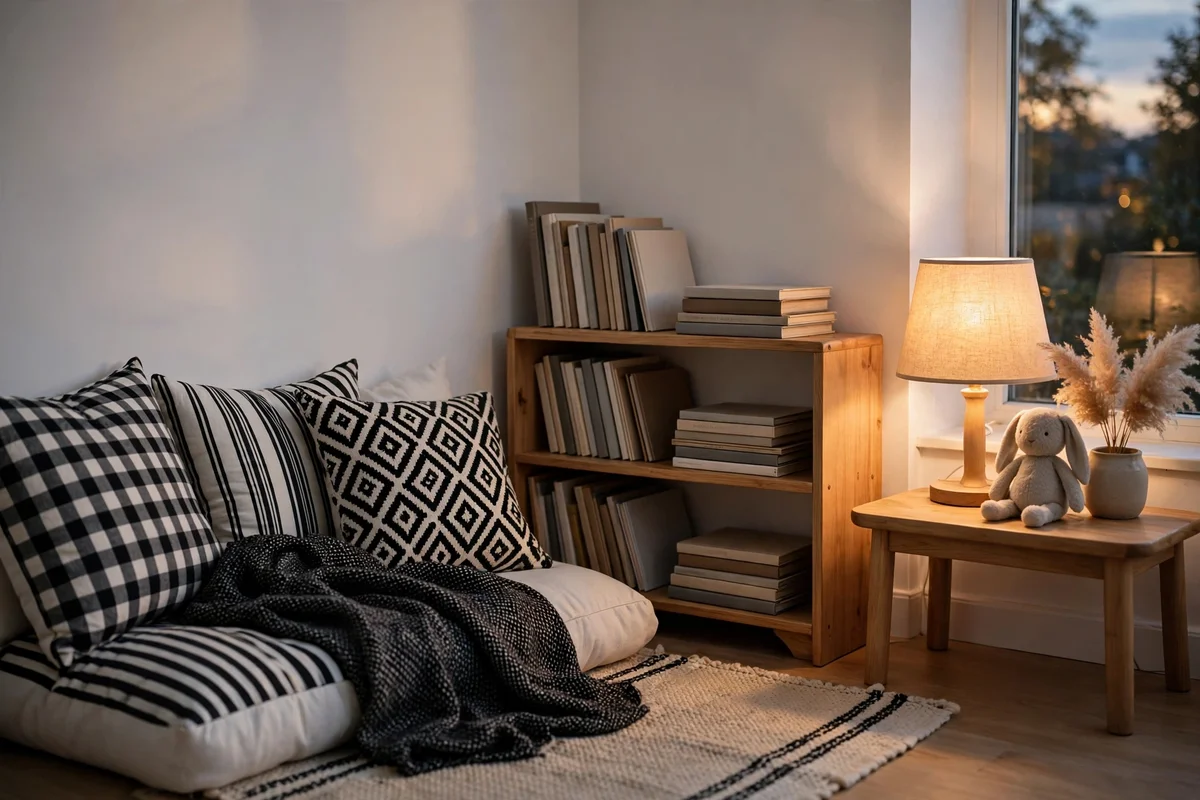
A reading corner is the cosiest corner a black and white room can have, and it needs very little: a comfortable seat, a light, and books within reach. A small armchair or a pile of floor cushions in black and white, a black and white striped cushion, a small bookshelf at arm's height, and a warm lamp are enough. The lamp matters more than the chair, because a reading corner is used in the evening, and a warm light against white walls makes the corner feel like a separate small room inside the big one. Keep the books facing outward where you can — a forward-facing shelf or a low basket of books lets a child choose by the cover, which is how children actually choose — and keep the corner free of toys, so it stays a reading place rather than a second play zone. This is the corner that gets used most in the house if it is comfortable, and it is the corner that gets ignored if the chair is too upright or the light is too dim.
12. Layer mixed textures
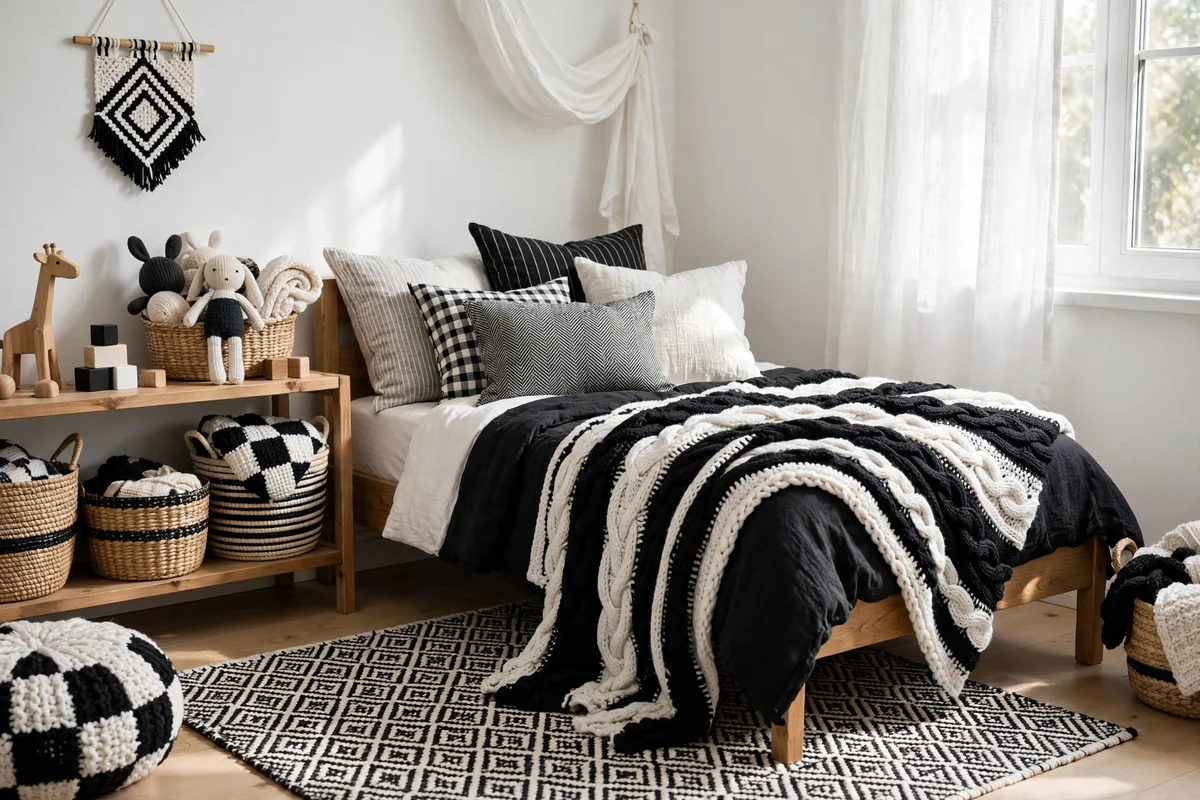
Texture is what stops a black and white room from feeling flat, and it is the cheapest softener in this whole list. A knitted throw over the end of the bed, a linen cushion on the chair, a woven basket by the door, a soft rug underfoot, and a cotton duvet cover are five different textures in the same two colours, and together they make the room feel warm in a way paint alone never can. The rule is to mix the textures deliberately: something soft (a knitted throw), something smooth (linen or cotton), something rough (a woven basket or a jute rug), and something hard (wood or metal). A room with only smooth surfaces feels cold; a room with only soft surfaces feels muffled. Wash the soft textures often, because a knitted throw and a floor cushion collect dust and crumbs, and a texture that is grubby stops being cosy. Keep one spare throw in the cupboard so the bed never looks bare while the first one is in the wash.
13. Tidy up with black storage baskets
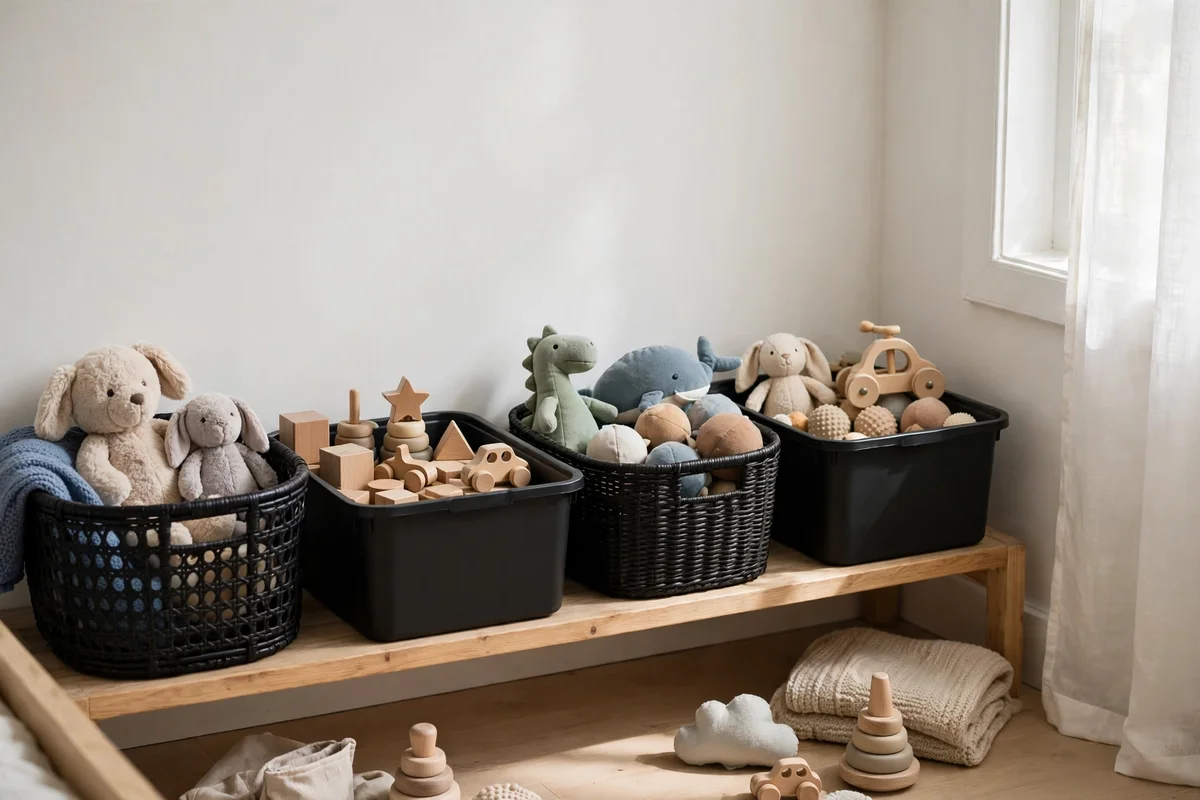
Black storage baskets are the workhorse of a black and white room: they hide the mess, they carry the palette, and they can be moved wherever the mess is. A row of black baskets on a low shelf, a large black basket for soft toys, and a set of smaller black bins for the small things — Lego, crayons, hair accessories — give every category a home, and a home is what makes tidying possible for a child. The system works best when it is simple: one basket per category, the basket labelled with a picture rather than a word for younger children, and the baskets low enough that putting something away is easier than leaving it on the floor. Woven baskets suit the farmhouse version of the room; plain fabric cubes suit the modern version; labelled bins suit a shared room, where each child's things need to stay separate.
Storage & display
14. Choose modern black lighting
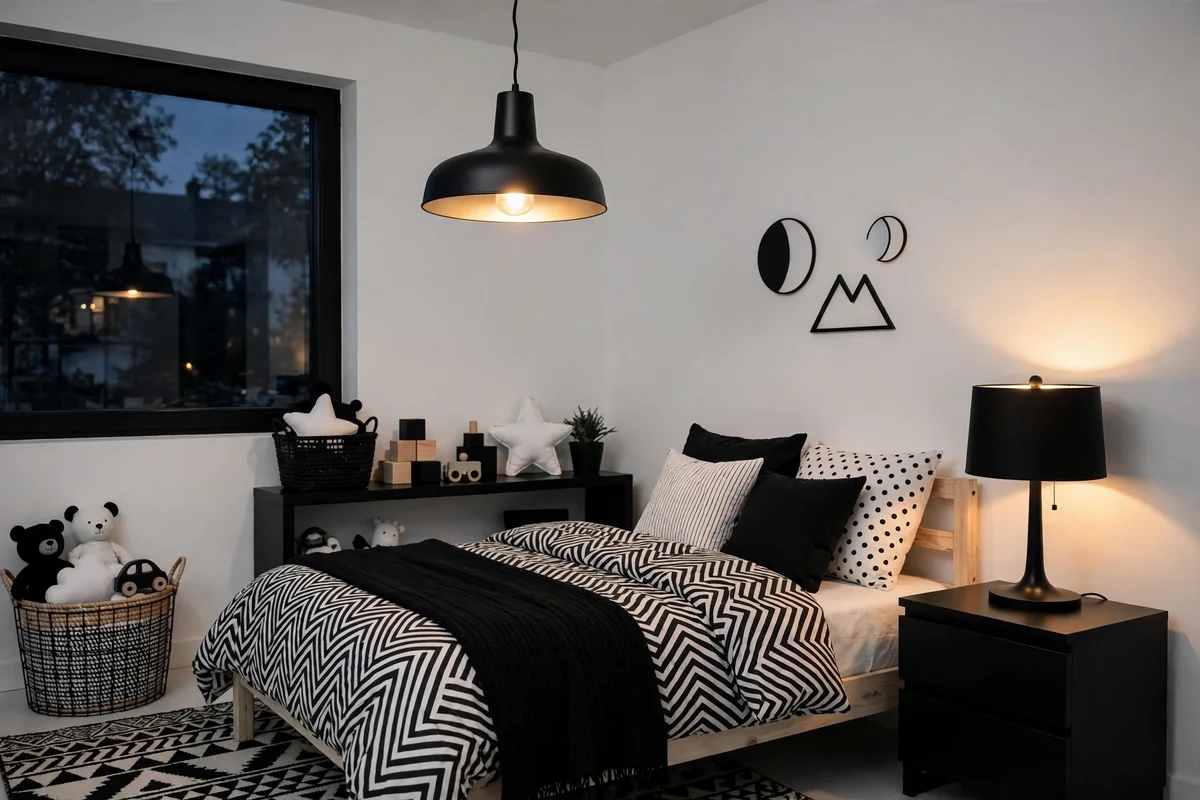
Lighting is the idea most people forget in a black and white room, and it is the one that makes every other idea look better after dark. A modern black pendant light over the bed or the desk, a black table lamp on the bedside table, and a warm bulb in both will make the black in the room look intentional rather than dark, because the light picks out the black shapes and gives them edges. Use warm white bulbs, not cool white, because cool white against black and white walls can feel clinical, while warm white feels cosy. Put the main light and the reading light on separate switches where you can, so the room can be bright for play and dim for bedtime without touching the main switch. And keep the lighting simple: one pendant, one bedside lamp, and one reading light are enough for most rooms, and a fourth light usually adds clutter rather than light.
15. Frame the windows in black
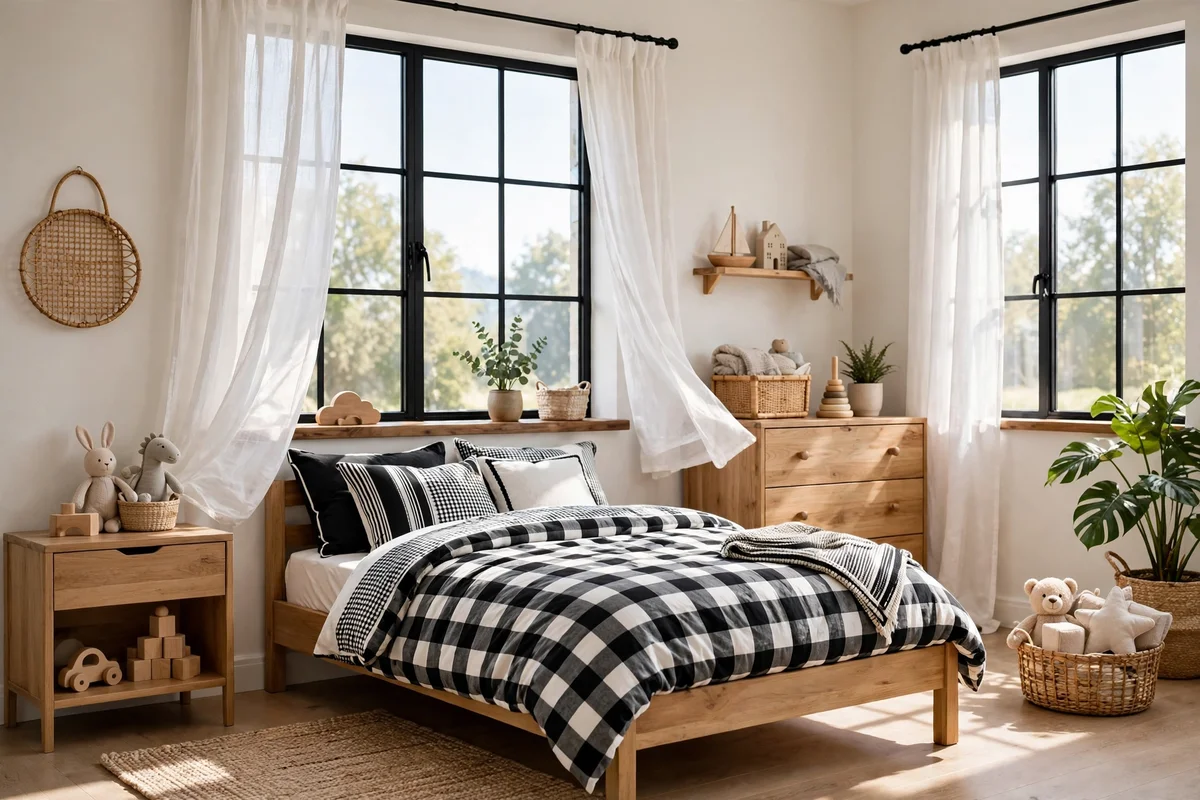
Black window frames are one of the strongest details in a black and white room, because a window is already a rectangle, and a black rectangle on a white wall is a picture. If the windows already have black frames, the room has a head start — dress them with plain white curtains and let the frames do the work. If the frames are white, you can get most of the effect by painting the frame, the sill, and the architrave black, which is a small job with a big return. White curtains soften the black and keep the room bright in the day, and a black curtain pole or a set of black curtain rings ties the window to the rest of the palette. The practical side matters here too: the curtains should be easy for a child to open and close, the cord — if there is one — should be fitted with a safety device and kept out of reach, and the window itself should have a restrictor if it opens wide enough for a child to climb through.
16. Allow exactly one colour accent
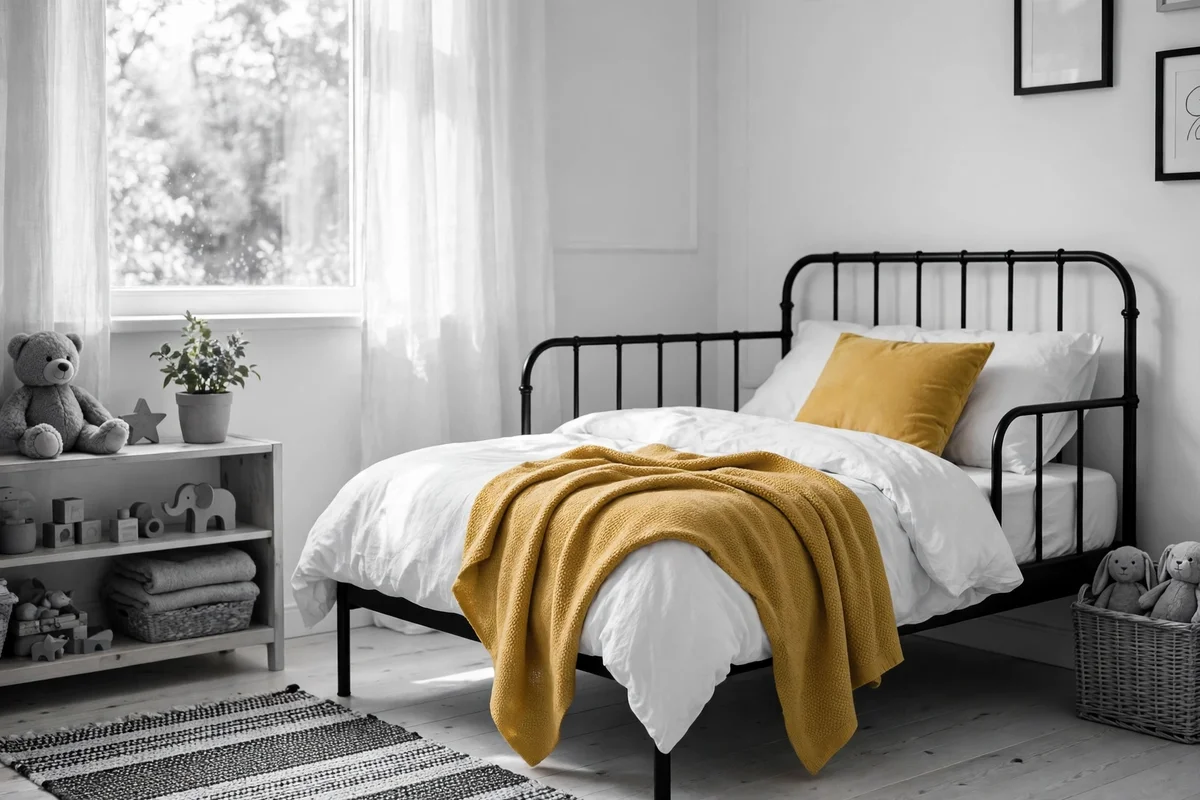
One colour, used sparingly, is what stops a black and white room from feeling like a rule rather than a home. A mustard cushion and a matching throw, a green plant on the windowsill, a pink lamp, or a single red toy on a shelf — one colour, in two or three places, and nowhere else. The colour should be one your child loves, because it is the one place in the room where their taste gets to speak loudly, and it should be easy to change, because the colour a child loves at five is rarely the colour they love at eight. The mistake is to allow a second colour, because two accent colours plus black plus white is four colours, and the room stops being monochrome and starts being colourful with a black and white base — which can work, but it is a different room, and it needs a different plan. If you want the accent to change with the seasons, change the cushion covers and the throw, not the furniture: a cushion cover costs little, and it is the easiest thing in the room to swap.
17. Add a chalkboard wall
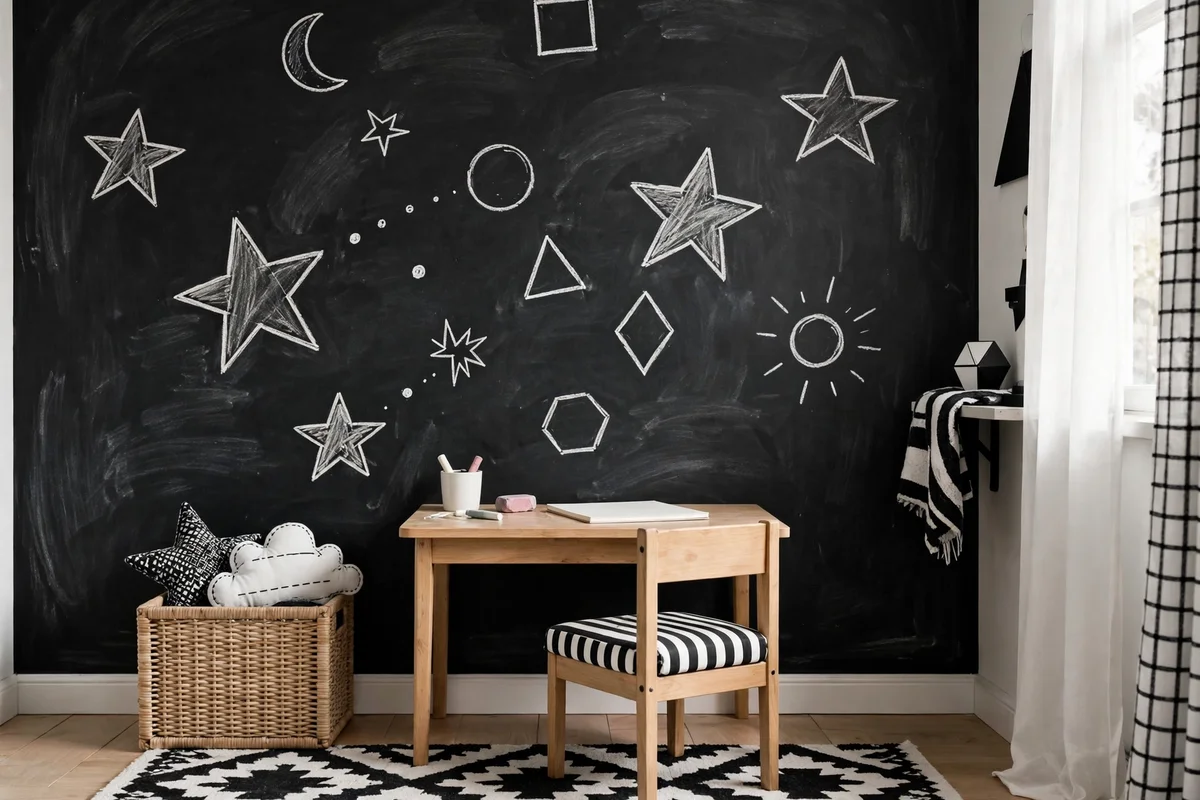
A chalkboard wall is the black and white idea that earns its keep every day, because it is a surface, not just a decoration. A section of wall painted with chalkboard paint gives your child a place to draw, practise spellings, leave messages, and plan the week — and it can be wiped clean and started again in a minute. Magnetic paint underneath, applied in three or four coats before the chalkboard paint goes on, adds a second function: magnets, photos, and artwork can be stuck up and moved around without tape or pins. Frame the chalkboard section with a strip of wood trim so it reads as a deliberate panel rather than a patch of black paint, and keep chalk and a small eraser in a pot on the shelf below it. This wall suits school-age children best, and it suits a study corner or the wall beside the desk more than the wall behind the bed, because a child draws standing up and needs space to step back.
Light & finishing touches
18. Swap in matte black fixtures and hardware
The smallest black details in a room are often the ones that make it look finished, because they are the details the eye catches last and remembers. Matte black handles on the dresser and the wardrobe, a matte black light switch plate, a black curtain pole, black hooks on the back of the door, and a black frame around the mirror — none of them is expensive, all of them can be changed in an afternoon, and together they tie the room's black pieces into a single system. Matte matters here: shiny black hardware can look cheap and shows fingerprints, while matte black looks considered and hides them. Change the handles first, because they are the hardware a child touches every day, and a handle that feels good to a small hand is worth more than a handle that only looks good. And check that every handle and hook is fixed tightly, because a loose handle on a drawer a child pulls hard is a handle that comes off in their hand.
19. Try checkerboard or spots in one small place
Checkerboard and Dalmatian spots are the two patterns that make a black and white room feel playful without making it feel busy, as long as they stay small. A checkerboard cushion on the bed, a spotted storage box, a checkerboard border on a plain rug, or a row of spots along the top of a wall are all enough — one small place, one pattern, and the rest of the room stays plain. The reason to keep it small is that both patterns are strong: a whole checkerboard wall can feel like a games board, and a whole spotted duvet can feel like a costume. Used in one place, they give the room a wink. Let your child choose between the two — spots or squares — because it is a choice with no wrong answer, and a child who chose the pattern will defend it long after you would have changed it.
20. Let your child's personality finish the room
The last idea is not a purchase or a paint job; it is the permission to stop. A black and white room is a stage, and the stage is finished when your child's things are on it: their drawings in the black frames, their favourite toy on the shelf, their books facing out, their name on the door in black letters, their collections in the baskets. A monochrome room with nothing personal in it looks like a showroom. The same room with a child's drawings, their trophies, and their half-finished Lego build on the desk looks like a home. The black and white palette will hold the room together no matter what goes on that shelf, because every colour looks good against it. That is the whole point of the palette: it does the hard work of looking intentional, so your child is free to fill it with whatever matters to them right now.
Small Rooms and Shared Rooms
A small black and white room needs the black kept to lines and details. Keep the walls white, use a black bed frame or black handles rather than a black wall, choose a rug with a fine pattern rather than a bold one, and keep at least one wall completely plain so the eye has somewhere to rest. Vertical stripes on one wall can make a low ceiling feel taller, and a mirror opposite the window bounces light into a dark corner. A floor bed in a small room keeps the black low, which makes the room feel taller, and low storage — baskets and low shelves rather than a tall wardrobe — keeps the walls clear. The 70/30 rule matters most in a small room, because a small room has less white to spare; if the room starts to feel dark, swap one black thing for a white one before you consider repainting.
A shared room needs a palette both children can live with, and a way for each child to have their own colour inside it. Black and white is the easiest palette for a shared room, because it takes no side: neither child's favourite colour is the wall colour, and both children's favourite colours look good against it. Give each child one signature colour inside the shared scheme — one child's bedding in blue, the other's in green, or one child's cushion in mustard and the other's in pink — while the walls, the furniture, and the storage stay black and white. If the beds are on opposite walls, each bed wall can carry its own small accent — a painted arch, a strip of wallpaper, a cluster of decals in that child's colours — with the shared wall kept neutral.
Black And White Rooms by Age
A nursery in black and white should be soft and high. Keep the black up where a baby can see it but not reach it — a patterned cot sheet, a black and white mobile, a framed print above the changing table — and keep the surfaces a baby touches pale and soft. A whole black wall behind a cot is stimulating at exactly the time you want calm, so keep the cot wall white or very pale. Everything within reach of the cot should be washable, and anything hung above it should be fixed securely.
A toddler's room can be bolder, because toddlers use the room for play as much as sleep. A striped wall, a chalkboard panel low enough to reach, decals at toddler height, and a rug with a bold pattern all suit this age. Keep the design to one wall and one idea, because toddlers change their minds fast and a room with three ideas is a room that needs redoing three times as often. Low furniture, a floor bed, and baskets a toddler can reach make the room usable, and a black and white palette makes the inevitable bright plastic toys look like they belong.
A school-age child's room can carry the strongest version of the palette. This is the age for the black feature wall, the geometric pattern, the gallery wall with their own art, and the chalkboard wall. Let them choose between options you have already approved — "stripes or spots?" — rather than facing the whole paint chart, and the room will feel theirs without becoming a colour you regret.
A pre-teen's room needs the palette to feel grown-up, not themed. Mostly white, black in the furniture and the frames, one pattern at most, and no decals. This is the age where a wall of spots starts to feel young, and where the room should be chosen so it can stay for several years. The calmest version of the palette is the right one here, because a pre-teen's tastes change fast and the room needs to survive several changes of mind without a repaint.
A Weekend Plan: Friday to Sunday
A black and white room does not need a month of planning. It needs a clear order, because painting before you have measured, or buying bedding before you have chosen the wall, creates the rework that eats weekends.
On Friday evening, choose the approach — modern, farmhouse, or playful — and the one wall that will carry the pattern or the black, if any. Measure the wall, write down the width and the height, and note where the sockets, light switches, and skirting boards sit. Make the shopping list and buy only what is on it: paint or wallpaper, tape, a roller, bedding, a rug, baskets, and any hardware. Wash the new bedding and cushion covers so they are ready for Sunday. Move the furniture away from the wall you will work on, protect the floor, and put the toys in boxes so the room is clear to work in.
On Saturday, do the messy work: paint the wall or hang the paper, paint the piece of furniture if you are painting one, and fix the shelves, hooks, and any anti-tip kits while the room is empty. While the paint dries, assemble the storage baskets and label them, and swap the handles on the dresser and wardrobe. Do not try to hang art or arrange shelves while paint is wet; it will get marked, and the art will have to move anyway once the furniture is back.
On Sunday, put the room back together in this order: bed and bedding first, then the rug, then storage, then the reading corner, then wall art and decals last. Finish by walking to the door and looking at the room as a visitor would — the view from the door is the view that matters most, because it is the one you see every day. If the room feels dark, swap one black thing for a white one. If it feels bare, add one texture — a throw, a cushion, a basket — rather than one more colour.
Budget: Three Rough Ranges
A black and white room does not have to be expensive. The difference between the three ranges below is how much is painted and how much is bought ready-made, not how good the result looks. These are rough ranges only, not researched prices — costs vary by shop, size, and quality, so treat them as a planning guide.
A refresh under $50 uses paint you already own or one tin of washable white paint, a roll of painter's tape for stripes, a set of removable decals, a black and white cushion cover, and art your child has already made in clip frames. The room changes without any new furniture, and it takes an afternoon. This is the best place to start if you are unsure the palette suits your child, because everything in it can be undone in a weekend.
A mid-level refresh, roughly $50 to $200, adds the pieces that make the biggest difference: a black and white duvet set, a rug, a set of black storage baskets, a tin of washable black paint for one feature wall or one piece of furniture, and a black pendant light or table lamp. This is the range most families choose, because it changes the room properly without changing the furniture.
A full redo, $200 and up, adds new furniture in the palette — a black bed frame, a white dresser, a bookshelf — plus a black and white rug, full storage, layered lighting, and a chalkboard wall or a panelled feature wall. This is worth doing when the room is being redecorated anyway — a new bed, new flooring, or a move — rather than as a standalone project. If you are spending at this level, spend it on the things that are hardest to change later: the bed, the storage, and the lighting. Bedding and art can always be upgraded later, one piece at a time.
Whatever the budget, buy the paint after you have chosen the bedding and the rug, not before. Paint comes in thousands of shades and bedding in dozens, so it is easier to match paint to bedding than bedding to paint — and a paint sample pot costs far less than a duvet set bought in the wrong shade.
Mistakes That Make Black And White Rooms Look Wrong
The most common mistake is too much black. A black wall plus a black bed plus black furniture plus a black rug is a dark room, not a monochrome room, and the fix is not a brighter lightbulb but a whiter thing: swap the black duvet for a white one, or the black rug for a pale one, and the room will lift immediately. Check the ratio from the doorway, and if the room reads as mostly dark, remove one black thing before you add anything else.
The second mistake is too many patterns. Stripes on the wall plus a geometric duvet plus a chevron rug plus spotted cushions is four patterns arguing, and the room looks busy rather than bold. Pick one patterned piece — the wall, the bedding, or the rug — and keep the rest solid colours drawn from the same palette. Solid colours let the pattern breathe, and the pattern gets the credit.
The third mistake is no texture and no softener. A room with black and white paint, black and white bedding, and nothing else — no wood, no wool, no woven basket, no plant — feels cold and clinical, and children do not settle in it. Add one wooden thing, one knitted thing, and one woven thing before you decide the palette has failed. Texture is the difference between a showroom and a bedroom.
The fourth mistake is ignoring the light. A black feature wall in a dark, north-facing room can feel heavy, and a brilliant white wall in a bright, south-facing room can feel glaring. If the room feels wrong and the colours looked right in the shop, the light is usually the reason. Swapping a black wall for a black bed frame, or a brilliant white for a warm white, often fixes it without redecorating.
The fifth mistake is forgetting that black shows everything. Black paint shows every fingerprint, every scuff, and every dust mark that a lighter colour would hide. Use a washable finish on black walls and black furniture, and keep a cloth handy.
How the Room Grows Up
The best thing about a black and white room is how little has to change as your child grows. When your child outgrows the spots and the stripes, peel off the decals, swap the patterned duvet for a plain white one, take down the themed prints, and change the cushion covers. That alone removes most of the theme, and the room will already feel older. The black bed frame, the white dresser, the black shelves, and the storage baskets can all stay, because they were never really part of the theme at all.
If that is not enough, repaint the one black wall in a single colour drawn from the room — a soft grey, a warm white, or a deep navy — and keep the black furniture, which will now look like a deliberate choice rather than part of a theme. And the gallery wall can grow up with your child, swapping drawings for photographs, posters, and certificates without the frames ever needing to change.
This is also why monochrome is one of the safest palettes for a room that needs to last into the pre-teen years. A black and white base with plain bedding and a black bed frame reads as design rather than decoration, and a pre-teen who would be embarrassed by a themed wall is usually happy with a monochrome one. If you want a sense of how a kids room can be planned to last into the older years, the Big Kids Room Ideas guide covers rooms designed for children who are growing out of the little-kid stage — and monochrome is one of the palettes that makes that transition easiest, because the base never needs to change, only the details on top of it.
Frequently Asked Questions
Is black and white too dark for a kids room?
Not if white leads. Keep roughly seventy percent of the room white or pale — the walls, the ceiling, the bedding, the large furniture — and let black take the remaining thirty percent in lines and shapes. A bright room can carry a black feature wall; a small or dark room should keep the black to frames, handles, and bedding. If the room feels dark, swap one black thing for a white one rather than repainting.
What is the 70/30 rule in a black and white kids room?
It is the ratio that keeps the palette balanced: about seventy percent white and pale tones, about thirty percent black. White is the background and black is the drawing on top of it — the bed frame, the rug, the frames, the handles. When black is used as a line, the room feels graphic and intentional; when it is used as a block, the room feels heavy.
Can I do a black and white room in a rental?
Yes, and it is one of the easiest palettes for a rental, because most of it needs no paint at all. White walls are usually already there. Black and white bedding, a rug, black storage baskets, black frames, and removable decals give you the whole look without touching the walls, and peel-and-stick wallpaper on one wall gives you the pattern with nothing permanent. Everything peels off or packs up when you move.
How do I stop a black and white kids room from feeling cold?
Add wood, grey, and texture. Natural wood furniture or woven baskets warm the palette, a soft grey throw or cushion sits halfway between the two colours, and layered textures — a knitted throw, linen cushions, a soft rug — make the room feel cosy. One green plant on the windowsill also helps, and it is the only colour the room needs.
What accent colour works best with black and white?
One colour, used in two or three places: mustard or ochre for warmth, green for life, pink for softness. The colour should be one your child loves and easy to change — a cushion cover and a throw, not furniture. Do not add a second accent colour, because two accents plus black plus white is four colours, and the room stops being monochrome.
How do I make a black and white room work for two children sharing?
Keep the base black and white and give each child one signature colour inside it — one child's bedding in blue, the other's in green, or one child's cushion in mustard and the other's in pink. Colour-coded storage baskets keep each child's things separate, and each bed wall can carry a small accent in that child's colour while the shared wall stays neutral.
Final Checklist Before You Start
- Pick the direction — modern, farmhouse, or playful — from the furniture and light you already have.
- Check the ratio: roughly seventy percent white, thirty percent black, with black used as lines, not blocks.
- Keep the walls white unless the room is bright enough for one black feature wall.
- Choose one pattern — the wall, the bedding, or the rug — and keep the rest plain.
- Add wood, grey, and texture before you decide the room feels cold.
- Allow at most one accent colour, in two or three places, and make it easy to change.
- Fix shelves, tall furniture, and anything climbable to the wall with anti-tip kits.
- Use washable paint on black surfaces, because black shows every mark.
- Put the art and decals up last, once the furniture is in place.
- Leave at least one wall completely plain, so the room has somewhere for the eye to rest.
A black and white kids room does not need to be perfect, and it does not need to be finished in one go. Start with white walls and the 70/30 rule, add one pattern and one softener, and let your child's drawings, books, and favourite things fill the rest. The rooms children love most are rarely the ones with the most colour on the walls — they are the ones where the palette stays calm, the toys have a home, and there is a comfortable corner to sit in. Get those three things right, and black and white takes care of itself.