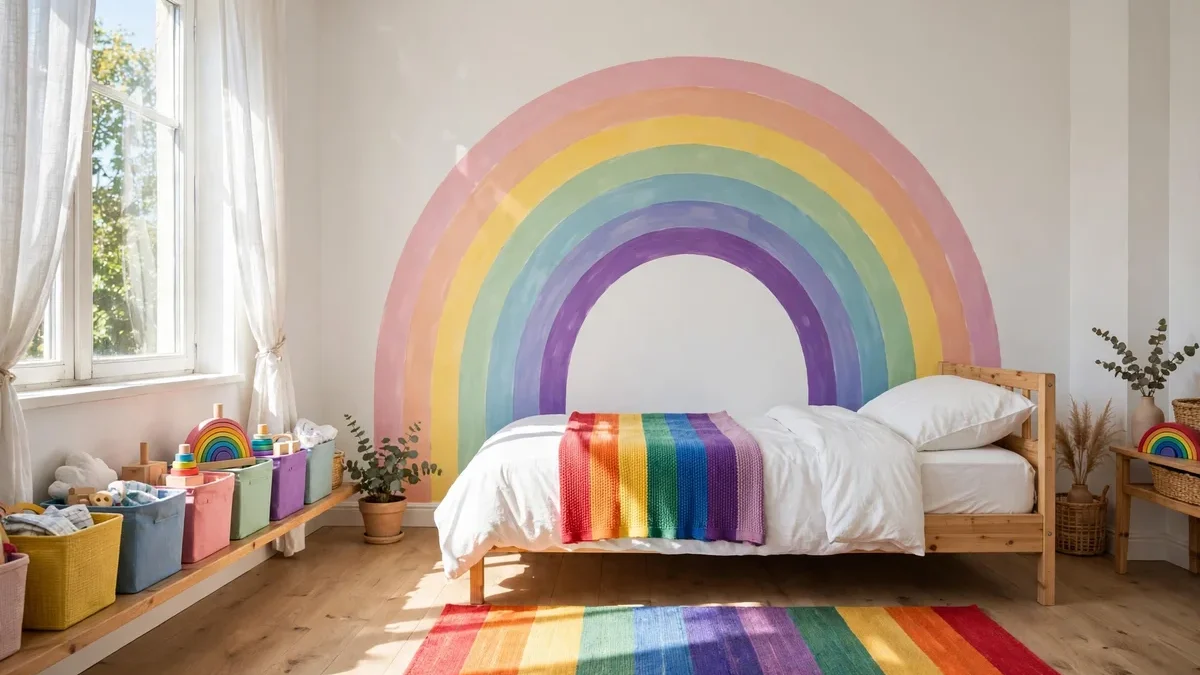
Rainbow Kids Room Ideas
A rainbow kids room works best when the colour has a plan behind it. Pick one palette, put the boldest colour on one wall or one zone, and repeat each colour at least twice around the room so nothing looks random. That is the whole trick. Everything else — the mural, the bedding, the storage bins, the reading corner — is just a way to carry out that plan.
If you want the short version: choose pastel, bold, or muted rainbow colours before you buy anything. Paint or paper a single feature wall, keep the other walls and the big furniture neutral, and let bedding, a rug, and storage do the rest of the colour work. A room done this way feels cheerful without feeling loud, it is easy to tidy, and you can change it in a weekend when your child outgrows it. The ideas below are arranged in the order most parents actually use them — walls first, then the bed, then the floor, then storage, then the little zones that make the room feel finished.
How to Keep a Rainbow Room From Looking Chaotic
Three simple rules keep a rainbow room calm. First, limit yourself to six colours, one for each band of the rainbow, and use the same six shades everywhere. A red that is cherry on the wall should be cherry on the pillow, not brick red on the rug and tomato red on the curtains. When shades drift, the room starts to look like a jumble rather than a theme.
Second, give every colour a job. Red might be the bed frame and one storage bin. Yellow might be the reading lamp and the desk chair. Blue might be the rug and the curtains. When a colour appears in two or three places, the eye reads it as a pattern. When it appears once, it reads as an accident.
Third, leave breathing room. White, warm cream, pale wood, or soft grey on at least half the room lets the bright colours stand out instead of competing with each other. This is why so many rainbow rooms that look good in photos have plain white bedding under a rainbow quilt, or a plain wooden bookshelf holding rainbow-coloured books. The neutral parts are doing as much work as the colourful parts.
A useful test before you buy anything: gather the items you already own that you plan to keep — the bed, the dresser, the rug — and lay paint swatches or fabric samples next to them in daylight and again under the bedroom lamp at night. Colours shift more than people expect between those two lights. A lavender that looks soft in the shop can turn grey-blue at night, and a sunny yellow can turn mustard. If a swatch looks wrong in either light, pick a different shade of the same colour rather than a different colour altogether.
Pick Your Palette First: Pastel, Bold, or Muted
The palette is the one decision that affects everything else, so make it before you shop. There are three palettes that work reliably in children’s rooms, and each one suits a different kind of room and a different kind of child.
Pastel rainbow is the softest option: blush pink, peach, butter yellow, sage green, powder blue, and lavender. It suits nurseries, small rooms, and north-facing rooms that get cool light, because the pale colours keep the space feeling bright. It also suits children who find strong colour overstimulating at bedtime. The trade-off is that pastels show marks more easily, so washable paint and washable cushion covers matter more here than in any other palette.
Bold primary rainbow is the classic: cherry red, bright orange, sunny yellow, emerald green, cobalt blue, and vivid violet. It suits big rooms with plenty of daylight, playrooms, and children who love strong colour. It photographs well and it is the easiest palette to shop for, because most rainbow bedding, rugs, and toys are made in these shades. The trade-off is that it needs the most neutral space around it — white walls on three sides, plain wood furniture — or it can feel overwhelming by bedtime.
Muted or earthy rainbow is the grown-up of the three: terracotta, mustard, olive green, dusty teal, faded indigo, and muted plum. It suits rooms that need to last for years, shared rooms where two children have different tastes, and homes where the children’s room opens onto a living area and needs to look settled rather than loud. It is also the easiest palette to live with if you are painting furniture, because a mustard dresser looks intentional in a way a bright orange one sometimes does not. The trade-off is that it is harder to shop for — fewer ready-made rainbow products come in these shades, so you will paint, dye, or sew more of it yourself.
| Palette | Best for | Watch out for | Easiest to change later |
|---|---|---|---|
| Pastel | Nurseries, small rooms, calm sleepers | Shows marks; needs washable finishes | Bedding and art swap out easily |
| Bold primary | Big bright rooms, playrooms, colour-loving kids | Needs lots of white/wood balance | Bedding and rug swap out easily |
| Muted/earthy | Shared rooms, rooms that must last years | Harder to find ready-made products | Painted furniture is the slow part to undo |
If you cannot decide, look at the room at 7 p.m., when your child is actually in it winding down. If the light is warm and dim, pastels will glow and bold colours will deepen; if the light is bright white, bold colours will stay punchy and pastels can look washed out. Let the evening light choose.
The One-Wall Rule: Where the Rainbow Goes
Every good rainbow room has one place where the colour is concentrated, and everywhere else the colour is an echo. That one place is usually the wall behind the bed, because it is the first thing you see from the door and the backdrop for the bed itself. A painted rainbow arch, a mural, a strip of wallpaper, or a set of removable decals all work on that wall. The key is that it is one wall, not four.
If the bed is against a short wall, a single wide arch in six bands, centred over the bed, is usually enough. The arch should be roughly the width of the bed plus a little extra on each side, so the bed looks framed rather than crowded. If the bed is against a long wall, a horizontal band of stripes or a mural that runs the length of the wall works better, because a small arch on a long wall can look lost.
The wall opposite the bed is the second-best spot, and it suits a different kind of feature: a gallery wall of rainbow prints, a bookshelf with colour-ordered books, or a row of wall shelves painted in rainbow order. This works well when the bed wall has a window or a wardrobe in the way, and it gives a child something colourful to look at from bed without the colour being right behind their head.
The ceiling is the third option, and it is the one people forget. Rainbow stripes or a soft gradient on the ceiling turn bedtime into something a child looks up at, and it leaves every wall free. It suits rooms where the walls are already busy with doors, windows, and built-in storage. It is also the hardest to repaint later, so it is best saved for a room you expect to keep for several years, or done with removable decals rather than paint.
Whichever wall you choose, measure it before you buy paint or wallpaper. Write down the width and height, note where the sockets, switches, and skirting boards are, and check whether the wall is straight — older houses often have walls that lean slightly, which matters for wallpaper and for straight painted stripes. A tape measure and ten minutes now save a second trip to the shop later.
18 Rainbow Kids Room Ideas You Can Actually Copy
Walls
1. Paint a rainbow arch behind the bed
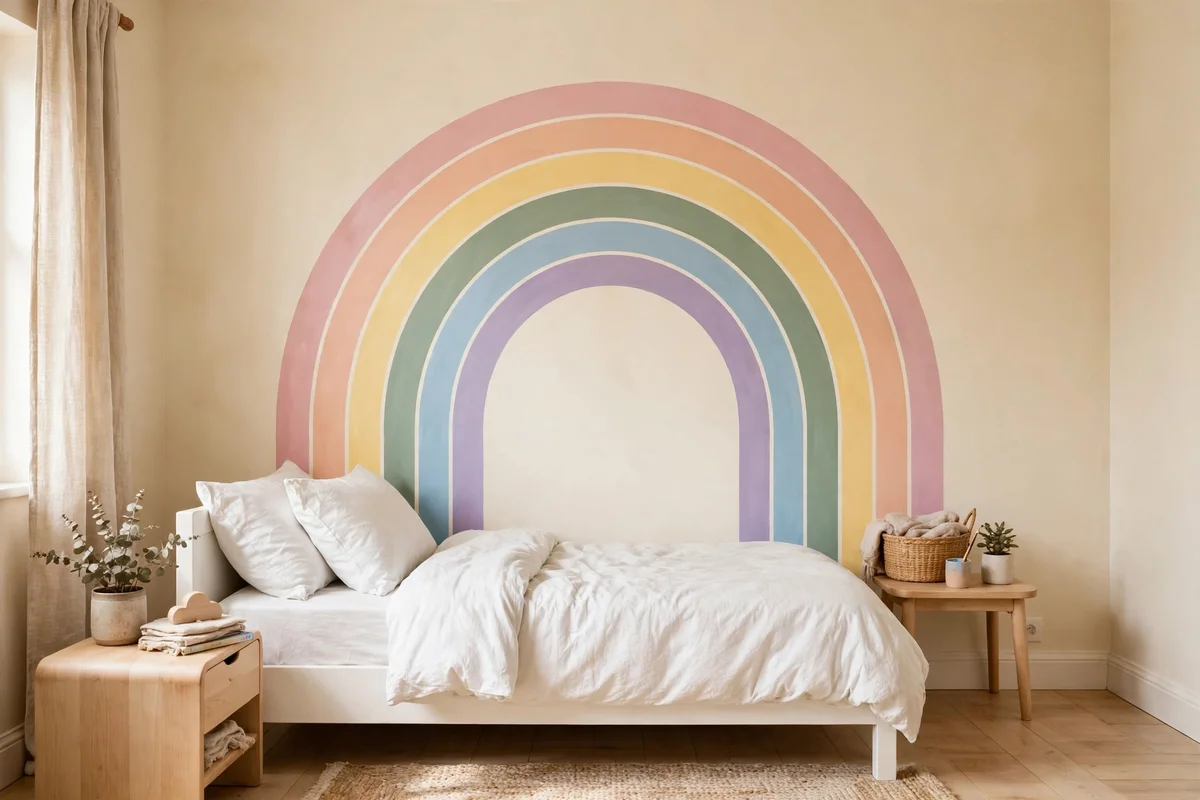
A painted arch is the most forgiving rainbow feature wall there is. You do not need to be good at painting — an arch is a series of curved bands, and a slight wobble reads as handmade rather than wrong. Mark the centre of the bed on the wall, tie a pencil to a piece of string, pin the string at the centre point, and draw each band with the string as a guide. Paint the widest band first and work inward, letting each band dry before you start the next so the edges stay clean. A low-sheen washable paint is the practical choice here, because a feature wall behind a bed gets touched, leaned on, and bumped by pillows. If you are renting, the same arch can be made with removable wall decals in arch shapes, which peel off without taking paint with them.
 Save this image to Pinterest (opens in a new tab)
2. Try a mural — or a mural that is only half a mural
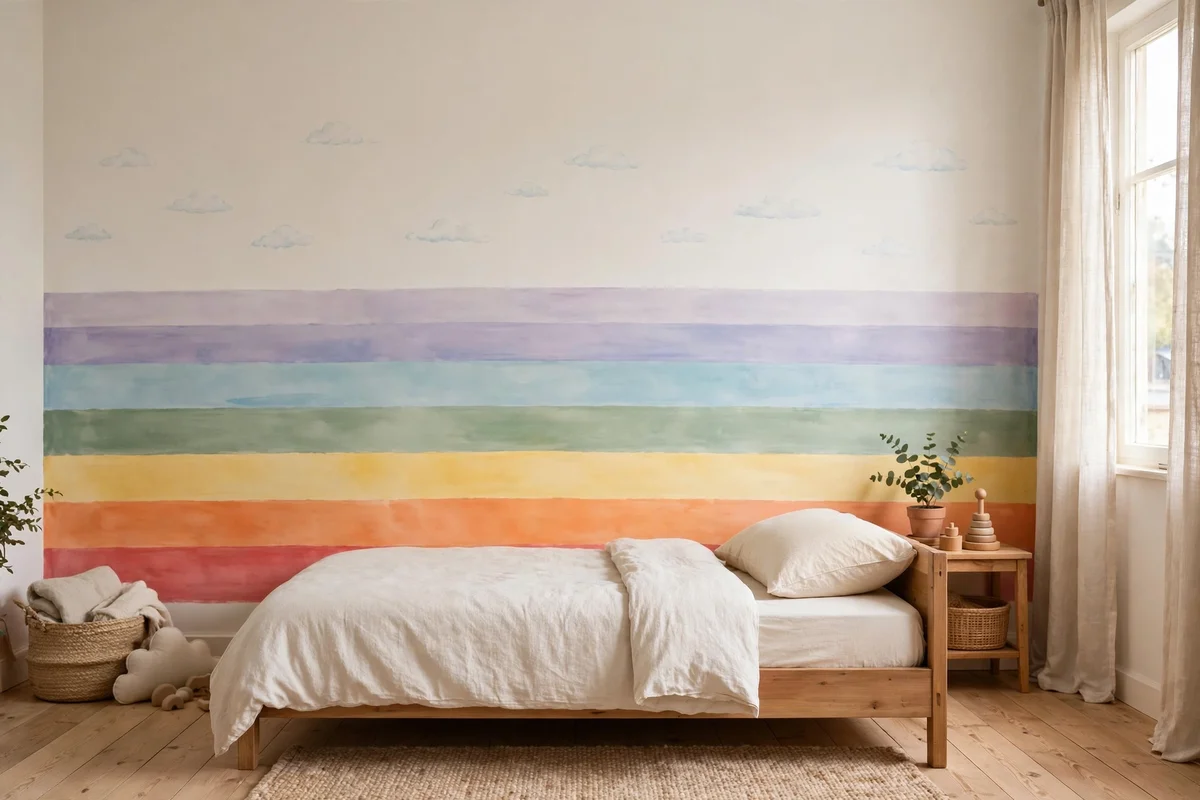
A full rainbow mural, with clouds and hills and a sun, looks wonderful in a playroom. In a bedroom, a simpler version usually works better: rainbow bands rising from behind the bed and fading into plain wall, or bands that start at the skirting board and stop halfway up the wall, like a sunrise. The half-height version has a practical advantage — the lower half is the part that gets scuffed by toys and feet, and a painted band hides scuffs far better than white paint does. If painting freehand feels daunting, painter’s tape and a spirit level give you straight stripes, and a large round bowl or plate gives you the curve for an arch. Leave the mural to dry fully before pushing the bed back against the wall, or the bed frame will leave a mark in soft paint.
 Save this image to Pinterest (opens in a new tab)
3. Use removable rainbow decals for a no-commitment start
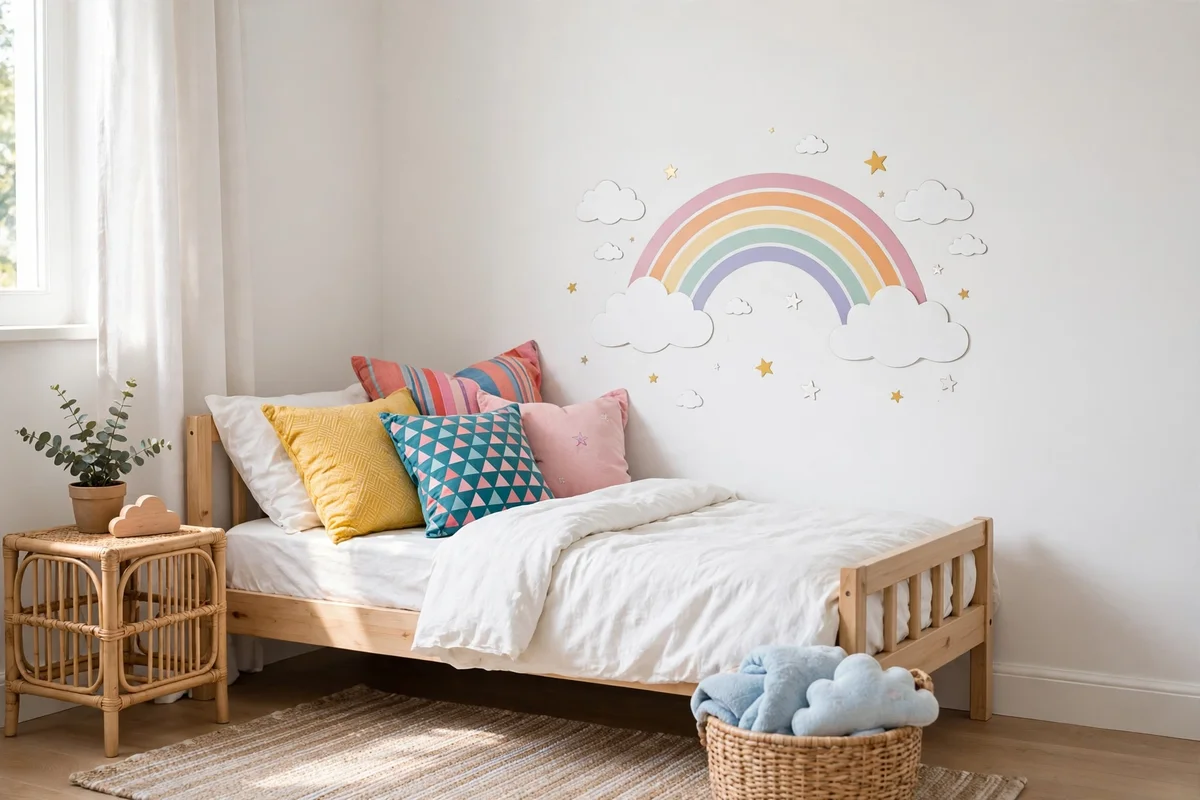
Decals are the right first step if you are unsure about the theme, if you rent, or if your child changes their mind often. A set of rainbow, cloud, star, and heart decals can cover a wall in an afternoon, and they can be moved when the furniture moves. Put the largest rainbow at eye level from the bed, not up near the ceiling where it is hard to see, and cluster smaller decals around it rather than scattering them evenly across the wall — a cluster reads as a design, while evenly spaced decals can look like a pattern that ran out of ideas. Keep a few spare decals in a drawer; when one peels at the corner, replacing it takes a minute, while re-sticking a peeling decal rarely holds.
 Save this image to Pinterest (opens in a new tab)
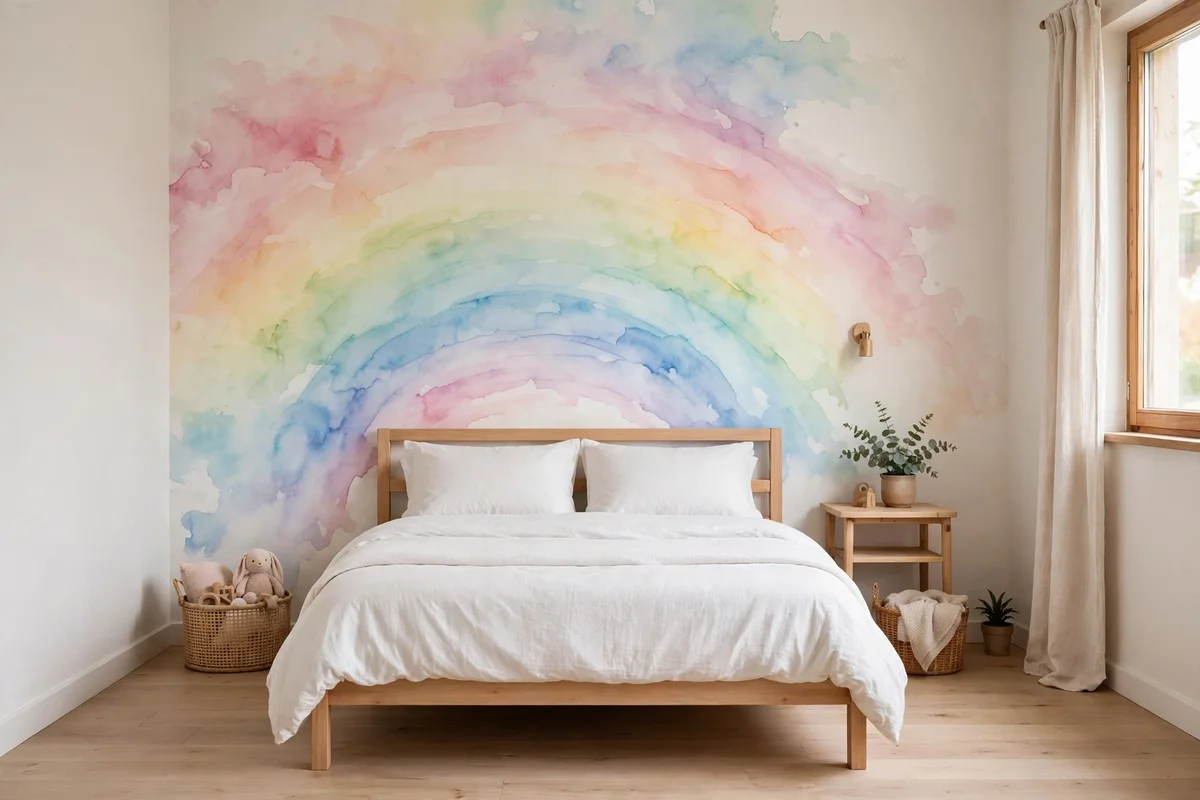
4. Hang one strip of rainbow wallpaper
Wallpaper makes the biggest impact for the least painting skill, and one strip or one wall is all you need. A watercolour rainbow print softens a room, a geometric rainbow sharpens it, and a narrow vertical stripe in rainbow order makes a low ceiling feel taller. Paste-the-wall wallpaper is the easiest type for a first attempt, and many modern wallpapers peel off cleanly, which matters in a child’s room. Before you order, buy one roll and check the pattern repeat — a large rainbow motif may need more rolls than the coverage on the packet suggests, because you lose paper matching the pattern at each join. Apply it to the bed wall, and keep the other walls plain so the pattern has room to breathe.
 Save this image to Pinterest (opens in a new tab)
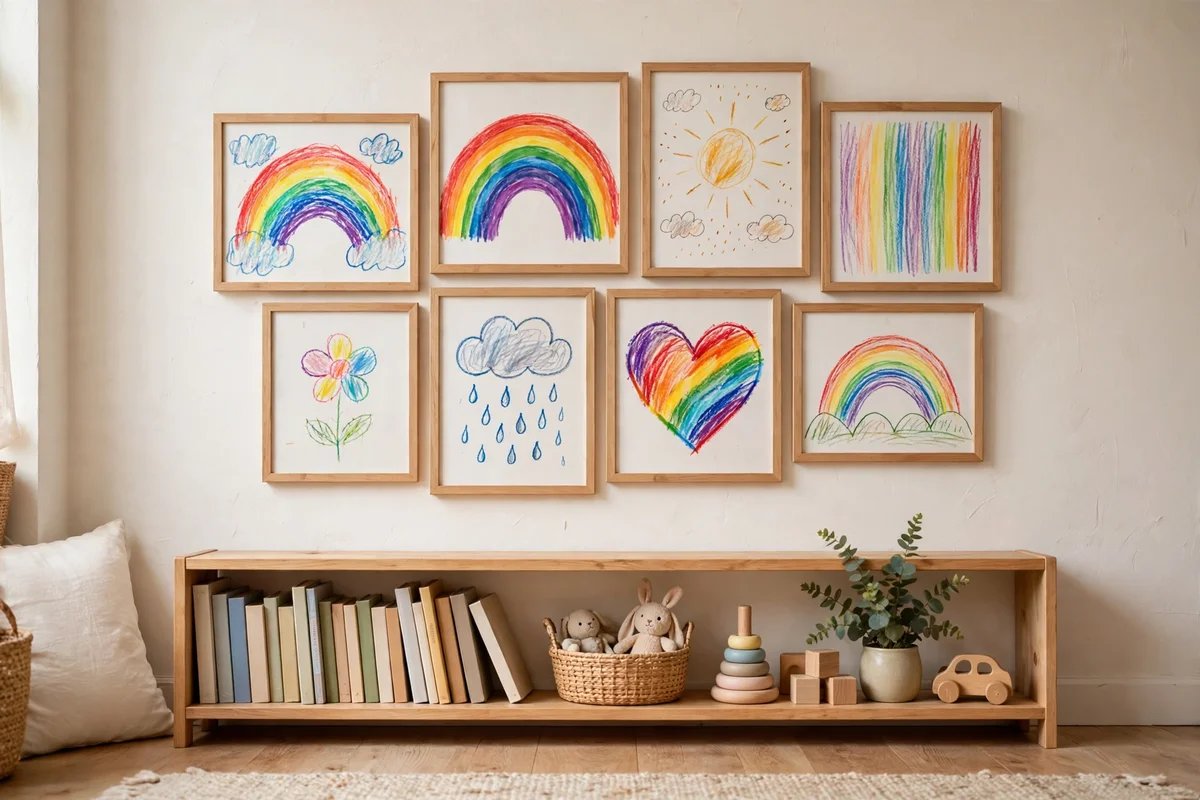
5. Build a rainbow gallery wall with your child’s own art
A gallery wall is the one rainbow feature that gets better over time, because it grows with your child. Start with three or four framed rainbow prints in matching frames — same frame colour, different art inside — and leave empty space for your child’s drawings. A simple clip frame or a magnetic poster hanger lets you swap art without tools. Arrange the frames on the floor first, take a photo of the arrangement you like, and then hang them using the photo as a guide. Keep the frames at your child’s eye level, not adult eye level, so the wall belongs to them. A gallery wall also solves the problem of what to do with school art: instead of a pile on top of the wardrobe, the best pieces go on the wall and the rest go in a folder.
 Save this image to Pinterest (opens in a new tab)
The bed
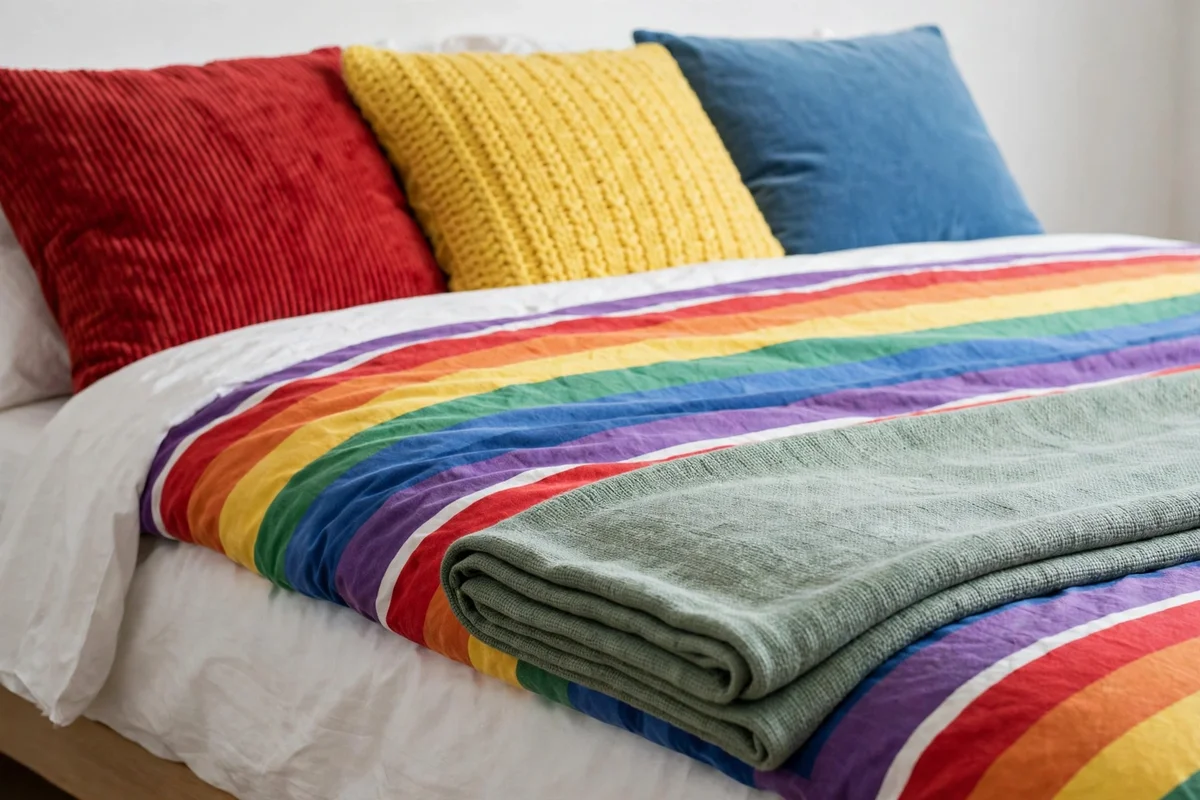
6. Let the bedding do the colour work
Bedding is the fastest rainbow change you can make, and the easiest to reverse. A rainbow-striped duvet cover, a watercolour rainbow quilt, or plain white sheets with a rainbow throw across the foot of the bed all work. The trick is to pick one colourful piece and keep the rest plain: a rainbow duvet with white pillowcases, or white bedding with rainbow pillows. If everything on the bed is rainbow, the pattern fights with itself. Layering helps here — a flat sheet in one rainbow colour, a throw in another, and a cushion in a third gives depth without clutter. Choose bedding you can wash often, because children’s bedding gets washed more than any other textile in the house, and check that the colours are colourfast before the first wash by washing the pillowcase alone.
 Save this image to Pinterest (opens in a new tab)
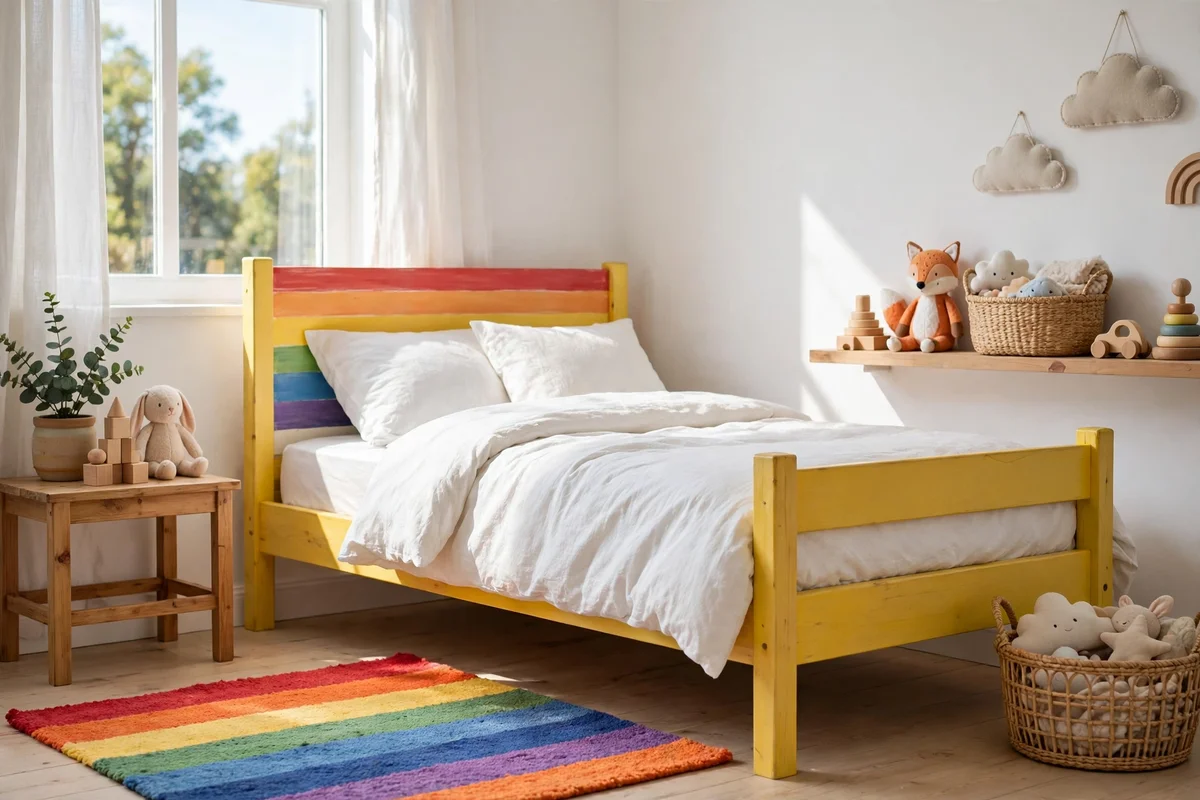
7. Paint the bed frame — or just the headboard
A painted bed frame turns the biggest piece of furniture in the room into the theme itself. Painting the whole frame in one rainbow colour, such as sunny yellow or sky blue, is bolder and simpler than painting each part a different colour. If a full rainbow frame feels like too much, paint only the headboard in rainbow stripes or an arch that echoes the wall behind it. Use furniture paint, not wall paint, and sand the surface lightly first so the paint grips. Two thin coats last longer than one thick coat, and a clear topcoat on the parts little hands touch — the headboard edge, the footboard — keeps the colour from chipping. Let it cure for a few days before your child sleeps in it, because furniture paint stays soft longer than it looks.
 Save this image to Pinterest (opens in a new tab)
8. Layer pillows, throws, and a reading cushion
Pillows are the cheapest way to test a palette before you commit to paint. Start with three cushions on the bed in three different rainbow colours, in three different textures — one smooth cotton, one knitted, one velvety — and see which colours your child reaches for. The ones they pull onto their lap are the keepers. A throw folded across the foot of the bed in a fourth colour ties the group together, and a large floor cushion in a fifth colour gives the reading corner its own seat. Keep pillow covers washable and avoid tiny buttons or beads on cushions for younger children. When the palette changes, the pillows are the first thing to swap, which is exactly why they are the best place to experiment.
The floor
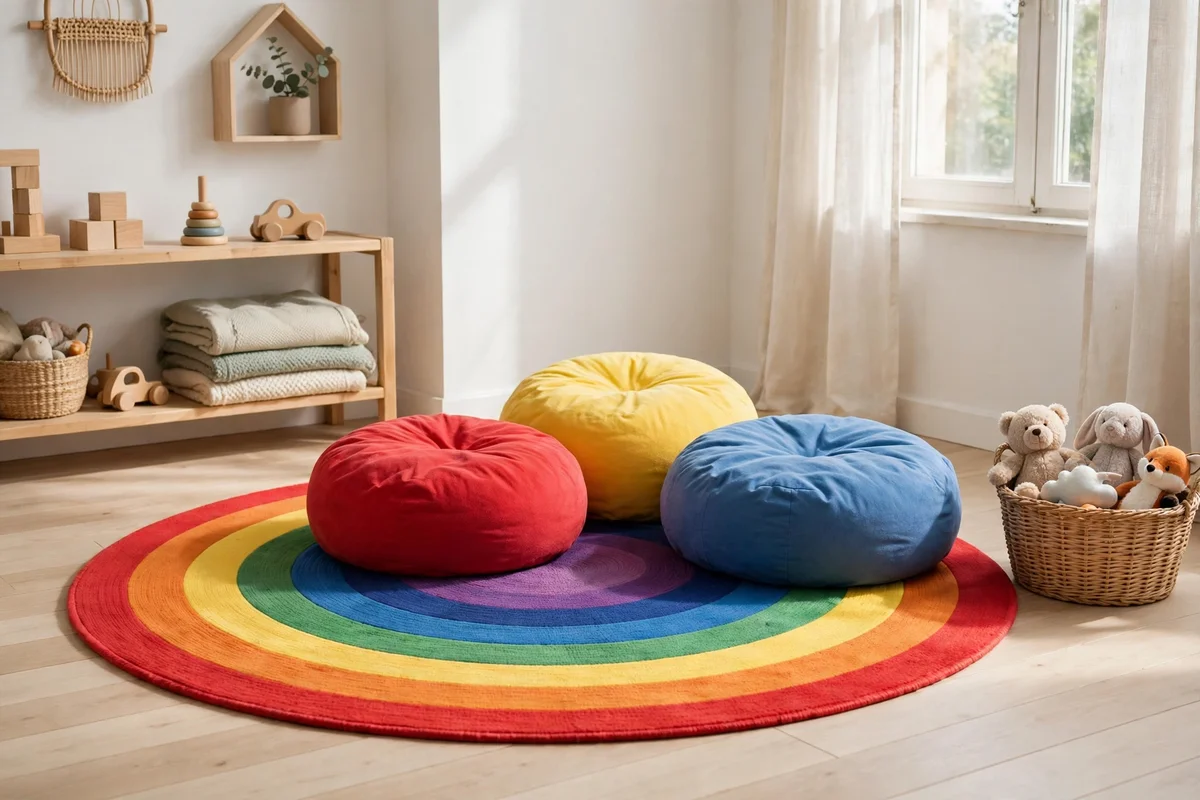
9. Anchor the room with a rainbow rug
A rug does two jobs at once: it adds a large block of colour, and it marks out where play happens. A rainbow-striped rug under the bed’s foot or in the middle of the play area pulls the room together, especially when the walls are mostly white. A round rug works well in a small room because it softens the corners, while a rectangular rug suits a long room. Choose a low-pile, washable rug — high-pile rugs trap crumbs and small toy parts, and a child’s rug will be spilled on. Put a non-slip underlay underneath, even on carpet, because a rug that slides is a tripping hazard. If a full rainbow rug feels too much, a plain rug in one rainbow colour, such as sage green or dusty blue, with rainbow cushions on top of it, gives you the colour without the pattern.
10. Add floor cushions for flexible seating
Large floor cushions in rainbow colours turn any patch of floor into a reading spot, a game spot, or a place for a friend to sit. They are lighter and easier to move than a chair, they can be stacked in a corner when the floor needs clearing, and they survive being jumped on better than most furniture. Pick cushions with removable, washable covers and a firm filling that holds its shape — flat, floppy cushions end up pushed against the wall and forgotten. Two or three cushions in different rainbow colours, stored in a basket when not in use, are enough. More than that, and the room starts to look like a cushion shop rather than a bedroom.
 Save this image to Pinterest (opens in a new tab)
Storage that earns its colour
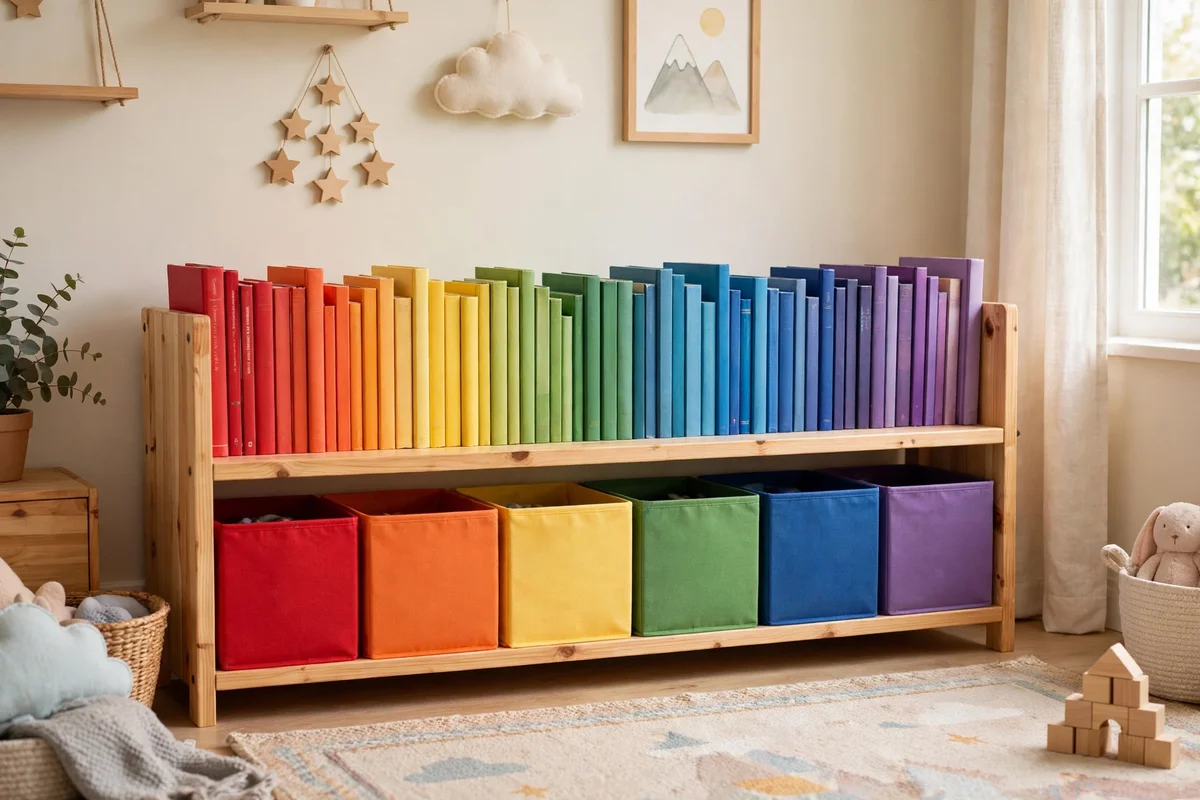
11. Colour-code storage so tidying is a game
Colour-coded storage is the rare decorating idea that also makes the room easier to live in. Assign one colour to each category: red bins for building blocks, yellow for art supplies, green for soft toys, blue for books, and so on. Label each bin with a picture as well as a word for younger children, so tidying does not depend on reading. Open baskets on low shelves work better than lidded boxes for everyday toys, because a child can see what is inside and put it back without help. Keep the bins themselves in rainbow order on the shelf — red, orange, yellow, green, blue, violet — so the shelf looks like a rainbow even when the bins are full of different things. This is the idea that most often survives long after the rest of the theme has changed, because it is useful first and decorative second.
12. Turn the bookshelf into a rainbow
Organising books by the colour of their spines is a small change with a big visual payoff. Pull all the books off the shelf, sort them into colour piles, and put them back in rainbow order. The shelf becomes a feature in itself, and children often start reaching for books they had ignored, simply because the shelf looks different. If the book collection is mostly one colour, paint the bookshelf itself instead — each shelf a different rainbow shade, or the whole shelf in one bold colour with rainbow books on top. A low, forward-facing bookshelf works best for younger children, because they choose books by their covers. Keep the heaviest books on the lowest shelf so the unit cannot tip forward, and anchor any tall bookshelf to the wall.
 Save this image to Pinterest (opens in a new tab)
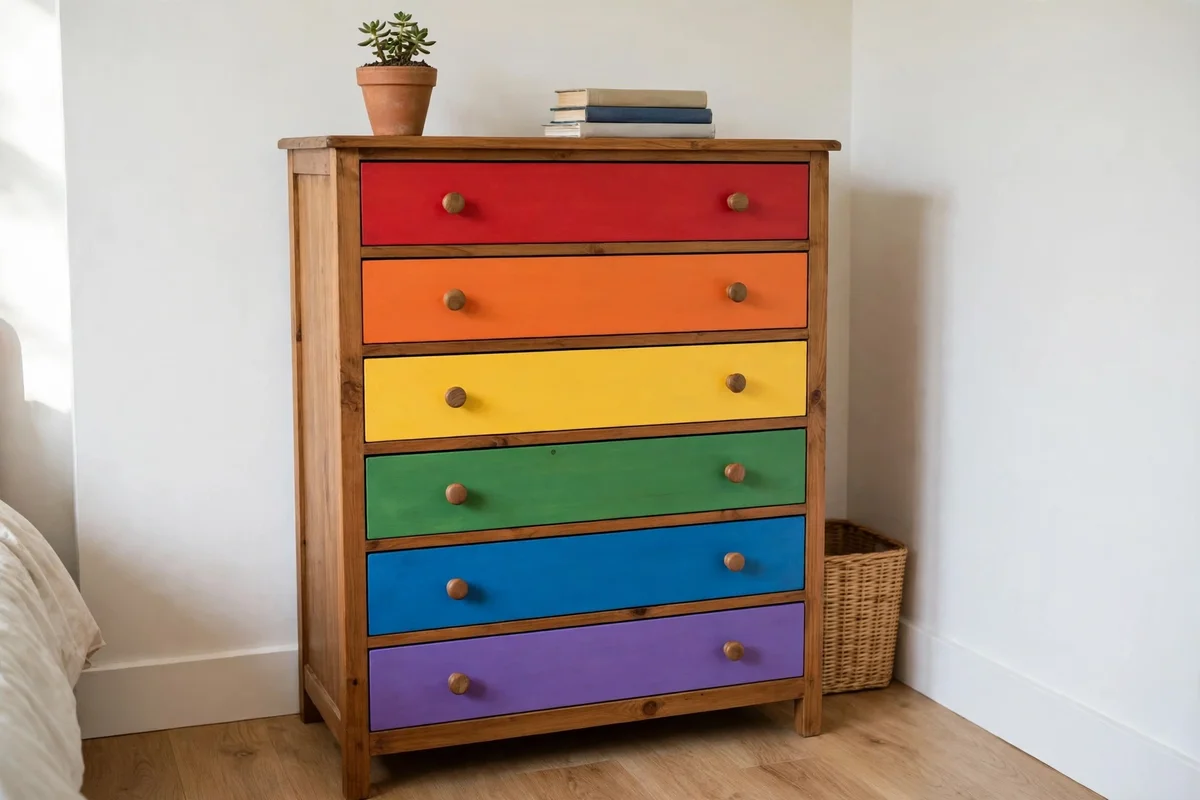
13. Paint a dresser, a stool, or a toy chest
One painted piece of furniture is often more effective than a whole room of colourful accessories. A dresser with each drawer front in a different rainbow colour, a stool painted sunny yellow, or a toy chest with a rainbow lid all give the room a focal point that is also useful. This is a good weekend project: sand, prime, paint two coats, and add new knobs in a single accent colour. If you are painting a second-hand piece, check it is solid wood or good-quality board first — very cheap flat-pack furniture can swell if it gets damp during preparation. And keep the inside of drawers plain, so clothes do not pick up paint colour.
 Save this image to Pinterest (opens in a new tab)
Zones that make the room work
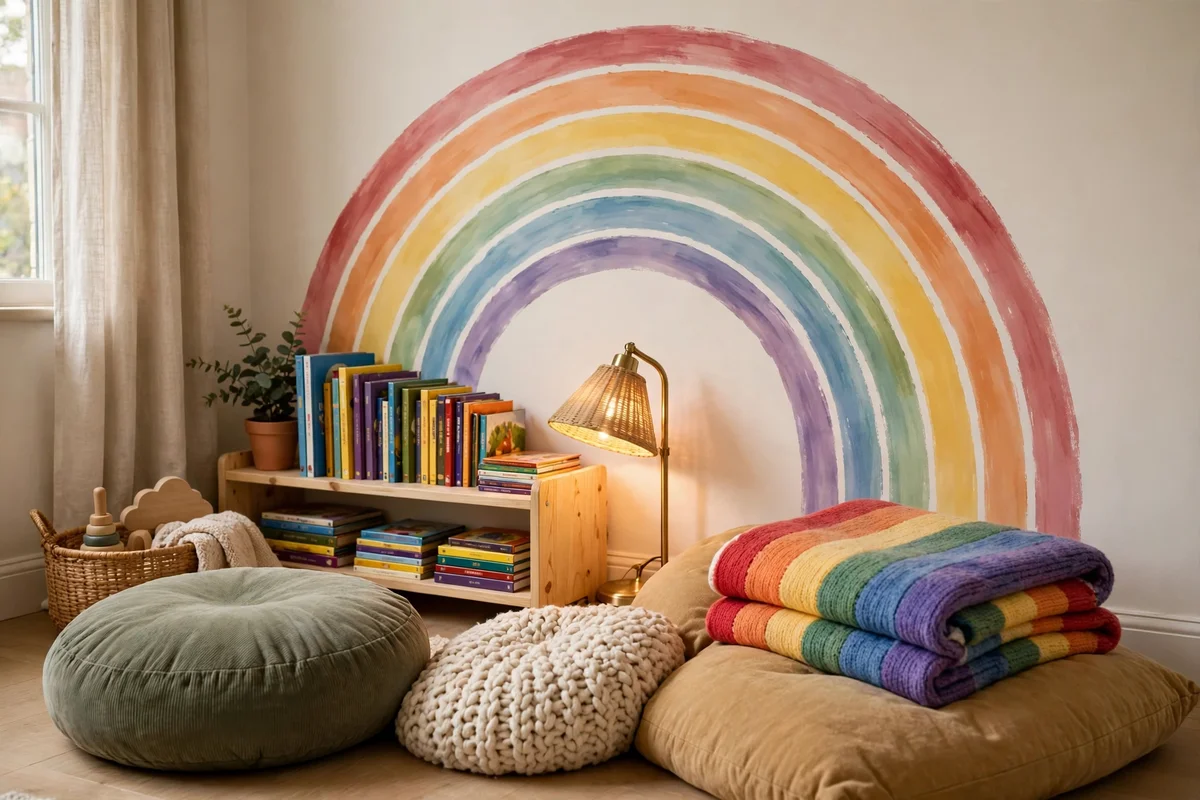
14. Build a rainbow reading nook
A reading nook needs only three things: something soft to sit on, light to read by, and books within reach. A corner of the room with a floor cushion, a small bookshelf, and a rainbow blanket does the job. A painted arch on the wall behind the nook marks it out as its own place, even in a small room — the arch does the work of a partition without taking up floor space. Add a small clip-on reading light or a battery lamp at child height, and keep the book selection small and rotated: ten books on the shelf, swapped every few weeks, get read more than fifty books crammed together. A basket for the book currently being read keeps the nook tidy without any rules.
 Save this image to Pinterest (opens in a new tab)
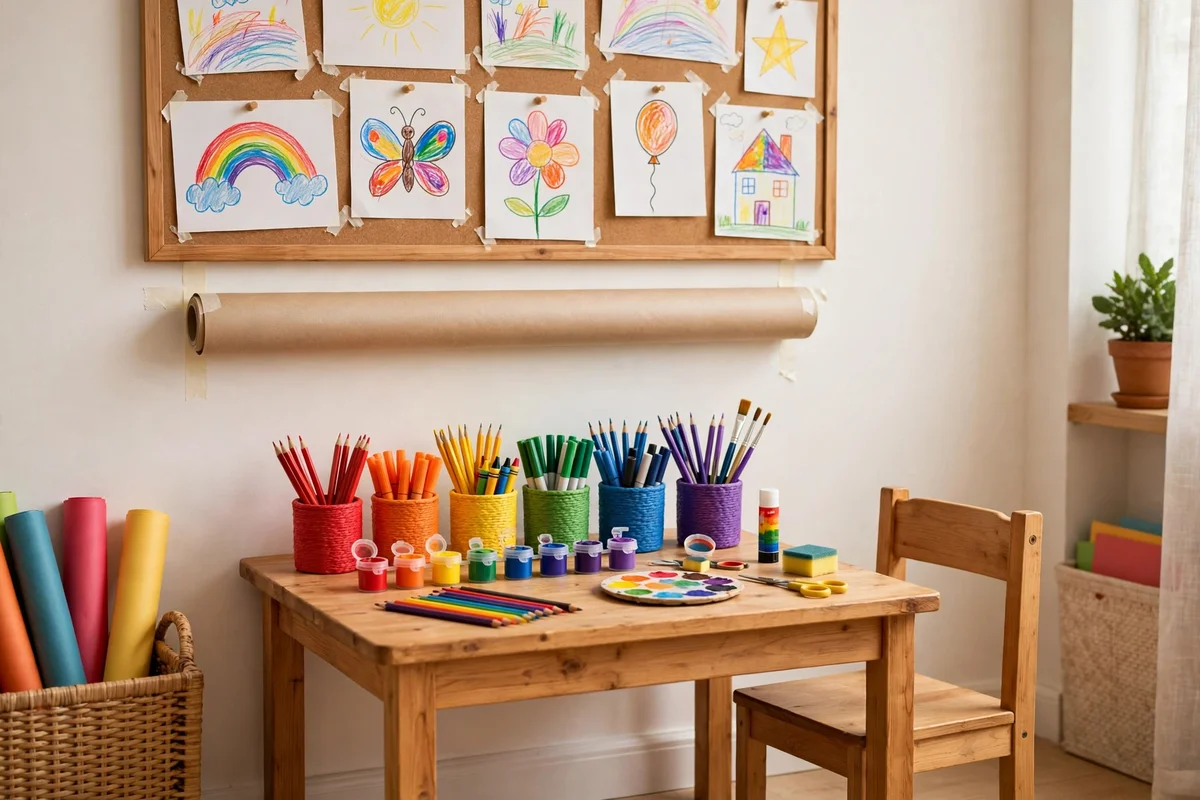
15. Set up a craft corner that can get messy
A craft corner is where the rainbow theme stops being decoration and starts being something a child uses. A small table, a chair at the right height, and storage for supplies in rainbow order — pencils, markers, paints, and paper each in their own coloured container — make the space inviting and easy to reset. A washable tablecloth or a wipe-clean mat protects the table, and a pinboard or a washing line with pegs above the table gives finished art somewhere to go. Keep the supplies visible rather than hidden in drawers: children use what they can see. A roll of paper taped to the wall at child height, with crayons in a pot beside it, gets used daily in a way a closed art cupboard does not.
 Save this image to Pinterest (opens in a new tab)
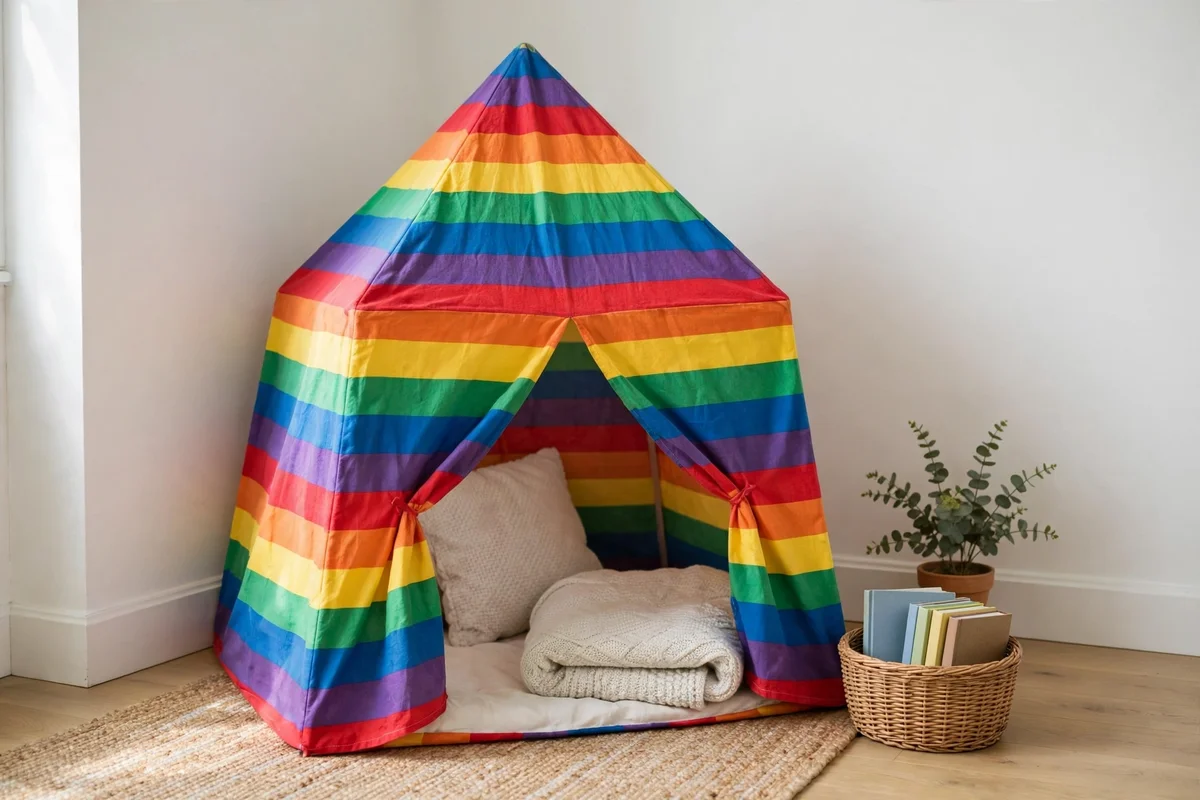
16. Add a play tent or canopy for a private hideaway
A play tent or a canopy over the bed creates a small room inside the room, and children use it for reading, quiet play, and winding down. A rainbow-striped tent in a corner, with a cushion and a blanket inside, needs no more than a square metre of floor. A canopy over the bed, made from sheer fabric in rainbow colours or plain white with rainbow bunting, softens the bed and makes it feel special. Keep the fabric light and well away from any lamp or heater, and make sure the tent or canopy can be taken down and washed. If floor space is tight, a canopy is the better choice, because it uses no floor at all.
 Save this image to Pinterest (opens in a new tab)
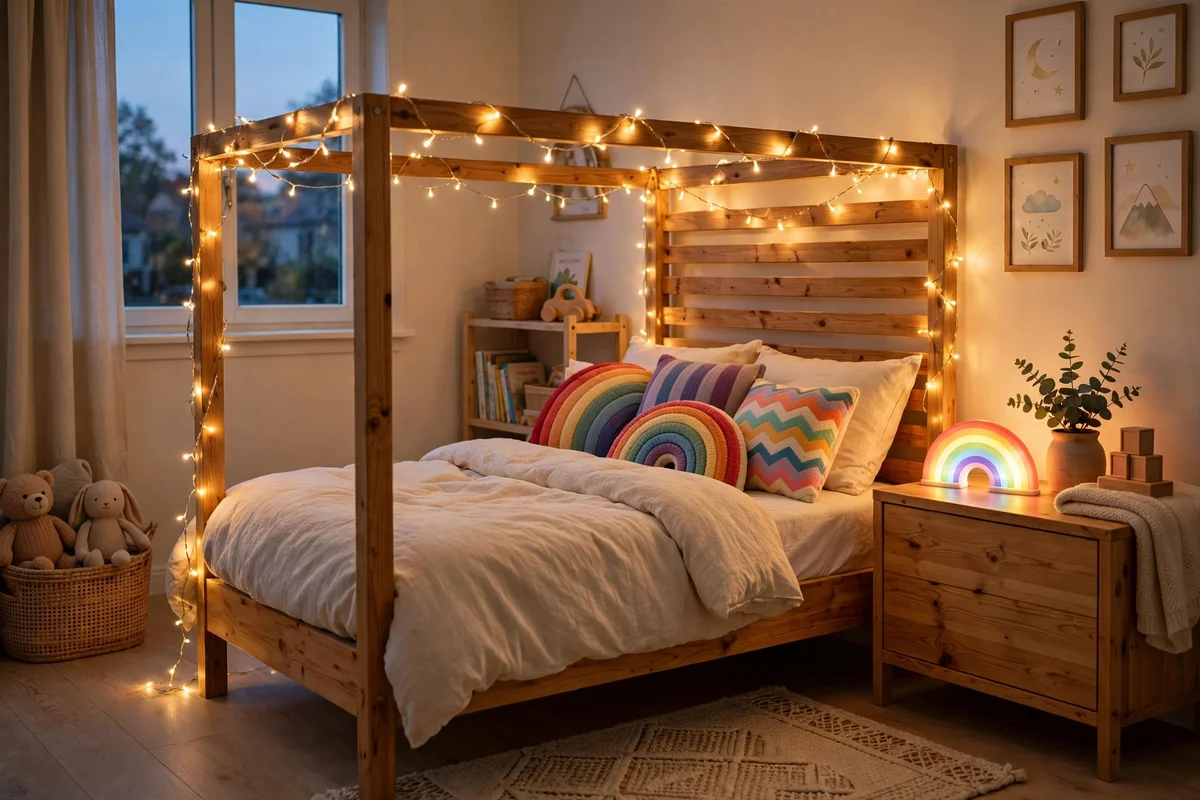
17. Use lighting to change the mood after dark
Lighting is what turns a rainbow room from a daytime playroom into a calm bedroom in the evening. A rainbow-shaped nightlight, a string of warm white fairy lights around the bed frame or the reading nook, or a lamp with a rainbow-striped base all add colour without adding clutter. Warm white light suits bedtime better than coloured bulbs, which can make the room feel like a party when it should feel like winding down. Keep cords and battery packs out of reach of younger children, and use a timer plug or a lamp with a built-in timer so the lights go off by themselves. A dimmer switch, if your wiring allows it, is the single most useful lighting change in a child’s room.
 Save this image to Pinterest (opens in a new tab)
18. Display toys as decoration — and rotate them
Many toys are already rainbow-coloured, and displaying them saves you buying extra decoration. A wooden rainbow stacker, a set of colourful building blocks, and a row of soft toys on an open shelf give the room colour and personality at the same time. The key is rotation: keep a small number on display and the rest in storage, swapping them every few weeks. The room looks tidier, the toys feel new again, and the display never gets dusty enough to need a deep clean. Open shelves at child height work best, because a display a child cannot reach is decoration for adults, not for them. Keep heavy toys low and light toys high, so nothing falls from a height.
A Weekend Plan: Friday, Saturday, Sunday
A rainbow room does not need a month of planning. It needs a clear order, because painting before you have measured, or buying bedding before you have chosen a palette, creates the rework that eats weekends.
On Friday evening, decide the palette and measure the feature wall. Take the swatches home, look at them in daylight and lamplight, and pick your six colours. Measure the wall, note the sockets and switches, and make a list: paint or wallpaper, bedding, rug, storage bins, and any one piece of furniture to paint. Order or buy only what is on that list.
On Saturday, do the messy work. Move the furniture away from the feature wall, protect the floor, and paint the arch, mural, or stripes — or hang the wallpaper. While the paint dries, paint the furniture piece outside or in a ventilated space. Wash the new bedding and cushion covers so they are ready for Sunday. Do not try to hang art or arrange shelves while paint is wet; it will get marked.
On Sunday, put the room back together in this order: bed and bedding first, then the rug, then storage and bookshelves, then the reading nook and craft corner, then wall art and decals last. Art goes last because it is the easiest thing to move, and you will only know where it belongs once the furniture is in place. Finish by walking to the door and looking at the room as a visitor would — the view from the door is the view that matters most, because it is the one you see every day.
Small Rooms and Shared Rooms
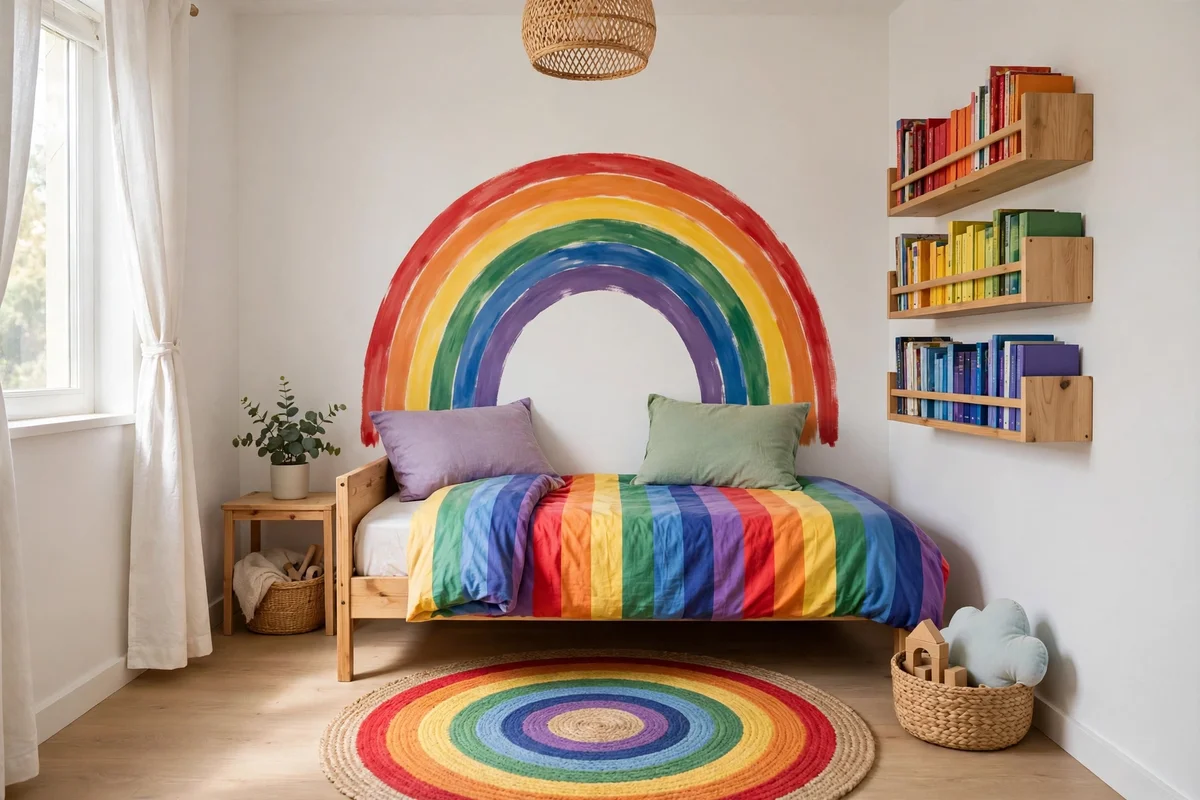
A small room needs the rainbow to work harder and take up less space. Use the palette on things that already have to be there: the bedding, the curtains, the storage bins, and one painted arch behind the bed. Skip the play tent, the large rug, and the gallery wall — in a small room, those three eat floor and wall space that the room cannot spare. A round rug instead of a rectangular one, a wall-mounted bookshelf instead of a standing one, and a canopy instead of a tent all save space while keeping the colour. Vertical stripes on the feature wall make a low ceiling feel taller, and a mirror opposite the window bounces light around a dark corner. Keep at least one wall completely plain, so the room has somewhere for the eye to rest.
 Save this image to Pinterest (opens in a new tab)
A shared room needs a palette both children can live with, and a way for each child to have their own colour inside it. The muted rainbow palette works well here, because it is less likely to feel like one child’s taste imposed on the other. Give each child one signature colour — one child’s bedding in blue, the other’s in green, for example — while the shared parts of the room, the rug, the curtains, and the storage, use the full rainbow. If the beds are on opposite walls, each bed wall can carry its own arch in that child’s colours, with the shared wall kept neutral. Colour-coded storage earns its keep twice over in a shared room: each child’s bins in their own colour end most arguments about whose toys are whose. And keep the layout symmetrical where you can — matching beds, matching lamps, matching shelves — because symmetry makes a shared room feel fair even when the colours differ.
Rainbow Rooms by Age
A nursery rainbow should be soft and low. Pastel colours, a rainbow mobile over the cot, pastel bedding, and a few framed prints are enough. Keep the wall behind the cot plain or very pale, because strong colour behind a baby’s head is stimulating at exactly the time you want calm. Everything within reach of the cot should be washable, and anything hung above it should be fixed securely.
A toddler room can be bolder, because toddlers use the room for play as much as sleep. Low furniture, a floor bed or a low bed with a rainbow arch behind it, colour-coded toy bins at floor level, and a reading corner with floor cushions suit this age. Keep the palette to the same six colours, but let the toddler choose between two options — “blue bedding or green bedding?” — rather than facing the whole rainbow at once. That choice is enough to make the room feel theirs.
A school-age child’s room can carry the strongest version of the theme, because the child can tell you what they like and what they have outgrown. This is the age for the craft corner, the gallery wall with their own art, the desk in a rainbow colour, and the reading tent. It is also the age to start planning the exit: a school-age child who loves rainbows now may not at twelve, so keep the expensive parts — the mural, the wallpaper, the painted furniture — to one wall and one piece, and let the rest be bedding and art that can change in an afternoon.
Budget: Three Price Levels
A rainbow room does not have to be expensive. The difference between the three levels below is how much is painted and how much is swapped, not how colourful the result is.
A refresh under $50 uses what you already have: sort the books by colour, move the toys onto open shelves in rainbow order, swap two cushion covers, add a set of removable decals, and hang a rainbow print you already own or print at home. The room changes without any paint or new furniture, and it takes an afternoon.
A mid-level refresh, roughly $50 to $200, adds the pieces that make the biggest difference: a rainbow duvet set, a washable rug, a set of colour-coded storage bins, and paint for one arch or one piece of furniture. This is the level most families choose, because it changes the room properly without changing the furniture.
A full redo, $200 and up, adds wallpaper or a mural on the feature wall, a painted bed frame or dresser, new curtains, and lighting. This is worth doing when the room is being redecorated anyway — new bed, new flooring, or a move — rather than as a standalone project. If you are spending at this level, spend it on the things that are hardest to change later: the wall finish and the furniture. Bedding and art can always be upgraded later, one piece at a time.
Whatever the budget, buy the rug and the bedding after you have chosen the paint, not before. Paint comes in thousands of shades and bedding in dozens, so it is easier to match bedding to paint than paint to bedding.
Mistakes That Make Rainbow Rooms Feel Messy
The most common mistake is using too many colours at once. Seven or eight shades, each appearing once, look busy. Six colours, each repeated two or three times, look planned. If the room feels chaotic, count how many times each colour appears. Any colour that appears only once is a candidate to remove or repeat.
The second mistake is matching everything exactly. Rainbow bedding, a rainbow rug, rainbow curtains, and a rainbow wall all in the same print fight each other. Pick one patterned piece — the bedding or the rug — and keep the rest solid colours drawn from the same palette. Solid colours let the pattern breathe.
The third mistake is forgetting storage. A colourful room with nowhere to put toys is a colourful mess by Tuesday. Colour-coded bins, a bookshelf, and a toy chest need to be part of the plan from the start, not added after the decorating is done. A good rule is that every toy should have a home a child can reach without help; if it does not, the storage is in the wrong place or there is not enough of it.
The fourth mistake is decorating at adult eye level. Art hung too high, shelves a child cannot reach, and a reading nook built for an adult all make the room look good in photos and work badly in real life. Hang the gallery wall and the hooks at your child’s height, and test every shelf by asking your child to reach it.
The fifth mistake is ignoring the light. A bold palette in a dark, north-facing room can feel heavy, and a pastel palette in a bright, south-facing room can look washed out. If the room feels wrong and you cannot say why, the light is usually the reason. Swapping a bold colour for a lighter shade of the same colour, or adding a warm lamp, often fixes it without redecorating.
How to Let the Room Grow Up With Your Child
The best rainbow rooms are built to be undone in stages. When your child outgrows the theme, change the cheap things first: swap the bedding for a solid colour, take down the decals, replace the rainbow prints with new art, and change the cushion covers. That alone removes most of the rainbow, and the room will already feel older.
If that is not enough, repaint the feature wall in a single colour drawn from the old palette — sage green, dusty blue, or warm cream — and keep the painted furniture, which will now look like a single accent piece rather than part of a theme. The storage bins can stay, because colour-coded storage is useful at any age, and the bookshelf organised by colour still looks good when the books themselves have changed.
The expensive reversals are the mural and the wallpaper, which is why they belong on one wall only. A single wall can be repainted in a day; four walls cannot. If you think the room will need to change within two years, choose decals over wallpaper and an arch over a mural. Future you will be grateful.
Frequently Asked Questions
What colours go with a rainbow kids room?
White, warm cream, pale wood, and soft grey go with every rainbow palette, because they give the bright colours space to stand out. If you want a second colour family alongside the rainbow, natural wood tones and soft sage green work with pastel and muted palettes, while crisp white and light wood work best with bold primary colours. Avoid adding a strong second pattern, such as a busy floral or a second stripe, alongside a rainbow pattern — one pattern per room is enough.
How do I do a rainbow room in a rental?
Use removable decals instead of paint or wallpaper, a rainbow duvet set and rug instead of a feature wall, and colour-coded storage instead of painted furniture. A tension rod with rainbow curtains, a gallery wall hung with removable hooks, and a canopy over the bed all add colour without touching the walls. When you move out, the decals peel off, the hooks come down, and the bedding and rug move with you.
Is a rainbow room too stimulating for bedtime?
It can be, if the brightest colours are right behind the bed and the lighting is bright white. Keep the boldest colour on the wall your child faces when they wake up, not the wall behind their head, use warm white lamps in the evening, and keep the bedding calmer than the walls — plain sheets with a single rainbow throw, rather than a full rainbow duvet. A consistent wind-down routine matters more than any single colour choice, and a room that is tidy at bedtime feels calmer than a colourful room that is not.
What age is a rainbow room best for?
It works from nursery to about age ten, with the palette changing as the child grows: pastels for a nursery, brighter colours for toddlers and younger school-age children, and muted or earthy rainbow shades for older children who want colour without a theme that feels young. After that, the same palette can stay in a more grown-up form — one painted piece of furniture, colour-coded storage, and art in rainbow colours — without the room reading as a themed children’s room.
How much does a rainbow kids room cost?
A refresh using what you already own can cost under $50. A mid-level refresh with new bedding, a rug, storage bins, and paint for one wall or one piece of furniture usually falls between $50 and $200. A full redo with wallpaper or a mural, painted furniture, curtains, and lighting costs $200 and up. The cheapest way to start is with bedding and decals, because both can be changed in an afternoon if the palette does not work.
Final Checklist Before You Buy Anything
- Pick one palette — pastel, bold, or muted — and write down your six colours.
- Measure the feature wall, note the sockets and switches, and check the wall is straight.
- Look at your swatches in daylight and under the bedroom lamp at night.
- Count how many times each colour will appear, and make sure every colour appears at least twice.
- Check that the rug has a non-slip underlay and that tall furniture will be anchored to the wall.
- Choose washable paint and washable fabric for everything a child can reach.
- Buy the paint first, then match the bedding and rug to it.
- Leave one wall plain, and leave some open floor space.
A rainbow kids room does not need to be perfect, and it does not need to be finished in one go. Start with the palette and the one wall, add the bedding and the storage, and let the reading corner and the art grow over time. The rooms that children love most are rarely the ones with the most colour — they are the ones where the colour has a plan, the toys have a home, and there is a comfortable corner to sit in. Get those three things right, and the rainbow takes care of itself.